Why Credit Ratings and Borrowing Costs Matter More Than You Think
Most retail investors obsess over revenue growth and profit margins — but completely ignore the cost at which a company borrows money. This is a mistake. A company’s credit profile reveals what bankers — who have far more information than public investors — truly think about the business. When ICICI Bank lends to Titan Biotech at just Repo Rate + 2.60%, it is making a calculated bet that this company will repay without trouble. That is a powerful signal.
In this case study, we dissect Titan Biotech Ltd’s borrowing structure, finance costs, and creditworthiness — and show why this ₹156 Cr revenue company is quietly transitioning from a borrower to a net cash business.
The Big Picture: 70.7% Borrowing Reduction in One Year
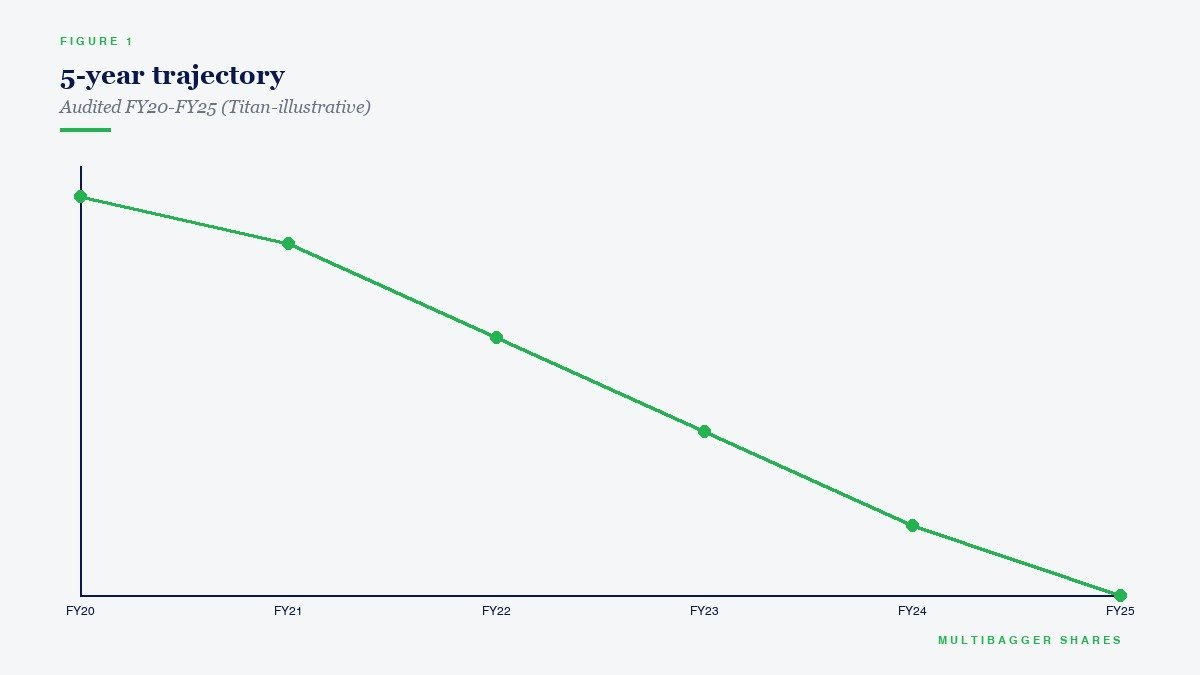
Let’s start with the headline number. Titan Biotech’s total borrowings collapsed from ₹7.17 Crores in FY2024 to just ₹2.10 Crores in FY2025 — a stunning 70.7% reduction in a single year. This wasn’t a one-off event. It is the continuation of a decade-long deleveraging trend that tells the story of a company systematically freeing itself from the banking system.
From ₹25 Crores to ₹2.10 Crores in seven years. That is a 91.6% total reduction in borrowings. The company repaid ₹4.80 Crores of short-term borrowings on a net basis in FY2025 alone — funded entirely from operating cash flows, not from equity dilution or asset sales. This is the hallmark of a self-funding business.
Inside Titan Biotech’s Borrowing Structure
A closer look at the FY2025 annual report reveals exactly how Titan Biotech structures its debt — and the numbers tell a compelling story of financial discipline.
The most significant reduction came from current borrowings (cash credit), which fell from ₹6.34 Crores to just ₹1.54 Crores. This means the company is relying far less on its working capital credit line — a sign that internal accruals are now sufficient to fund day-to-day operations. The remaining borrowings are primarily vehicle loans (Toyota Financial Services at 8.50% and HDFC Bank at 9.10%–11.50%) and a small cash credit facility from ICICI Bank.
The Borrowing Cost Advantage: Repo Rate + 2.60%
Here’s where things get really interesting for investors who understand credit markets. Titan Biotech’s cash credit facility from ICICI Bank is priced at Repo Rate + 2.60% per annum. With the RBI repo rate at 6.25% (as of April 2025), this translates to an effective borrowing rate of approximately 8.85%.
Why does this matter? Because the spread a bank charges above the repo rate is a direct reflection of how risky it perceives the borrower to be. For context, most small-cap manufacturing companies in India borrow at Repo Rate + 4% to 6%, translating to effective rates of 10%–12%. Some weaker borrowers pay 14%–18% from NBFCs. Titan Biotech’s 2.60% spread places it in the low-risk borrower category — territory typically reserved for companies with much larger balance sheets.
This isn’t just a number. When ICICI Bank — India’s second-largest private bank with a credit assessment team that evaluates thousands of companies — agrees to lend at just 260 basis points above the benchmark, they are effectively saying: this company’s cash flows are predictable, its assets are solid collateral, and the probability of default is very low.
Finance Costs: 31.5% Decline Year-on-Year
Lower borrowings naturally translate to lower finance costs. Here is the complete breakdown from Titan Biotech’s income statement:
The core interest on borrowings component fell by 44.7% — from ₹79.57 Lakhs to ₹44.04 Lakhs. This ₹35.53 Lakhs saved in interest cost flows directly to the bottom line as incremental profit. Over time, this compounding effect is significant. Every rupee saved on interest is a rupee available for reinvestment, capacity expansion, or shareholder returns.
The only component that increased marginally was the defined benefit plan interest cost (gratuity obligations), which rose by ₹0.32 Lakhs — a negligible amount that simply reflects the growth of the employee base.
The Cash Position: From Borrower to Net Cash
The most powerful transformation in Titan Biotech’s balance sheet is the flip from a net borrower to a net cash company. Consider these numbers side by side:
In FY2024, Titan Biotech was a net debtor — it owed ₹4.33 Crores more than it held in cash. By FY2025, the company flipped to a net cash position of ₹3.03 Crores. The cash pile grew by 80.6% (from ₹2.84 Cr to ₹5.13 Cr) while borrowings shrank by 70.7%. That is a ₹7.36 Crore swing in net cash position in a single year — funded entirely by the operating engine of the business.
Banking Relationships: What ICICI and HDFC Signal
Titan Biotech’s primary bankers are ICICI Bank and HDFC Bank — India’s two largest private sector banks. This is not a coincidence. These banks have rigorous credit appraisal systems, and they do not extend facilities to small-cap companies unless the underlying financials are sound.
The vehicle loan facilities from Toyota Financial Services (8.50%), HDFC Bank (9.10% and 11.50%), and the working capital line from ICICI Bank (Repo + 2.60%) are all secured against specific assets. The interest rates on vehicle loans (8.50%–11.50%) are standard market rates, while the cash credit rate of Repo + 2.60% is actually below the median rate for companies of this size.
The lease liabilities (effective interest of 8.10%–9.00%, maturing in FY2028-29) are Ind AS 116 accounting entries and represent rental obligations, not traditional debt. When you strip these out, the company’s actual financial borrowings are even lower than the headline figure suggests.
Peer Comparison: How Does Titan Biotech Stack Up?
To truly appreciate Titan Biotech’s credit profile, we need to compare it with peers in the specialty chemicals and biotech ingredients space.
Titan Biotech holds its own among peers that are 5–15x larger in revenue terms. Its D/E ratio of 0.02x is comparable to much larger companies like Fine Organic Industries, and its finance cost of ₹0.80 Crores is minimal. What makes Titan Biotech’s position especially impressive is the speed of deleveraging — moving from ₹25 Crores of borrowings to near-zero in seven years while simultaneously growing revenues from ₹70 Cr to ₹156 Cr. Most companies of this size either lever up to grow or stay stagnant to reduce debt. Titan Biotech did both — grew and deleveraged — simultaneously.
What Warren Buffett Would Notice Here
Warren Buffett has always said: “Wide diversification is only required when investors do not understand what they are doing.” The reason he favours concentrated portfolios is precisely because he looks for companies with financial characteristics like these — businesses that generate enough cash to self-fund their growth, pay down debt, and build cash reserves, all without needing the capital markets.
Peter Lynch called excessive diversification “di-worse-ification” because spreading your capital across 30-40 stocks means you inevitably own companies with weak balance sheets, high debt, and fragile credit profiles. The concentrated investor, who deeply understands 8-15 quality businesses, can identify companies like Titan Biotech where the borrowing cost advantage compounds silently in the background, year after year.
Consider this: the ₹35.53 Lakhs Titan Biotech saved in interest costs during FY2025 may seem small today. But that is ₹35.53 Lakhs of profit that did not exist before — profit generated not by selling more product, but by financial discipline. Over a 10-year horizon, cumulative interest savings from deleveraging could easily add ₹3-5 Crores to retained earnings — capital that compounds at the company’s ROCE of 17.7%.
The Transition Narrative: From Leveraged to Self-Funding
Here’s what the credit story really tells us about Titan Biotech’s evolution as a business:
Phase 1 (Pre-2018): The company relied on bank borrowings of ₹20-25 Crores to fund working capital and capacity expansion. This is typical for a growing small-cap manufacturer.
Phase 2 (2018-2023): As profitability improved and margins expanded, the company began systematically paying down debt. Borrowings fell from ₹25 Cr to ₹8 Cr over five years — a steady, disciplined reduction.
Phase 3 (2024-2025): The company crossed the inflection point. With borrowings at just ₹2.10 Cr and cash at ₹5.13 Cr, Titan Biotech is now a net cash business. It retains the ICICI Bank cash credit facility as a backup line (₹1.54 Cr drawn against what is likely a much larger sanctioned limit), but it does not need bank funding to run operations.
This three-phase evolution — from leveraged growth to disciplined paydown to net cash — is the classic trajectory of a compounding business. It is the same path followed by companies like Asian Paints, Pidilite, and HDFC AMC in their early growth years.
Key Takeaway for Long-Term Investors
Titan Biotech’s credit and borrowing profile tells a story that quarterly earnings often cannot — the story of a management team that prioritises financial independence over aggressive, debt-fuelled expansion. Total borrowings down 91.6% over seven years, finance costs down 31.5% in the latest year, cash position nearly doubled, and a net cash surplus of ₹3.03 Crores. When a company can fund its own growth, it does not depend on banks, capital markets, or equity dilution. That is the foundation of true long-term wealth creation.
The next time you evaluate a small-cap company, don’t just look at the revenue line. Look at what the bankers think. Look at the spread on the borrowing rate. Look at whether cash is growing while debt is shrinking. These are the signals that separate compounders from pretenders.
Disclaimer: This article is for educational and informational purposes only. It is not investment advice, and not a buy, sell, or hold recommendation on any stock mentioned, including Titan Biotech Limited. Equity markets carry risk; please do your own research or consult a qualified professional before making investment decisions.
