April 08, 2026
(Wednesday)
What Is Anchoring Bias — And Why Is It Destroying Your Portfolio?
Picture this scene: you bought shares of a mid-cap IT company at ₹850. Six months later, the company loses a major client, quarterly revenue drops 18%, and the stock falls to ₹520. Every fundamental metric screams “sell.” But you refuse. Why? Because your brain is anchored to that ₹850 purchase price. You keep telling yourself, “I’ll sell when it gets back to ₹850.” That magical number has nothing to do with the company’s future earning power — yet it controls your every decision.
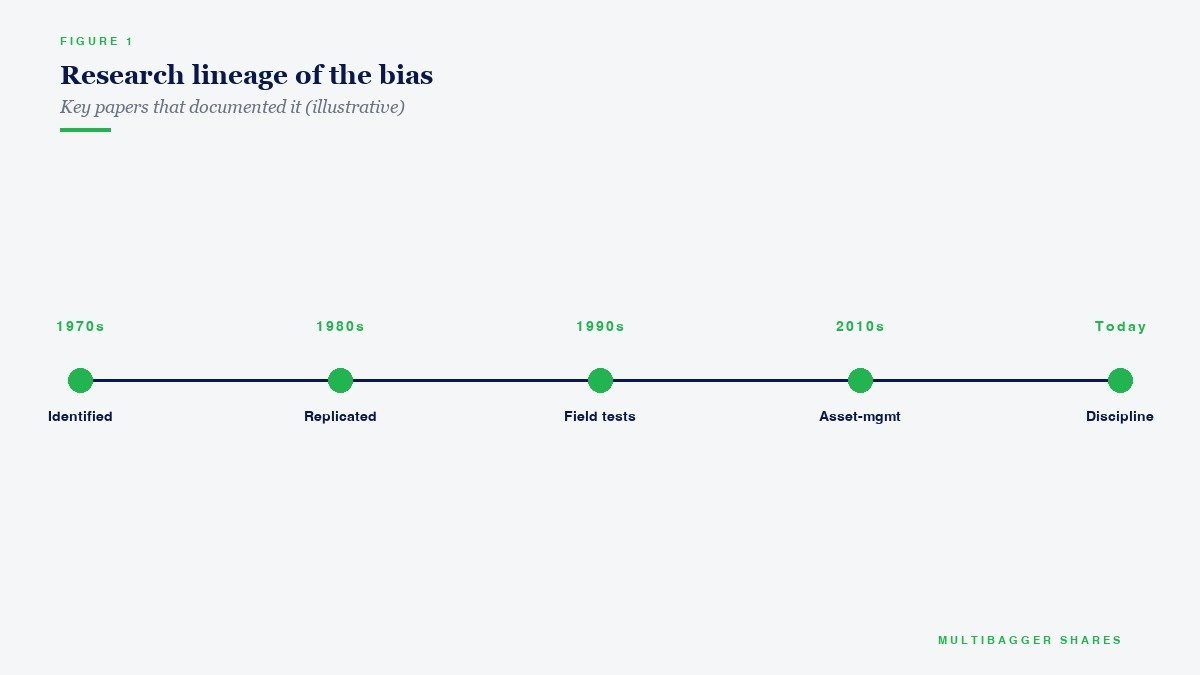
This is anchoring bias — one of the most dangerous cognitive traps in investing. First identified by Nobel Prize-winning psychologists Daniel Kahneman and Amos Tversky in 1974, anchoring bias is the tendency to rely too heavily on the first piece of information you encounter (the “anchor”) when making subsequent decisions. In the stock market, this anchor can be a purchase price, a 52-week high, an analyst target, a round number on the Sensex, or even the price at which your friend recommended a stock.
Today, as the Indian markets surge with the SENSEX closing at 77,562.90 (up a massive 3.95%) and NIFTY at 23,997.35 (up 3.78%) — driven by the US-Iran ceasefire and RBI’s rate hold decision — anchoring bias is especially relevant. On a day like this, many investors are anchored to the lower prices from last week’s correction, thinking “the market has run up too much already.” Others are anchored to even higher levels, thinking “we’re still below the all-time high, so there’s room to run.” Both groups are making decisions based on irrelevant reference points instead of current fundamentals.
The Psychology Behind the Anchor: Why Your Brain Betrays You
Your brain is a pattern-recognition machine that evolved to make quick decisions in a dangerous world. When faced with uncertainty — which describes every single stock market decision — your brain desperately seeks a reference point, a number to latch onto. This is the anchor. Once the anchor is set, all subsequent judgments are made by adjusting from that anchor, and research consistently shows that this adjustment is almost always insufficient.
In a famous experiment, Kahneman and Tversky spun a rigged wheel that landed on either 10 or 65. They then asked participants to estimate the percentage of African countries in the United Nations. Those who saw 10 on the wheel estimated 25%. Those who saw 65 estimated 45%. A completely random, irrelevant number changed their estimates by 20 percentage points. If a random wheel can anchor our thinking, imagine what a stock purchase price or a broker’s target price does to our investment decisions.
In the Indian market context, this plays out in devastating ways every single day. Retail investors who bought stocks at their 2024 highs are now “anchored” to those prices, refusing to sell even when the business fundamentals have deteriorated. Meanwhile, they ignore genuinely undervalued quality businesses because the current price “feels expensive” relative to some arbitrary historical anchor.
The Five Deadly Anchoring Traps in Indian Stock Markets
Trap #1: The Purchase Price Anchor
This is the most common and most destructive form of anchoring bias. When you buy a stock at ₹500, that ₹500 becomes your emotional benchmark for every future decision. If the stock drops to ₹350, you hold on because selling would “lock in a loss.” If it rises to ₹600, you sell quickly to “book profits” — even if the business is worth ₹1,200 based on fundamentals. Your purchase price has zero bearing on the stock’s future value. The market does not know or care what you paid. Yet this single number controls the behavior of millions of Indian retail investors every day.
Consider Titan Biotech (BSE: 524717), currently trading at ₹478 with a market cap of ₹1,976 Crore. An investor who bought before the February 2026 stock split at a pre-split price equivalent of ₹2,000+ might anchor to that historical high and think the stock is “cheap” at ₹478. Another investor who bought at ₹75 near the 52-week low might feel the stock has “run up too much.” Both are wrong — because neither anchor tells you anything about Titan Biotech’s intrinsic business quality. What matters is the company’s ROCE of 16.9%, its ROE of 15.0%, its consistent earnings growth, and its debt-free balance sheet. The purchase price is irrelevant to the investment thesis.
Trap #2: The 52-Week High/Low Anchor
Indian financial media constantly flashes “stock near 52-week high” or “stock at 52-week low” alerts. These create powerful anchors. A stock at its 52-week high “feels” expensive. A stock at its 52-week low “feels” like a bargain. But these are arbitrary time-based reference points that tell you nothing about value. A stock at its 52-week high could still be 50% undervalued if earnings have doubled. A stock at its 52-week low could still be 50% overvalued if the business is in permanent decline.
The great investors never think in terms of 52-week highs or lows. Warren Buffett has famously said: “Wide diversification is only required when investors do not understand what they are doing.” The flip side of this wisdom is that when you truly understand a business deeply, you make decisions based on intrinsic value — not on where the stock price happened to be 52 weeks ago. Concentrated, conviction-based investing requires you to strip away these psychological anchors and focus purely on business fundamentals.
Trap #3: The Analyst Target Price Anchor
When a brokerage house sets a “target price” of ₹700 on a stock trading at ₹500, that ₹700 becomes a powerful anchor. Investors buy the stock and wait for ₹700 — often selling the moment it reaches that level, even if the business fundamentals now justify ₹1,000. Worse, when the same analyst revises the target down to ₹400, the original ₹700 anchor creates a sense of betrayal and loss that leads to panic selling at the worst possible time.
The truth is that analyst target prices are just one person’s estimate based on models with dozens of assumptions. A 10% change in the discount rate or growth assumption can change a target price by 40-50%. Treating these estimates as anchors is like anchoring your ship to a floating buoy instead of the ocean floor.
Trap #4: The Round Number Anchor
How many times have you heard “SENSEX will hit 80,000” or “NIFTY will touch 25,000”? These round numbers become massive psychological anchors for the entire market. Today, with the NIFTY at 23,997 — tantalizingly close to 24,000 — you can be certain that thousands of traders have placed orders anchored to that round number. When the SENSEX crossed 77,562 today, many investors compared it to 80,000 and concluded we’re “almost there.” Others compared it to 75,000 and felt “we’ve come up too fast.” Both groups are anchored to round numbers rather than evaluating whether current valuations justify current prices.
Trap #5: The “What I Was Told” Anchor
Perhaps the most insidious anchor in Indian markets comes from tips and recommendations. When your colleague tells you “buy XYZ at ₹200, it will go to ₹500,” you are now anchored to both ₹200 (the entry price) and ₹500 (the expected outcome). If you buy at ₹220, you feel you’ve already “overpaid.” If it reaches ₹450, you feel cheated that it didn’t reach ₹500. The entire framework of your analysis has been hijacked by someone else’s arbitrary numbers.
Real-World Anchoring Disasters in Indian Markets
The destruction caused by anchoring bias in Indian markets is massive and well-documented. During the 2018 NBFC crisis, thousands of retail investors were anchored to the pre-crisis prices of stocks like DHFL, IL&FS, and Yes Bank. As these stocks fell 30%, 50%, 70%, investors kept “averaging down” — not because the fundamentals justified buying, but because the lower prices looked “cheap” compared to their mental anchor. Many investors rode these stocks to near-zero, losing their life savings because they couldn’t let go of an irrelevant reference point.
The same pattern repeated during the COVID-19 crash of March 2020 and during the recent geopolitical correction. Investors anchored to pre-crash prices either sold in panic (anchored to the fear of further decline) or held doomed positions (anchored to the hope of price recovery). Meanwhile, the truly rational investors — those who had trained themselves to ignore anchors and focus on intrinsic value — were busy accumulating quality businesses at genuine bargains.
SEBI’s own research tells the story: 9 out of 10 individual traders in the equity Futures & Options segment incurred net losses. Many of these losses can be traced directly to anchoring bias — traders anchoring to entry prices, refusing to cut losses, doubling down on losing positions, and selling winners too early. The F&O segment is essentially gambling, and anchoring makes it even more dangerous.
The Multibagger Shares Framework: How to Defeat Anchoring Bias
At Multibagger Shares, we teach our community to invest using a rigorous 95-factor fundamental analysis framework that is specifically designed to eliminate cognitive biases like anchoring. Here’s how you can rewire your brain:
Strategy #1: Always Think in Terms of Intrinsic Value, Never in Terms of Price History
When evaluating any stock, the only question that matters is: “What is this business worth based on its future earning power?” Not “What was the stock price last month?” Not “What is the analyst target?” Not “What did I pay for it?” If you cannot estimate the intrinsic value of a business independent of its stock price, you have no business buying it. This is why we advocate for deep, concentrated research into your best 5-10 ideas rather than spreading your capital across 50 mediocre positions you barely understand.
Strategy #2: Write Down Your Thesis Before You Buy
Before buying any stock, write a clear investment thesis that includes: (a) why you believe the business is undervalued, (b) what catalysts will unlock value, (c) what would make you sell, and (d) your estimate of fair value based on fundamentals. Critically, your sell criteria must be based on business fundamentals, not price levels. “I will sell if ROE drops below 12% for two consecutive years” is a good sell rule. “I will sell when the stock reaches ₹700” is an anchoring trap.
Strategy #3: Use the “Fresh Eyes” Test
Every quarter, look at each stock in your portfolio and ask: “If I didn’t own this stock and had never owned it, would I buy it at today’s price based on today’s fundamentals?” This simple exercise strips away the purchase price anchor. If the answer is “no,” you should sell — regardless of whether you’re sitting on a profit or a loss. Your purchase price is a sunk cost; it should have zero influence on your forward-looking decision.
Strategy #4: Focus on Business Metrics, Not Stock Price Metrics
Train yourself to evaluate companies based on operating metrics rather than stock price metrics. Instead of looking at “how far is the stock from its 52-week high,” look at revenue growth, operating margin trends, return on capital employed, cash flow consistency, and management quality. For instance, Titan Biotech’s investment case rests on its ROCE of 16.9%, its debt-free status, its consistent earnings trajectory, and its strong promoter holding of 55.87% — not on whether the current price of ₹478 is above or below some historical anchor.
Strategy #5: Embrace Concentrated Conviction Investing
The best antidote to anchoring bias is deep knowledge. When you truly understand a business — its competitive moat, its unit economics, its management quality, its growth runway — you become immune to the noise of price fluctuations. As Warren Buffett teaches us, “Wide diversification is only required when investors do not understand what they are doing.” When you concentrate your portfolio in 5-10 deeply researched, high-conviction ideas, you understand each business so well that no price anchor can shake your conviction. The greatest Indian investors — Rakesh Jhunjhunwala, Radhakishan Damani, Vijay Kedia — all made their fortunes through concentration, not diversification.
A Practical Exercise to Test Your Anchoring Bias
Here’s an exercise you can do right now. Pick any three stocks in your current portfolio. For each stock, write down: (1) the price you paid, (2) the current price, and (3) your estimate of fair value based purely on fundamentals. Now ask yourself honestly: is your fair value estimate truly independent of the price you paid? Most investors will discover that their “fundamental” estimate is suspiciously close to — or slightly above — their purchase price. That’s anchoring bias at work. The cure is to remove your purchase price from the equation entirely and build your valuation from scratch using earnings, cash flows, growth rates, and competitive position.
The Titan Biotech Case Study: Thinking Beyond Anchors
Titan Biotech provides an excellent illustration of why anchors are irrelevant. The company completed a 5:1 stock split in February 2026, which means the pre-split price of ₹2,000+ is now equivalent to ₹400+ post-split. An investor anchored to the pre-split number might think the stock has “crashed.” An investor anchored to the 52-week low of ₹74.7 might think it has “run up 540%.” Neither perspective helps you make a good decision today.
What matters is the business reality: Titan Biotech is a debt-free company with a book value of ₹40.3 per share, ROCE of 16.9%, and a growing presence across 100+ countries. The company’s fundamentals should be the anchor — not its stock price history. This is the kind of deep, fundamental analysis we teach in our free value investing course available on YouTube: Watch the Complete Course Here.
Key Takeaways: Your Anti-Anchoring Checklist
1. Your purchase price is irrelevant to a stock’s future value — stop using it as a decision-making tool.
2. 52-week highs and lows are arbitrary time-based reference points, not indicators of value.
3. Analyst target prices are estimates with wide error margins — never anchor to them.
4. Round numbers (Sensex 80,000, Nifty 25,000) are psychological traps, not fundamental benchmarks.
5. Always evaluate stocks based on intrinsic business value, not price history.
6. Use the “Fresh Eyes” test every quarter to defeat the purchase price anchor.
7. Concentrate your portfolio in 5-10 deeply researched ideas — deep knowledge is the ultimate cure for anchoring bias.
8. Avoid F&O gambling where anchoring bias causes 9 out of 10 traders to lose money. Focus on quality stock picking and long-term value investing instead.
📢 Join Our Telegram Channel
Get daily value investing lessons, stock analysis & Titan Biotech updates — delivered straight to your phone!
✈️ Join @longtermequityy on Telegram
🔔 Free • No spam • Value investing insights daily
Disclaimer: This article is for educational and informational purposes only. It is not investment advice, and not a buy, sell, or hold recommendation on any stock mentioned, including Titan Biotech Limited. Equity markets carry risk; please do your own research or consult a qualified professional before making investment decisions.
