Value Investing — Educational Series
The uncle who is always waiting for the right time
You have almost certainly met him. At every family function there is an uncle who has strong views on the market. This year he will not invest, he says, because an election is coming. Then it is the Budget. Then the American central bank might change interest rates (the price of borrowing money). Then there is tension at the border, or the price of crude oil is rising, or the rupee is falling. There is always one more reason to wait for a clearer picture. Ten years pass, and he is still waiting, still holding his money in the bank, still sure that the right time is just around the corner.
Now think of a quieter person in the same family. She is not clever about the economy. She cannot tell you where the market is headed next month, and she does not try. She simply bought small pieces of a few good, steady businesses over the years, and she kept them. She lived through all the same scary headlines. But because she was not waiting for a perfect moment, her money quietly grew while the uncle’s sat still.
The difference between these two people is the whole point of today’s lesson. The uncle is trying to forecast (guess the future of) the economy. The lady is simply watching her businesses. And here is the surprising truth that the greatest investors in the world have been repeating for decades: the lady has the better method. Trying to predict the economy is close to a waste of time. Watching the quality of the business is where the real money is made.
What “forget the forecast” really means
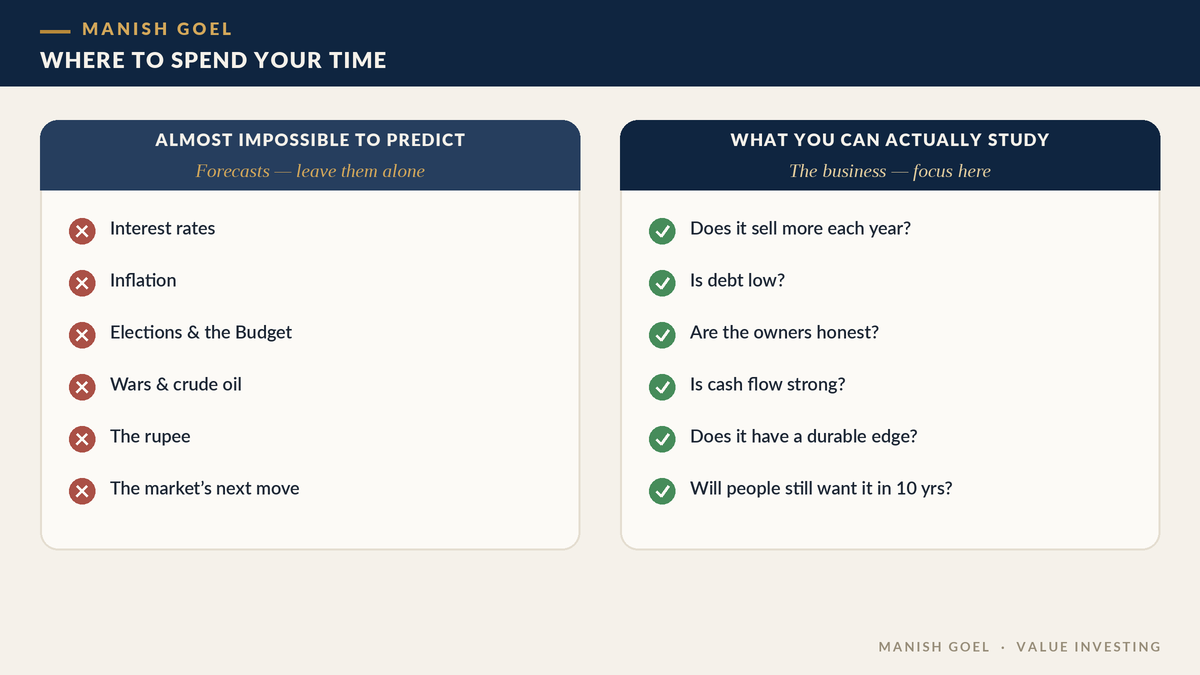
Let us be clear about the words first. A forecast is simply a guess about what will happen next. The economy (or “macro”, short for macroeconomics) is the big picture of the whole country — how fast it is growing, whether prices are rising (inflation), how many people have jobs, and what the Reserve Bank of India is doing with interest rates. Every day, on television and on your phone, clever-sounding people forecast these things: the market will crash, the rupee will sink, rates will rise, a recession (a period when the economy shrinks and business slows) is coming.
“Forget the forecast” does not mean you should be careless or ignore the world. It means something simpler and freeing: do not build your investment decisions on anybody’s guess about the economy or the market — including your own. Peter Lynch, who ran one of the most successful funds in history, put it bluntly. “Nobody can predict interest rates, the future direction of the economy or the stock market,” he wrote. “Dismiss all such forecasts and concentrate on what’s actually happening to the companies in which you’ve invested.”
Lynch even made a joke of it. He liked to say that if you spend more than thirteen minutes a year thinking about economic forecasts, you have wasted ten of them. He was not being lazy. He was saying that those minutes are far better spent understanding a business — what it sells, whether customers keep coming back, whether it earns good money without drowning in debt.
Here is a homely way to hold the idea. Nobody can tell you whether it will rain on a particular Tuesday eight months from now. The monsoon is simply too complex to predict that far ahead. But a good farmer does not need that forecast. He picks good land and a hardy crop that can handle a wet year or a dry one, and then he tends it. Investing is the same. You cannot predict the economic weather. You can choose a sturdy business and stay with it.
Why it works — even the experts get it wrong
Why should you trust this idea over the confident voice on the news? Because the record of forecasting is genuinely terrible, and this is not a matter of opinion.
The International Monetary Fund — one of the most respected economic bodies in the world — studied how well professional economists predict recessions. The finding was almost comical. One of its own economists, Prakash Loungani, concluded that “the failure of economists to forecast recessions is virtually unblemished.” In one review, forecasters as a group had missed 148 of the previous 150 recessions until they had almost already arrived. These are the experts, with all the data in the world, and they still cannot see the turn coming.
And suppose you somehow guessed the news correctly. You would still have to guess how the market will react to it — and the market has a maddening habit of doing the opposite of what feels obvious. Prices often fall while the news is still cheerful, and start climbing again when the headlines are at their darkest and most hopeless. So even a correct economic call can lead you to exactly the wrong action. It is really two impossible guesses stacked on top of each other: what will happen, and how everyone else will feel about it.
There is a deeper reason it works, and Warren Buffett explained it best. Look back at the surprises of any few decades: wars nobody expected, oil shocks, a superpower breaking apart, sudden crashes, interest rates swinging wildly. Buffett’s point is that these blockbuster events arrive without warning, and yet the great businesses kept doing business right through them. So in 1994 he wrote that his company would “continue to ignore political and economic forecasts, which are an expensive distraction for many investors and businessmen.” An expensive distraction — because acting on those guesses usually costs you money and pulls your eyes away from what matters.
And notice what we are not doing here. We are not asking whether the market is cheap or expensive today. We are asking a quality question: is this a good business that will keep selling and earning through good years and bad? A high-quality business — one with a durable edge, low debt, honest owners and steady cash — is worth understanding whatever the headlines say. Forecasts are noise. The business is the signal.
A real story — and an Indian one too
Peter Lynch is the clearest proof. Between 1977 and 1990 he ran the Fidelity Magellan fund in America. Over those thirteen years the fund grew its investors’ money at about 29 percent a year — a remarkable pace — and it grew from a tiny 18 million dollars to 14 billion, becoming the best-performing fund in the world at the time. How did he do it? Not by predicting the economy. He famously found his ideas by watching ordinary life — which shops were busy, which products his family loved, which companies were quietly growing. He studied businesses, not the forecasts of economists.
Buffett offered one more line worth remembering. “Fear,” he said, “is the foe of the faddist, but the friend of the fundamentalist.” In plain words: scary news frightens the person who chases fashions and forecasts, but it is a gift to the person who calmly focuses on good businesses, because fear often puts wonderful companies on sale.
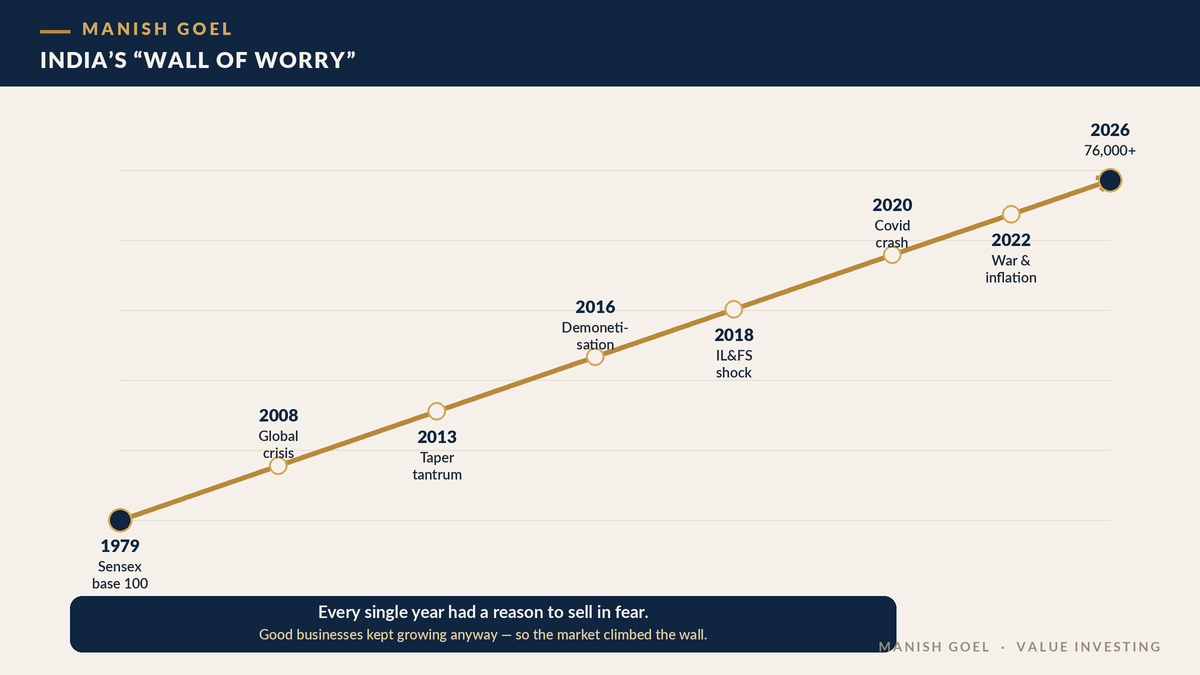
You do not have to look abroad to see this. Think about the last eighteen years in India, and how many times the forecast said “stay away”. There was the global financial crisis of 2008, when the whole world seemed to be sinking. The “taper tantrum” of 2013, when the rupee slid and panic spread. Demonetisation in November 2016, when overnight the biggest notes stopped being legal. The IL&FS shock of 2018, when a giant lender collapsed. The Covid crash of early 2020, when the market fell like a stone in a few weeks. And 2022, with war in Europe, high inflation, and rising rates all at once.
Any investor who sold out on each of these frightening forecasts would have spent the last two decades hopping in and out, paying costs and taxes, and mostly sitting in fear. Yet the Sensex — India’s best-known market index, a basket that tracks 30 large companies — began in 1979 at a base value of 100. Through every one of those crises, it has climbed to well over 76,000 today. Not in a straight line, and with some terrifying drops along the way. But the long climb happened because good Indian businesses kept selling more soap, more loans, more cars, more electricity, year after year, no matter what the economists were saying.
India’s own investing legends understood this in their bones. Rakesh Jhunjhunwala and Radhakishan Damani did not build their fortunes by guessing the next move of the RBI or the next election result. They found good businesses, backed them with conviction, and held on for years and years while others panicked and traded. Their edge was patience and a focus on the business — not a crystal ball for the economy. (These names are mentioned only to explain the idea, and nothing here is a suggestion to buy or sell any share.)
How you can use this as an ordinary investor
This is one of the most relaxing lessons in all of investing, because it removes a burden you were never able to carry anyway. Here are three simple habits to put it to work.
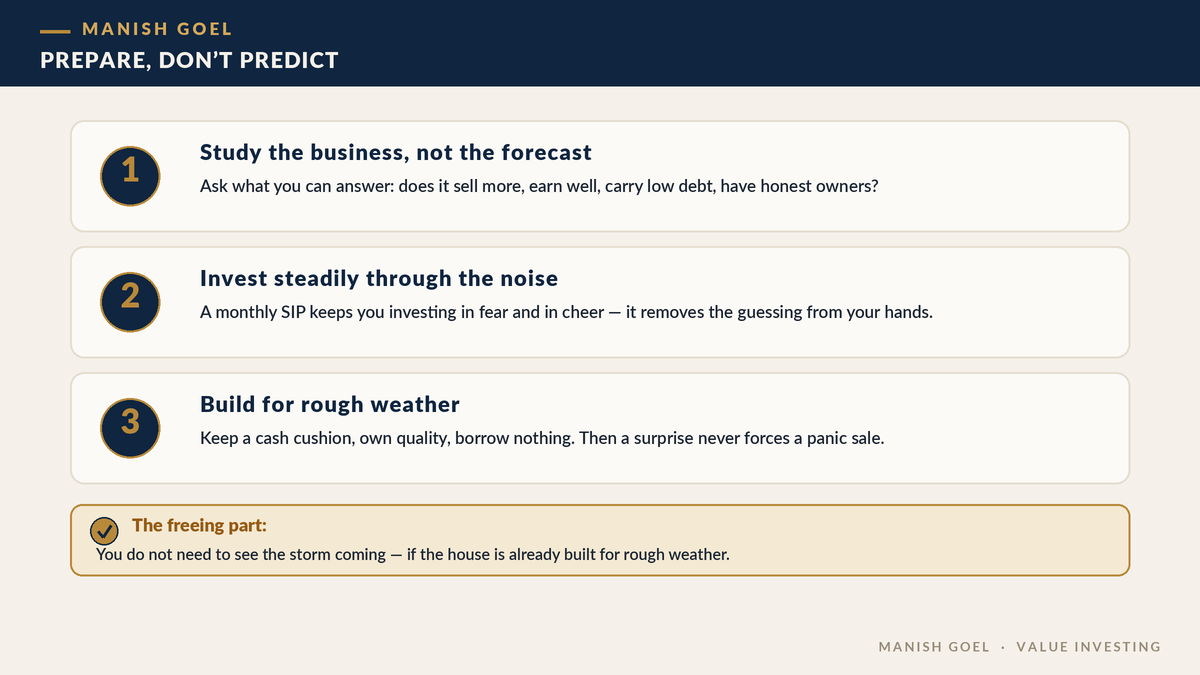
1. Spend your time on the business, not the forecast. When you look at a company, ask the questions you can actually answer: Does it sell something people will still want in five or ten years? Is it growing? Does it earn good profits without heavy debt? Are the owners honest and capable? These are knowable things. “Where is the market headed next quarter?” is not. Move your attention from the television screen to the business — that is where an ordinary investor has a real chance to be right.
2. Treat every dramatic prediction — scary or exciting — as noise. When a headline screams that a crash is coming, or a friend is certain the market will double, do not let it push you to buy or sell. The plainest tool for this is a Systematic Investment Plan, or SIP (investing a fixed sum every month, in good times and bad). It quietly takes the forecasting decision out of your hands. You keep investing through the fear and the excitement, and the long climb does the work.
3. Prepare, do not predict. Since you cannot know which surprise is coming, get ready for surprises in general. Keep a cash cushion so a shock never forces you to sell in a panic. Own quality businesses that can survive a bad year. Do not borrow money to invest. A prepared investor does not need to see the storm coming — the house is already built to handle rough weather. As the old discipline goes: the goal is to be ready for anything, not to guess the one thing.
Put these three habits together and a great weight lifts off your shoulders. You no longer have to win an argument with the economy every morning. You simply have to find a few good businesses, keep buying steadily, stay prepared, and let time and quality do the rest. That is a game an ordinary person can actually win.
Key takeaways
- A forecast is a guess about the future of the economy or market — and even the best experts guess wrong most of the time.
- The IMF found that economists’ record of predicting recessions is “virtually unblemished” in its failure — they missed 148 of 150.
- Peter Lynch earned about 29% a year for 13 years by studying businesses, not by predicting the economy; Buffett calls forecasts “an expensive distraction”.
- India’s market climbed from a base of 100 in 1979 to over 76,000 today — straight through 2008, demonetisation, Covid and every other scare.
- Forget the forecast. Spend your time on business quality, invest steadily through the noise, and prepare for surprises instead of trying to predict them.
— Manish Goel
