Value Investing — Educational Series
Picture a busy market on a Sunday. There is a shiny new stall in the corner with bright lights and loud music, selling the latest must-have gadget. A crowd is pushing to get in. Everyone is talking about it. Right next to it sits a small, plain shop that has been there for twenty years. It sells something dull — glue, tape, and a few boxes of nails. Nobody is excited about it. Nobody takes a photo of it. And yet it quietly sells a little to almost everyone, every single day, year after year. Ask any old shopkeeper which of the two will still be standing in another twenty years, and you already know the answer.
The very same thing happens in the stock market. Beginners are pulled towards exciting, glamorous companies — the ones in the news, the ones friends brag about at weddings, the ones with thrilling stories. Meanwhile, the plain companies that make unglamorous things — pipes, adhesives, bolts, paint, packaging, biscuits, soap — get ignored. But one of the most successful investors who ever lived taught exactly the opposite lesson. He said the boring ones are often the beautiful ones.
That investor was Peter Lynch. Today, let us learn his simple, almost playful idea — that “boring is beautiful” — and understand why a dull, overlooked business can quietly turn out to be a wonderful one. By the end, you will look at “boring” companies with completely new eyes.
The man who fell in love with boring
First, who is Peter Lynch, and why should we listen to him? Lynch was a fund manager — a person whose job is to invest a large pool of many people’s money on their behalf. He ran a famous American mutual fund (a common pot where thousands of ordinary people’s savings are invested together by an expert) called Fidelity Magellan. He managed it from 1977 to 1990 — thirteen years. In that time the fund grew from about 18 million dollars into about 14 billion dollars, and earned its investors roughly 29% a year on average. To put that plainly, that is about 29 paise of profit for every rupee, every single year, for over a decade — one of the greatest records in the history of investing.
So when a man with that record tells you what kind of company he looks for, it is worth leaning in. And here is what he wrote in his famous 1989 book One Up on Wall Street: the perfect company, he said, “has to be engaged in a perfectly simple business, and the perfectly simple business ought to have a perfectly boring name.” He even admitted he got “even more excited when a company with a boring name also does something boring.” A brilliant investor, openly cheering for dull companies. Why on earth would he do that? Because he had noticed something the excited crowd kept missing.
What “boring is beautiful” really means
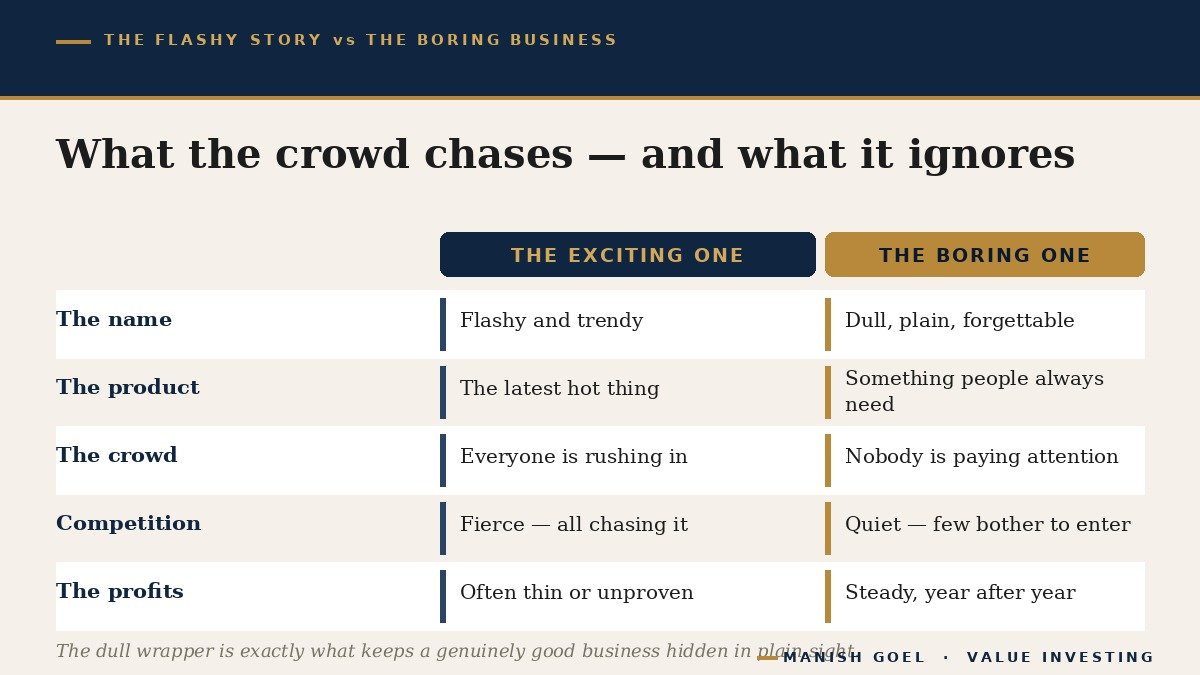
A “boring business” simply means a company that makes or sells something dull and unexciting that people quietly keep needing — glue, pipes, paint, nuts and bolts, labels, cardboard boxes, biscuits, soap. Nobody makes a movie about a glue factory. Nobody discusses a bolt manufacturer over dinner. The crowd (all the other buyers and sellers, and the daily roar of news, tips and opinions) walks right past these companies because they are not exciting.
Think of a boring business like the steady chaiwala who has sold the same chai to the same regulars every morning for thirty years. He will never be famous. But his little cash box fills up reliably, rain or shine. Compare him with the flashy new café that everyone rushes to for a month — and that quietly shuts down within two years. In the market, the chaiwala is the boring business, and the café is the exciting one. Excitement draws a crowd; quiet steadiness builds wealth.
Lynch’s deeper point was about human nature. A flashy name on an average company, he warned, gives people “a false sense of security” and pulls in a crowd, while a dull name on a fine company keeps that crowd away. His advice was almost cheeky: “Invest in simple companies that appear dull, mundane, out of favour, and haven’t caught the fancy of the market.” In other words, do not run from boring. Walk towards it, and look closely at what everyone else is too bored to notice.
Why dull businesses are often such good businesses
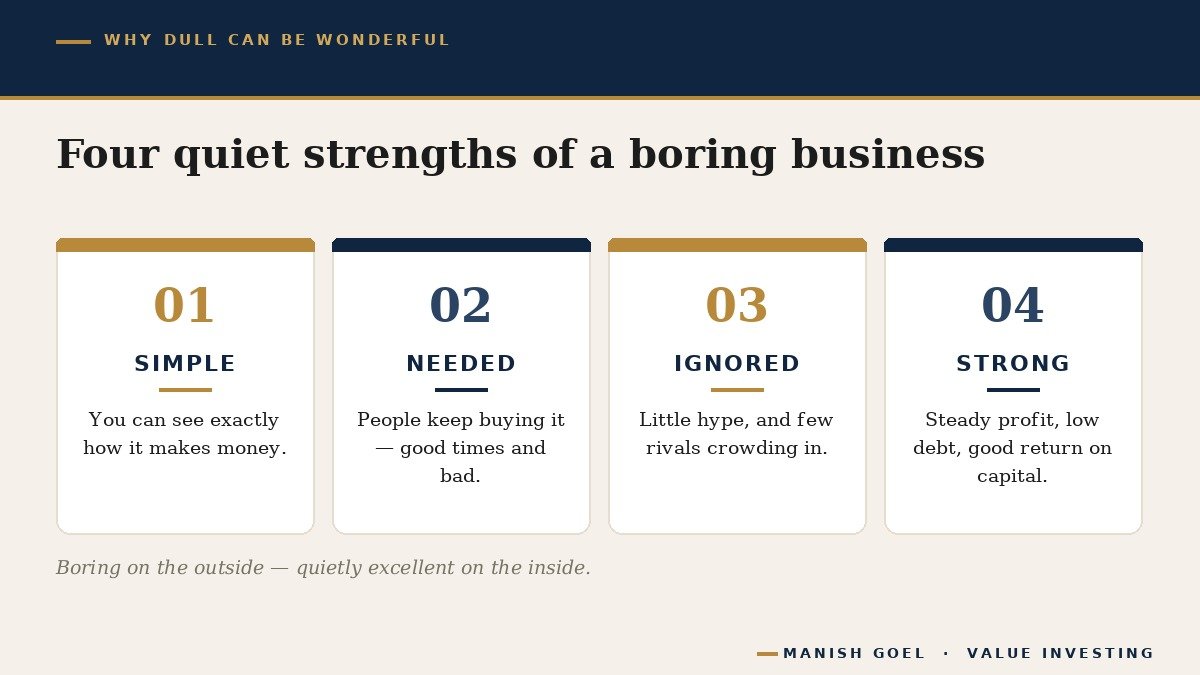
This is the heart of it. Why would something boring be a better business, and not just a duller one? There are four plain reasons, and none of them needs any finance degree to follow.
One: you can actually understand it. A simple, dull business is easy to follow. You can see exactly how it makes money — it sells glue, people buy glue, it earns a little on every tin. There is no mystery. Warren Buffett put it perfectly: “I try to invest in businesses that are so wonderful that an idiot can run them — because sooner or later, one will.” A simple business does not depend on a genius sitting at the top. It just keeps working. This durability is what investors call a moat (a lasting edge that protects a business from competitors, the way a water-filled moat protects a fort).
Two: people keep buying it, in good times and bad. Boring products are usually everyday essentials. Whether the economy is booming or struggling, people still need soap, pipes, packaging, medicines, glue and biscuits. This steady, repeated demand makes the company’s profits predictable — the very opposite of a fragile fad that everyone wants this year and forgets the next. Predictable demand is like a farmer who grows a crop the whole village eats daily, rather than one fancy flower that may or may not sell.
Three: the crowd ignores it, so there is less hype and often less competition. Because dull businesses are not exciting, fewer eager new rivals rush in — who dreams of starting a nuts-and-bolts company? And the noisy market mostly leaves these quiet companies alone. That calm is actually a gift to you. With no mania and no panic swirling around the name, you can study a wonderful business and own it with a steady mind, instead of being swept up in the daily excitement that makes people act foolishly.
Four: the numbers are often quietly strong. Free from glamour, many boring companies simply get on with the unglamorous work of earning steady profits, keeping debt low, and making good money on what they put in. That last point matters: a high return on capital (for every ₹100 the business uses, how many rupees of profit it earns back each year) is one of the clearest signs of a high-quality business. Boring companies, left in peace, often post these strong numbers year after year while nobody is watching.
A few real stories
Peter Lynch did not just preach this — he practised it, and his favourites were gloriously dull. He loved a company called Crown Cork & Seal that did almost nothing but make cans and bottle caps. Could there be a duller business? And yet its profits were anything but dull, and because it was so boring, there was little competition crowding in. He was also fond of a company that ran funeral homes. As he joked, there is little the market wants to ignore more than death — and that very neglect was the opportunity. These plain, overlooked businesses quietly grew into some of his biggest winners, precisely because everyone else found them too dull to bother with.
Now an Indian story you will recognise instantly. Think of Pidilite, the company behind Fevicol. Pause on that for a second: Fevicol is glue. Could anything possibly be more boring than glue? And yet “Fevicol” has become the everyday Indian word for adhesive itself — people walk into a hardware shop and simply ask for “Fevicol,” even when any glue would do. For around sixty years Pidilite has quietly led India’s branded adhesive market, holding roughly a 70% share, while also building everyday names like Fevikwik, M-Seal and Dr. Fixit. A dull product, sold again and again to carpenters and households across the country, was patiently turned into a strong, durable, household-name business. (This is shared only as a story to learn from — it is not advice to buy or sell any share, and we are saying nothing here about its share price.)
Notice the common thread in all of these. The dullness was never the weakness. The dullness was the disguise — the plain wrapper that kept the excited crowd away from a genuinely good business, leaving it quietly compounding for the patient few who bothered to look.
How you can use this — three simple habits
One: do not judge a business by how exciting it sounds. The thrill of a story is not the same as the quality of a business. When something feels exciting and everybody around you is talking about it, slow down and be a little careful. When something feels dull and nobody cares about it, do the opposite — look closer. That plain, ignored corner is exactly where Lynch found his quiet winners.
Two: look in the dull corners of your own everyday life. Lynch’s other famous advice was to simply notice the ordinary products all around you. Who makes the pipes in your walls, the paint on them, the glue in your child’s school project, the biscuits in your tin, the soap in your bathroom, the cement in your building, the packaging on nearly everything you buy? Many of these makers are ordinary listed companies hiding in plain sight, doing dull and durable work while the crowd chases the next shiny thing.
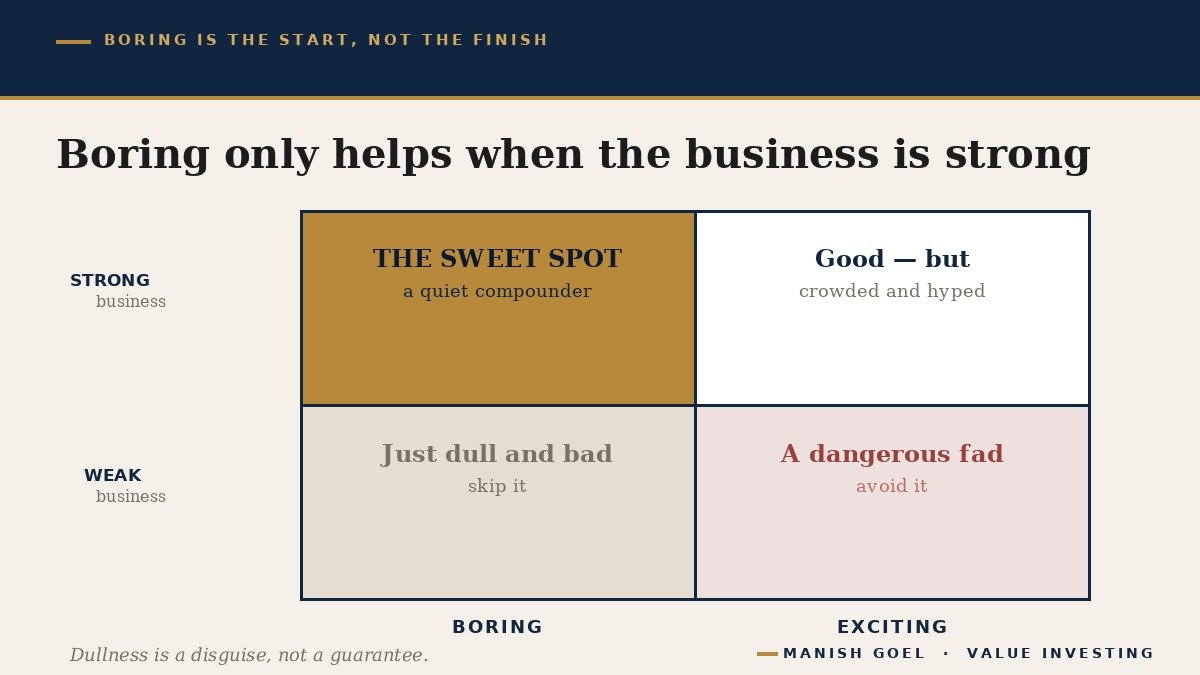
Three: remember that boring is the start, not the finish — always check the quality. This is the most important caution of all. A boring business is only beautiful if it is also a good business. A dull company that loses money, drowns in debt, or is run by dishonest owners is simply dull and bad — leave it alone. So once “boring” has caught your attention, calmly check the quality: Is the business simple and easy to understand? Do people keep buying its product? Are profits steady and growing? Is debt low? Are the promoters (the main owners who run the company) honest and capable? Boring plus genuine quality is the real sweet spot — and the picture below shows why both halves matter.
Key takeaways
- Peter Lynch’s lesson was “boring is beautiful”: a dull, simple, overlooked business is often a wonderful one, and the crowd’s boredom with it is your chance to study and own it calmly.
- Lynch ran the Magellan fund from 1977 to 1990 and earned about 29% a year — and many of his best picks were gloriously dull, from cans and bottle caps to funeral homes.
- Dull businesses are often good businesses because they are simple to understand, sell things people keep buying in good times and bad, attract little hype or competition, and quietly earn steady profits with low debt.
- An Indian example: Pidilite turned glue — about as boring as it gets — into a strong, durable, household-name business with Fevicol. (Shared as a story to learn from, not as advice on any share.)
- Boring is only the starting point: always check the quality. A boring and genuinely strong, low-debt, honestly-run business is the sweet spot; a boring but weak one is best left alone.
— Manish Goel
Disclaimer: This article is for educational and informational purposes only. It is not investment advice, and not a buy, sell, or hold recommendation on any stock mentioned. Equity markets carry risk; please do your own research or consult a qualified professional before making investment decisions.