Value Investing — Educational Series
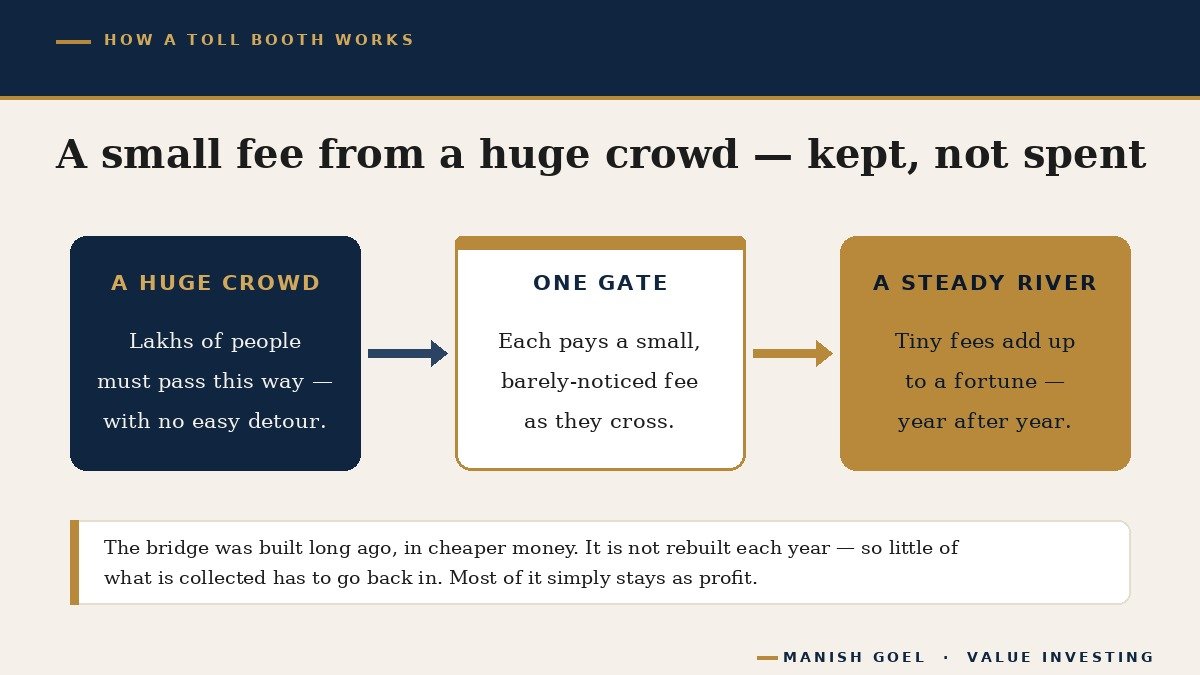
Picture yourself driving from your town to the city on a national highway. After a while you slow down at a toll plaza. A small amount — maybe forty or fifty rupees — quietly leaves your account through your FASTag, the boom barrier lifts, and you carry on. You hardly notice the money go. But now stop and watch that same toll plaza for one full day. Thousands upon thousands of cars, trucks and buses roll through, and every one of them pays a small fee. The road was built once, years ago. Nobody is rebuilding it today. The owner simply sits at the gate and collects a little from a very large crowd — all day, every day, year after year.
Now ask yourself a simple question. Would you rather own the shiny car showroom beside the highway, which must chase every single customer, fight ten rivals down the road, and pray that people feel like buying this year — or that quiet toll gate, which everyone must pass and pay, whether they are buying a car or not? One of the greatest investors who ever lived gave a clear answer. He said the toll gate is one of the most beautiful businesses you can ever own.
That investor is Warren Buffett. Today, in very plain language, let us understand his famous “toll bridge” idea — why a business that quietly collects a small fee from a huge crowd, without needing much fresh money, is such a powerful thing to own. And, just as importantly, how an ordinary investor like you can learn to spot one. This is a lesson about how to recognise a high-quality business — not about whether any share is cheap or expensive.
The bridge Buffett wished he owned
First, a word on why we should listen to him. Warren Buffett is widely regarded as the most successful investor in history. For sixty years he has run a company called Berkshire Hathaway (a large company that owns many other businesses outright and also holds shares in others). Across his long life he has tried again and again to explain, in the simplest possible words, what a truly wonderful business looks like. And his favourite picture is a toll bridge.
Here is how he once put it: “In an inflationary world, a toll bridge would be a great thing to own because you’ve laid out the capital costs. You built it in old dollars, and you don’t have to keep replacing it.” Let us unpack that slowly, because every word matters. Capital is the money a business must put in to build itself and keep running — the bridge, the machines, the shop, the stock on the shelves. “Built it in old dollars” means the big spending happened long ago, when money was worth more. Inflation is the slow rise in prices and costs every year that quietly makes your money buy less — your hundred rupees today buys less than a hundred rupees did five years ago.
So put together, Buffett’s point is this. The toll bridge was paid for long ago. It does not have to be built again. Most ordinary businesses hate inflation, because their costs — raw materials, wages, electricity — keep climbing, and they struggle to keep up. The toll bridge simply shrugs. It already owns the bridge, the crowd still needs to cross, and it can gently nudge the toll upward as the years pass. Time, which slowly wears most businesses down, quietly works in the toll bridge’s favour.
What a “toll booth” business really means
You do not need to own a real bridge to enjoy these economics. A “toll booth” business, in plain words, is any business that does three things at once: it sits in a spot people cannot easily go around; it takes a small fee from a very large flow of people or transactions; and it does not need much fresh money to keep going. The highway toll plaza we started with is the perfect everyday picture, but the idea stretches far beyond roads. Any business that quietly stands between a huge crowd and something they want to do, and takes a small cut each time, is a toll booth.
This protected position has a name in investing — a moat (a lasting edge that keeps competitors out, just like the water-filled ditch around an old fort kept enemies out). A toll booth’s moat is simply its position: there is no other gate. If you must cross the river and there is only one bridge, the bridge does not have to be clever or charming. It just has to be there, in the one spot you cannot avoid.
There is a second quiet strength. Because each person pays only a tiny amount, the toll booth can raise its fee a little and almost nobody walks away. That ability to raise the price without losing customers is called pricing power. A fifty-rupee toll rising to fifty-five will not make you sell your car or take a mud track through the fields. You shrug and pay. But that small rise, multiplied across lakhs of vehicles, becomes a great deal of extra money — earned without selling anything new.
Why a toll booth is such a strong business
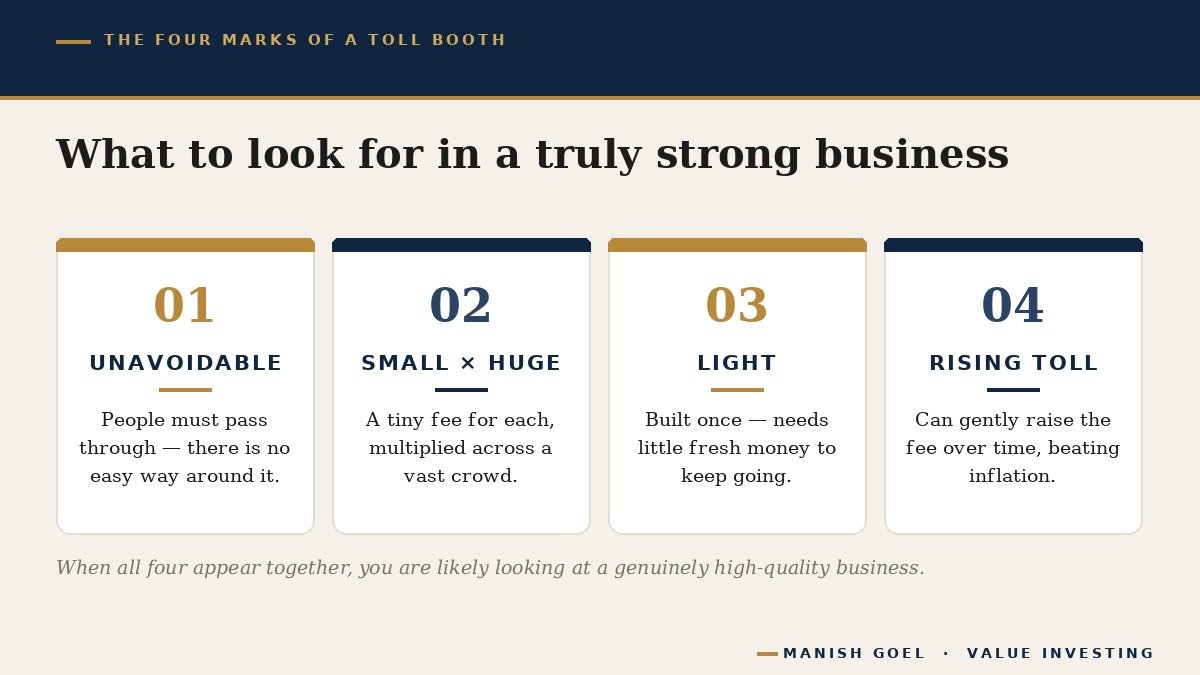
Here is the plain logic, in four simple parts. None of them needs a finance degree to follow.
One: the crowd cannot go around it. A toll booth sits in a spot with no easy detour — like the only bridge across a wide river. If you need to cross, you pay. This is completely different from a popular new shop, which people can simply choose to ignore next month. Position is stronger than popularity, because position does not depend on staying fashionable.
Two: the fee is small for each person, but huge in total. A few rupees per car feels like nothing to the driver. But multiply it by lakhs of vehicles every day and it becomes a wide, steady river of money. And because no single payer feels the pinch, the toll can be nudged up a little over time without anyone protesting. Small for one, enormous for all — that is the quiet magic.
Three: it does not eat much money to keep going. Once the bridge is built, you do not rebuild it every year. So most of the money the toll collects is free cash (the profit left over after the business has paid for everything it needs to keep running). Compare that with a steel plant, which must keep pouring enormous sums into furnaces and machines just to stand still. A toll booth keeps what it earns; a heavy factory must give much of it straight back. The money a toll booth keeps can be handed to its owners or used to build the next bridge.
Four: time and inflation are on its side. As the years pass and prices drift upward, the toll drifts upward too, while the old bridge keeps standing and serving. The business quietly grows richer without doing anything dramatic — no frantic expansion, no risky bets, just the same gate collecting a slightly larger fee from a slightly larger crowd.
Why does all of this matter so much? Buffett’s lifelong partner, Charlie Munger, explained it in one of the most important lines in investing: “if a business earns 18% on capital over 20 or 30 years, even if you pay an expensive looking price, you’ll end up with a fine result.” In plain words: a business that earns a high, steady return on the money put into it will make you wealthy over the years — even if you did not manage to buy it cheap. That is exactly why we hunt for the toll booth’s quality first. A wonderful toll booth bought at a full price will usually treat you far better than a poor business bought on sale. Our job is to find the quality, not to bargain-hunt the price.
A few real toll booths
The clearest real toll booths in the world today are the card networks. Every time someone taps or swipes a Visa or Mastercard card at a shop, a tiny fee — usually a small slice of the bill — flows to the network that carried the payment. The shopper never notices it. But across billions of swipes around the world, those slivers add up to an ocean of money. The network did not sell you the shirt or the groceries; it simply stood at the gate between your card and the shop, and took a small cut. Investors so often describe these companies as “toll booths” that the word has practically become their nickname. Warren Buffett himself has owned American Express — another business that earns a small fee on spending — for decades.
A gentle but important caution: I am naming these companies only to make the idea clear. This is not a suggestion to buy or sell any of these shares, and nothing here is about their price. They are simply easy, famous pictures of the toll-booth shape.
Now bring it home to India, where you already meet a toll booth almost every time you travel. Since February 2021, FASTag made highway tolls automatic — your account is tapped the instant you cross — and the country now records billions of such crossings every year. But here is a quieter Indian toll booth, hidden inside the share market itself. When you buy shares in India, they do not arrive as paper certificates. They sit safely in electronic form in your demat account (an account that holds your shares in digital form), kept by an institution called a depository. India has two of them, named CDSL and NSDL. Each time shares move, a small flat fee — often around eighteen rupees plus tax — quietly goes into that system. You barely notice it. Yet nearly every investor in the entire country must pass through that same gate. Once again — this is only to show the shape of the idea, not advice about any share or its price.
How you can spot one — and avoid the fakes
You do not need a screen full of numbers to begin. Three simple questions will point you towards a real toll booth.
First, ask: “must people pass through here?” Look for an unavoidable position, not merely a popular product. A trendy snack has eager buyers today and forgotten shelves next year. A toll booth has a crowd with no easy way around it. When you study a company, try to find the gate — the point where customers have little real choice but to pass through and pay.
Second, check that the fee is small for the payer but large in total — and that the business keeps most of what it earns. A real toll booth takes a thin sliver each time, from a very large number of times, and does not have to spend most of it straight back just to keep the gate open. Steady profits that do not demand constant heavy spending are the true fingerprint of these businesses. If a company must pour almost everything it earns back into machines and factories just to survive, it is a heavy factory, not a toll booth.
Third, make sure the toll can hold and gently rise. The very best toll booths can nudge their fee up a little each year without the crowd leaving. If a business can never raise its fee, the slow tide of inflation will quietly wear it away, year after year. Durable pricing power is what lets a toll booth keep winning long after it was built.
But beware — not every gate is a real toll booth. There are three classic traps, and a careful investor learns to watch for all of them.
The regulator can cap the toll. Buffett himself joked that the only trouble with owning a real toll bridge is that “the government won’t let me raise the toll.” If an outside authority sets or freezes the fee, much of the magic disappears, because the business can no longer keep pace with rising costs. A new road can be built around it. Today’s unavoidable gate can quietly become tomorrow’s bypass when technology changes. The old toll booth on letters and telegrams was simply walked around by the mobile phone. Always ask: could a new road appear and empty this one? And one big customer can refuse to pay. If most of the toll comes from just one or two large payers, then they hold the power, not you. A genuine toll booth collects from a huge, scattered crowd, so no single payer can ever bully it.
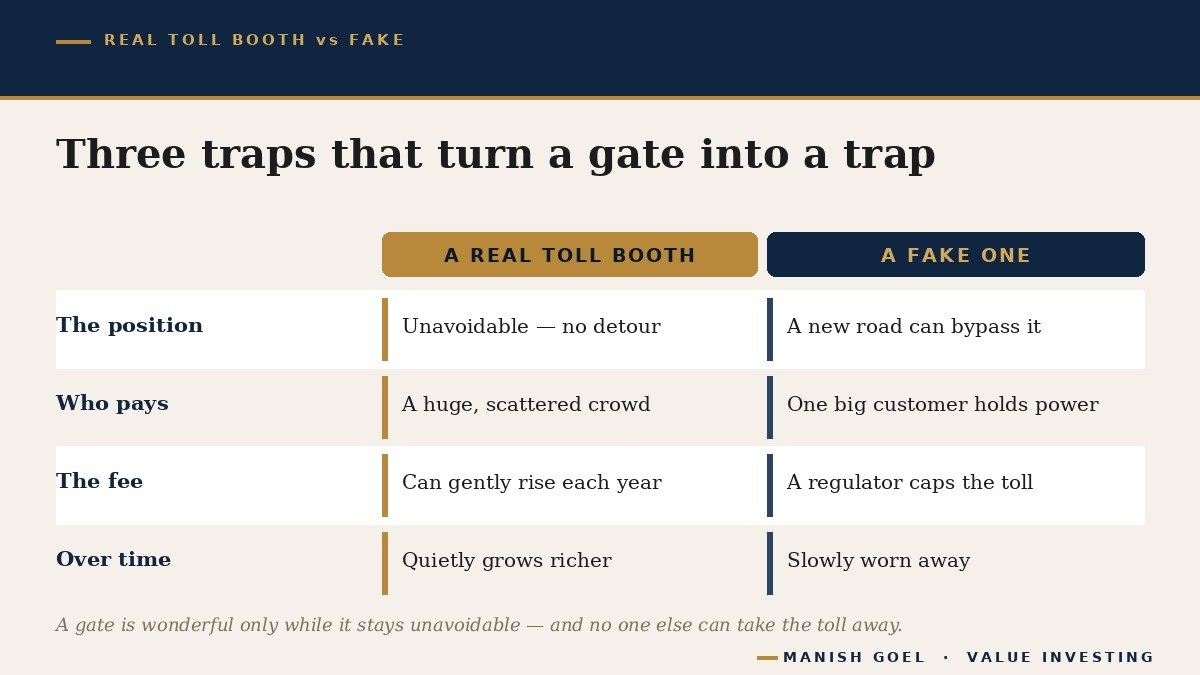
A toll booth is wonderful only for as long as it stays unavoidable. So the lesson is not simply “find a business that takes a small fee.” It is “find a small fee collected from a crowd that genuinely cannot go around it — and that no regulator, no new road, and no single customer can take away.” That is real, durable quality, and it is exactly what Buffett means when he dreams of owning a bridge.
Key takeaways
- A “toll booth” business sits in a spot people cannot easily avoid and collects a small fee from a very large crowd — like a highway toll plaza built once and collecting forever.
- Its strength comes from four things together: an unavoidable position (a moat), a tiny fee that is enormous in total, a low need for fresh money, and gentle pricing power that beats inflation.
- Buffett’s picture is a toll bridge built long ago in cheaper money, that simply keeps collecting — and can quietly raise the toll as the years pass.
- Munger’s reminder: a business that earns a high, steady return on its capital makes you wealthy over time, so focus on that quality first — not on bargain-hunting the price.
- Beware the fakes: a toll the regulator can cap, a gate a new road can bypass, or a booth that leans on one big customer who can simply refuse to pay.
So the next time you slow down at a highway toll plaza and watch that small fee leave your account, do not see it as a nuisance. See it as a quiet lesson in what a wonderful business looks like — patient, unavoidable, and collecting a little from a great many, year after year. Learn to spot that shape, and you will start to notice quality where the excited crowd sees nothing at all.
— Manish Goel
Disclaimer: This article is for educational and informational purposes only. It is not investment advice, and not a buy, sell, or hold recommendation on any stock mentioned. Equity markets carry risk; please do your own research or consult a qualified professional before making investment decisions.
