April 11, 2026
(Saturday)
Why Most Indian Investors Are Sizing Their Bets Completely Wrong
Ask the average Indian retail investor how much they put into their best stock idea, and you will hear answers that range from “5% of my portfolio” to “I divided my money equally across 30 stocks.” Both answers reveal the single biggest reason why retail investors underperform the market by 6-8% annually, decade after decade. They have no mathematical framework for deciding how much to bet on any single conviction.
This is the silent killer of compounding. You can identify the next Bajaj Finance, the next Asian Paints, the next Titan Biotech-style multibagger — and still end up with mediocre returns simply because you allocated 2% of your capital to it instead of 15%. The world’s greatest investors solved this problem decades ago, and they did it by borrowing a formula from a Bell Labs physicist named John Larry Kelly Jr. who originally designed it to optimize signal transmission over noisy telephone lines.
That formula is called the Kelly Criterion, and today, after deeply studying the writings of Warren Buffett, Charlie Munger, Edward Thorp, Mohnish Pabrai, and Bill Gross, we are going to decode it specifically for Indian value investors. By the end of this post, you will understand exactly why your bet sizing — not your stock picking — is probably the biggest leak in your investment process.
As of yesterday’s close on April 10, 2026, the SENSEX stood at 77,550.25 (+1.20%) and the NIFTY 50 closed at 24,050.60 (+1.16%). Markets are firmly in optimistic territory, which makes this conversation about disciplined bet sizing more urgent, not less. When everyone is bullish, the temptation to spread money thin across hot tips is overwhelming. Resist it. The Kelly Criterion is your antidote.
The Origin Story: From Bell Labs to Las Vegas to Wall Street
In 1956, John Larry Kelly Jr., a physicist working at Bell Labs in New Jersey, published a paper titled “A New Interpretation of Information Rate” in the Bell System Technical Journal. Kelly was trying to solve a telecommunications problem: how do you transmit information optimally over a noisy channel? But buried in his mathematics was a side-result that would change finance forever — a formula that calculated the optimal fraction of capital to bet on any positive-expectancy wager to maximise long-term wealth.
The formula in its simplest form is breathtakingly elegant:
f* = (bp – q) / b
Where f* is the fraction of your capital to bet, b is the net odds received on the wager (gain divided by loss), p is the probability of winning, and q is the probability of losing (which equals 1 minus p). The genius of the formula is that it tells you to bet more when your edge is bigger, and less — or nothing at all — when your edge is small or non-existent.
Kelly’s paper sat in obscurity until a young MIT mathematics professor named Edward Thorp picked it up. Thorp used the Kelly formula to systematically beat the casinos at blackjack in the early 1960s, then took the same mathematical mind to Wall Street and ran one of the first quantitative hedge funds — Princeton/Newport Partners — which delivered 19.1% annualized returns over 19 years with almost no losing months. Thorp’s success was not luck. It was Kelly Criterion bet sizing applied with iron discipline.
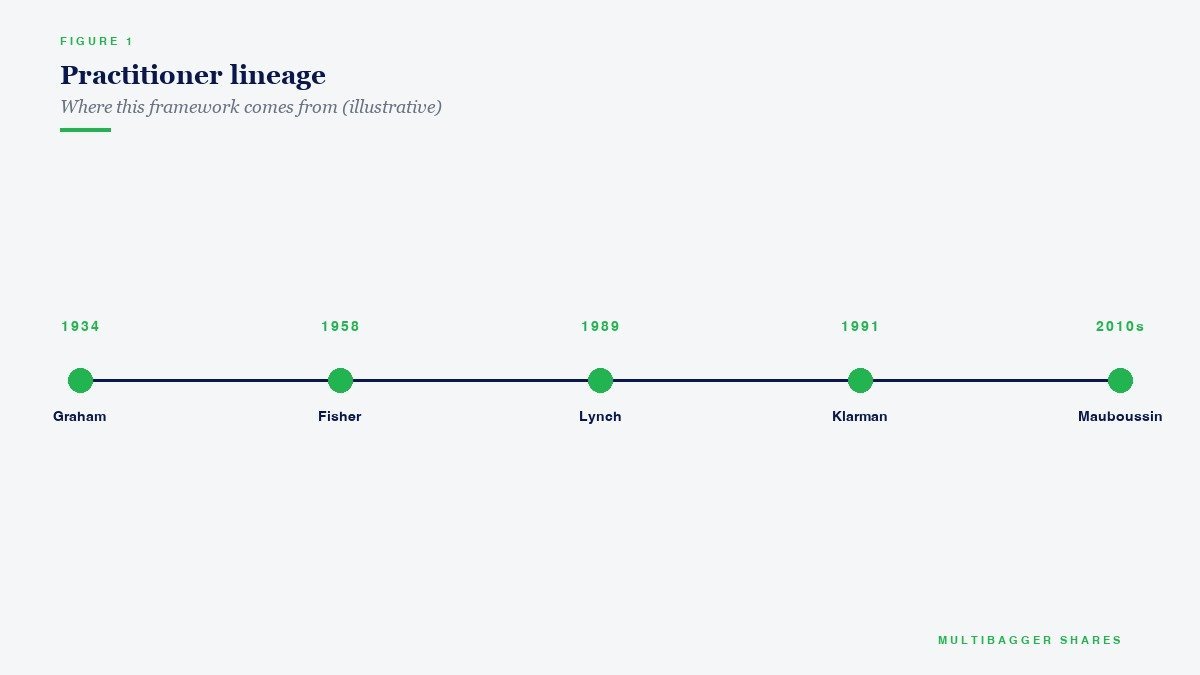
From there, the formula spread quietly through the world’s best minds. Warren Buffett, Charlie Munger, Bill Gross of PIMCO, and Mohnish Pabrai have all credited Kelly-style thinking for the most concentrated and successful bets of their careers.
Why Buffett’s Biggest Bets Were Pure Kelly Logic
Charlie Munger said it bluntly at the 2004 Berkshire Hathaway annual meeting: “The wise ones bet heavily when the world offers them that opportunity. They bet big when they have the odds. And the rest of the time, they don’t. It’s just that simple.” Read that sentence three times. That is the entire Kelly Criterion compressed into 32 words.
Warren Buffett has lived this philosophy his entire career. In 1963, when American Express was caught in the “Salad Oil Scandal” and the stock crashed, Buffett poured 40% of his entire partnership’s capital into a single stock. He had done his homework, the odds were overwhelmingly in his favour, and he sized the bet accordingly. The result was a fortune that launched his reputation. In 1988, when Coca-Cola was mispriced after the New Coke disaster, Buffett deployed 25% of Berkshire Hathaway’s equity portfolio into KO stock. That position alone has compounded into more than $25 billion of value for Berkshire shareholders.
Then look at his 2008 bet on Goldman Sachs during the global financial crisis — $5 billion in preferred stock with warrants when Wall Street was on fire. Or his 2011 plunge into Bank of America for $5 billion in preferred shares plus warrants for 700 million common shares. In every case, Buffett’s pattern is identical: years of patient waiting, followed by a massive concentrated allocation when the edge becomes unmistakable.
This is the polar opposite of how 99% of Indian retail investors operate. They scatter ₹10,000 each across 30 random stocks based on a WhatsApp tip. They have no mathematical reason to own any of them in any particular size. Buffett, by contrast, allocates capital like a heavyweight boxer throws punches — most of the time he is patiently waiting, and when he commits, he commits with everything.
The Kelly Math: A Worked Example for Indian Value Investors
Let us put real numbers on this. Imagine you have spent six months researching a small-cap company. You have read every annual report for ten years, met the management twice, calculated the intrinsic value, studied the competitive landscape, verified the corporate governance, and confirmed promoter buying. Based on your research, you estimate:
You believe there is a 70% probability that the stock will double over the next three years, and a 30% probability that the stock will lose 25% of its value if your thesis is wrong. So p = 0.70, q = 0.30, gain = 100%, loss = 25%, which means b = 100/25 = 4.
Plug into the Kelly formula: f* = (4 × 0.70 − 0.30) / 4 = (2.80 − 0.30) / 4 = 2.50 / 4 = 0.625 or 62.5%.
Mathematically, the Kelly Criterion says you should put 62.5% of your portfolio into this single stock. That number probably terrifies you. It should. And this is precisely why almost every serious practitioner uses what is called Half-Kelly or Quarter-Kelly — they take the theoretical optimum and divide it by two or four to account for the fact that you are not 100% certain about your win probability and your estimated payoffs. Half-Kelly in this example would still suggest a 31% allocation to your single best idea.
Compare this to the diversified mutual fund holding 80 stocks where the largest position is 5%. There is simply no mathematical world in which scattering capital like that produces the same compounding power as a Kelly-sized concentrated bet on a deeply-researched conviction.
Why Half-Kelly and Fractional Kelly Are the Real-World Answer
Pure Kelly is mathematically optimal — but only if your inputs are perfect. In real-world investing, your “win probability” is always a guess. You think there is a 70% chance of success; the true probability might be 55% or 85%. This input uncertainty is why every serious Kelly practitioner uses fractional Kelly. The standard formulations are:
Full Kelly maximises long-term geometric growth but produces wild drawdowns. Half-Kelly gives you roughly 75% of the long-term return with about half the volatility — a vastly better risk-adjusted experience. Quarter-Kelly is what conservative practitioners like Bill Gross have used in their fixed-income portfolios, and Edward Thorp himself ran his hedge fund at roughly half-Kelly throughout the 1970s and 1980s.
For Indian retail investors with limited capital, our recommended approach is Quarter-Kelly to Half-Kelly, with hard caps. This means even your highest-conviction idea should rarely exceed 20-25% of your portfolio, and your top 5-7 ideas should collectively represent 70-80% of your capital. The remaining capital is your “bench” of smaller positions you are still researching, and your dry powder for new opportunities.
How Mohnish Pabrai Uses Kelly to Build 5-Stock Portfolios
Mohnish Pabrai, the Indian-American value investor who manages Pabrai Funds and openly credits Buffett and Munger as his mentors, runs one of the most concentrated portfolios in the world. At various points in his career, his entire equity portfolio has consisted of just five to ten stocks. In his book The Dhandho Investor, Pabrai explicitly invokes Kelly Criterion thinking to justify this concentration.
Pabrai’s logic is mathematically airtight. If you find one stock per year where the odds are heavily in your favour and the downside is limited, why would you dilute that conviction by spreading your money across 49 mediocre ideas? Munger calls this “diworsification” — the idea that adding more stocks beyond a point actually worsens your portfolio rather than improving it.
Pabrai’s portfolio has frequently held positions of 10-25% in single stocks. Like Buffett, he waits years between allocations. And like Buffett, when he commits, he commits with conviction-sized bets.
Titan Biotech: A Case Study in Kelly-Worthy Conviction
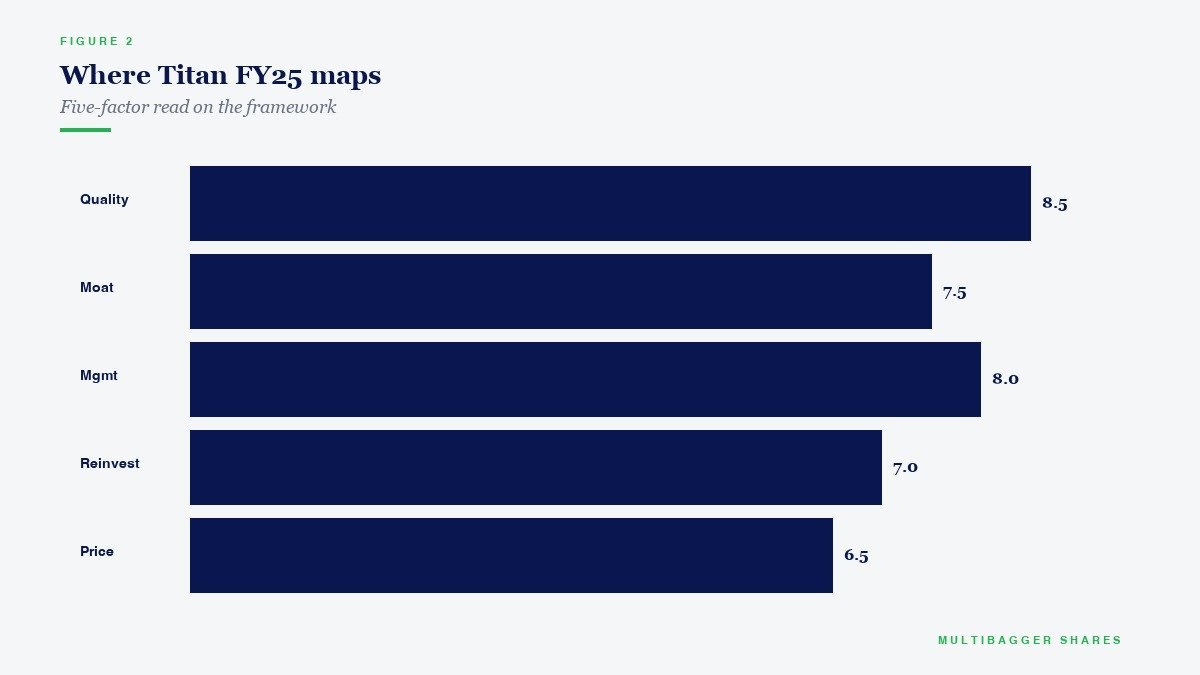
At today’s close, Titan Biotech (BSE: 524717) trades at ₹432 with a market capitalization of ₹1,783 crore. The stock has a 52-week range of ₹74.7 to ₹556, a current P/E of 65.6, a book value of ₹40.3, and management has historically delivered an ROCE of 16.9% with an ROE of 15%. The promoters have aggressively increased their stake from 48% to 55.87%, the company is virtually debt-free with a D/E ratio of 0.02x, generates 34.5% of revenue from exports to 100+ countries, and has paid uninterrupted dividends for 14 consecutive years.
What does Kelly thinking say about a setup like this? It says — assuming you have done your independent verification and your conviction is genuine — that this is exactly the kind of business where serious capital should be deployed, not nibbled at. A company with promoter accumulation, a 14-year dividend track record, export diversification across 100 countries, zero financial leverage, and strong governance is the polar opposite of a speculative gamble. The Kelly Criterion was designed precisely for situations where the expected value is positive and the downside is bounded by genuine business strength.
This is not a recommendation to buy Titan Biotech today. It is a recommendation to think differently about position sizing. When you find a business of genuine quality after deep research, do not insult your own work by allocating 2% of your portfolio to it. Use Kelly logic. Size your bet to match your conviction.
The Anti-F&O Application of Kelly Criterion
According to a SEBI study, 9 out of 10 individual traders in equity Futures & Options incurred net losses. That means F&O has a win probability of approximately 10%. Plug that into the Kelly formula with even generous assumptions about the payoff ratio, and you get a result that is negative. A negative Kelly value has only one meaning in mathematics: do not bet at all. Kelly Criterion is the most rigorous mathematical proof you will ever see that F&O trading is a wealth destruction machine for retail investors.
Compare this to long-term value investing in genuinely high-quality businesses purchased after deep research. Historical data on Indian quality compounders suggests win rates of 60-80% over 5-7 year holding periods, with payoff ratios of 3:1 to 10:1. Kelly Criterion for this kind of disciplined value investing produces large positive numbers — meaning you should bet meaningfully on your best ideas. The same formula tells you to allocate aggressively to value investing and to allocate nothing to F&O speculation.
Why Diversification Is the Enemy of Kelly Logic
Warren Buffett once said: “Wide diversification is only required when investors do not understand what they are doing.” The Kelly Criterion is the mathematical formalisation of this insight. If you genuinely understand a business — its moat, its management, its industry, its risks, its valuation — then diluting that understanding across 50 mediocre stocks is not “risk management.” It is cowardice disguised as prudence, and it guarantees mediocre returns.
The greatest value investors of our time — Buffett, Munger, Pabrai, Greenblatt, Klarman, Jhunjhunwala, Damani — have all built their fortunes through concentrated portfolios of deeply researched, high-conviction ideas. Not one of them ever owned 50 stocks. Most of them have owned 10 or fewer at any time. The Kelly Criterion explains why: the math simply does not justify dilution when your edge is real.
The Practical Kelly Framework for Indian Investors
Here is how to put Kelly thinking to work in your portfolio starting tomorrow morning. First, before you buy any stock, write down your honest estimate of the probability that the thesis succeeds and your honest estimate of the upside and downside scenarios. Second, calculate the Kelly fraction using the formula, and then divide by two or four to get your fractional Kelly position size. Third, apply hard caps — never let any single position exceed 25% of your portfolio regardless of what Kelly says, simply because you are not as smart as you think you are. Fourth, refuse to take positions where the Kelly fraction is negative or trivially small — those are stocks the market is not paying you to own. Fifth, build your portfolio with 5-10 conviction names, not 30-50 random names.
This framework will feel uncomfortable at first because it forces you to admit that most of your “ideas” are not really ideas at all. They are random tips, half-formed hunches, and emotional purchases dressed up as analysis. Kelly Criterion is the mirror that shows you the truth about your own research. If you cannot defend a position size of 10% or more, you do not really believe in the stock — and if you do not really believe in it, why do you own it?
The Bottom Line
Stock picking is only half the battle. Bet sizing is the other half — and for most retail investors, it is the half they completely ignore. The Kelly Criterion gives you a mathematical framework for matching the size of your bet to the strength of your edge. Use it. Use it as Buffett uses it. Use it as Munger uses it. Use it as Pabrai uses it. Use it as Edward Thorp used it to beat both the casinos of Las Vegas and the markets of Wall Street.
The math does not lie. Concentrated, conviction-sized bets on deeply researched businesses compound wealth faster than any other strategy in the history of investing. Diversification across mediocre ideas guarantees average returns at best. The choice is yours — and the formula is now in your hands.
Want to learn the complete 95-factor framework we use at Multibagger Shares to identify Kelly-worthy quality stocks before allocating capital? Watch our complete value investing course on YouTube: Master Value Investing Course Playlist.
📢 Join Our Telegram Channel
Get daily value investing lessons, stock analysis & Titan Biotech updates — delivered straight to your phone!
✈️ Join @longtermequityy on Telegram
🔔 Free • No spam • Value investing insights daily
Disclaimer: This article is for educational and informational purposes only. It is not investment advice, and not a buy, sell, or hold recommendation on any stock mentioned, including Titan Biotech Limited. Equity markets carry risk; please do your own research or consult a qualified professional before making investment decisions.
