April 11, 2026
(Saturday)
Imagine a shop where every one hundred rupee note was being sold for sixty rupees. You would walk in, empty your wallet, and buy every single note on the shelf. You would not need a PhD in finance to figure out it was a screaming bargain. Yet this exact situation exists every single day in the Indian stock market — hiding in plain sight inside a corner most retail investors completely overlook. That corner is called the holding company, and the phenomenon is known as the Holding Company Discount.
What Is a Holding Company? The Simple Definition
A holding company is a parent entity whose primary purpose is not to run its own operating business, but to own shares in other companies. Its balance sheet is essentially a portfolio. Instead of factories, brands, and customers, a pure holding company holds equity stakes — sometimes in listed subsidiaries, sometimes in unlisted ones, sometimes in sister concerns, and sometimes in a basket of financial investments.
Famous global examples include Berkshire Hathaway, which Warren Buffett transformed from a failing textile mill into the world’s most successful investment holding company. India has its own rich ecosystem of holding companies — but unlike Berkshire, almost all of them trade at a significant discount to the combined market value of what they own. That gap is where the opportunity lives.
The Holding Company Discount: A Concrete Example
Let us make this real with arithmetic any investor can follow. Suppose HoldCo Ltd is a listed holding company whose only assets are:
- 40% stake in Listed Subsidiary A, whose current market capitalisation is ₹10,000 crore → stake worth ₹4,000 crore
- 25% stake in Listed Subsidiary B, whose current market capitalisation is ₹8,000 crore → stake worth ₹2,000 crore
- Cash and liquid investments on its own balance sheet → ₹500 crore
- Zero debt
Adding these up, the total Net Asset Value (NAV) per share of HoldCo comes to ₹6,500 crore. This is the look-through value — the real economic worth of what a shareholder of HoldCo actually owns. But when you open the stock screen, HoldCo itself may be trading at a market cap of just ₹2,600 crore. The gap — ₹3,900 crore, or 60% — is the Holding Company Discount. As an investor, for every ₹40 you pay for HoldCo, you are indirectly buying ₹100 worth of its underlying holdings. That is Benjamin Graham’s dream come true.
Why Does the Discount Exist? The Six Real Reasons
The Indian market is not stupid. If holding companies trade at 50% discounts year after year, there must be structural reasons — and understanding them is the difference between spotting a bargain and walking into a trap. Here are the six real drivers of the holding company discount in India:
One: Double taxation of dividends. When the operating subsidiary pays a dividend to the holding company, it flows through, and when the holding company eventually pays it out to its own shareholders, there is another tax layer along the way. This structural drag is estimated to cost 10-15% of intrinsic value.
Two: Illiquidity. Indian holding companies tend to have tiny daily trading volumes compared to their operating subsidiaries. A mutual fund that wants to buy ₹50 crore worth of the stock simply cannot do so without moving the price, so institutions stay away. Retail investors then dominate the shareholder register, and retail sentiment is fickle.
Three: Promoter overhang and the “never going to unlock” fear. Most Indian holding companies are controlled by legendary business families — Tata, Bajaj, Kalyani, Godrej, Pilani. These promoters use the holding company as their family’s perpetual vehicle for control. They have no intention of liquidating it, selling underlying assets, or returning cash to shareholders. The market therefore assumes the underlying NAV will never be unlocked, and applies a permanent discount.
Four: No operating business of their own. Holding companies usually have zero operating revenue. They produce nothing. They earn dividends and interest. Growth-oriented investors, who dominate the Indian market, find this structurally unattractive.
Five: Perceived corporate governance risk. A handful of Indian holding companies have historically been used to route related-party transactions, cross-holdings, and promoter loans. Even where today’s governance is clean, the market paints all holding companies with the same brush.
Six: No inclusion in major indices. Because holding companies derive most of their market cap from underlying stakes, index committees typically exclude them from Nifty 50 and Sensex to avoid double-counting. No index inclusion means no passive flows — and in an era when ETFs and index funds dominate, absence of passive demand is a significant headwind.
The Four Categories of Indian Holding Companies
Not all Indian holding companies are created equal. For our 95-factor framework at Multibagger Shares, we classify them into four distinct buckets, each with a different risk-reward profile.
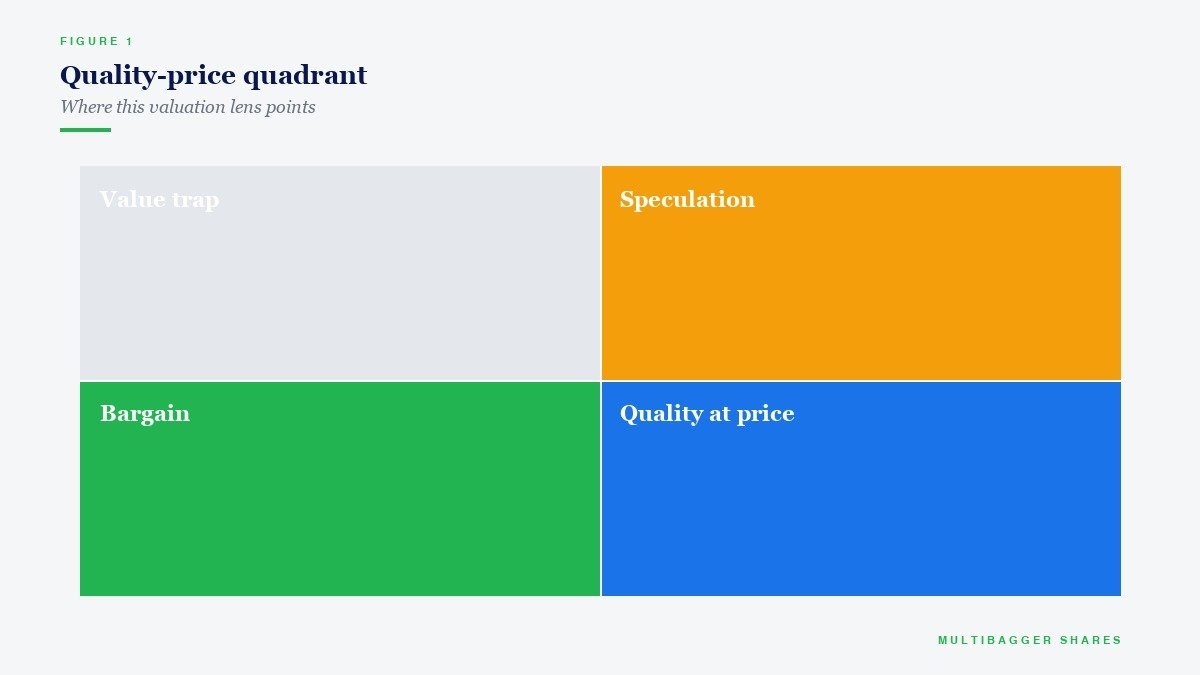
Category 1 — Pure Investment Holding Companies. These are entities whose sole purpose is to hold and manage a portfolio of investments. Examples include Tata Investment Corporation, which holds a diversified basket of Tata group stocks, blue chip equity investments, and debt instruments; and Kalyani Investment, which holds stakes in Bharat Forge, Kalyani Steels, and other group companies. These typically trade at 40-50% discount to NAV and are the cleanest way to express the holding company trade.
Category 2 — Operating Holding Companies. These have a small operating business of their own alongside significant investments in listed entities. Bajaj Holdings & Investment is the textbook example — it owns stakes in Bajaj Auto, Bajaj Finserv, and Bajaj Finance, plus its own treasury. Historically, Bajaj Holdings has traded at a 50-60% discount to NAV despite the underlying Bajaj franchise being one of the finest in India.
Category 3 — Conglomerate Parent Holdings. These are companies that own a diversified mix of listed and unlisted businesses, each with different dynamics. Maharashtra Scooters (owned by the Bajaj group) and Nalwa Sons Investments (Jindal group) fit here. Valuation is harder because you must estimate unlisted subsidiary values.
Category 4 — Cash-Rich Family Office Holdings. These are effectively promoter family treasury vehicles that hold mostly cash, short-term debt, and a handful of listed equity positions. They tend to trade closest to NAV but offer the least upside.
How to Calculate the Holding Company Discount: A Step-by-Step Framework
Follow these five steps to compute the exact discount for any Indian holding company you are researching:
Step one: Pull the latest annual report or the most recent shareholding disclosure to identify every listed investment the holding company owns, along with the exact number of shares held in each subsidiary.
Step two: Multiply each listed stake by the current market price of that subsidiary. This gives you the mark-to-market value of the listed portfolio as of today.
Step three: For unlisted investments, use the latest audited financials to compute a fair value — typically book value plus any strategic premium you believe is warranted. Be conservative. Under-value rather than over-value unlisted holdings.
Step four: Add cash, short-term investments, and other balance sheet assets; subtract all debt and contingent liabilities. The result is your total Net Asset Value (NAV).
Step five: Divide NAV by the number of outstanding shares to get NAV per share. Compare this to the current market price. The gap, expressed as a percentage, is your holding company discount.
A helpful rule of thumb: if the discount is less than 30%, the stock is likely fully priced — the market has caught up. If it is between 30% and 50%, there may be a reasonable margin of opportunity, but proceed only if governance and catalysts check out. If it is above 50%, you may be looking at a serious opportunity but you must investigate why the discount is so wide — the market is usually right more often than it is wrong.
Three Catalysts That Narrow the Discount
Discounts only matter if there is a realistic path for them to close. History shows three catalysts that have worked in India:
Catalyst one — Buybacks and capital returns. When a holding company announces a buyback or a special dividend, it signals that management is willing to return capital to shareholders, which is the only real way to unlock NAV. The market rewards this almost immediately with a re-rating.
Catalyst two — Restructuring, mergers, or de-mergers. If a holding company merges with its operating subsidiary, or spins off a portion of its holdings, the discount collapses because shareholders now directly own the underlying business. This is the most powerful catalyst of all.
Catalyst three — Improving transparency and disclosure. Holding companies that proactively publish quarterly NAV updates, investor presentations, and analyst calls tend to trade at narrower discounts than silent, opaque ones. Simply showing up and talking to shareholders can be worth 10-15% of re-rating.
The Titan Biotech Connection: Why Quality Beats Discounts
At this point, you may be asking — if holding companies offer such steep discounts, why bother with anything else? Why not just build your entire portfolio from Indian holding companies? This is where the quality filter matters more than the cheapness filter.
Consider Titan Biotech Ltd, a company we have studied intensively at Multibagger Shares. As of today’s close on April 11, 2026, Titan Biotech trades at ₹432 per share with a market capitalisation of approximately ₹1,783 crore. It is NOT a holding company — it is a focused operating business in pharmaceutical intermediates, life sciences ingredients, and specialty biotech products, with 34.5% of revenue coming from exports to 100+ countries. It has ROCE of 16.9%, ROE of 15.0%, zero promoter pledging, a 14-year unbroken dividend track record, and promoter holding that has increased from 48% to 55.87% — evidence of deep insider conviction.
A holding company at a 50% discount might deliver a one-time 20% re-rating if a catalyst hits. Titan Biotech, by contrast, is a real compounder that can grow its intrinsic value at 15-18% annually for a decade through sheer operational excellence. The discount play is a one-shot trade. The quality compounder is a multi-year story. This is why Warren Buffett famously said: “It’s far better to buy a wonderful company at a fair price than a fair company at a wonderful price.” Holding companies are “fair companies at wonderful prices”. Titan Biotech is a “wonderful company at a fair price”.
Why Concentration — Not Diversification — Is the Right Answer
Some readers may now be tempted to “diversify” into ten holding companies, thinking that spreading money across many discounted names reduces risk. We strongly disagree. Warren Buffett himself has said, “Wide diversification is only required when investors do not understand what they are doing.” At Multibagger Shares, our editorial position is that the investor who deeply researches 5-10 best ideas will always outperform the investor who spreads capital thin across 50 mediocre ones. If after rigorous analysis you identify a genuinely exceptional holding company opportunity, size it meaningfully within a concentrated portfolio of high-conviction multibagger stocks. Do not dilute your wealth by buying every discounted name you find — most of them trade at discounts for valid structural reasons, and they will stay discounted for decades.
This is the same philosophy that made Rakesh Jhunjhunwala, Radhakishan Damani, Mohnish Pabrai, and Charlie Munger wealthy. They concentrated. They understood. They waited. They did not diversify for the sake of diversifying.
The F&O Warning You Cannot Afford to Ignore
Before we close, a critical reminder. A SEBI study released in 2024 found that nine out of ten individual traders in the equity Futures & Options segment incurred net losses — and the aggregate loss ran into tens of thousands of crores. F&O trading is not investing. It is gambling dressed up in financial language. Every day you spend hunting for intraday tips is a day you are not compounding wealth through quality stock picking. Close the F&O tab. Open an annual report. Study a holding company’s NAV calculation. Read a Titan Biotech investor presentation. That is the path to real, durable wealth.
Your Next Steps as a Value Investor
Start by building a simple Excel tracker for the five largest Indian holding companies — Tata Investment Corporation, Bajaj Holdings, Kalyani Investment, Maharashtra Scooters, and Pilani Investment. Compute their NAV, discount, and five-year historical discount range. You will quickly see that discounts are fairly stable — which means buying when discounts are at the wide end of their historical range gives you an edge.
Also, enrol in our free comprehensive Value Investing Course on YouTube, which walks you step-by-step through the 95-factor framework, forensic accounting, behavioural finance, and Indian small-cap research techniques. You can access the full playlist here: Multibagger Shares Value Investing Course.
Holding companies are not for every investor. But for the patient, analytical value investor who understands what they are doing, they represent one of the few remaining corners of the Indian market where Graham-style deep value still lives. Learn the framework. Apply the filters. Concentrate on quality. And remember — the discount is only useful if the underlying business is excellent and a realistic catalyst exists to close the gap.
📢 Join Our Telegram Channel
Get daily value investing lessons, stock analysis & Titan Biotech updates — delivered straight to your phone!
✈️ Join @longtermequityy on Telegram
🔔 Free • No spam • Value investing insights daily
Disclaimer: This article is for educational and informational purposes only. It is not investment advice, and not a buy, sell, or hold recommendation on any stock mentioned, including Titan Biotech Limited. Equity markets carry risk; please do your own research or consult a qualified professional before making investment decisions.
