When investors evaluate a company, they typically look at revenue growth, profit margins, and return ratios. But there is a hidden layer of business quality that separates truly well-managed companies from those that merely look good on the surface: working capital efficiency. How efficiently does a company collect money from its customers, turn over its inventory, and manage its payments to suppliers? This is the operating cycle — the lifeblood of any manufacturing business.
Today, we perform a deep-dive analysis of Titan Biotech Ltd’s (BSE: 524717) working capital efficiency over the past decade — examining debtor days, inventory days, creditor days, and the cash conversion cycle — to understand how this quiet small-cap compounder manages its operating cycle with discipline that rivals much larger companies.
What Is Working Capital Efficiency and Why Should Investors Care?
Working capital is the money a company needs to fund its day-to-day operations — the gap between what it is owed by customers and what it owes to suppliers, with inventory sitting in between. The operating cycle measures how many days it takes for a company to convert its raw materials into cash in the bank. A shorter, well-managed cycle means the business generates cash faster and needs less external funding to grow.
The three pillars of working capital efficiency are:
1. Debtor Days (Days Sales Outstanding) — How many days it takes to collect payment from customers. Lower is better — it means the company has pricing power and customers pay quickly.
2. Inventory Days (Days Inventory Outstanding) — How many days inventory sits in the warehouse before being sold. For a biotech ingredients company like Titan Biotech, some inventory buildup is natural due to fermentation and processing cycles, but the trend matters.
3. Creditor Days (Days Payable Outstanding) — How many days the company takes to pay its suppliers. Higher creditor days (within ethical limits) mean the company is using supplier credit to fund operations, reducing its own cash needs.
The Cash Conversion Cycle (CCC) = Debtor Days + Inventory Days − Creditor Days. It tells you the total number of days a company’s cash is tied up in operations before it comes back as cash.
Titan Biotech’s Working Capital Triangle: 12-Year Data From Screener.in
Let us examine Titan Biotech’s working capital metrics over the past 12 years using live data from Screener.in:
Decoding Each Metric: What the Numbers Tell Us
1. Debtor Days: Consistently in the 42-55 Day Range — Strong Collection Discipline
Titan Biotech’s debtor days have remained remarkably stable in the 42-55 day band over the entire 12-year period. In FY2024, debtor days hit a decade-low of just 42 days — meaning the company collects payment from customers in about 6 weeks. This is exceptional for a B2B biotech ingredients manufacturer where 60-90 day payment terms are industry standard. A stable debtor days trend signals that the company has strong pricing power and its products are essential enough that customers pay on time rather than delay.
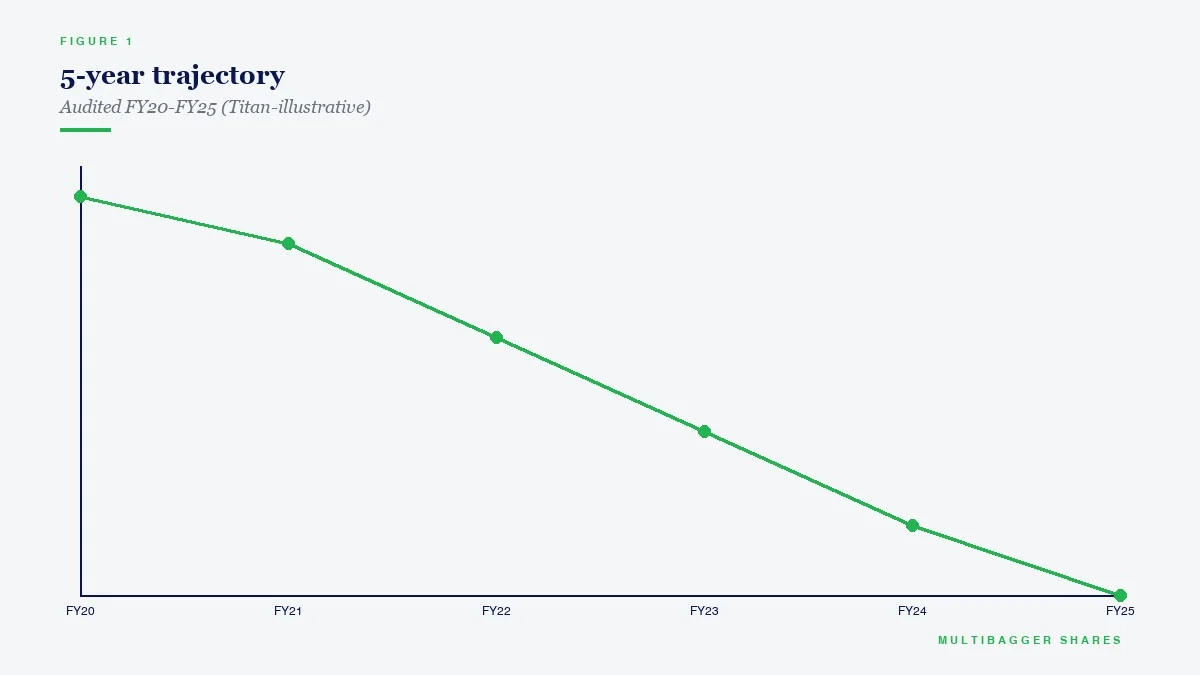
The fact that debtor days haven’t ballooned even as revenue grew from ₹39 Cr (FY2014) to ₹156 Cr (FY2025) — a 4x increase — proves that Titan Biotech is not chasing revenue by offering loose credit terms. Growth is quality growth, not credit-driven growth.
2. Inventory Days: Higher but Strategically Justified
Titan Biotech’s inventory days range from 97 (FY2014) to 242 (FY2025), which at first glance appears high. However, context is critical here. Titan Biotech manufactures gelatin, collagen peptides, and biotech-grade reagents — products that require long fermentation, processing, and quality testing cycles. The raw materials (animal bones, hides) go through multi-stage extraction processes that naturally require higher inventory holding periods compared to, say, an FMCG company.
More importantly, the increase in inventory days from FY2018 onwards coincides with Titan Biotech’s massive capacity expansion and diversification into higher-value products like collagen peptides and pharmaceutical-grade ingredients. The company has been deliberately building strategic inventory buffers to serve growing export demand and ensure uninterrupted supply to pharmaceutical clients where reliability is non-negotiable.
3. Creditor Days: Conservative Payment Discipline
Titan Biotech’s creditor days range between just 12 to 36 days over the decade. The company pays its suppliers quickly — typically within 2-4 weeks. While aggressive companies stretch supplier payments to 60-90 days to improve their own cash position, Titan Biotech chooses to pay promptly. This conservative approach builds strong supplier relationships, ensures raw material quality, and avoids supply chain disruptions — critical factors for a company supplying pharmaceutical-grade ingredients.
The Cash Conversion Cycle: Putting It All Together
Titan Biotech’s cash conversion cycle ranges from 128 days (FY2014) to 263 days (FY2020). The higher CCC reflects the nature of biotech manufacturing — long processing times mean cash is naturally tied up for longer. However, three critical observations make this fundamentally acceptable:
First, the company remains virtually debt-free despite the longer cycle. Borrowings fell from ₹25 Cr (FY2018) to just ₹3 Cr (FY2025) — proving the company funds its working capital needs from internal accruals, not bank loans.
Second, operating cash flow has been consistently positive and growing — ₹20-21 Cr annually in recent years with a CFO/OP ratio exceeding 85-103%. This means operating profits are converting into real cash despite the longer cycle.
Third, free cash flow turned positive from FY2019 onwards and has averaged ₹12 Cr in FY2024-2025, proving the company generates surplus cash even after funding capex and working capital.
CFO/Operating Profit Ratio: The Ultimate Working Capital Quality Test
The ratio of Cash Flow from Operations to Operating Profit is the gold standard test for working capital quality. A ratio above 70% means the company is efficiently converting its accounting profits into actual cash. Let us look at Titan Biotech’s track record:
— Aswath Damodaran, Professor of Finance, NYU Stern
Why Titan Biotech’s Working Capital Story Is Fundamentally Positive
Let us connect the dots across all the working capital metrics:
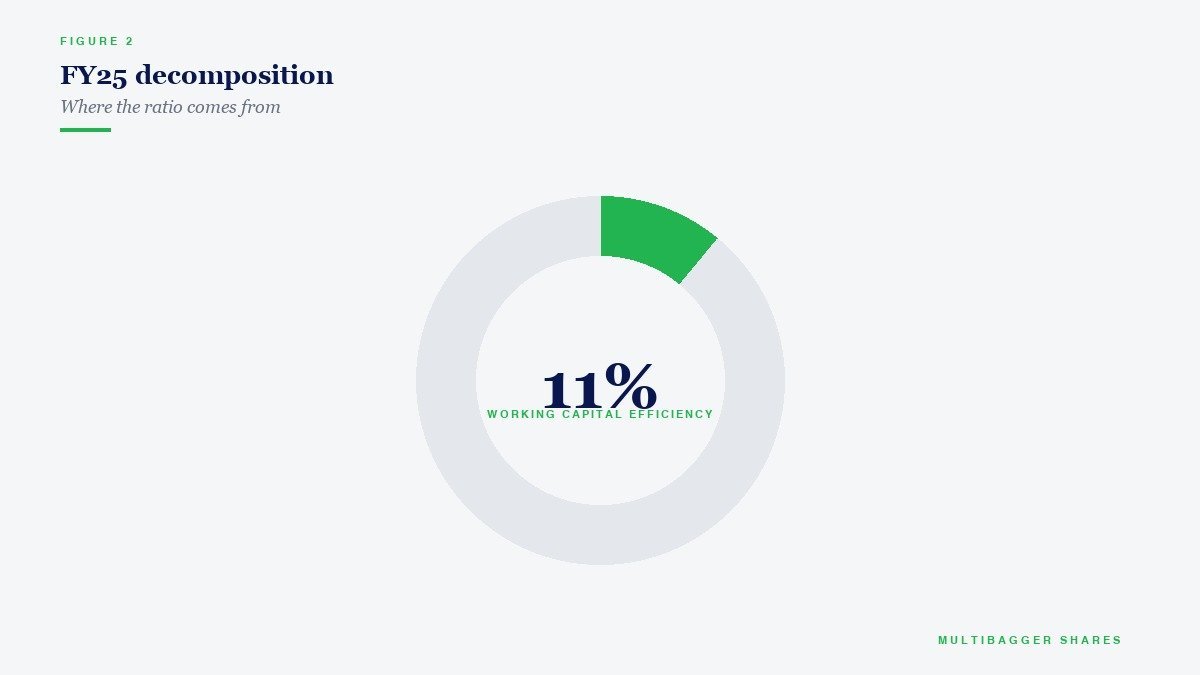
Debtor Days Tight at 42-44: Customers pay Titan Biotech within 6 weeks — a sign of product stickiness and strong relationships. The company is not giving away free credit to chase revenue.
Inventory Building Is Strategic: Higher inventory days reflect capacity expansion, product diversification (gelatin, collagen, pharmaceutical reagents), and the biological reality of fermentation-based manufacturing. This inventory is not dead stock — it is generating 16-21% operating margins.
Creditor Days Are Ethical: Paying suppliers in 15-25 days builds supply chain trust. This is a long-term competitive advantage — reliable raw material access at consistent quality.
Debt-Free Working Capital Funding: Despite a longer cash conversion cycle, Titan Biotech reduced borrowings from ₹25 Cr to just ₹3 Cr over seven years. The company funds its entire working capital cycle from internal cash generation — a sign of exceptional capital discipline.
CFO/OP Ratio Averaging 90%+: For the last four years, Titan Biotech has converted 85-103% of its operating profit into actual operating cash flow. This is the ultimate proof that working capital management is sound — profits are real, not stuck in receivables or unsold inventory.
The Investor’s Takeaway: What Working Capital Efficiency Reveals About Business Quality
Working capital efficiency is the X-ray of a company’s operational DNA. You can have spectacular revenue growth and impressive margins, but if the company is not collecting its receivables, turning over its inventory, and managing its payables efficiently, those profits remain on paper — never reaching the bank account.
Titan Biotech passes this test with distinction. Tight debtor days, strategically justified inventory, ethical supplier payments, falling debt, and near-perfect cash conversion — this is the operating cycle of a well-managed, owner-operated business that understands that cash is the oxygen of growth.
When a small-cap company grows its revenue 4x in a decade, eliminates its debt, generates ₹20 Cr+ in annual operating cash flow, and maintains 42-day debtor collections — you are looking at a business with genuine operational excellence, not just financial engineering.
Data Source: Screener.in — Live financial data for Titan Biotech Ltd (BSE: 524717) as of April 2026.
Disclaimer: This article is for educational and informational purposes only. It is not investment advice, and not a buy, sell, or hold recommendation on any stock mentioned, including Titan Biotech Limited. Equity markets carry risk; please do your own research or consult a qualified professional before making investment decisions.
