April 06, 2026
(Monday)
Today’s market snapshot — SENSEX: 73,073 | NIFTY 50: 22,718 | Titan Biotech (BSE: 524717): ₹529, Market Cap ₹2,187 Cr, ROCE 16.9%
The Biggest Lie in Investing: “Diversify, Diversify, Diversify”
Walk into any financial advisor’s office in India, and within five minutes you’ll hear the same sermon: “Don’t put all your eggs in one basket.” They’ll tell you to spread your money across 30 stocks, add some large-caps, throw in index funds, maybe some gold ETFs, and perhaps some international exposure for good measure. By the time they’re done, your portfolio looks like a mutual fund — except you’re paying more in brokerage and getting less in returns.
Here’s what they won’t tell you: the greatest wealth creators in market history — every single one of them — built their fortunes through concentration, not diversification.
Warren Buffett, the Oracle of Omaha and arguably the greatest investor who ever lived, has been crystal clear on this point throughout his career. His words should be etched into the mind of every serious investor:
“Wide diversification is only required when investors do not understand what they are doing.”
— Warren Buffett
Read that again. Buffett isn’t saying diversification is bad for everyone. He’s saying it’s a crutch for ignorance. If you don’t understand the businesses you own, then yes — spread your bets and pray. But if you’ve done the deep work, studied the financials forensically, understood the competitive dynamics, and know the management like the back of your hand — then concentrating your capital in your best ideas isn’t reckless. It’s rational.
The Legends Speak: What History’s Greatest Investors Actually Did
Let’s examine the evidence. Not theory. Not textbook models. The actual behaviour of investors who generated extraordinary, multi-decade returns.
Warren Buffett: 40% in One Stock
In the early Buffett Partnership years (1957-1969), Buffett routinely placed 25-40% of his entire fund into a single idea. His famous investment in American Express during the Salad Oil Scandal of 1963 consumed roughly 40% of the partnership’s assets. He knew the business deeply, understood the temporary nature of the crisis, and had the conviction to act decisively. The result? A massive multi-bagger that supercharged the partnership’s returns.
Buffett has also said:
“I cannot understand why an investor… elects to put money into a business that is his 20th favourite rather than simply adding that money to his top choices.”
— Warren Buffett, 1993 Shareholder Letter
Think about this profound logic. If your best idea has the highest probability of generating superior returns, why on earth would you dilute your capital into your 15th, 20th, or 30th best idea? The marginal stock in a diversified portfolio is almost always mediocre — it’s there for “safety,” not for returns.
Charlie Munger: Three Stocks Made Him a Billionaire
Buffett’s partner Charlie Munger built his personal fortune through extreme concentration. His investment in Berkshire Hathaway, Costco, and a handful of other deep-conviction positions made him a billionaire. Munger’s philosophy was devastatingly simple:
“The wise ones bet heavily when the world offers them that opportunity. They bet big when they have the odds. And the rest of the time, they don’t. It’s just that simple.”
— Charlie Munger
Rakesh Jhunjhunwala: India’s Big Bull Bet Big
In India, the late Rakesh Jhunjhunwala — often called India’s Warren Buffett — demonstrated the same principle spectacularly. His legendary investment in Titan Company was not a small, “diversified” position. He accumulated a massive, concentrated stake and held it for decades. That single conviction bet generated returns of over 10,000% and was the cornerstone of his ₹46,000 Cr+ portfolio. He didn’t achieve that by owning 50 stocks equally. He achieved it by knowing Titan deeply and betting big.
Mohnish Pabrai: The Dhandho Investor
Mohnish Pabrai, the Indian-American investor who has compounded capital at extraordinary rates, runs a concentrated portfolio of just 5-10 stocks. His “Dhandho” philosophy — derived from the Gujarati business community — is about finding situations with limited downside and massive upside, and then betting heavily:
“Heads I win, tails I don’t lose much. When the odds are overwhelmingly in your favour, bet big.”
— Mohnish Pabrai
Philip Fisher: The Anti-Diversification Pioneer
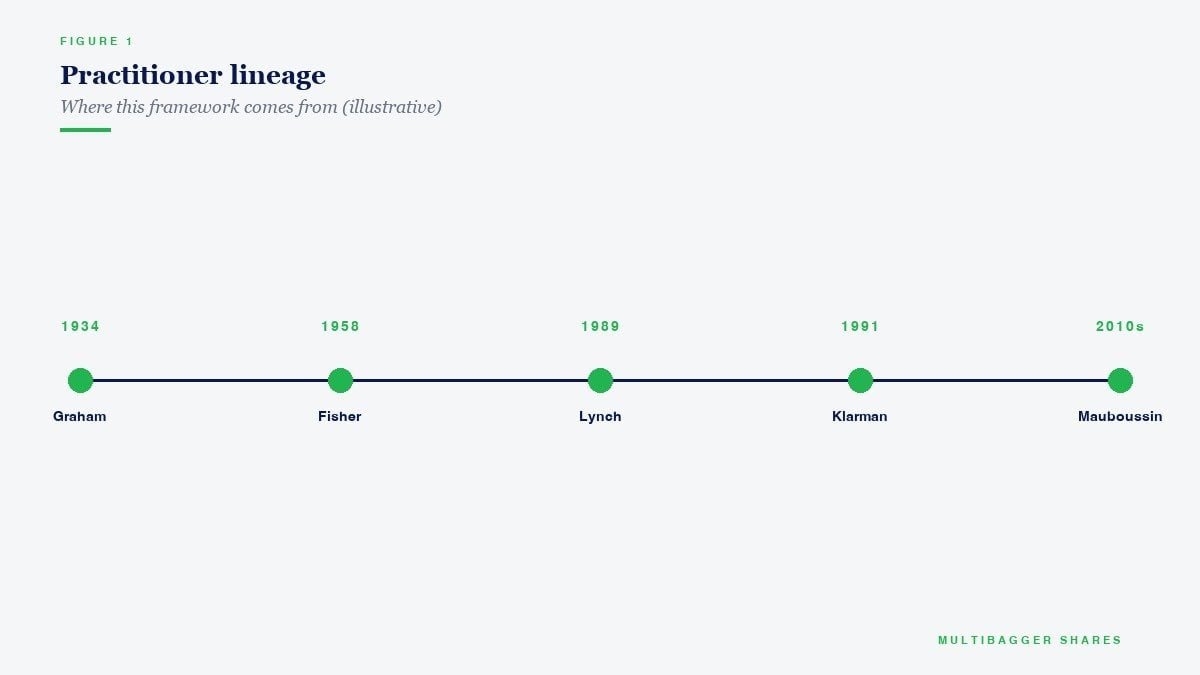
Even before Buffett, the legendary growth investor Philip Fisher argued passionately against over-diversification. In his timeless classic Common Stocks and Uncommon Profits, Fisher wrote:
“Owning stocks is like having children — don’t get involved with more than you can handle.”
— Philip Fisher
Fisher typically owned fewer than 10 stocks at any given time. His concentrated bet on Motorola in the 1950s — held for decades — generated returns that dwarfed any diversified portfolio of his era.
The Mathematics of Mediocrity: Why Diversification Destroys Returns
Let’s think about this mathematically. Imagine you’ve identified one truly exceptional business — a company with a durable competitive moat, honest management, strong ROCE (like Titan Biotech’s 16.9%), growing revenues, and a long runway ahead. You’re deeply confident in your analysis.
Scenario A — Concentrated: You invest ₹10 Lakh into this one conviction bet. The stock returns 500% over 5 years. Your ₹10 Lakh becomes ₹60 Lakh.
Scenario B — Diversified: You invest only ₹50,000 into this stock (because your advisor told you to “spread risk”) and put the remaining ₹9.5 Lakh into 19 other “safe” stocks. The conviction bet still returns 500%, but the other 19 stocks average a market-matching 12% CAGR. Result? Your portfolio grows to roughly ₹19.7 Lakh.
The diversified portfolio gave you ₹19.7 Lakh. The concentrated one gave you ₹60 Lakh. That’s the price of diversification — ₹40 Lakh in foregone wealth, sacrificed at the altar of false safety.
The Real Risk: Not Knowing What You Own
The conventional argument for diversification is “risk reduction.” But this confuses two very different types of risk:
1. Risk from ignorance — You don’t understand the businesses you own. In this case, yes, diversification provides some protection. But the real solution is: do better research.
2. Risk from volatility — Your stocks fluctuate in price. This is not risk — this is opportunity. As Buffett says, the market is there to serve you, not to instruct you. Price drops in fundamentally strong businesses are gifts, not dangers.
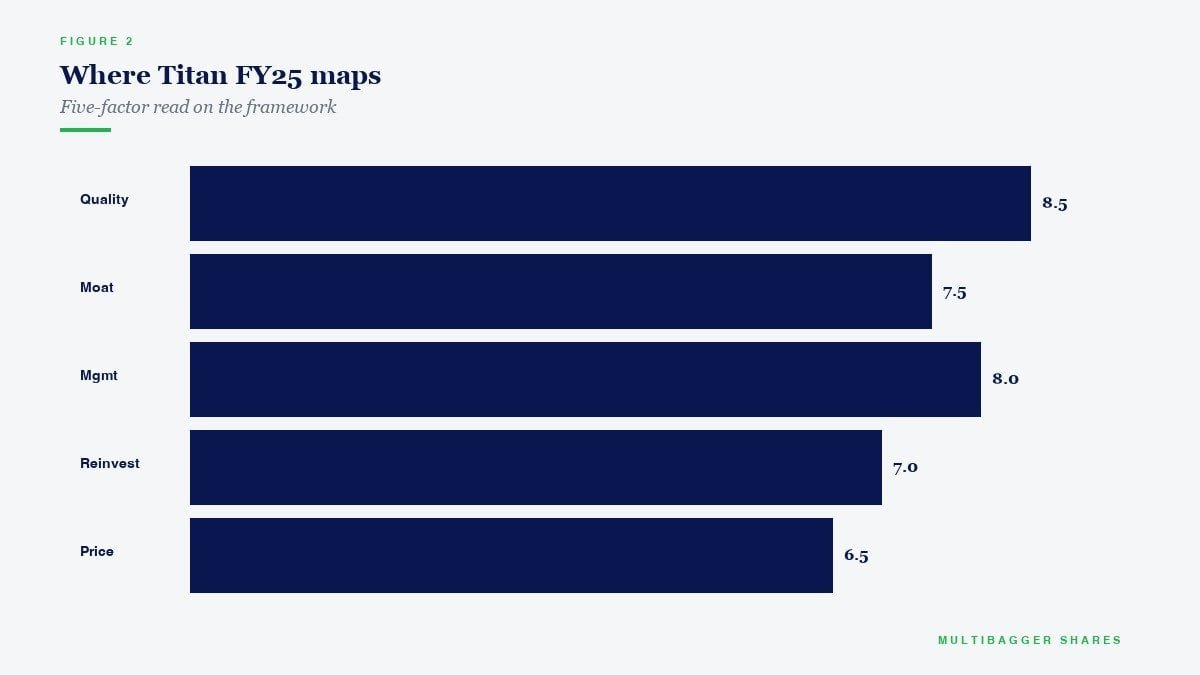
At Multibagger Shares, we’ve developed a rigorous 95-factor evaluation framework that examines every dimension of a business — from forensic accounting red flags to management quality, competitive moats, capital efficiency, growth runway, and survival probability. When you’ve subjected a company to this level of scrutiny, you don’t need 30 stocks for protection. Your protection comes from the depth of your understanding.
Consider Titan Biotech (BSE: 524717) — currently trading at ₹529 with a market cap of ₹2,187 Cr. This company scores exceptionally on our 95-factor framework with ROCE of 16.9% and ROE of 15.0%. When you understand a business at this depth, concentration isn’t gambling — it’s the most rational capital allocation strategy available.
What the Academic Evidence Actually Shows
Proponents of diversification love to cite Modern Portfolio Theory (MPT) and the Efficient Market Hypothesis (EMH). But consider what the actual evidence shows:
Study after study has shown that the best-performing fund managers run concentrated portfolios. A landmark research paper by Kacperczyk, Sialm, and Zheng found that mutual fund managers who deviated most from index-like diversification — i.e., the most concentrated managers — delivered the highest alpha. The “closet indexers” — those who diversified broadly — delivered returns barely distinguishable from the index, minus fees.
Joel Greenblatt, the legendary investor behind Gotham Capital (which returned 50% annualised for a decade), put it bluntly:
“Choosing individual stocks without any idea of what you’re looking for is like running through a dynamite factory with a burning match. You may live, but you’re still an idiot.”
— Joel Greenblatt
The point isn’t to buy one random stock and pray. The point is to do the work — deep, forensic, 95-factor-level work — and then have the courage to back your conviction with meaningful capital.
The Multibagger Shares Philosophy: 5-10 Deep Conviction Bets
Our approach at Multibagger Shares is clear and unapologetic:
Own 5-10 deeply researched, high-conviction stocks. Know each one inside out. Monitor them quarterly. And have the patience to hold for years.
This is not reckless. This is how Buffett, Munger, Jhunjhunwala, Pabrai, Damani, and every wealth-creating legend actually invested. They didn’t diversify into 50 names. They didn’t hide in index funds. They didn’t allocate to gold “for safety.” They found extraordinary businesses, understood them deeply, and bet big.
As Seth Klarman, the legendary value investor who manages over $30 billion, warns:
“Diversification is a hedge for ignorance. It makes little sense for those who know what they’re doing.”
— Seth Klarman
Your Action Plan: From Scattered to Concentrated
If you currently hold 20, 30, or 50 stocks, ask yourself honestly: How many of these do I truly understand? How many have I analysed with the depth required to justify holding them?
For most investors, the honest answer is: 3-5 at most. The rest are filler — stocks bought on tips, media hype, or “diversification” logic. These filler stocks are not protecting you. They are diluting your returns and giving you a false sense of security.
The path to wealth creation is not wider — it’s deeper. Study fewer companies, but study them with the intensity of someone who is staking their financial future on their analysis. Because that’s exactly what you’re doing.
To build this analytical depth, we encourage you to follow our comprehensive Value Investing Course: Watch the full course on YouTube
Remember: 9 out of 10 individual traders in the equity Futures & Options segment incurred net losses according to a SEBI study. F&O trading is essentially gambling. Instead of gambling with derivatives or diluting returns through over-diversification, focus on what actually creates wealth — deep understanding and concentrated conviction.
📢 Join Our Telegram Channel
Get daily value investing lessons, stock analysis & Titan Biotech updates — delivered straight to your phone!
✈️ Join @longtermequityy on Telegram
🔔 Free • No spam • Value investing insights daily
Disclaimer: This article is for educational and informational purposes only. It is not investment advice, and not a buy, sell, or hold recommendation on any stock mentioned, including Titan Biotech Limited. Equity markets carry risk; please do your own research or consult a qualified professional before making investment decisions.
