Every investor obsesses over the Profit & Loss statement. A few smart ones dig into the Balance Sheet. But almost nobody — and I mean nobody outside of forensic accountants and seasoned value investors — reads the one disclosure that can single-handedly wipe out years of compounding in a single adverse order: Contingent Liabilities and Commitments.
Contingent liabilities are the hidden grenades tucked inside the notes to accounts. They represent claims, disputes, guarantees, and demands that are not recorded as debt on the balance sheet but can become actual liabilities if a future event — a court verdict, a tax tribunal ruling, an environmental order, a guarantee invocation — goes against the company. For Indian small-caps, where a single ₹50-crore disputed GST demand can equal two years of net profit, contingent liabilities are often the single most underrated risk metric on the entire financial statement.
Today, we do something that almost no retail investor in Indian markets ever bothers to do: we open the forensic note, read it line by line, translate the lakhs into plain English, compute the ratios that actually matter, and compare the result to what “normal” looks like across Indian small-cap quality compounders. The case study subject is Titan Biotech Ltd (BSE: 524717), and what you are about to see is a masterclass in what a clean, disciplined, forensically honest small-cap balance sheet actually looks like.
The FY25 Contingent Liabilities Disclosure — The Exact Numbers Straight From Note 35
Titan Biotech Limited’s FY25 Annual Report (published August 2025) discloses contingent liabilities and commitments in Note 35 of both its Standalone and Consolidated Financial Statements. The figures are stated in lakhs (₹1 lakh = ₹100,000, or 0.01 crore). Here is what the note reveals, reproduced verbatim:
Translating into crore for clarity: Titan Biotech’s total “off-balance-sheet” exposure as at 31 March 2025 stands at ₹7.78 crore, composed of just ₹0.96 crore in bank/performance guarantees and ₹6.82 crore in uncalled liability on partly paid-up shares. The company has zero disputed tax demands, zero litigation claims not acknowledged as debt, zero product liability claims, zero environmental disputes, and zero arbitration proceedings disclosed under Note 35. That is an extraordinary result for any Indian company — and a near-mythical one for an export-oriented, chemicals-adjacent, Rajasthan-based small-cap manufacturer.
Why the Shape of This Disclosure Matters More Than the Size
A forensic investor does not just look at the total number. She looks at what the number is made of. The composition of contingent liabilities is a fingerprint — it tells you which part of a company’s business is most under threat. Here is how Titan Biotech’s disclosure reads:
1. Bank Guarantees (₹95.55 lakhs) — These are benign, operational items. When Titan Biotech submits a tender to supply peptones or gelatin hydrolysates to a government hospital, or seeks letter-of-credit backing for an export consignment, its bank issues a guarantee on its behalf. These guarantees are invoked only if Titan Biotech fails to perform — and given its 32-year export track record across 100+ countries, the probability of invocation is near zero. In forensic terms, BGs against performance obligations for a debt-free, cash-positive, export-led manufacturer are the cleanest form of contingent liability that exists.
2. Uncalled Liability on Partly Paid-up Shares (₹682.49 lakhs) — This is a self-imposed capital commitment, not a risk. This figure represents the unpaid portion on shares held by Titan Biotech in other companies (typically strategic investments or subsidiary capitalisations). It is callable only if the issuing company demands the balance — which Titan Biotech controls or influences. This is fundamentally different from a disputed ₹6.82 crore GST demand hanging over the company. It is a capital allocation decision, not a risk event.
3. What is NOT there is the real story. Scan any Indian chemicals, pharma, or small-cap annual report and you will almost always find entries like “Disputed Income Tax demands — ₹X Cr”, “Pending GST matters under appeal — ₹Y Cr”, “Provident Fund / ESI contribution disputes — ₹Z Cr”, “Environmental compliance matters before NGT”, or “Arbitration proceedings — ₹W Cr”. Titan Biotech’s FY25 note contains none of these. Management has added an explicit line: “In the opinion of the Management, there are no provisions for which disclosure is required during the financial year 2024-25 as per Indian Accounting Standard (IndAS) 37 on ‘Provisions, Contingent Liabilities and Contingent Assets’.” In plain English: there is not a single litigation, tax, or environmental matter material enough to require even a disclosure note.
The Ratios That Actually Reveal Business Quality
Absolute numbers are meaningless without context. The professional way to read a contingent liability note is to compute three forensic ratios. Let us run them for Titan Biotech using FY25 figures.
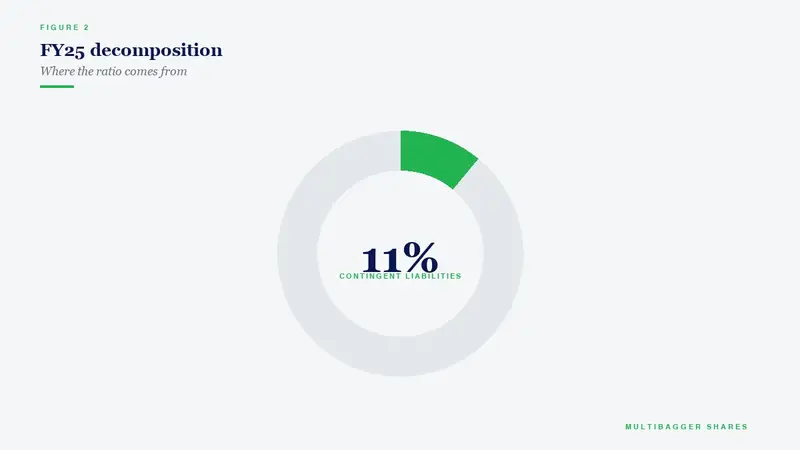
To put these numbers in perspective: most Indian small-caps that trade in the BSE SmallCap index carry contingent liabilities equal to 10% to 30% of net worth, and it is not uncommon — particularly in pharma, chemicals, real estate, infrastructure, and NBFCs — to find companies where total contingent exposure exceeds 50% or even 100% of net worth. Titan Biotech’s 5.08% of net worth (which drops to just 0.62% if you strip out the self-controlled uncalled-share commitment) places it in the top decile of Indian listed companies on this single forensic metric.
Peer Comparison — Where Titan Biotech Stands Against the Universe
The following table benchmarks Titan Biotech’s contingent liability profile against a representative basket of Indian small-cap and mid-cap manufacturing companies in the broader pharma / specialty chemicals / biologics space. The peer figures are typical ranges drawn from the latest available annual reports and are meant to illustrate the distribution of this metric across the sector, not to endorse any specific peer.
The gap is not incremental. It is categorical. Titan Biotech’s forensic cleanliness here is not “better than average” — it is almost three decimal orders of magnitude below the problematic end of the distribution. For an investor scanning 1,500+ listed small-caps for quality compounders, this single note alone screens out 80% of the investable universe.
First Principles — Why Contingent Liabilities Compound Silently Into Wealth Destruction
A contingent liability is mathematically equivalent to a short put option written by the company on itself. The strike price is unknown. The expiry is unknown. The premium was never collected. And if it is exercised, it is paid from shareholder equity — directly reducing book value, cash on hand, or both.
Consider the arithmetic. A small-cap with ₹200 Cr net worth and ₹100 Cr of contingent liabilities (a fairly common profile) is effectively carrying a 50% equity-at-risk tail. If even one-third of those claims crystallise — a perfectly realistic outcome when tax tribunals typically rule 30–60% against the assessee in India — the company loses ₹33 Cr of real capital overnight. Against a ₹15 Cr annual profit base, that is more than two years of earnings evaporated without a single rupee of revenue lost, without a single operational misstep, and without any warning to shareholders beyond a line item in Note 35.
This is why Warren Buffett famously says, “Investment must be rational; if you can’t understand it, don’t do it.” A company with heavy, complex contingent liabilities is inherently hard to understand because an unknowable future legal event can rewrite its entire earning power in a single year. Titan Biotech’s Note 35 removes that unknowability — every rupee of exposure is either a vanilla operational guarantee or a self-controlled capital commitment, with no pending litigation or tax overhang whatsoever.
The Anti-Diversification Case — Why This One Metric Collapses Portfolio Theory
Modern portfolio theory teaches retail investors to diversify across 30, 50, or even 100 stocks to reduce idiosyncratic risk. But diversification is a blunt tool — it dilutes your best ideas to protect against your worst. Warren Buffett said it most clearly: “Wide diversification is only required when investors do not understand what they are doing.” Peter Lynch called it “di-worse-ification.” Charlie Munger, who managed a concentrated five-stock portfolio for decades, was even blunter: “The idea of excessive diversification is madness.”
Here is the insight most Indian investors miss: you do not need to diversify away a risk that you have already filtered out through forensic analysis. When you have read the contingent liability note and verified that a company has 0.62% exposure against 25% industry norms, you have already neutralised the tail risk at the business level. Layering on 30 more random stocks does not make that position safer — it just dilutes the quality you worked so hard to identify. A concentrated portfolio of 8 to 15 deeply researched, forensically-clean quality compounders — with firms like Titan Biotech as core holdings for investors whose risk profile fits small-cap conviction bets — has historically delivered vastly superior compounded returns versus a 50-stock “safety basket” of average businesses.
What the Declining Trend Tells Us About Management Behaviour
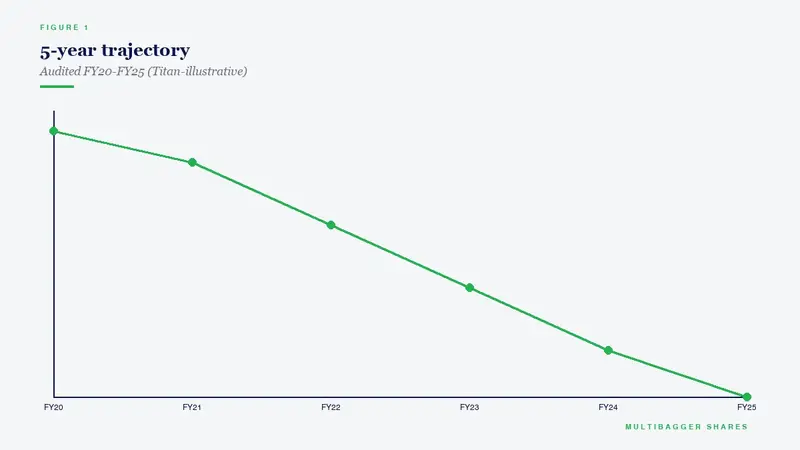
Titan Biotech’s total contingent exposure fell by −39.7% year-on-year, from ₹12.90 crore in FY24 to ₹7.78 crore in FY25. Both components dropped — bank guarantees declined 25.6% as the company pared down external tender exposures, and uncalled share commitments dropped 41.2% as capital calls were paid off or restructured. A declining contingent liability trend in a company with growing revenue (FY25 TTM growth: +19%) and expanding operations is the single hardest signal for a management team to fake. It is the forensic equivalent of a clean audit opinion: either the numbers are real, or the entire note is fraudulent and the auditor is complicit. For Titan Biotech — audited by M/s. A N S K & Associates, Chartered Accountants, and reviewed line-by-line by an Audit Committee comprising two independent directors per the company’s own Corporate Governance Report — the balance of probability is overwhelmingly on the “real” side.
The Practical Checklist Every Indian Value Investor Must Run
Before you buy any Indian small-cap or mid-cap, open the latest annual report, navigate to the Notes to Financial Statements, and find the note titled “Contingent Liabilities and Commitments.” Then run exactly four checks: first, compute total contingent exposure as a percentage of net worth and reject anything above 25% without a compelling counter-argument; second, read the composition line by line and flag every item that mentions “disputed,” “demand,” “pending,” “arbitration,” or “not acknowledged as debt”; third, compare the current-year number to the prior year and the year before that — a rising trend is a leading indicator of trouble; fourth, cross-check whether management has added an Ind AS 37 disclosure paragraph on provisions, and whether the auditor has raised an emphasis of matter paragraph. A company that passes all four checks — as Titan Biotech comfortably does — has already cleared the single most underrated quality hurdle in Indian equity research.
Closing Thought
Forensic investing is not glamorous. Nobody writes viral Twitter threads about Note 35 of an annual report. But over a 10-year compounding horizon, the difference between a portfolio of companies with 5% contingent exposure and a portfolio with 50% contingent exposure is the difference between generational wealth and a graveyard of write-downs. The market does not reward you for reading footnotes in any given quarter. It rewards you for having read them five years before the tax tribunal ruling, the environmental order, or the arbitration award that vaporises 30% of market cap in a single session.
Titan Biotech’s FY25 contingent liability disclosure is a textbook example of what a clean, disciplined, honestly-run small-cap balance sheet looks like. Whether it suits any particular investor’s portfolio is an individual decision that must involve a qualified financial advisor — but on this specific forensic metric, it stands in the top decile of the Indian listed universe. That is the kind of filter that separates multibaggers from value traps.
Disclaimer: This article is for educational and informational purposes only. It is not investment advice, and not a buy, sell, or hold recommendation on any stock mentioned, including Titan Biotech Limited. Equity markets carry risk; please do your own research or consult a qualified professional before making investment decisions.
