18 April 2026
(Saturday)
Most Indian investors read the headline profit, glance at the EPS, and close the annual report. They never scroll to Note 38 — or whichever note the company uses for “Segment Information” under Ind AS 108. And in doing so, they miss the single most powerful X-ray of a business’s true quality that every listed Indian company is legally forced to disclose.
Segment reporting is the section where a company is required to break its consolidated revenue, profit, assets and liabilities into the distinct business and geographic slices its Chief Operating Decision Maker (CODM) actually uses to run the company. Done honestly, it tells you exactly which part of the business is subsidising which, where the real moat lives, and whether a seemingly diversified conglomerate is secretly a single-product company wearing a wig. Done dishonestly — and we will show you the forensic tests — it gives you an early-warning red flag worth crores.
As on 17 April 2026, the SENSEX closed at 78,493.54 (+0.65%) and the NIFTY 50 at 24,353.55 (+0.65%), with quality small-caps once again outperforming the broader averages. In a market where narrative outruns numbers every week, the investors who actually pull up the segment note are the ones who stay on the right side of every major earnings surprise. This post teaches you exactly how to do that — in under 20 minutes of annual-report reading per company.
What Ind AS 108 Actually Requires
Ind AS 108 — India’s segment reporting standard, fully aligned with IFRS 8 — forces every listed company to disclose, for each “operating segment”:
- External revenue and inter-segment revenue
- Segment result (usually operating profit before interest and unallocated corporate expenses)
- Segment assets and segment liabilities
- Depreciation, amortisation and other material non-cash items allocated to that segment
- Capital expenditure made during the year inside each segment
- A reconciliation from the sum of segment numbers to the consolidated P&L and balance sheet totals
In addition, companies must disclose geographic segments (India vs. rest of the world, or country-by-country where material) and a list of major customers who individually contribute more than 10% of revenue. These four data points — segment revenue mix, segment profitability mix, geographic mix and customer concentration — form the skeleton of every professional bottom-up analyst’s first 30 minutes with a new company.
Why Retail Investors Skip This — And Lose Money Doing So
Segment notes are usually buried as Note 35, 38 or 42 of the consolidated financial statements, printed in 8-point font, and visually indistinguishable from boilerplate. Three habits keep 90% of retail investors from ever reading them:
First, “the consolidated number is enough” — a myth. A 22% consolidated operating margin can hide a 40% software business cross-subsidising a 4% steel-trading division that is silently destroying capital. Ignoring the segment view is like accepting a team’s average salary without asking who is a partner and who is a trainee.
Second, “segments are too technical” — also false. Reading a segment table takes arithmetic no harder than dividing a restaurant bill. The patterns it reveals, on the other hand, are devastatingly useful: declining margins in the largest segment, growing share of a low-quality segment, or capex pouring into a segment that already earns sub-cost-of-capital returns.
Third, “management commentary says the same thing” — the single most expensive assumption on Dalal Street. Management commentary is marketing. Segment disclosures are audited. When the two diverge, the auditor’s numbers always win.
The 7-Point Forensic Test You Can Run in 20 Minutes
Open any Indian annual report, find the segment note, and work through these seven tests. We recommend doing this on at least five years of segment data — one year tells you the snapshot, five years tell you the trajectory.
1. Is the Segment Mix Changing in a Good Direction?
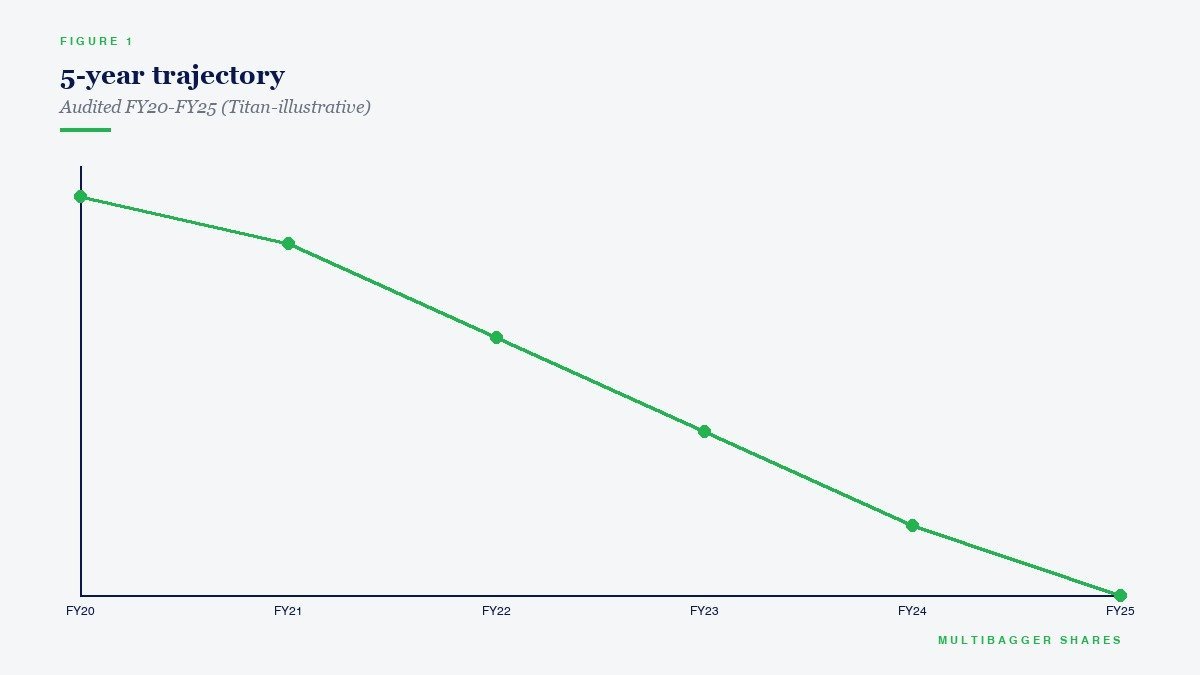
Compute each segment’s share of total revenue for each of the last 5 years. A wealth-creating business is usually shifting its mix toward higher-margin, higher-ROCE segments — not away from them. If the biggest share of the mix is slowly drifting into a low-margin commodity segment, the consolidated margin will silently erode over the next 3–5 years even if the company “keeps growing”.
Consider Titan Biotech Ltd (BSE 524717), trading at ₹475 as of 17 April 2026 with a market capitalisation of ₹1,961 crore. A reader of Titan Biotech’s segment and product-category disclosures sees a business that has steadily shifted its mix toward higher-value biotech inputs — peptones, yeast extracts, gelatin and specialty biologicals serving pharmaceutical, nutraceutical and food companies across 100+ countries. That is precisely the “mix migration toward quality” signal Ind AS 108 is designed to surface, and it is one of the reasons thoughtful long-term investors study this small-cap compounder with patience rather than chasing it as a trade.
2. Which Segment Earns What Margin?
Divide each segment’s result by each segment’s external revenue to get the segment operating margin. Then rank them. Two red flags appear almost immediately: (a) one segment earning aggressive margins while another bleeds — where is the cross-subsidy going, and is it sustainable, and (b) the company’s most-discussed growth segment actually earning lower margins than the legacy segment it is replacing. If growth is margin-dilutive, the “re-rating story” management tells investors is fragile.
3. Which Segment Consumes Capital — And Which Releases It?
Compute segment ROCE as segment result ÷ segment assets. This single ratio, tracked for five years, distinguishes a true quality compounder from a narrative stock. Segments with a falling ROCE despite rising capital employed are where shareholder money is quietly being destroyed. Segments with stable or rising ROCE on a small asset base are where the moat lives and where incremental capex should be directed.
4. Where Is the Capex Actually Going?
Ind AS 108 requires companies to disclose segment-wise capital expenditure. Match it against segment revenue growth and segment ROCE. A management that keeps pouring capex into the lowest-ROCE segment — because it is the “legacy” business the board can’t walk away from politically — is a management that quietly destroys capital every year. The segment capex disclosure is where you catch this pattern three years before it shows up in consolidated ROCE.
5. How Much of the Revenue Is Geographically Concentrated?
Pull up the geographic segment table. Companies with revenue from 20+ countries have structurally lower volatility than those dependent on 1–2 markets. In our reference example, Titan Biotech’s disclosed exports spread across 100+ countries — roughly a third of its revenue earned from outside India — is exactly the kind of geographic diversification that reduces single-country risk and protects the business through rupee swings and regional slowdowns. This is visible in the segment note, not in the price chart.
6. Are There Customers Contributing More Than 10%?
Ind AS 108 requires disclosure of any single external customer whose revenue exceeds 10% of total revenue. If a 45% gross-margin story is actually supported by one customer who could walk away, the “margin story” is not a moat — it is a hostage situation. Many mid-cap IT services and contract manufacturers have valuations that assume no customer concentration; the segment note tells you the truth in one sentence.
7. Does the Segment Reconciliation Add Up Cleanly?
At the bottom of every Ind AS 108 note, the company reconciles segment revenue, segment result, segment assets and segment liabilities to the consolidated numbers. Look at “unallocated corporate expenses”, “unallocated assets” and “eliminations”. Large and growing unallocated expenses — especially relative to consolidated profits — often hide discretionary promoter perks, legal exposures, or loss-making early-stage ventures that management does not want to name. A clean reconciliation with small, stable unallocated items is a governance green flag.
Three Segment-Reporting Red Flags That Have Destroyed Indian Investor Wealth
Red flag #1: Sudden segment re-definition. A company that quietly merges two segments — or splits one into three — in a year when the “loser” segment would have looked ugly on its own is almost always hiding something. Ind AS 108 allows operating-segment definitions to evolve with the business, but every change requires a restated comparative. If the comparative doesn’t add up cleanly, assume the worst.
Red flag #2: Segment revenue rising but segment assets rising faster. This is the classic capital-destruction pattern. Capex is outrunning productivity. Over 3–5 years, segment ROCE collapses even though the top line looks healthy. Indian capex-heavy cyclicals that destroyed two decades of investor wealth all show this exact pattern in their segment tables in the years before the crash.
Red flag #3: Segment-level inter-company receivables ballooning. Hidden in the segment note of many group companies is a line where one segment “sells” to another at inflated prices, parking value in the segment that is slated for IPO or for promoter benefit. If inter-segment revenue is a high fraction of external revenue and is rising, treat it as a corporate governance yellow card until the annual report gives a clear non-arm’s-length explanation.
How This Fits the Value Investing Discipline
Benjamin Graham asked: “What would an intelligent businessman pay for this entire enterprise?” The segment note is the answer’s raw material. You cannot value a business you cannot decompose. And you cannot decompose a business without the disclosures Ind AS 108 forces every listed Indian company to publish — for free — every single year.
This is why, at Multibagger Shares, our research process always begins with 5 years of segment data before we touch a single valuation metric. It is also why we prefer quiet, operationally disciplined businesses where the segment note reads the same way every year — rising external revenue, stable mix, clean reconciliation, modest unallocated expenses. Titan Biotech is one such example we have tracked patiently; its product-category and geographic disclosures have, over a decade, narrated a story of steady shift toward higher-value biologicals and disciplined capital deployment, which is what long-term compounding looks like before the market recognises it.
A 90-Second Drill You Can Do Tonight
Pick any Indian listed company you own. Open the latest consolidated annual report. Ctrl-F for “Segment” or “Operating segment” or “Ind AS 108”. In 90 seconds, write down four things: (1) the segment with the highest revenue share, (2) the segment with the highest operating margin, (3) the segment absorbing the most capex, (4) whether any single customer is >10% of revenue. If (1), (2) and (3) are the same segment — you own a focused quality business. If they are three different segments — you own a conglomerate, and you need to ask whether the capex is chasing the highest-margin segment or the legacy segment. If you cannot answer this in 90 seconds because the disclosure is vague or missing — that is the answer.
Avoid the F&O Shortcut Trap
A SEBI study has shown that 9 out of 10 individual traders in the equity Futures & Options segment incurred net losses. F&O trading is, for the vast majority of participants, indistinguishable from gambling. The compounding power of careful segment analysis, position sizing grounded in cash flows, and long holding periods is why Warren Buffett, Charlie Munger, Radhakishan Damani and Rakesh Jhunjhunwala never needed a single F&O contract to build generational wealth. The segment note is one of the quiet, slow, unglamorous tools they used instead.
Conclusion
Segment reporting is the single most under-used forensic disclosure in Indian annual reports. It is audited, it is free, and it is legally enforced. If you learn to read it — five years of history, seven forensic tests, three classic red flags — you will already be ahead of the overwhelming majority of retail investors who stop at the headline EPS. Combine that skill with discipline, patience and a focus on quality Indian small-caps such as Titan Biotech Ltd, and you are doing exactly what Graham, Buffett, Munger and Damani did at your age: paying attention to the numbers the crowd ignores, long before the crowd wakes up.
You can learn this systematically — free — in our structured value investing course on YouTube: Multibagger Shares — Value Investing Course Playlist. Each episode is text-friendly, India-focused, and built around the same principles we apply in our research.
📢 Join Our Telegram Channel
Get daily value investing lessons, stock analysis & Titan Biotech updates — delivered straight to your phone!
✈️ Join @longtermequityy on Telegram
🔔 Free • No spam • Value investing insights daily
Disclaimer: This article is for educational and informational purposes only. It is not investment advice, and not a buy, sell, or hold recommendation on any stock mentioned, including Titan Biotech Limited. Equity markets carry risk; please do your own research or consult a qualified professional before making investment decisions.
