In the world of fundamental analysis, most investors obsess over revenue growth, profit margins, and return ratios. These are important metrics, no doubt. But there is one deeply revealing metric that almost nobody talks about — the effective tax rate. It is the single most transparent window into whether a company’s reported profits are genuine, sustainable, and free from accounting manipulation.
Today, we are going to conduct a deep-dive analysis of Titan Biotech Ltd (BSE: 524717) through the lens of tax rate efficiency — examining what its decade-long tax rate trajectory reveals about accounting quality, governance integrity, and earnings predictability.
As Warren Buffett once said: “You only find out who is swimming naked when the tide goes out.” The effective tax rate is one of those rare metrics that tells you whether a company is wearing clothes — even when the tide is high.
What Is the Effective Tax Rate and Why Should Investors Care?
The effective tax rate (ETR) is simply the percentage of profit before tax (PBT) that a company actually pays as income tax. It is calculated as:
Effective Tax Rate = (Tax Expense ÷ Profit Before Tax) × 100
Why does this matter? Because the ETR reveals several critical truths about a business:
First, it reveals accounting honesty. A company with wildly fluctuating tax rates — swinging between 5% and 40% across years — is likely using aggressive accounting tactics. Deferred tax assets, write-offs, tax holidays, and special exemptions can artificially inflate or deflate reported profits. A stable, predictable ETR close to the statutory rate signals that the company is reporting profits as they truly are — without window-dressing.
Second, it reveals governance quality. Companies that promptly adopt new tax regimes (like India’s 2019 corporate tax reduction) demonstrate forward-thinking management focused on shareholder benefit. Companies that delay or use complex structures to game the system often have deeper governance issues.
Third, it reveals earnings quality. When the tax rate is consistent quarter after quarter, year after year, it means the earnings stream is genuine. Tax authorities are the ultimate auditors — they verify every rupee of profit. If a company consistently pays 25% of its PBT as tax, you can be confident that those profits are real.
Titan Biotech’s Tax Rate: A Decade of Transparency
Let us examine Titan Biotech’s effective tax rate over the last 11 years, using data directly from Screener.in:
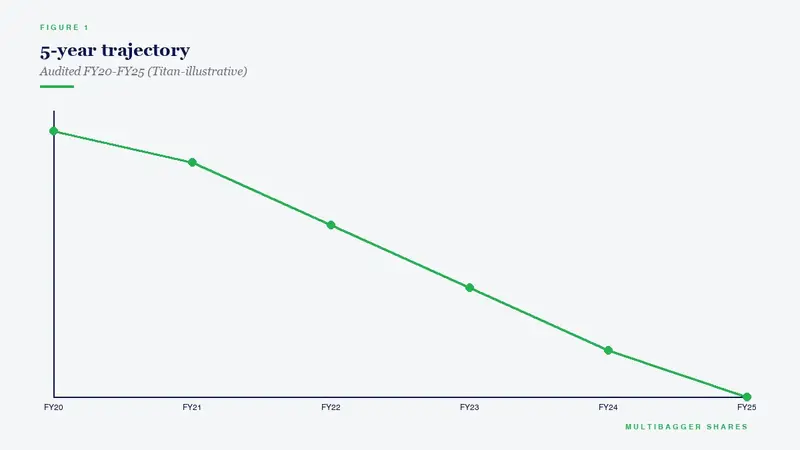
The pattern is unmistakable. From FY2015 to FY2018, Titan Biotech paid the standard Indian corporate tax rate of 33-35%. When the Government of India announced the historic corporate tax cut in September 2019 — reducing the base rate from approximately 30% (plus surcharges) to 25.17% under Section 115BAA — Titan Biotech was among the companies that adopted the new regime promptly. From FY2020 onwards, the effective tax rate has been locked at 25-26% for six consecutive years.
This is not a trivial observation. This consistency tells us three important things about Titan Biotech as a business.
Lesson 1: No Tax Shelters, No Gimmicks — Pure Earnings
Many Indian companies — especially in the small-cap and mid-cap space — show wildly fluctuating effective tax rates. You might see a company report a tax rate of 8% one year and 35% the next. What causes this?
Common culprits include: deferred tax asset creation and reversal, tax holidays from SEZ or STPI units, capital gains from property or investment sales being taxed at different rates, losses carried forward from subsidiaries, and aggressive tax planning through related party structures.
Titan Biotech shows none of these patterns. The company has no special tax holidays, no SEZ benefits being phased in or out, no complex subsidiary structures creating deferred tax volatility. What you see is what you get — the company earns genuine operating profits from its core business of manufacturing biological peptones, dehydrated culture media, and biotech ingredients, and pays the standard statutory tax rate on those profits.
This is what Benjamin Graham called “transparency of earnings.” When the tax rate is stable and predictable, it means there are no hidden adjustments distorting the income statement. The net profit you see at the bottom of the P&L is as close to economic reality as financial statements can get.
Lesson 2: Quarterly Consistency — The Ultimate Litmus Test
Annual tax rates can sometimes mask quarterly volatility. A company might pay zero tax in Q1 and 50% in Q4, averaging out to 25% for the year. This kind of quarterly volatility in tax rates often signals earnings manipulation — management might be timing revenue recognition or expense booking to manage quarterly earnings.
Let us examine Titan Biotech’s quarterly tax rates over the last 13 quarters:
Look at the remarkable consistency. Across 13 consecutive quarters, Titan Biotech’s effective tax rate has ranged between 23.73% and 27.04% — a variance of just 3.3 percentage points. The average quarterly ETR is approximately 25.2%, which is almost exactly the statutory rate of 25.17% under Section 115BAA.
This kind of quarter-to-quarter tax rate stability is extraordinarily rare in Indian small-caps. It tells us that management is not playing games with provisional tax calculations, is not timing deductions or write-offs to manage earnings, and is reporting profits honestly and consistently.
Lesson 3: How Titan Biotech Compares to Peers — Tax Rate Benchmarking
To truly understand whether Titan Biotech’s tax rate pattern is exceptional, we must compare it against similar companies in the specialty chemicals and biotech ingredients space. Here is how Titan Biotech stacks up against three prominent peers:
The comparison reveals something striking. While all four companies operate in the post-2019 tax regime and show broadly similar tax rates, Titan Biotech has the most consistent and the lowest average ETR at exactly 25.0% with zero variance over four years. The peers show average rates 1-2 percentage points higher, with small but meaningful year-to-year fluctuations.
Why does Advanced Enzyme Technologies show 27-28% tax rates — higher than the base statutory rate? This typically happens when a company has certain income streams (like capital gains on investments or foreign income) that are taxed at different rates, or when surcharges and cess push the effective rate above the base 25.17%. It is not necessarily negative, but it does indicate a more complex tax structure.
Titan Biotech’s clean 25% rate suggests a simple, transparent business structure — primarily domestic manufacturing income taxed at the standard rate, with no complex cross-border structures, subsidiary arrangements, or special income categories creating deviations.
The September 2019 Inflection Point: A Case Study in Good Governance
On September 20, 2019, Finance Minister Nirmala Sitharaman announced one of the most significant corporate tax reforms in Indian history. The Taxation Laws (Amendment) Ordinance, 2019 introduced Section 115BAA, allowing companies to opt for a reduced tax rate of 22% (effective 25.17% including surcharge and cess) — provided they forgo certain exemptions and deductions.
This was a landmark moment that tested every Indian company’s governance quality. Companies had to make a strategic choice: continue with the old regime (30%+ effective rate) and keep their exemptions, or adopt the new regime (25.17%) and sacrifice certain deductions.
Titan Biotech’s response was immediate and decisive. The company’s effective tax rate dropped from 30% in FY2019 to 25% in FY2020 — the very first full year the new regime was available. This tells us that the management had no complex tax shelters or exemptions worth preserving. The cleanest, simplest path was to adopt the new rate — and that is exactly what they did.
Compare this to companies that took years to switch, often because they were clinging to SEZ benefits, Chapter VI-A deductions, or other tax incentives that would be lost under the new regime. While those incentives are not inherently bad, the speed of Titan Biotech’s adoption reveals the simplicity and transparency of its business structure.
What Tax Rate Consistency Means for Earnings Predictability
For value investors building a concentrated portfolio of 8-15 deeply researched quality stocks — as we advocate at Multibagger Shares — earnings predictability is paramount. When you hold a small number of high-conviction positions, you need to trust that the earnings each company reports are real, sustainable, and not distorted by one-time items.
As Warren Buffett has said: “Wide diversification is only required when investors do not understand what they are doing.” The corollary is that concentrated investors must understand their holdings deeply — and one of the deepest levels of understanding is knowing that the company’s tax expense confirms its reported profits.
Here is a simple thought experiment. If Titan Biotech reports a PBT of ₹32 crore (as it did in FY2024), and you know the tax rate will be 25%, you can immediately calculate the net profit as approximately ₹24 crore. There are no surprises, no sudden tax reversals that inflate one quarter’s profit and deflate the next.
This predictability is what allows patient, concentrated investors to hold through short-term volatility with confidence. You are not worried about a random quarter where a deferred tax reversal makes earnings look artificially high, only to be followed by a quarter where the reversal unwinds and earnings collapse.
Red Flags to Watch For: When Tax Rates Signal Trouble
As an educational framework, let us discuss what problematic tax rate patterns look like — patterns that Titan Biotech thankfully does not exhibit:
Consistently Below-Statutory Rates (below 20%): If a company consistently pays tax rates significantly below the statutory rate without a clear explanation (like SEZ benefits with a defined sunset period), it could indicate aggressive tax planning, transfer pricing manipulation, or fictitious deductions. When the tax benefit eventually ends, profits can collapse overnight.
Wild Year-to-Year Swings (10% to 35%): Large swings in the effective tax rate almost always indicate either earnings manipulation (booking one-time gains in low-tax quarters) or complex deferred tax accounting that masks the true economic reality of the business.
Tax Rate Declining While Profits Rise: If profits are growing but the tax rate is falling simultaneously, it may indicate that “profit growth” is being manufactured through tax engineering rather than genuine business improvement. Peter Lynch warned investors about exactly this pattern: profits that grow through financial engineering rather than operational excellence are what he called “di-worse-ification” of the income statement.
Titan Biotech passes all three tests with flying colors. Its tax rate is at the statutory level, it is consistent year after year, and it moves in lockstep with the government’s tax policy — not in opposition to it.
The Bigger Picture: Tax Rate as a Corporate Governance Score
In India’s small-cap universe — where over 5,000 listed companies compete for investor attention — corporate governance quality varies enormously. Many small-caps maintain parallel cash books, underreport revenue, or use complex related party structures to minimize taxes. The effective tax rate is one of the simplest screens to filter for honest companies.
A company that consistently pays the full statutory tax rate is, by definition, reporting its full income to the tax authorities. The Income Tax Department — arguably the most thorough auditor any Indian company faces — has verified these earnings through assessments, audits, and scrutiny. When Titan Biotech pays 25% tax on ₹24 crore of PBT, it means the tax authorities have confirmed that ₹24 crore of profit is genuine.
This is why legendary investors like Charlie Munger have always emphasized the importance of finding companies with “no surprises.” In the Indian context, a stable tax rate at the statutory level is perhaps the strongest single signal of “no surprises” that any fundamental analyst can find.
Key Takeaway for Indian Investors
The effective tax rate is not a glamorous metric. It will never make headlines. Nobody on financial television discusses it. But for serious fundamental analysts and deep value investors, it is one of the most reliable indicators of accounting quality, governance integrity, and earnings predictability.
Titan Biotech’s decade-long tax rate journey — from 33-35% under the old regime to a rock-solid 25% under the new regime, with quarterly consistency that most large-caps would envy — tells us something profound about this business. It is a company that earns honest profits, pays its fair share of taxes, and reports its financials without gimmicks or complexity.
In a market where many small-caps play hide-and-seek with the taxman, Titan Biotech stands as a textbook example of what clean, transparent accounting looks like. And for concentrated, conviction-driven investors who do the deep work to understand their holdings at this level — rather than spreading money across 30 or 40 names and hoping for the best — this kind of fundamental clarity is what separates permanent wealth creation from speculative gambling.
As we always say at Multibagger Shares: do your homework, understand the fundamentals at the deepest level, and let compounding do the rest.
Disclaimer: This article is for educational and informational purposes only. It is not investment advice, and not a buy, sell, or hold recommendation on any stock mentioned, including Titan Biotech Limited. Equity markets carry risk; please do your own research or consult a qualified professional before making investment decisions.
