April 09, 2026
(Thursday)
The Dangerous Illusion: Why the Stocks You Study Are Not the Full Picture
Every Indian investor has heard stories like this: “If you had invested ₹10,000 in Infosys in 1993, you would have ₹15 crore today.” Or: “Asian Paints has compounded at 22% CAGR for 30 years.” These stories are factually accurate — but they contain a devastating hidden bias that silently distorts your investment thinking.
That bias is called Survivorship Bias — and it is one of the most dangerous, least understood cognitive traps in the entire world of investing.
Today, with the SENSEX at 76,632 (down 1.20% on profit-taking after yesterday’s 3.95% surge) and NIFTY 50 at 23,765, markets are reminding us that volatility is the price of admission. But the far bigger risk than a single red day is building your entire investment philosophy on a foundation of distorted data — data corrupted by survivorship bias.
What Exactly Is Survivorship Bias?
Survivorship bias is a logical error that occurs when you draw conclusions from a dataset that only includes “survivors” — the successes — while ignoring the far larger pool of failures that have disappeared from view. In investing, it means studying only the companies that still exist and have thrived, while completely ignoring the thousands of companies that went bankrupt, were delisted, or destroyed shareholder wealth.
Think of it this way: imagine you walk into a room of 100 people who all started businesses 20 years ago. But the room only contains the 8 people whose businesses survived and thrived. The other 92 — whose businesses failed — were never invited. If you ask the 8 survivors what made them successful, you might conclude that “working 18-hour days” or “following your passion” are the keys to success. But many of the 92 failures did the exact same things. You just never heard their stories.
The stock market works identically. When you look at the NIFTY 50 index today, you are looking at the 50 strongest survivors. The hundreds of companies that were once in the index but got removed due to poor performance? They are invisible. They are in the graveyard — and nobody visits the graveyard.
The Graveyard of Indian Stocks: What Nobody Talks About
Consider these sobering facts that most stock market “gurus” will never mention:
Of the original 30 stocks in the SENSEX when it was constituted in 1986, fewer than half remain in the index today. Companies like Premier Automobiles, Mukand Iron, Zenith Ltd, and Ballarpur Industries were once considered blue-chip giants. They were the “quality stocks” of their era. Today, many of these companies have either been delisted, gone bankrupt, or trade as penny stocks.
According to SEBI data, over 1,500 companies have been compulsorily delisted from Indian stock exchanges in the past two decades. Thousands more trade at prices below ₹10 — effectively dead money for anyone who invested in them during their glory days. But when investment advisors show you “30-year SENSEX returns,” these catastrophic failures are scrubbed clean from the data. The index automatically replaces losers with winners, creating an illusion of consistent upward progress.
This is survivorship bias at its most dangerous: it makes the stock market look safer and more profitable than it actually is for the average stock picker.
How Survivorship Bias Corrupts Your Investment Process
1. Backtesting Strategies on Survivor-Only Data: When someone tells you “my strategy returned 25% CAGR over 15 years,” ask them: did you test it on companies that existed 15 years ago, including those that subsequently went bankrupt or got delisted? If they only tested on companies that survived until today, their backtest is fundamentally flawed. The strategy would have also picked some of those failed companies in real-time — and those losses are nowhere in the results.
2. Studying Only Successful Companies: Every investing book celebrates Infosys, HDFC Bank, Asian Paints, and TCS. But for every Infosys, there were dozens of IT companies in the late 1990s that promised the same growth — Silverline Technologies, DSQ Software, Pentamedia Graphics — all of which destroyed 95-100% of shareholder wealth. If you study only Infosys’s success without studying why Silverline failed, you have an incomplete and dangerously optimistic picture.
3. Mutual Fund Selection: When you see that “equity mutual funds have delivered 15% CAGR over 20 years,” remember that this statistic only includes funds that still exist. Hundreds of underperforming funds have been merged or shut down over the decades. The dead funds — the ones that delivered 2% or lost money — have been removed from the dataset. The surviving funds naturally show better performance. This is why SEBI’s “9 out of 10 individual traders in F&O lose money” statistic is so valuable — it includes the losers, giving you the REAL picture.
4. Sector Analysis Distortion: When analysts say “pharma stocks have been great long-term wealth creators,” they typically point to Sun Pharma, Dr. Reddy’s, and Divi’s Labs. They conveniently forget Ranbaxy (acquired after scandals), Wockhardt (destroyed by FDA issues), or dozens of mid-cap pharma companies that simply faded into obscurity.
The Abraham Wald Story: The Classic Survivorship Bias Lesson
During World War II, the US military studied bomber planes returning from missions and found bullet holes clustered on the wings and fuselage. Military leaders wanted to add armor to these damaged areas. But statistician Abraham Wald pointed out the critical flaw: they were only studying planes that survived. The planes that were hit in the engines and cockpit never made it back. Therefore, the military needed to armor the areas where surviving planes had no damage — because those were the areas where damage was fatal.
As an investor, you must think like Abraham Wald. Don’t just study the stocks that “survived” to become multibaggers. Study the ones that got shot down. Understanding why companies fail is just as important — perhaps more important — than understanding why they succeed.
How Survivorship Bias Applies to Titan Biotech (BSE: 524717)
Let me illustrate this with a real example. Titan Biotech (currently trading at ₹454, Market Cap ₹1,877 Cr, ROCE 16.9%, ROE 15.0%) is a company we frequently highlight as a quality small-cap compounder. But the reason Titan Biotech stands out is precisely because we have done the survivorship-bias-corrected analysis.
In the Indian biotech and specialty chemicals space, dozens of small-cap companies were listed in the early 2000s with similar-sounding promises. Many had exciting product portfolios, decent revenue growth, and charismatic promoters. Today, most of them are either delisted, penny stocks, or mired in corporate governance scandals. The graveyard of Indian biotech small-caps is vast.
Titan Biotech survived — and thrived — because of fundamentally different qualities: a debt-to-equity ratio of just 0.02x (virtually debt-free), consistent dividend payments for 14 consecutive years, zero promoter pledging, promoter holding increased from 48% to 55.87%, genuine R&D-driven products across 100+ countries, and a book value of ₹40.3 that reflects real asset accumulation rather than accounting gimmicks.
The lesson is not “buy Titan Biotech because it has survived.” The lesson is: understand the specific, measurable qualities that separate survivors from failures, and then use those qualities as your stock selection filter. This is exactly what our 95-factor fundamental analysis framework does — it is designed to be a survivorship-bias antidote.
Five Practical Steps to Defeat Survivorship Bias in Your Investing
Step 1 — Study Failures With the Same Intensity You Study Successes: For every multibagger case study you read, force yourself to study one failure. Why did Satyam Computer collapse? Why did Unitech go from ₹500 to ₹2? Why did Yes Bank crater from ₹400 to ₹12? The patterns of failure are more consistent and more instructive than the patterns of success.
Step 2 — Be Skeptical of Backtested Returns: Any strategy that shows incredible historical returns should be tested on the full universe of stocks that existed at each point in time, including delisted companies. If someone cannot provide this “full universe” backtest, treat their results with extreme caution.
Step 3 — Focus on Process, Not Outcomes: Survivorship bias tempts you to reverse-engineer success. “Company X succeeded, therefore everything Company X did was smart.” This is dangerous. Good companies can fail due to factors outside their control, and bad companies can succeed due to luck. Focus on having a robust process — deep fundamental analysis, honest assessment of risks, and concentrated conviction in your best ideas, as Warren Buffett wisely said: “Wide diversification is only required when investors do not understand what they are doing.”
Step 4 — Use “Pre-Mortem” Analysis: Before investing in any stock, conduct a “pre-mortem.” Ask yourself: “Assume this investment has failed completely in 5 years. What went wrong?” This forces you to confront the scenarios that survivorship bias would otherwise hide from you. It is the Abraham Wald approach applied to stock selection.
Step 5 — Demand Quality Metrics That Predict Survival: Instead of chasing past price performance (which is inherently survivor-biased), focus on quality metrics that predict future survival: low debt-to-equity, high interest coverage ratio, consistent cash flows from operations, honest management with skin in the game (rising promoter holding), and genuine competitive advantages. These are the metrics that differentiate Titan Biotech from the hundreds of small-caps in the biotech graveyard.
Why Concentrated Conviction Investing Is the Antidote
Here’s the counterintuitive connection: survivorship bias is actually an argument against wide diversification and for concentrated, deeply-researched portfolios. Here’s why:
If you blindly diversify across 50 stocks because “diversification reduces risk,” you are almost certainly buying some future failures along with your future winners. Wide diversification is a lazy substitute for genuine understanding. It’s the equivalent of armoring the bullet holes you can see instead of thinking deeply about where the fatal damage really occurs.
The greatest investors — Buffett, Munger, Pabrai, Jhunjhunwala — made their fortunes not by spreading capital across hundreds of stocks, but by deeply understanding a few businesses and concentrating their capital where conviction was highest. They defeated survivorship bias not through diversification, but through depth of analysis. They studied the graveyards. They understood why companies fail. And they used that knowledge to pick the rare survivors with extreme confidence.
As Buffett famously said: “Risk comes from not knowing what you’re doing.” If you truly understand a business — its competitive moat, its financial fortress, its management quality — concentrating your portfolio in your 5-10 best ideas is not risky. It’s rational. What’s truly risky is owning 50 stocks you don’t understand, hoping that diversification will save you from your own ignorance.
The SEBI F&O Warning: The Ultimate Survivorship Bias Stat
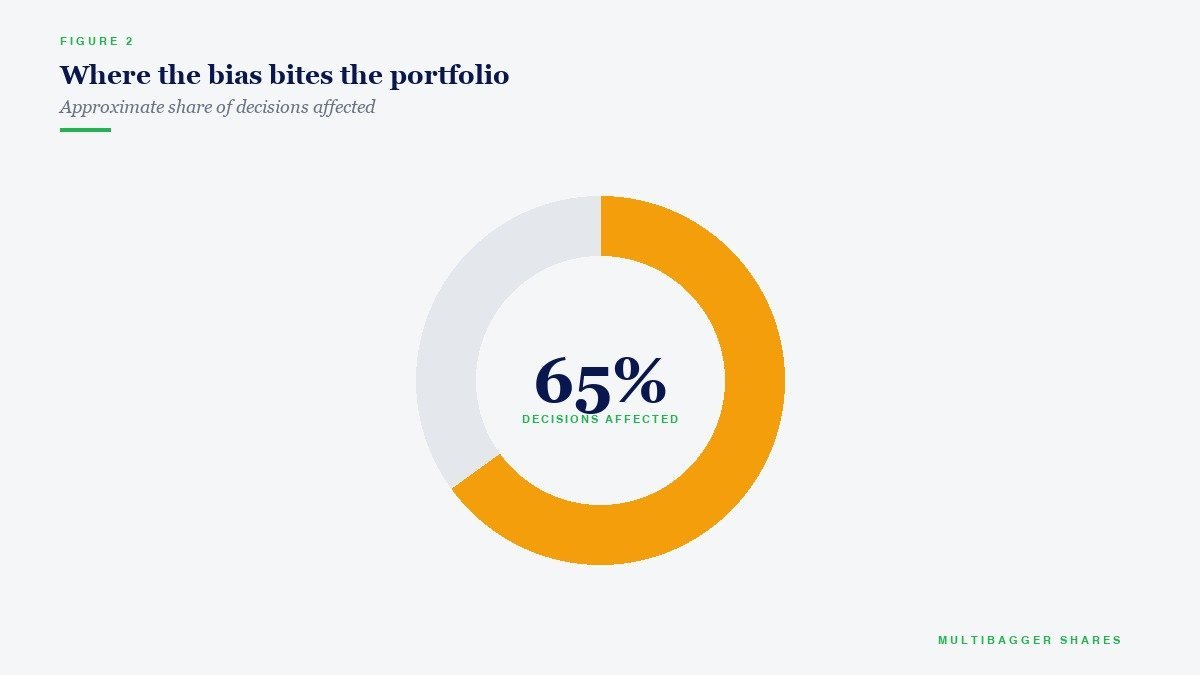
SEBI’s landmark study found that 9 out of 10 individual traders in equity Futures & Options lost money. This is one of the rare statistics in finance that includes the losers. It’s the full picture — not a survivorship-biased version.
Compare this with the narrative you hear on social media: “I turned ₹1 lakh into ₹10 lakh in F&O trading!” You only hear from the 1 in 10 who survived. The 9 who lost everything are silent. This is pure survivorship bias — and it lures lakhs of young Indians into financial destruction every year.
The antidote is clear: reject the gambling mentality of F&O trading. Focus on quality stock picking and long-term value investing — where you can actually use deep analysis to tilt the odds in your favor.
Practical Application: Building a Survivorship-Bias-Proof Watchlist
Here is a simple exercise every serious investor should do:
Go back to the NIFTY 50 composition from 10 years ago (2016). Write down all 50 companies. Now compare with today’s NIFTY 50. The companies that were removed — these are your case studies. Study why they fell out. Was it declining ROCE? Rising debt? Governance issues? Management complacency? Regulatory headwinds?
Then look at the companies that were added. What qualities did they have that the removed companies lacked? This exercise — studying both survivors and casualties — gives you a complete, unbiased picture of what drives long-term stock market success in India.
For a deeper understanding of fundamental analysis frameworks that correct for survivorship bias, check out our free Value Investing Education course: Multibagger Shares Value Investing Course on YouTube.
Final Thought: The Graveyard Has More Lessons Than the Hall of Fame
The next time someone shows you a chart of “how ₹10,000 invested in Stock X became ₹1 crore,” remember: they are showing you one survivor out of potentially hundreds of contemporaries that went to zero. The chart is not wrong — but it is radically incomplete.
True investment wisdom comes not from celebrating winners, but from understanding the full distribution of outcomes — including the failures. Survivorship bias hides the failures. Your job as a serious investor is to seek them out, study them, and use that knowledge to build a portfolio of genuinely high-quality businesses that are statistically most likely to survive and compound for decades.
That is the path to real, sustainable wealth creation in the Indian stock market.
📢 Join Our Telegram Channel
Get daily value investing lessons, stock analysis & Titan Biotech updates — delivered straight to your phone!
✈️ Join @longtermequityy on Telegram
🔔 Free • No spam • Value investing insights daily
Disclaimer: This article is for educational and informational purposes only. It is not investment advice, and not a buy, sell, or hold recommendation on any stock mentioned, including Titan Biotech Limited. Equity markets carry risk; please do your own research or consult a qualified professional before making investment decisions.
