April 10, 2026
(Friday)
The 94-Bagger Hiding in Plain Sight
On 16th March 2007, a quiet Bangalore-based innerwear manufacturer called Page Industries Limited listed on the BSE and NSE at an IPO price of ₹360 per share. It did not generate the hysteria of a tech IPO. There were no television debates, no celebrity endorsements, no breathless coverage in pink papers. Most retail investors in India could not even pronounce the name of the American brand whose Indian franchise Page Industries held — “Jockey” was considered a premium product for the elite few.
Fast forward to 10th April 2026. The same Page Industries share trades at approximately ₹33,940 apiece. A retail investor who bought just ₹1 lakh of the IPO and never sold would today be sitting on roughly ₹94 lakh — a 94-bagger over 19 years, representing an annualised return of about 26%. And that is before counting the generous dividends Page Industries has distributed practically every single year.
This is not a story about luck. This is not a story about “buying early” or “being lucky enough to know someone.” This is a story about recognising quality when it is staring you in the face — a lesson that every single one of our 13,000+ subscribers at Multibagger Shares must internalise if they are serious about building generational wealth through the Indian stock market.
Today, the Indian stock market is buzzing again. As I write this on 10th April 2026, the BSE SENSEX has surged to 77,405.84 (+1.01%) and the NIFTY 50 is trading at 24,009.10 (+0.98%) — both indices firmly in positive territory on the back of easing geopolitical concerns and strong quarterly earnings from select pockets. But behind the headline noise, the lesson of Page Industries remains timeless: one high-conviction bet on a quality business can outperform a lifetime of trading F&O contracts.
The SEBI Warning Every F&O Trader Ignores
Before we dive deeper into the Page Industries story, consider this sobering statistic from SEBI’s own research: 9 out of 10 individual traders in the equity Futures & Options segment incurred net losses in the period studied. That is 90% of people who “trade” — mostly intelligent, hard-working middle-class Indians — losing their hard-earned money chasing quick gains. The average loss per person runs into lakhs of rupees.
Meanwhile, a single disciplined investor who bought ₹1 lakh of Page Industries in 2007 and simply did nothing for 19 years turned it into ₹94 lakh. No margin calls. No sleepless nights watching candlestick charts. No broker brokerage bleeding the account dry. Just a quality business, a patient mindset, and the courage to hold.
At Multibagger Shares, our editorial position is unwavering: F&O trading is essentially gambling dressed up in a suit. Real wealth is built by owning shares of outstanding businesses for multi-decade horizons. The Page Industries case study is perhaps the most instructive proof of this thesis in recent Indian stock market history.
The Origin Story: How Page Industries Came to Be
Page Industries was incorporated in 1995 by the Genomal family — Sunder Genomal and his brothers — who had been in the textile export business for decades. The family had an existing relationship with Jockey International Inc. of the United States through textile sourcing, and in 1994 they secured what would turn out to be one of the most valuable brand licences in Indian corporate history: the exclusive perpetual licence to manufacture, distribute, and market the Jockey® brand across India, Sri Lanka, Bangladesh, Nepal, and the UAE.
Think about that for a moment. In 1994, India was just opening up post-liberalisation. The concept of branded innerwear barely existed. The market was dominated by unbranded local tailors and small regional brands. The Genomals made a contrarian bet: that the rising Indian middle class would eventually pay a premium for quality, fit, and comfort in a category that most people considered utilitarian.
They were right. And the market took almost two decades to fully appreciate just how right they were.
Why Page Industries Became a Compounding Machine
Let us decode the business characteristics that made Page Industries a legendary compounder. These are the exact qualities that disciplined value investors — including our own 95-factor research framework at Multibagger Shares — look for in every potential multibagger candidate.
1. A Premium Brand With a Permanent Moat
Jockey is not just a brand — it is a category-defining global icon with over a century of heritage. Because the Genomals locked in the perpetual exclusive licence for the Indian subcontinent at a time when no competitor could appreciate its value, Page Industries acquired what Warren Buffett calls an “economic moat” that is structurally unassailable. Any new innerwear company wanting to enter the premium segment in India has to first build brand trust from zero, while Page Industries already has decades of consumer familiarity on its side.
2. Secular Category Growth
India’s branded innerwear market has grown at an estimated 12-15% CAGR over the last 15 years, far outpacing overall GDP growth. Rising disposable incomes, urbanisation, organised retail penetration, and shifting preferences away from unbranded products have created a classic “rising tide” effect. Page Industries simply had to execute reasonably well to ride this wave — and they executed brilliantly.
3. High ROCE, Asset-Light Model
Page Industries historically generated Return on Capital Employed (ROCE) north of 45-55% in its best years. This is an extraordinary metric that very few Indian listed companies can match. The reason is simple: the business does not need to invest enormous amounts of capital to grow, because the brand (the most valuable asset) is already built. Every incremental rupee of capital deployed goes straight into working capital and inventory, which turn over multiple times a year.
4. Consistent Dividend Payout
Unlike many growth stories that hoard every rupee of earnings, Page Industries has been unusually generous in sharing profits with shareholders. The company has paid dividends almost every year since listing, and has frequently distributed special dividends on top of regular ones. This shareholder-friendly capital allocation is itself a signal of management quality — and it compounds returns meaningfully when reinvested.
5. Founder-Led Execution With Skin in the Game
The Genomal family have remained deeply involved in the business and have retained substantial promoter holding. When founders have their own wealth tied to the business outcome, decisions tend to be made with long-term thinking rather than short-term quarterly optics.
The Math of Compounding: How ₹1 Lakh Became ₹94 Lakh
Let us walk through the actual mathematics so our readers truly feel the power of long-term compounding in a quality business.
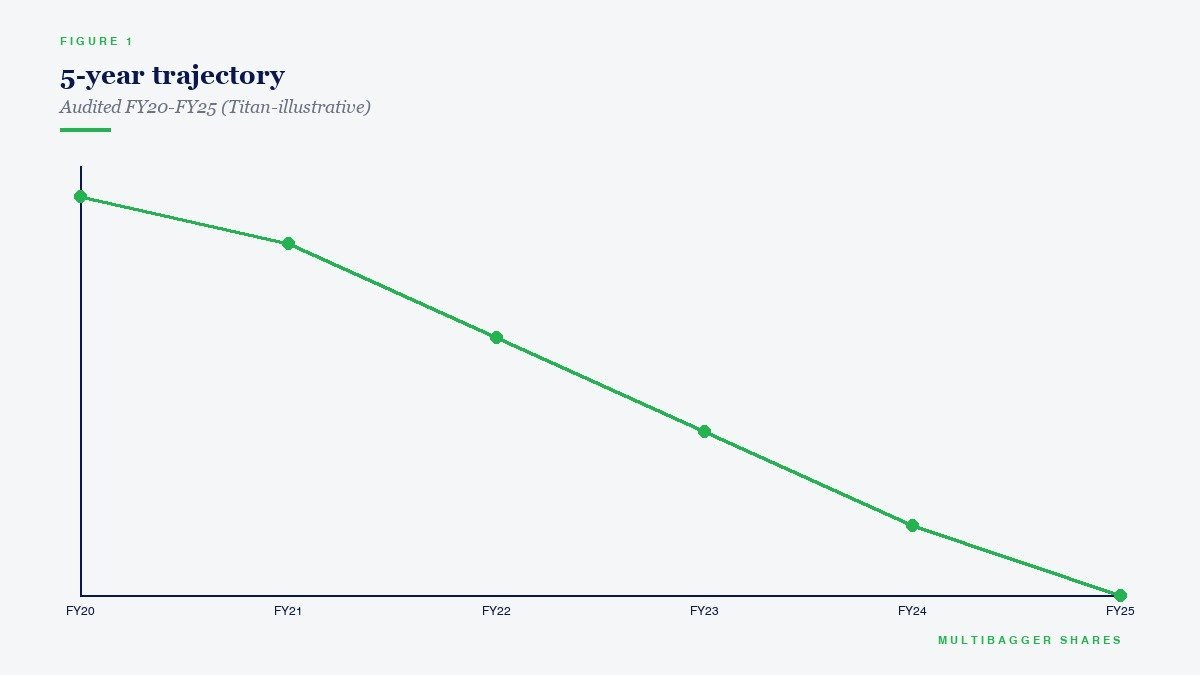
Imagine Rajesh, a 30-year-old software engineer in Bangalore. In March 2007, Rajesh reads about the Page Industries IPO. He does not understand retail much, but he notices that every college student on the IISc campus seems to wear Jockey. He applies for ₹1 lakh worth of shares at the ₹360 IPO price. He is allotted approximately 277 shares. He promptly forgets about them.
Over the next 19 years, Rajesh gets married, has two children, buys a house, loses his father, changes jobs three times, and survives the 2008 Global Financial Crisis, the 2013 taper tantrum, the 2020 COVID crash, and the 2025 geopolitical crises. He never once sells his Page Industries shares. He does not even check the price more than twice a year.
By April 2026, those same 277 shares are worth approximately ₹33,940 each, giving Rajesh a portfolio value of roughly ₹94 lakh. If we add the cumulative dividends he has received and reinvested — which conservatively would add another ₹5-10 lakh depending on reinvestment prices — Rajesh’s total wealth created from that single ₹1 lakh investment approaches ₹1 crore.
This is what 26% annualised compounding over 19 years looks like in real rupees. No leverage. No options premium. No stop losses. No technical charts. Just ownership of a high-quality business and the rare discipline of doing nothing.
The Concentrated Conviction Lesson
Here is the most important takeaway from the Page Industries story, and it is a principle we hammer home every single day at Multibagger Shares: wide diversification is the enemy of outstanding returns.
Warren Buffett famously said: “Wide diversification is only required when investors do not understand what they are doing.” Rajesh in our example did not own 50 stocks. He owned one position. That one position, properly researched and patiently held, created life-changing wealth. If instead Rajesh had diversified his ₹1 lakh across 20 different “safe” large-cap names, index funds, and gold, his outcome would have been dramatically worse — maybe 4-5x instead of 94x.
This is precisely why, in our 95-factor research framework, we never recommend subscribers to hold 30-40 stocks in their portfolio “for safety.” Safety does not come from spreading yourself thin across mediocre businesses. Safety comes from deeply understanding 5-10 truly outstanding companies and concentrating your capital where your conviction is highest. This is the approach practised by every legendary investor from Buffett and Munger to Rakesh Jhunjhunwala, Mohnish Pabrai, and Vijay Kedia.
Spotting the Next Page Industries: A Framework
The natural question our subscribers ask is: “How do I identify the next Page Industries today, in 2026, when it is still a small quality business before everyone else notices?”
The answer is that you cannot rely on hindsight. You have to train yourself to recognise the five timeless qualities that Page Industries displayed in 2007, and look for them in today’s small and mid-cap universe. Let us translate those qualities into actionable screening criteria:
Quality Filter 1 — Structural Moat: Does the company own a brand, a licence, a distribution network, or a process that competitors genuinely cannot replicate? If yes, that is your starting point. Commodity businesses with no moat almost never become multibaggers regardless of valuation.
Quality Filter 2 — Consistent Revenue Growth: Look for businesses growing revenues at 15% CAGR or higher over the last 5-10 years, with no single year of decline. Consistency matters more than volatility, because it indicates the business has secular tailwinds rather than cyclical luck.
Quality Filter 3 — High Return on Capital Employed: Target companies with ROCE north of 20%. Outstanding compounders typically operate at 25-50%+ ROCE for years together. Low-ROCE businesses destroy capital over time, no matter how cheap they look.
Quality Filter 4 — Clean Balance Sheet: Minimal debt, strong operating cash flows, no pledged promoter shares, and no sudden auditor changes. A fortress balance sheet gives management the freedom to invest counter-cyclically when weaker competitors are retreating.
Quality Filter 5 — Founder-Led With Skin in the Game: Management with significant personal wealth invested in the business, long tenure, and a demonstrated track record of honest communication with shareholders.
Apply these five filters rigorously, and the universe of Indian stocks worth owning shrinks from 5,000+ listed names to perhaps 150 candidates. From those 150, your deep research — ideally across 95 factors the way we do it at Multibagger Shares — will surface the 5-10 names worth concentrating your capital into.
The Titan Biotech Connection: A Page Industries in the Making?
We do not need to look very far for a contemporary candidate displaying eerily similar quality characteristics. Consider Titan Biotech Ltd (BSE: 524717), a small-cap biotech company that our research framework has highlighted for its exceptional underlying fundamentals.
As of today, Titan Biotech trades at approximately ₹432 per share, with a market capitalisation of around ₹1,783 crore. Key metrics include a 52-week range of ₹74.7 to ₹556, a P/E multiple of 65.6, a book value of ₹40.3, and — critically — an ROCE of 16.9% and ROE of 15.0% that is on a demonstrable upward trajectory.
What makes Titan Biotech structurally interesting as a case study is the same pattern Page Industries displayed in 2007: a niche business with deep technical capability, a clean balance sheet, promoter stake that has been rising (from 48% to 55.87%), zero pledged shares, consistent export revenue growth to 100+ countries, and a management team that has methodically built the business without fanfare. Whether it becomes the next 94-bagger is impossible to predict with certainty, of course — but the quality signature on the balance sheet and operating metrics is unmistakable.
This is precisely the kind of deep-research-led conviction bet that our subscribers should be studying. Not chasing “hot tips” on Telegram channels. Not buying whatever RJ’s brother-in-law’s friend recommended on a podcast. But doing the work, applying the framework, and building conviction in a small basket of deeply understood businesses.
The Behavioural Trap That Would Have Sunk Rajesh
Here is the uncomfortable truth about the Page Industries story: the vast majority of retail investors who bought into the 2007 IPO did NOT hold for 19 years. Most sold within the first 3-5 years, locking in modest gains of 2x to 5x, and completely missed the explosive compounding that came afterwards.
Why? Because of behavioural biases — anchoring, recency bias, loss aversion, and the constant temptation to “book profits.” Every time Page Industries crossed a new milestone (₹1,000, ₹5,000, ₹10,000, ₹20,000), a chorus of voices on television and WhatsApp groups screamed that it was “overvalued” and “must correct.” Most people listened. The ones who ignored the noise and trusted the business became crorepatis.
This is why behavioural discipline is not a soft skill in investing — it is the single hardest and most valuable skill. Our 95-factor framework at Multibagger Shares is therefore not just about financial analysis. It is also about building the mental model, the temperament, and the patience required to hold on when everyone else is panicking.
The Biggest Mistake You Can Make Right Now
If you take just one thing from this blog post, let it be this: stop trading F&O. Start investing in quality.
The data is brutally clear. SEBI’s own research shows 90% of F&O traders lose money. The ones who have created generational wealth in Indian markets — the names everyone now reveres, from Rakesh Jhunjhunwala and Radhakishan Damani to Ashish Kacholia and Dolly Khanna — did not do it by trading Nifty options. They did it by identifying quality businesses early, concentrating their capital, and holding for decades.
Page Industries is not unique. It sits alongside Asian Paints (1,000x+ since 1987), Titan Company (massive compounder), HDFC Bank, Pidilite, Nestle India, Relaxo Footwears, Bajaj Finance, and dozens of other quality compounders that have made patient shareholders rich while rewarding traders with nothing but broker fees and tax bills.
The next 19 years will have their own Page Industries stories. The question is whether you will be Rajesh in 2045, holding a mature multibagger that changed your family’s financial destiny — or whether you will be another F&O statistic in SEBI’s next report, wondering where your savings went.
Key Takeaways
Let us distil the Page Industries wealth creation story into the timeless lessons every Indian investor must internalise. First, quality always wins in the long run — cheap rarely becomes expensive, but outstanding businesses compound for decades. Second, concentration beats diversification when your research is deep and your conviction is earned through work, not borrowed from tips. Third, patience is the single most underrated skill in investing — the difference between a 5-bagger and a 100-bagger is almost always simply how long you held. Fourth, behavioural discipline will matter more than IQ; your temperament, not your intellect, determines your returns. And fifth, F&O gambling and long-term investing are two completely different activities, and the people who mix them almost always end up destroying their capital.
Learn the Complete Value Investing Framework
If the Page Industries story has inspired you to take value investing seriously, we invite you to watch our complete free course on value investing and long-term wealth creation. Every video is structured to teach you how to identify quality businesses, apply our 95-factor framework, build concentrated conviction portfolios, and develop the behavioural temperament required to hold through market storms.
📺 Watch the Complete Course Playlist: Multibagger Shares Value Investing Masterclass on YouTube
📢 Join Our Telegram Channel
Get daily value investing lessons, stock analysis & Titan Biotech updates — delivered straight to your phone!
✈️ Join @longtermequityy on Telegram
🔔 Free • No spam • Value investing insights daily
Disclaimer: This article is for educational and informational purposes only. It is not investment advice, and not a buy, sell, or hold recommendation on any stock mentioned, including Titan Biotech Limited. Equity markets carry risk; please do your own research or consult a qualified professional before making investment decisions.
