When you study a company’s Profit & Loss statement, most investors zoom straight to revenue, operating profit, and net profit. But there is a line item sitting quietly between Operating Profit and Profit Before Tax that can reveal an enormous amount about the quality of a company’s earnings — Other Income.
Other Income includes everything that is NOT generated from a company’s core business operations — interest on bank deposits, dividend income from investments, profit on sale of assets, foreign exchange gains, government subsidies, and one-time items like insurance claims or legal settlements. While some Other Income is healthy and sustainable, excessive or volatile Other Income is a classic red flag that signals the core business may not be as profitable as it appears.
In this deep-dive, we analyse 12 years of Titan Biotech’s Other Income data alongside its investment portfolio growth to understand whether this company’s impressive profit trajectory is genuinely driven by core operations — or artificially inflated by one-time windfalls.
Why Other Income Quality Matters
Imagine two companies, both reporting ₹20 Cr in Net Profit. Company A generates ₹19 Cr from its core operations and ₹1 Cr from fixed deposit interest. Company B generates ₹12 Cr from operations and ₹8 Cr from selling a piece of land. Which company would you trust more? Obviously Company A — because its earnings are repeatable, sustainable, and driven by the actual business.
Many small-cap companies in India inflate their reported profits through one-time Other Income items — land sales, exceptional insurance payouts, government grants, or even aggressive forex accounting. This makes their P&L look attractive in one year but collapses in the next, leaving investors who bought based on inflated earnings holding a bag of disappointment.
As the legendary investor Charlie Munger once said: “The quality of the earnings is just as important as the quantity.” This is precisely why forensic analysis of Other Income is a non-negotiable skill for serious value investors.
Titan Biotech’s 12-Year Other Income Track Record
Let us examine Titan Biotech’s Other Income data from FY2014 to FY2025, alongside its Operating Profit and Net Profit, to understand how much of the company’s earnings come from core operations versus non-operating sources.
The data tells a remarkably clean story. For the first eight years (FY2014 to FY2021), Other Income was essentially zero or negligible. During FY2021 — the company’s blockbuster year when Net Profit surged to ₹29 Cr — Other Income was literally ₹0 Cr. Every single rupee of that extraordinary profit came from core operations. This is a powerful signal of earnings authenticity.
The Investment Portfolio Story: Smart Treasury Management
In recent years, Other Income has grown from ₹0-1 Cr to ₹4 Cr (FY2025) and ₹5 Cr on a trailing twelve-month basis. Is this a red flag? Absolutely not — and here is why.
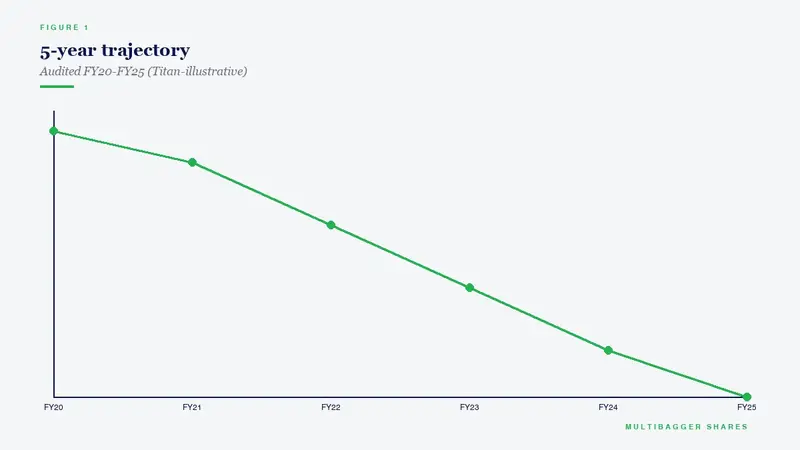
The Balance Sheet reveals a crucial detail: Titan Biotech’s Investment portfolio has grown dramatically over the past decade.
This is a textbook example of prudent capital allocation. As the company’s core business generated consistent profits, management built reserves from ₹8 Cr to ₹148 Cr and deployed surplus cash into an investment portfolio that grew from nearly ₹0 to ₹38 Cr. Simultaneously, borrowings were slashed from ₹25 Cr (FY2018 peak) to just ₹3 Cr in FY2025.
The growing Other Income is therefore not from one-time windfalls — it is from recurring treasury income on a growing investment portfolio. This is healthy, sustainable, and a sign of excellent capital management. The company is essentially earning a return on its accumulated surplus rather than letting cash sit idle.
Quarterly Other Income Analysis: Consistency Check
To verify that Other Income is genuinely recurring and not driven by lumpy one-time events, let us examine the quarterly breakdown over the last 12 quarters.
The quarterly data confirms that Other Income flows in steadily every quarter — typically ₹0.30 to ₹1.60 Cr — consistent with recurring investment and treasury income. There are no sudden ₹10-15 Cr spikes that would signal a one-time asset sale or exceptional item. The slight elevation in Q3 FY2025 (₹1.59 Cr) and Q4 FY2025 (₹1.38 Cr) aligns perfectly with the growing investment portfolio on the Balance Sheet reaching ₹24 Cr.
Note that in Q3 FY2025, when Operating Profit temporarily dipped to ₹4.85 Cr, Other Income of ₹1.59 Cr pushed the OI/NP ratio to 41.8%. This might alarm a superficial analyst — but a deeper look reveals that the core business faced a seasonal dip while the treasury continued delivering steady returns. By Q3 FY2026 (Dec 2025), Operating Profit bounced back strongly to ₹10.83 Cr, bringing OI/NP back down to a healthy 16%.
The Acid Test: What Happens If You Remove All Other Income?
The truest test of earnings quality is a simple one: strip out all Other Income and see if the company is still profitable from its core operations alone.
Even after stripping out every rupee of Other Income, Titan Biotech generates ₹20-39 Cr in core Pre-Tax Profit in every recent year. The company does not need Other Income to be profitable — it is simply a bonus from smart treasury management. This is the hallmark of genuine earnings quality.
Red Flags to Watch: When Other Income Becomes Dangerous
For context, here are the warning signs that indicate dangerous Other Income in Indian companies — none of which apply to Titan Biotech:
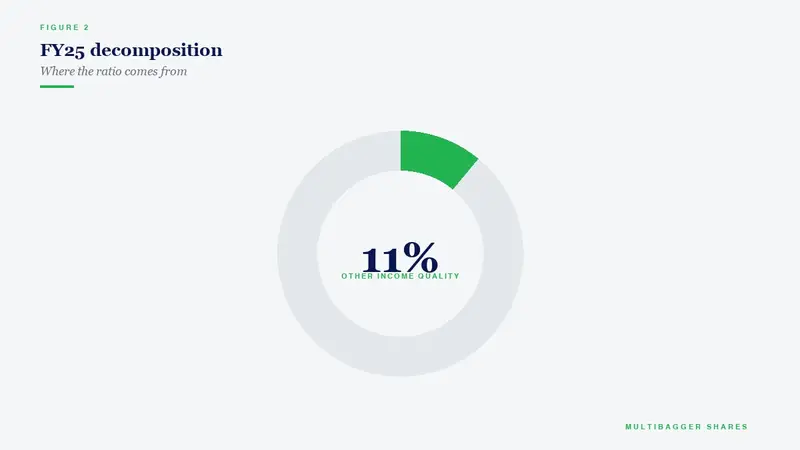
1. OI exceeding 30-50% of PBT consistently — suggests the core business cannot generate profits on its own. Titan Biotech’s annual OI/PBT has averaged under 5% over the last decade.
2. Sudden one-time spikes — a land sale or insurance claim creating a ₹50 Cr Other Income in one year and ₹0 the next. Titan Biotech’s OI has grown gradually and predictably.
3. Forex gains masking operational weakness — companies with heavy forex exposure may show volatile Other Income that reverses in subsequent quarters. Titan Biotech’s OI is treasury-driven, not forex-driven.
4. OI growing while Operating Profit declines — the most dangerous combination, suggesting management is papering over declining business fundamentals. While Titan Biotech’s OP did moderate in FY2025, it bounced back strongly in Q2 and Q3 FY2026 (₹9.33 Cr and ₹10.83 Cr respectively), confirming the core business remains robust.
The Bigger Picture: What This Tells Us About Management Quality
A company’s Other Income profile reveals management’s capital allocation philosophy. Titan Biotech’s trajectory tells a clear story: the management team first focused on building a profitable, cash-generating core business. As profits accumulated and borrowings were repaid, they deployed surplus capital into an investment portfolio that now generates ₹4-5 Cr in recurring income annually.
This is the approach of a management team that thinks in decades, not quarters. They could have taken on more debt for aggressive expansion, paid out all profits as dividends, or indulged in unrelated diversification. Instead, they built a fortress balance sheet with ₹148 Cr in reserves, ₹38 Cr in investments, and minimal borrowings — creating optionality for future growth moves, acquisitions, or capacity expansion at exactly the right time.
As Warren Buffett has often said: “Wide diversification is only required when investors do not understand what they are doing.” The same principle applies to how companies deploy their capital. Titan Biotech’s concentrated focus on its core biological products business — while prudently managing surplus cash — is a textbook example of disciplined capital allocation that compound investors should study carefully.
Key Takeaways for Indian Investors
When analysing any company’s Profit & Loss statement, do not skip the Other Income line. Ask yourself these three questions: First, what percentage of total profit comes from Other Income? If it is consistently above 25-30%, the core business may be weaker than it appears. Second, is the Other Income recurring or one-time? Treasury income from FDs and investments is healthy; land sales and legal settlements are not. Third, is the investment portfolio growing because of genuine profit accumulation, or is the company neglecting its core business and parking money elsewhere?
Titan Biotech passes all three tests with flying colours. Its ₹156 Cr revenue and ₹25 Cr operating profit in FY2025 are overwhelmingly from core biological products manufacturing. The ₹4 Cr in Other Income is a natural byproduct of disciplined capital management — not an accounting trick. And with revenue already running at ₹193 Cr on a trailing twelve-month basis with operating profit bouncing back to ₹33 Cr TTM, the core business story remains firmly intact.
For investors who believe in concentrated portfolios of 8-15 deeply researched quality stocks — rather than the “di-worse-ification” that Peter Lynch warned about — this kind of forensic earnings quality analysis is what separates genuine compounders from companies that merely look good on the surface.
Disclaimer: This article is for educational and informational purposes only. It is not investment advice, and not a buy, sell, or hold recommendation on any stock mentioned, including Titan Biotech Limited. Equity markets carry risk; please do your own research or consult a qualified professional before making investment decisions.
