📊 MARKET SNAPSHOT — 7th April 2026
1. What Happened Today
Indian equity markets took a breather on Tuesday, 7th April 2026, after a spirited three-day rally that had been fuelled by US-Iran ceasefire optimism. The Nifty 50 slipped 28 points (−0.12%) to settle around 22,940, while the Sensex eased 76 points (−0.10%) to 74,031. The pullback was modest and entirely healthy — a sign of consolidation, not capitulation.
Markets had opened on a cautious note, with GIFT Nifty signalling a 167-point gap-down in the pre-market session. Asian cues were mixed: the Hang Seng dropped nearly 1%, while Japan’s Nikkei slipped 0.25% and South Korea’s KOSPI managed to stay in positive territory. Despite the shaky start, domestic buyers — led by institutional support — ensured that the indices recovered most of the early losses.
The previous session (April 6) had been a blockbuster day: Nifty surged 255 points (+1.12%) to 22,968, Sensex jumped 787 points (+1.07%) to 74,107, and Bank Nifty soared 1,060 points (+2.06%) to 52,609. That momentum naturally invited some profit-booking today.
Key movers from the recent sessions: Axis Bank (+3.73%), Titan Company (+3.61%), UltraTech Cement (+3.29%), Trent (+7.9%), Hindalco (+3.4%), and CreditAccess Grameen (+6.2%) were among the top performers. On the losing side, Jubilant FoodWorks (−6.8%), Reliance Industries (−0.6%), and Eternal (−1.6%) weighed on the indices. The Nifty Oil & Gas index was the weakest sector, dragged down by concerns that elevated crude prices near $110/barrel could trigger adverse policy measures.
2. Why It Happened
Several forces are pulling the market in different directions right now, and understanding them is critical for any serious investor.
The Ceasefire Factor: Reports that the US, Iran, and mediators are actively discussing a 45-day ceasefire in the Middle East gave markets a massive relief rally over three sessions. However, today’s slight pullback suggests that investors are waiting for concrete confirmation before committing further capital. Geopolitical optimism is priced in partially — any breakdown in talks could trigger sharp reversals.
Crude Oil at $110: Brent crude trading near $110/barrel remains the elephant in the room for India. As a net oil importer, every $10 increase in crude adds roughly 0.4% to India’s current account deficit and puts pressure on the Rupee (currently at ₹93/USD). The Nifty Oil & Gas index’s underperformance reflects fears of potential windfall taxes and margin compression for downstream companies.
FII vs. DII Tug-of-War: Foreign Portfolio Investors (FPIs) sold a net ₹8,167 crore on April 6, continuing their pattern of persistent selling. Domestic Institutional Investors (DIIs) countered with ₹8,089 crore in net buying — almost perfectly offsetting FII outflows. This DII wall of support has been the single most important reason why the market hasn’t cracked despite relentless foreign selling.
Strong Banking Q4 Updates: Major lenders including Axis Bank, HDFC Bank, and Bajaj Finance reported robust loan growth for the March quarter. This powered the Bank Nifty’s 2%+ rally on Monday and continues to underpin the financial sector’s outperformance. Banks remain the backbone of India’s structural growth story.
RBI Policy Awaited: The market is also positioning itself ahead of the Reserve Bank of India’s upcoming monetary policy decision. With inflation contained but oil prices elevated, the RBI faces a delicate balancing act. Any dovish surprise could propel the next leg of the rally.
3. What It Means for Investors
A 0.1% dip after a 3-day, 1,000+ point rally on Sensex is not a cause for concern — it’s a cause for relief. Healthy markets don’t go up in a straight line. They climb, pause, consolidate, and then climb again. This is textbook behaviour.
What should concern you, however, is if you find yourself glued to the screen, panicking over every 50-point move in Nifty. That’s the behaviour of a trader, not an investor. And traders, statistically, lose money in Indian markets. The data is unambiguous: over 93% of F&O traders lose money, according to SEBI’s own study.
If you are invested in fundamentally strong businesses — companies with growing revenues, expanding margins, low debt, and honest management — then a 0.1% dip is irrelevant noise. Your job is to understand your businesses deeply, not to predict tomorrow’s market direction.
4. The Value Investor’s Perspective
Warren Buffett once said: “The stock market is a device for transferring money from the impatient to the patient.” Days like today perfectly illustrate this principle. While short-term traders scramble to book profits after a three-day rally, patient investors who understand their companies simply do nothing — and that “doing nothing” is often the most profitable strategy.
Benjamin Graham taught us to think of Mr. Market as an emotional business partner who shows up every day offering to buy or sell shares at different prices. Some days he’s euphoric, some days he’s depressed. Your job is not to take his mood seriously — it’s to take advantage of his irrationality when he offers you wonderful businesses at foolish prices.
And here’s the critical truth that most investors miss: wide diversification is only required when investors do not understand what they are doing. That’s not my opinion — that’s Warren Buffett’s. The greatest investors in history — Buffett, Munger, Pabrai, Rakesh Jhunjhunwala — made their fortunes through concentrated conviction in their best ideas, not by spreading thin across 50 mediocre stocks or hiding in index funds. If you’ve done deep research using frameworks like our 95-factor analysis, you should have the courage to concentrate your capital in your 5-10 best ideas.
🏆 TITAN BIOTECH — Quality Compounding in Action
While markets dip 0.1% and traders panic over intraday moves, let’s zoom out and look at what truly matters: business performance.
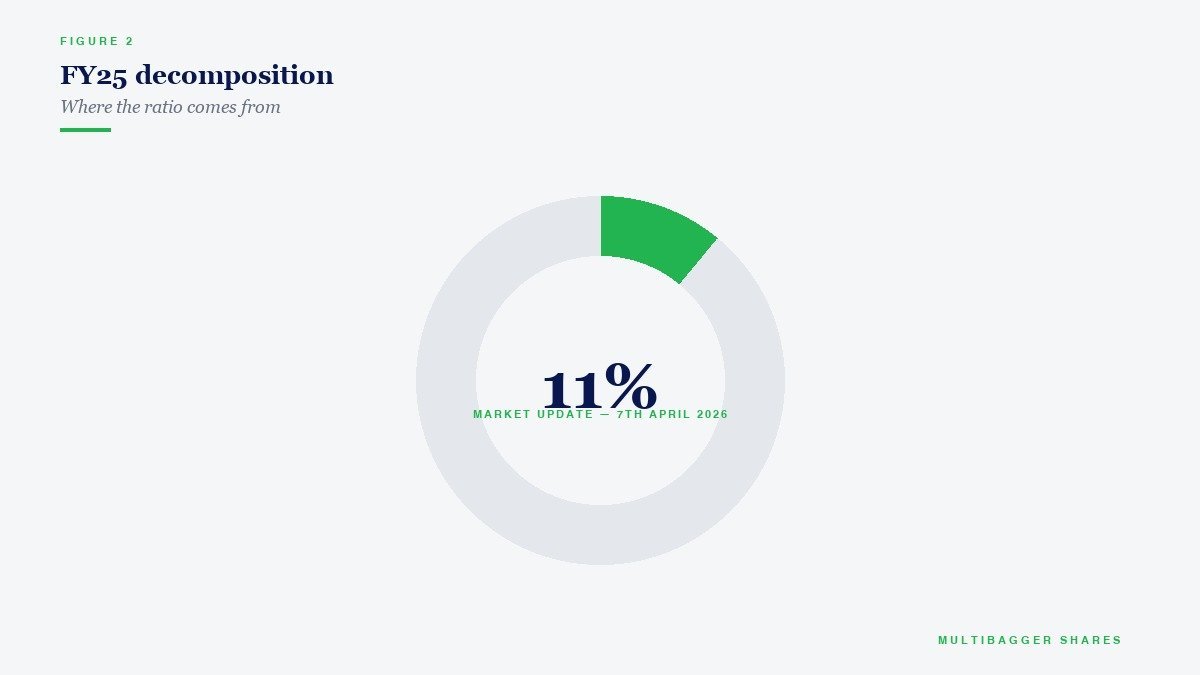
Titan Biotech delivered 94% profit growth in its last reported quarter — not through financial engineering or one-time gains, but through genuine business expansion. While the market swings on geopolitical headlines and FII flows, quality compounders like Titan Biotech quietly keep growing their earnings, expanding their moat, and rewarding patient shareholders.
This is the difference between investing and speculating. Speculators ask: “What will the market do tomorrow?” Investors ask: “Is this business growing its intrinsic value?” When a company grows profits at 94% year-over-year, the stock price eventually follows — regardless of what FIIs or crude oil or geopolitics do in the short term.
Remember: Multibagger wealth is built in years, not in trading sessions.
5. Action Plan for Smart Investors
DO:
- Use this consolidation phase to review your portfolio’s fundamentals — are your companies still growing revenues and profits?
- Keep a watchlist of quality businesses you’d like to own at better prices. Market pauses create those opportunities.
- Study businesses deeply. Read annual reports. Understand the management. This is how you build the conviction to concentrate your capital in your best ideas.
- Stay invested in quality. Don’t sell fundamentally strong businesses because of a 0.1% market dip.
DON’T:
- Don’t trade F&O. SEBI data proves 93%+ of derivatives traders lose money. It’s not investing — it’s gambling with extra steps.
- Don’t chase momentum. Today’s top gainer can be tomorrow’s top loser.
- Don’t diversify into 50 stocks “for safety.” That’s not safety — that’s guaranteed mediocrity. Deep knowledge of 5-10 businesses beats shallow knowledge of 50.
- Don’t let FII selling scare you. DIIs are absorbing the selling. Indian retail and institutional investors are the new backbone of this market.
⚠️ WARNING: Stay Away from F&O Trading
Futures & Options trading is NOT investing. SEBI’s comprehensive study found that over 93% of individual F&O traders incurred losses, with the average loss being ₹2 lakh per year. That’s money you could invest in quality businesses that compound your wealth over decades. Don’t gamble your financial future. Invest in quality. Be patient. Think long-term.
📚 Want to Learn Value Investing from Scratch?
Watch Manish Goel’s complete Value Investing Course Playlist — free educational content to help you become a better, smarter, more disciplined investor.
— Manish Goel
Founder,
Helping long-term investors find quality businesses since 2018
Disclaimer: This commentary is for educational and informational purposes only. It does not constitute financial advice, stock recommendations, or an invitation to trade. All investment decisions should be made after consulting with a SEBI-registered investment advisor. Past performance is not indicative of future results. Markets are subject to risks — please invest responsibly. The author and may hold positions in stocks mentioned.
Disclaimer: This article is for educational and informational purposes only. It is not investment advice, and not a buy, sell, or hold recommendation on any stock mentioned, including Titan Biotech Limited. Equity markets carry risk; please do your own research or consult a qualified professional before making investment decisions.
