April 08, 2026
(Tuesday)
What If You Could Beat 96% of Professional Fund Managers With Just Two Numbers?
In 2005, a legendary hedge fund manager named Joel Greenblatt published a tiny book called “The Little Book That Beats the Market.” It was only 179 pages. It had no complex algorithms, no insider secrets, no sophisticated derivatives strategies. Instead, it contained a deceptively simple formula that had delivered 30.8% annualized returns over a 17-year backtest period from 1988 to 2004 — compared to just 12.4% for the S&P 500 during the same period.
That means Greenblatt’s approach more than doubled the market’s return, turning $10,000 into over $9.6 million versus the market’s $7.8 lakh over 17 years. And here’s the stunning part: the formula uses only two variables — Earnings Yield and Return on Capital.
Today, with the Indian markets surging — the Sensex rallied a spectacular ~2,840 points to around 77,456 and the Nifty 50 jumped 3.62% to approximately 23,961 on April 8, 2026, fueled by the Iran-US ceasefire and RBI’s steady hand — it’s the perfect time to learn how to apply Greenblatt’s Magic Formula to Indian stocks. This method can help you systematically find cheap, high-quality businesses without spending hours on complex financial modeling.
Who Is Joel Greenblatt?
Joel Greenblatt is no armchair theorist. He is the founder of Gotham Capital, a hedge fund that delivered an astonishing 40% annualized return from 1985 to 2005 — one of the best track records in Wall Street history. He’s also a professor at Columbia Business School (the same school where Benjamin Graham and Warren Buffett taught and studied) and the author of multiple bestselling investment books.
What makes Greenblatt unique among legendary investors is his belief in simplicity. While most quant funds employ hundreds of PhD mathematicians and billions of dollars in computing power, Greenblatt argued that ordinary investors can beat the professionals using a formula so simple that a 13-year-old could apply it. In fact, he wrote the book specifically so his children could understand it.
The Magic Formula: Two Pillars of Genius
The Magic Formula ranks all stocks based on just two factors:
Factor 1: Earnings Yield (EBIT / Enterprise Value)
Earnings Yield tells you how CHEAP a stock is relative to its earnings power. It’s essentially the inverse of the P/E ratio, but more accurate because it uses EBIT (Earnings Before Interest and Taxes) divided by Enterprise Value (Market Cap + Debt – Cash). This makes it superior to the simple P/E ratio because it accounts for a company’s debt structure. A company with high debt may look cheap on P/E but is actually expensive when you consider its total enterprise value.
Think of Earnings Yield as asking: “For every ₹100 I pay for this entire business, how many rupees of operating profit am I getting?” The higher the earnings yield, the cheaper the stock.
Factor 2: Return on Capital (EBIT / Net Working Capital + Net Fixed Assets)
Return on Capital tells you how GOOD a business is at generating profits from its invested capital. This is not the same as ROE or ROCE — Greenblatt specifically uses EBIT divided by (Net Working Capital + Net Fixed Assets) to eliminate the distortions caused by different tax rates and capital structures across companies.
Think of Return on Capital as asking: “How efficiently does this company convert its factories, inventory, and equipment into profit?” The higher the return on capital, the better the business quality.
The magic is in the combination: You rank ALL stocks by Earnings Yield (cheapest gets rank #1) and separately rank ALL stocks by Return on Capital (highest gets rank #1). Then you ADD the two ranks together. The stocks with the LOWEST combined rank are your Magic Formula picks — they are simultaneously cheap AND high-quality.
Why This Formula Works: The Behavioral Edge
The Magic Formula works because of a fundamental truth about human psychology: most investors cannot hold their nerve when a high-quality company temporarily falls out of favor.
When a great business like Titan Biotech — currently trading at ₹478 with a market cap of ₹1,976 crore, ROCE of 16.9%, and ROE of 15% — goes through a temporary dip, most investors panic. They sell at the worst possible time. The Magic Formula, by being purely systematic, removes emotion from the equation entirely.
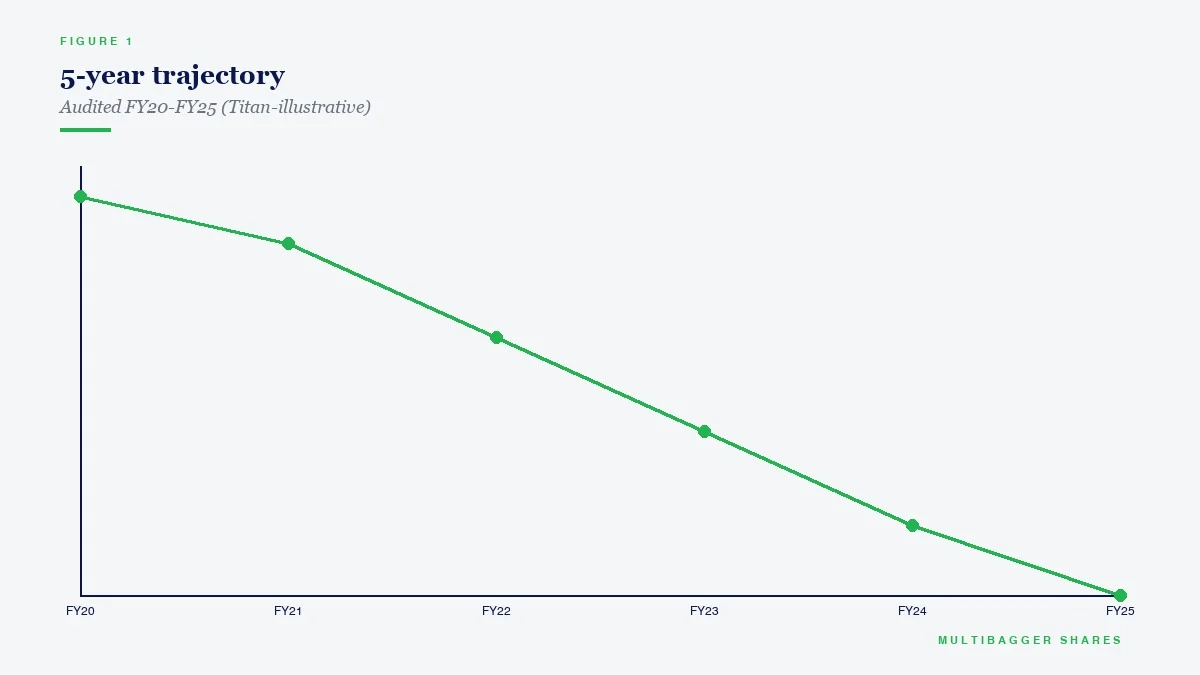
Academic research, including a 2021 paper on the Indian market by researchers at SSRN, found that the Magic Formula delivered average returns of 13.9% annually for a 30-stock portfolio versus 9.3% for the BSE Sensex during the period July 2012 to February 2020. That’s a 50% outperformance — and this was during a period when most professional mutual fund managers in India underperformed their benchmarks.
Applying the Magic Formula to Indian Stocks: A Step-by-Step Guide
Step 1: Define Your Universe
Start with all BSE/NSE-listed companies above a minimum market cap threshold. Greenblatt originally used $50 million; for India, a market cap floor of ₹500 crore works well. Exclude financial companies (banks, NBFCs, insurance) because their capital structures make earnings yield and return on capital calculations misleading. Also exclude utilities and highly regulated sectors.
Step 2: Calculate Earnings Yield for Each Company
Earnings Yield = EBIT ÷ Enterprise Value. Use trailing twelve months (TTM) EBIT. Enterprise Value = Market Cap + Total Debt – Cash and Cash Equivalents. You can find these numbers easily on Screener.in for any Indian company.
Step 3: Calculate Return on Capital for Each Company
Return on Capital = EBIT ÷ (Net Working Capital + Net Fixed Assets). Net Working Capital = Current Assets – Current Liabilities. Net Fixed Assets = Total Fixed Assets – Depreciation. Again, all available on Screener.in or the annual reports.
Step 4: Rank and Combine
Rank all companies by Earnings Yield (highest = rank 1) and separately by Return on Capital (highest = rank 1). Add the two ranks. The companies with the lowest combined score are your top Magic Formula picks.
Step 5: Build a Concentrated Portfolio
Now here’s where we deviate from Greenblatt’s original advice. He suggested buying 20-30 stocks. But as Warren Buffett wisely said: “Wide diversification is only required when investors do not understand what they are doing.” We believe in concentrated conviction investing. Use the Magic Formula as a screening tool — it gives you a shortlist of cheap, high-quality businesses. Then apply deep fundamental analysis to select your best 5-10 ideas.
The greatest wealth creators in India — Rakesh Jhunjhunwala, Radhakishan Damani, Vijay Kedia — all made their fortunes through concentrated bets on deeply researched companies, not by spreading money across 30 mediocre picks. Use the Magic Formula to find candidates, then use our 95-factor analysis framework to pick the winners.
Real-World Indian Example: How the Formula Spots Hidden Gems
Let’s look at how the Magic Formula would evaluate a company like Titan Biotech (BSE: 524717). With its current ROCE of 16.9%, consistent profit margins, and a debt-to-equity ratio of just 0.02x (essentially debt-free), Titan Biotech scores exceptionally well on the Return on Capital factor. The company has grown its revenue at a 15% CAGR over a decade, and its operating margins have expanded from 10% to 19%.
When you combine this excellent capital efficiency with the stock’s valuation metrics, you get a company that the Magic Formula would flag as a high-quality business worth investigating deeply. This is exactly the kind of stock that systematic, disciplined value investing helps you discover — businesses with strong fundamentals that the market hasn’t yet fully priced in.
The Indian Magic Formula Backtests: What the Data Shows
Several Indian financial platforms now offer Magic Formula screeners for BSE and NSE stocks. The historical results are compelling:
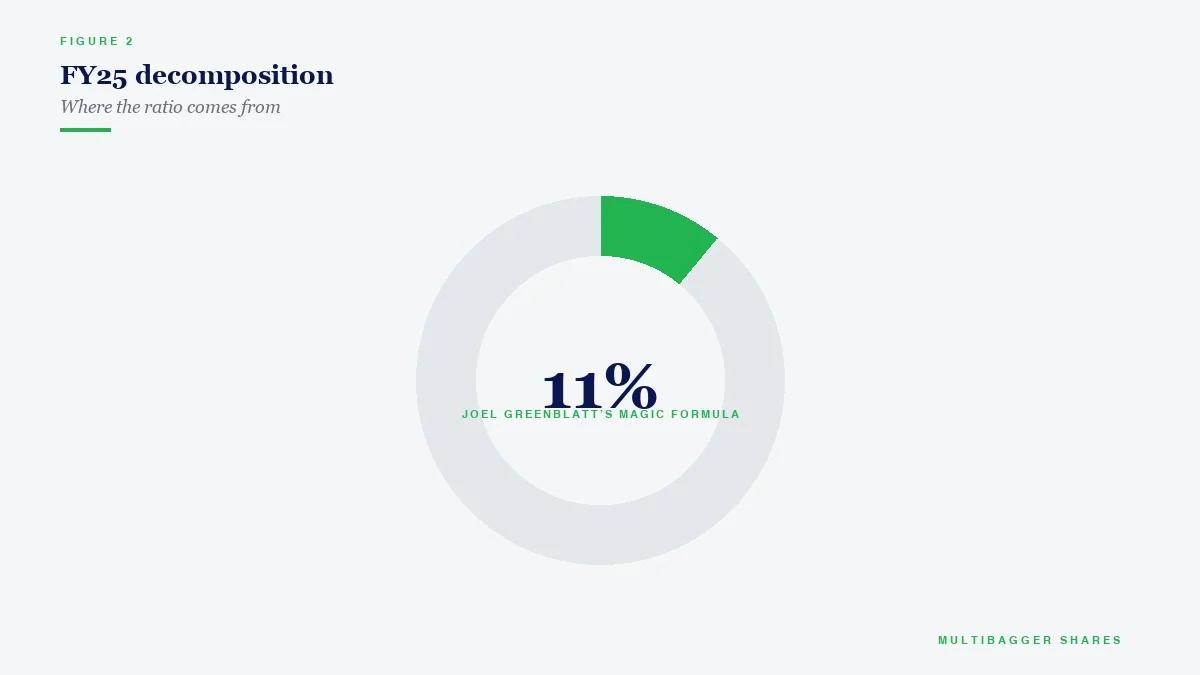
Between 2012 and 2020, a simple Magic Formula strategy applied to Indian mid-cap and small-cap stocks generated significant alpha over the Sensex and Nifty 50. The strategy tends to work best over 3-5 year holding periods — which aligns perfectly with the value investing philosophy we teach at Multibagger Shares.
Importantly, the Magic Formula tends to underperform in raging bull markets when speculative, low-quality stocks lead the charge. But it dramatically outperforms during corrections and bear markets because it’s concentrated in genuinely profitable businesses bought at reasonable prices. This is why you need patience — the same patience that turned ₹5,000 into ₹45,000 crore for Rakesh Jhunjhunwala.
Common Mistakes Indian Investors Make with the Magic Formula
Mistake 1: Using P/E Instead of Earnings Yield — The P/E ratio ignores debt. A company with a P/E of 10 might look cheap, but if it carries massive debt, its Enterprise Value is much higher, making the true Earnings Yield much lower. Always use EV-based calculations.
Mistake 2: Including Financial Companies — Banks and NBFCs have fundamentally different business models. Their “capital” is other people’s deposits. Including them in a Magic Formula screen will give you misleading results.
Mistake 3: Blindly Following the Ranking Without Deep Research — The Magic Formula is a screening tool, not a complete investment strategy. It identifies candidates. You still need to analyze management quality, competitive moats, growth runway, and corporate governance before investing.
Mistake 4: Giving Up After One Bad Year — Greenblatt himself warned that the formula will underperform the market in roughly one out of every four years. Most investors abandon the strategy during these periods — and miss the subsequent outperformance. As Greenblatt wrote: “The secret to the Magic Formula’s success is that it works over the long term. In the short term, it might not work at all.”
Mistake 5: Over-Diversifying the Results — If you find 30 Magic Formula stocks and buy all 30 equally, you’ll get market-like returns minus your costs. Instead, concentrate your capital in the 5-10 stocks from the Magic Formula list where your deep research gives you the highest conviction.
Why F&O Traders Should Abandon Gambling and Learn This Instead
According to SEBI’s landmark study, 9 out of 10 individual traders in the equity Futures & Options segment incurred net losses. The average F&O trader lost ₹1.1 lakh per year. Meanwhile, a simple, systematic value investing approach like the Magic Formula has beaten the market consistently for decades — in the US, in India, and in markets worldwide.
The choice is clear: you can gamble in F&O and join the 90% who lose money, or you can learn disciplined, systematic value investing and build genuine, lasting wealth. The Magic Formula isn’t magic at all — it’s just common sense applied systematically: buy good businesses at cheap prices and hold them with conviction.
How to Get Started Today
If you want to learn value investing from the ground up — including how to apply the Magic Formula, DCF analysis, forensic accounting, and our proprietary 95-factor analysis framework — check out our free value investing course on YouTube: Complete Value Investing Course Playlist.
The markets are rewarding quality today. The Sensex has rallied ~2,840 points as geopolitical tensions ease and RBI holds steady. But remember — the real wealth is built not on one day’s rally, but on years of disciplined, concentrated investing in high-quality businesses bought at fair prices. Joel Greenblatt showed the world that you don’t need a PhD or a Bloomberg terminal to beat the market. All you need is patience, discipline, and a simple formula.
📢 Join Our Telegram Channel
Get daily value investing lessons, stock analysis & Titan Biotech updates — delivered straight to your phone!
✈️ Join @longtermequityy on Telegram
🔔 Free • No spam • Value investing insights daily
Disclaimer: This article is for educational and informational purposes only. It is not investment advice, and not a buy, sell, or hold recommendation on any stock mentioned, including Titan Biotech Limited. Equity markets carry risk; please do your own research or consult a qualified professional before making investment decisions.
