April 07, 2026
(Tuesday)
Why One Man’s Reading Habit Created More Wealth Than Most Hedge Funds Combined
Charlie Munger — Warren Buffett’s partner, Berkshire Hathaway’s Vice Chairman, and arguably the most intellectually formidable investor who ever lived — didn’t become a billionaire by staring at stock charts or running complicated algorithms. He did it by reading 500+ pages every single day across disciplines as varied as physics, psychology, biology, history, and mathematics — and then weaving those insights into a unified decision-making system he called the “Latticework of Mental Models.”
While most investors obsess over one metric — P/E ratios, moving averages, or earnings surprises — Munger built an intellectual toolkit of 80-100 mental models drawn from every major discipline of human knowledge. This multi-disciplinary approach gave him an almost unfair advantage: he could see what others couldn’t because he was looking through lenses that others didn’t even know existed.
Today, with the Sensex at approximately 76,600 and the Nifty 50 closing at 23,124 on April 7, 2026 — with markets extending their fourth consecutive day of gains despite geopolitical tensions around Iran and elevated crude oil prices above $110/barrel — the ability to think clearly across multiple dimensions is more critical than ever for Indian investors navigating complexity.
Let’s decode Munger’s latticework and show you exactly how to apply it to the Indian stock market.
What Exactly Is a “Latticework of Mental Models”?
Munger once said: “You’ve got to have models in your head. And you’ve got to array your experience — both vicarious and direct — on this latticework of models.”
Think of it like this: if you only have a hammer, every problem looks like a nail. But if you have a hammer, a wrench, a screwdriver, a saw, and a level — you can build a house. Munger’s genius was accumulating intellectual tools from every major field of knowledge and using them simultaneously to evaluate businesses and investment opportunities.
This isn’t just theory. Berkshire Hathaway’s investment in See’s Candies — purchased for $25 million in 1972 and generating over $2 billion in cumulative pre-tax earnings — happened because Munger convinced Buffett to look beyond Benjamin Graham’s “cigar butt” approach (buying cheap assets) and instead pay a fair price for an extraordinary business with pricing power. That single mental model shift — from “buying cheaply” to “buying quality” — transformed Berkshire from a good investment vehicle into one of the greatest wealth-creation machines in history.
The 10 Most Powerful Mental Models Every Indian Investor Must Learn
1. Inversion — Think Backward to Move Forward
Munger’s favourite mental model, borrowed from the mathematician Carl Jacobi: “Invert, always invert.” Instead of asking “How do I pick a great stock?”, ask “How would I guarantee losing money in the stock market?” The answers — buying on tips, trading F&O without understanding, ignoring fundamentals, following the herd — become your avoidance checklist.
For Indian investors, this is especially powerful. SEBI’s own study found that 9 out of 10 individual traders in the equity Futures & Options segment incurred net losses. Inversion tells you: if 90% lose in F&O, the single best thing you can do is NOT gamble in F&O and focus instead on quality stock picking and long-term value investing.
2. Circle of Competence — Know What You Know (and What You Don’t)
Munger and Buffett are ruthless about staying within their circle of competence. Munger said: “Knowing what you don’t know is more useful than being brilliant.”
For Indian investors, this means: if you deeply understand the Indian biotech and life sciences sector — companies like Titan Biotech (BSE: 524717), currently trading at approximately ₹472 with a market capitalization of ₹1,601 Cr — then concentrate your capital in your highest-conviction ideas within that circle. Don’t dilute your edge by spreading thin across 50 random stocks you barely understand.
As Warren Buffett himself said: “Wide diversification is only required when investors do not understand what they are doing.” The greatest investors in history — Buffett, Munger, Pabrai, Jhunjhunwala — all made their fortunes through concentrated, high-conviction investing in businesses they understood deeply.
3. The Lollapalooza Effect — When Multiple Forces Converge
This is Munger’s term for situations where multiple psychological tendencies or economic forces act in the same direction simultaneously, creating an outsized result. Think of it as compounding, but for causes rather than money.
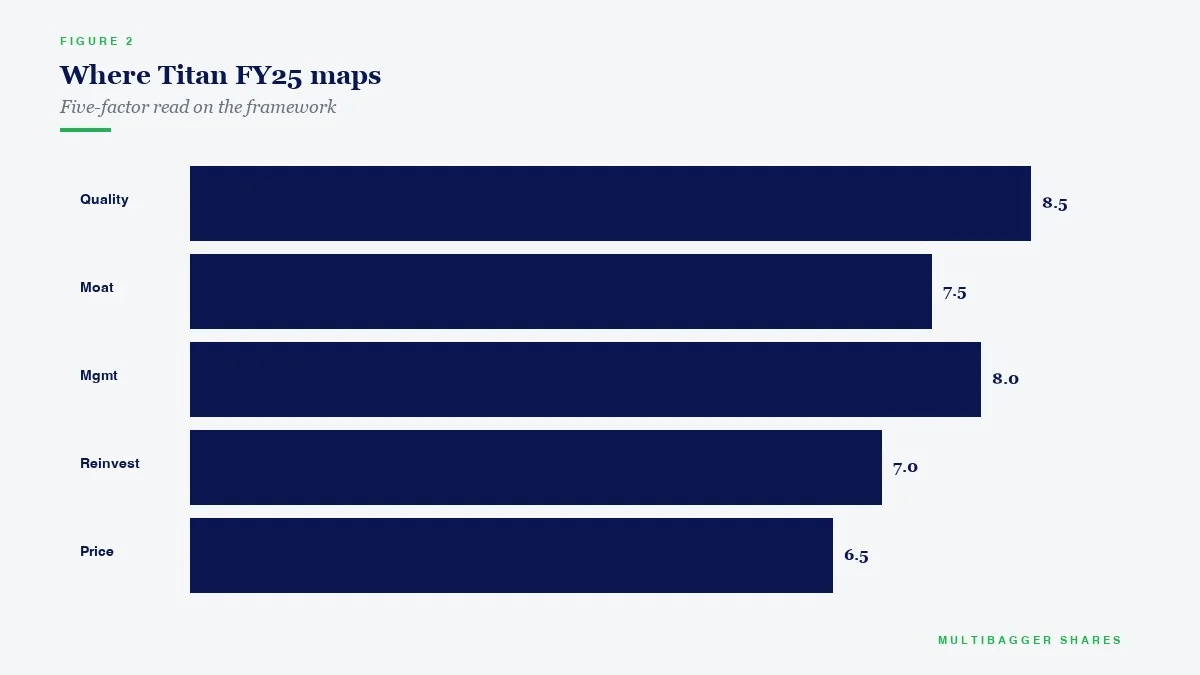
In Indian markets, you see the Lollapalooza Effect when a company has: (a) strong promoter buying, (b) improving fundamentals, (c) industry tailwinds, and (d) institutional interest — all converging at once. Titan Biotech is an example where multiple positive forces aligned: promoter stake increase to 55.87%, operating margin expansion from 10% to 19%, debt-free balance sheet (D/E of 0.02x), and a growing addressable market in biotech inputs. When multiple forces compound together, the results are extraordinary.

4. Opportunity Cost — The Hidden Price of Every Decision
Every rupee you invest in Stock A is a rupee you can’t invest in Stock B. Munger was religious about this: “The wise ones bet heavily when the world offers them that opportunity. They bet big when they have the odds. And the rest of the time, they don’t.”
When you hold 50 mediocre stocks “for safety,” your opportunity cost is enormous — you’re forgoing concentration in your 5-10 best ideas that could genuinely compound into multibaggers. The greatest investors didn’t build their wealth through diversification. They built it through conviction.
5. Second-Order Thinking — See Beyond the Obvious
First-order thinking: “This stock is cheap, I’ll buy it.” Second-order thinking: “This stock is cheap — but WHY? Is it cheap because the market is irrational, or because the business is genuinely deteriorating?”
Munger always thought in cascading consequences. When evaluating an Indian company, don’t just look at today’s P/E ratio. Ask: What happens to this business if interest rates rise 200 basis points? What if their largest customer switches suppliers? What if a new regulation disrupts their industry? With the RBI keeping rates steady at this juncture and crude oil above $110, second-order thinkers are already modeling the downstream effects on import-dependent sectors.
6. Incentive-Caused Bias — Follow the Money, Always
Munger considered this the most important model in psychology: “Never, ever, think about something else when you should be thinking about the power of incentives.”
In India, this model is invaluable for detecting red flags. When a promoter pledges shares, their incentive shifts from building the business to protecting the share price. When auditors are paid by the companies they audit, independence is compromised. When brokers earn commissions on every trade, they’ll always tell you to trade more. Always ask: Who benefits? And does their incentive align with yours as a long-term shareholder?
7. The Map Is Not the Territory — Models Are Useful, Not Perfect
Borrowed from the philosopher Alfred Korzybski, this model reminds us that our mental representations of reality are simplified abstractions, not reality itself. A DCF model is not the company. A P/E ratio is not the business. An earnings estimate is not future profit.
Indian investors often mistake the model for reality — they fall in love with a spreadsheet that shows a stock “should” be worth ₹1,000 and refuse to sell at ₹800 when the business fundamentally changes. Munger would remind you: hold the model loosely, hold the facts tightly.
8. Margin of Safety — The Engineering Principle Applied to Finance
Engineers build bridges that can hold 10 times the maximum expected load. Munger applied the same thinking to investing: always buy with a cushion so that even if your analysis is partially wrong, you still don’t lose money.
In Indian small-caps, where information asymmetry is highest, the margin of safety must be even larger. When you use Manish Goel’s 95-factor framework to analyze a stock deeply — examining everything from promoter integrity to cash conversion cycles — you’re essentially building a thicker margin of safety through depth of understanding. The deeper you understand, the less diversification you need.
9. The Munger Operating System — Patience + Discipline + Rationality
Munger described his approach as: “Sit on your ass investing. You’re paying less to brokers, you’re listening to less nonsense, and if it works, the tax system gives you an extra one, two, or three percent per year.”
This is the ultimate anti-F&O message. While 90% of F&O traders are destroying their capital paying premiums, brokerage, and taxes — patient, quality-focused investors who buy and hold great businesses are compounding tax-efficiently. The math is devastating: if you trade actively, you might pay 30% short-term capital gains tax annually. If you hold for more than a year, you pay just 12.5% LTCG above ₹1.25 lakh. Over 20 years, that tax difference alone can mean the difference between a ₹1 Cr and a ₹3 Cr portfolio.
10. The Psychology of Human Misjudgment — All 25 Tendencies
In his legendary 1995 speech at Harvard, Munger catalogued 25 cognitive biases that cause human misjudgment. For Indian investors, the most destructive are:
- Social Proof (Herd Mentality): Buying a stock because “everyone’s buying it” — the same force that inflated the SME IPO bubble
- Deprival Super-Reaction: The pain of loss is 2x the pleasure of gain — causing investors to hold losers far too long
- Excessive Self-Regard: Believing you’re a better stock picker than you are — the Dunning-Kruger effect in markets
- Contrast Misreaction: A stock that fell from ₹500 to ₹250 “feels” cheap, even if it’s still overvalued at ₹250
Understanding these biases doesn’t make you immune to them — but it makes you aware of them, which is the first step to rational decision-making.
How to Build Your Own Latticework — A Practical Framework for Indian Investors
Munger didn’t build his mental model library overnight. He read voraciously for decades. Here’s how you can start:
Step 1: Master the Core Disciplines. You don’t need a PhD. Read one foundational book each from: psychology (Robert Cialdini’s Influence), economics (any good microeconomics text), accounting (learn to read financial statements), statistics (understand probability and base rates), and history (especially financial history).
Step 2: Build Your Investing Checklist. Convert your mental models into a physical checklist. Before buying any stock, run through it: Does this business have a durable competitive advantage? Is management aligned with shareholders? Is the valuation reasonable given conservative assumptions? What could go wrong? What’s the opportunity cost of this capital?
Step 3: Read Annual Reports Like Munger. Munger read annual reports obsessively — not just the financials, but the footnotes, the management discussion, the auditor’s notes. For Indian companies, the Annual Report is a goldmine of information that 95% of investors ignore.
Step 4: Keep a Decision Journal. Write down WHY you bought each stock, what your thesis is, and what would make you sell. Review it quarterly. This combats hindsight bias and helps you refine your models over time.
Step 5: Learn from Our Free Value Investing Course. We’ve distilled many of these principles into a comprehensive course that walks you through fundamental analysis, valuation methods, and the psychology of investing — all with Indian market examples. Watch it here: Multibagger Shares Value Investing Course
Munger’s Legacy — What Indian Investors Must Take Away
Charlie Munger passed away on November 28, 2023, at the age of 99 — just 33 days before his 100th birthday. He left behind not just a $2.6 billion fortune, but something far more valuable: a thinking framework that any investor, anywhere in the world, can adopt for free.
The core message is simple: the quality of your investment decisions is directly proportional to the quality of your thinking. And the quality of your thinking depends on the breadth and depth of your mental models.
In today’s Indian markets — with the Sensex at 76,600, small-caps showing mixed performance, and geopolitical uncertainty creating volatility — the investors who will thrive are not the ones with the fastest trading platforms or the most sophisticated algorithms. They’re the ones who, like Munger, have built a latticework of mental models that allows them to see opportunities where others see only chaos.
Titan Biotech (BSE: 524717, CMP: ~₹472, Market Cap: ~₹1,601 Cr) exemplifies what happens when you apply Munger’s framework: a debt-free company with expanding margins, increasing promoter confidence, and strong fundamentals in a growing sector. The kind of business Munger would recognize — one where multiple positive forces create the Lollapalooza Effect.
Stop gambling. Start thinking. Build your latticework. That’s the Munger way.
📢 Join Our Telegram Channel
Get daily value investing lessons, stock analysis & Titan Biotech updates — delivered straight to your phone!
✈️ Join @longtermequityy on Telegram
🔔 Free • No spam • Value investing insights daily
Disclaimer: This article is for educational and informational purposes only. It is not investment advice, and not a buy, sell, or hold recommendation on any stock mentioned, including Titan Biotech Limited. Equity markets carry risk; please do your own research or consult a qualified professional before making investment decisions.
