April 08, 2026
(Wednesday)
Why Most Investors Get Market Cycles Completely Wrong
Today’s market session tells a powerful story about cycles. The SENSEX surged to approximately 77,400 — up nearly 3.8% from yesterday’s close of 74,616 — as the Iran-US ceasefire announcement and the RBI’s decision to hold rates steady at 5.25% triggered a massive relief rally. The NIFTY 50 climbed to around 23,960, adding over 830 points in a single session.
Meanwhile, a quality small-cap compounder like Titan Biotech (BSE: 524717) traded at Rs 478 today — down 5% even on this euphoric day — with a market cap of approximately Rs 1,976 Crore. With 55.87% promoter holding, Rs 193 Crore in revenue, Rs 27.2 Crore in profit, and trading at 11.9x book value, this is exactly the kind of business that cycle-aware investors accumulate when the crowd is looking elsewhere.
But here is the question every investor must ask: Where are we in the cycle right now? And more importantly — do you have a framework for answering that question systematically? That is exactly what legendary investor Howard Marks spent his entire career teaching us.
Who Is Howard Marks?
Howard Marks is the co-founder and co-chairman of Oaktree Capital Management, one of the world’s largest alternative investment firms managing over $190 billion in assets. He is widely regarded as one of the greatest investors alive, and his investor memos — which he has written since 1990 — are required reading for professionals across Wall Street, Dalal Street, and every serious investing desk in between.
Even Warren Buffett has said: “When I see memos from Howard Marks in my mail, they are the first thing I open and read. I always learn something.”
Marks’ magnum opus, “Mastering the Market Cycle: Getting the Odds on Your Side” (2018), distills decades of investment wisdom into one powerful thesis: you cannot predict cycles, but you can position for them — and that positioning is the single biggest determinant of long-term investment success.
The Core Thesis: Markets Are a Pendulum, Not a Line
Howard Marks’ central insight is deceptively simple yet profoundly powerful: markets do not move in straight lines — they swing like a pendulum between euphoria and despair.
Think about this carefully. Most investors, especially retail investors in India, think of markets as either “going up” or “going down.” They look at the SENSEX chart and try to predict direction. Marks argues this is fundamentally wrong. Instead of trying to predict WHERE the market is going, smart investors should focus on understanding WHERE IN THE CYCLE the market currently sits.
Here is Marks’ pendulum framework:
At one extreme: Euphoria. Everyone is bullish. IPOs are oversubscribed 100x. Your cab driver is giving stock tips. Valuations are stretched to absurd levels. People say “this time is different.” Risk is ignored. Greed dominates.
At the other extreme: Despair. Everyone is bearish. FIIs are selling relentlessly. Business channels predict doom. Quality stocks trade below book value. People say “the market will never recover.” Fear dominates.
The critical insight: The pendulum spends very little time at the midpoint (fair value). It is ALWAYS swinging toward one extreme or the other. And — this is the key — the swing toward one extreme inevitably creates the energy for the swing back toward the other.
Euphoria plants the seeds of the next crash. Despair plants the seeds of the next bull run. This is not a prediction — it is a law of market physics.
The Seven Key Cycles Every Indian Investor Must Understand
Howard Marks identifies several interconnected cycles that drive market behavior. Let us examine each through the lens of the Indian stock market:
1. The Economic Cycle
India’s GDP growth oscillates between periods of acceleration (7-8%+) and deceleration (4-5%). The RBI’s decision today to hold rates at 5.25% is itself a cyclical signal — it reflects the central bank’s assessment of where we stand in the economic cycle. Smart investors do not just react to GDP numbers; they anticipate the TURNING POINTS in the economic cycle. When growth is decelerating but the rate of deceleration is slowing, that is often the best time to buy — not when growth is already booming and everyone can see it.
2. The Profit Cycle
Corporate profits in India swing dramatically. Companies like Titan Biotech — which has grown revenue at a 15% CAGR over a decade, expanded operating margins from 10% to 19%, and maintained a rock-solid debt-to-equity ratio of just 0.02x — demonstrate what it means to compound THROUGH cycles. The profit cycle rewards businesses with genuine competitive advantages and punishes leveraged, cyclical businesses that look great only during boom times.
3. The Credit Cycle
This is perhaps the most powerful cycle in Marks’ framework. When credit is easily available, marginal businesses get funded, asset prices inflate, and risks accumulate invisibly. When credit tightens, the tide goes out and you see who has been swimming naked (to borrow Buffett’s metaphor). In India, we saw this dramatically during the IL&FS crisis in 2018 and the Yes Bank collapse in 2020. The companies that survive credit crunches — debt-free fortresses like Titan Biotech with its 0.02x D/E ratio — are the ones that create generational wealth.
4. The Risk Attitude Cycle
This is where Marks’ thinking becomes truly differentiated. He argues that risk itself is not constant — investor attitudes toward risk swing cyclically. When everyone is risk-tolerant (subscribing to SME IPOs at 200x P/E, buying F&O without understanding Greeks, chasing penny stocks on tips), that is when risk is HIGHEST — because risk-tolerant behavior inflates prices and compresses future returns. When everyone is risk-averse (moving to fixed deposits, refusing to look at equity), that is when risk is LOWEST — because fear has already driven prices to levels where the margin of safety is enormous.
SEBI’s own study confirms this: 9 out of 10 individual traders in the equity Futures & Options segment incurred net losses. The F&O frenzy in Indian markets is a textbook example of extreme risk tolerance at the wrong time. Quality stock picking and deep research — not leverage gambling — is how lasting wealth is built.
5. The Psychology Cycle
Marks emphasizes that investor psychology swings between greed and fear, between optimism and pessimism, between credulity and skepticism. Today’s market — surging 3.8% on ceasefire news after falling on Iran tensions just days ago — perfectly illustrates this psychological pendulum. The same investors who were panicking last week are euphoric today. The underlying businesses have not changed at all. Only the PSYCHOLOGY has changed.
6. The Availability Cycle
When markets are hot, capital is abundant. IPOs flood the market. Promoters raise money at inflated valuations. When markets are cold, capital disappears. Even good companies struggle to raise equity. Smart investors like Titan Biotech’s promoters — who have INCREASED their stake from 48% to 55.87% over time — are essentially providing capital to their own business when external capital was available at better terms, signaling deep conviction in the intrinsic value they see.
7. The Valuation Cycle
Valuations are the ultimate expression of all other cycles combined. When all the other cycles are at their highs (strong economy, easy credit, risk tolerance, euphoria), valuations get stretched to unsustainable levels. When all cycles are at their lows, valuations compress to levels that offer extraordinary returns for patient, disciplined investors.
Howard Marks’ Practical Framework: How to Know Where You Stand
Marks provides an incredibly practical tool for cycle positioning. He calls it “taking the temperature of the market.” Here are the questions every Indian investor should ask RIGHT NOW:
Question 1: Is the economy growing or contracting? India’s economy is in a moderate growth phase. The RBI holding rates suggests cautious optimism — not overheating, not recession. This is a MID-CYCLE signal.
Question 2: Are investors optimistic or pessimistic? With the market swinging wildly between panic (Iran tensions last week) and euphoria (ceasefire rally today), we are seeing ELEVATED VOLATILITY — a signal that psychology is unstable, which typically occurs in TRANSITIONAL periods.
Question 3: Are lenders providing capital freely? Credit conditions in India remain moderately tight. NBFCs are cautious. Banks are selective. This is actually HEALTHY — it prevents the kind of credit excess that leads to devastating busts.
Question 4: Are valuations stretched or compressed? The NIFTY at around 23,960 is trading at reasonable valuations compared to 2021 euphoria, but not at deep-value levels either. Individual stock picking — finding quality businesses like Titan Biotech at reasonable prices — remains the best strategy in this environment.
Question 5: What are people excited about? IPOs, SME listings, F&O trading, and crypto. When the crowd is excited about speculative instruments, quality fundamental investors have a natural edge.
The Most Important Paragraph in “Mastering the Market Cycle”
In his book, Marks writes what I consider the most important passage for any investor:
“We may never know where we are going, but we had better have a good idea where we are. That is, even if we cannot predict the timing and extent of cyclical fluctuations, it is essential that we strive to ascertain where we stand in cyclical terms and act accordingly.”
This is the difference between PREDICTION (impossible) and POSITIONING (possible and powerful). You do not need to predict that the SENSEX will hit 80,000 or fall to 65,000. You need to understand the current cyclical environment and position your portfolio accordingly.
Why Concentrated, High-Conviction Investing Is the Best Cycle Strategy
Here is where Marks’ cycle framework connects directly with superior investing practice. If you truly understand where you are in the cycle, you do not need 50 stocks for “safety.” As Warren Buffett famously said: “Wide diversification is only required when investors do not understand what they are doing.”
The greatest investors — Buffett, Munger, Marks, Pabrai, Jhunjhunwala — all practice concentrated investing. They make their fortunes through CONVICTION, not diversification. When you deeply understand a business like Titan Biotech using rigorous fundamental analysis (our 95-factor framework), and you understand where that business sits in the cycle, you should have the courage to concentrate your capital in your best 5-10 ideas rather than diluting returns across 50 mediocre picks.
Spreading money across large-cap index funds, gold, bonds, and 30 random stocks is what advisors recommend when they do not have the skill to identify truly exceptional businesses. If you are reading this, you are developing that skill. Use it with conviction.
Applying Marks’ Framework to Indian Markets in April 2026
Let me give you my honest assessment of where we stand in the cycle right now, using Marks’ framework:
Economic cycle: Mid-cycle. Growth is moderate but positive. Not overheating, not recessionary. Favorable for quality companies with organic growth drivers.
Credit cycle: Healthy. Credit availability is moderate, not excessive. This protects against bubble formation and favors debt-free companies. Titan Biotech’s fortress balance sheet (D/E of 0.02x, Rs 38 Crore cash) is perfectly positioned.
Psychology cycle: Volatile. The market is swinging between fear and euphoria on geopolitical headlines. This creates opportunity for disciplined investors to buy quality on fear-driven dips.
Risk attitude: Mixed. Retail traders are still gambling aggressively in F&O (where 90% lose money per SEBI data), but institutional investors are being more selective. This divergence is interesting — it suggests retail is at peak risk tolerance while smart money is cautious.
Valuation cycle: Moderate. Not cheap enough for aggressive buying across the board, but individual stock opportunities abound in the small-cap and mid-cap quality space.
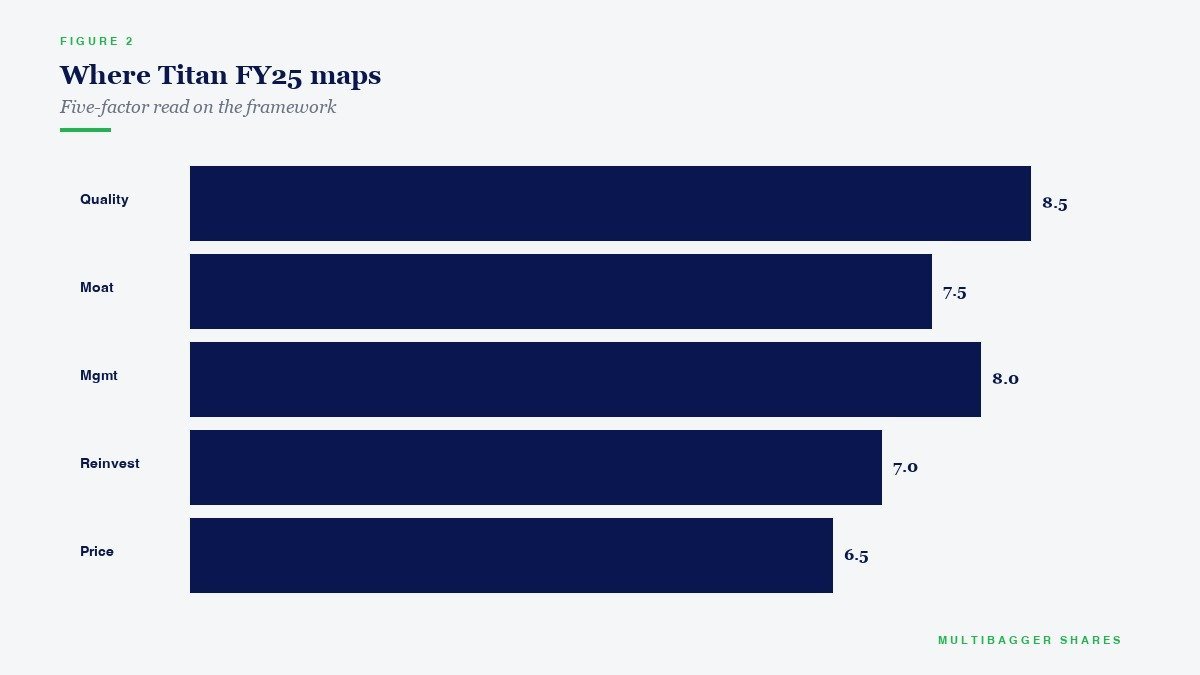
Bottom line: This is a SELECTIVE market — not a time to buy everything, and not a time to sell everything. It is a time to concentrate on your highest-conviction quality ideas and hold them patiently through the noise.
Five Lessons from Howard Marks for Indian Value Investors
Lesson 1 — “Being too far ahead of your time is indistinguishable from being wrong.” Even if you identify a quality business early, you need patience. The market may take years to recognize what you see. Titan Biotech’s promoters who held and increased their stake for years understand this deeply.
Lesson 2 — “The biggest investing errors come not from factors that are informational or analytical, but from those that are psychological.” Your biggest enemy is not bad data — it is your own emotions. When the SENSEX drops 1,400 points on geopolitical fears (as it did last week), your instinct screams “SELL!” But your rational mind, trained by Marks’ framework, should whisper “this is cyclical — stay the course.”
Lesson 3 — “Risk means more things can happen than will happen.” Most investors think risk is the probability of losing money. Marks teaches us that risk is the RANGE OF OUTCOMES. A debt-free company with consistent earnings (like Titan Biotech with 28.6% EPS CAGR) has a narrow range of outcomes — most of them positive. A leveraged, cyclical company has a wide range — including catastrophic ones.
Lesson 4 — “You cannot predict. You can prepare.” Stop trying to guess whether NIFTY will hit 25,000 or 22,000 next month. Instead, build a portfolio of quality businesses bought at reasonable prices, held with conviction, and resilient across cycles. That is preparation, not prediction.
Lesson 5 — “The most profitable investment actions are by definition contrarian.” When everyone is buying SME IPOs at 200x P/E, the contrarian buys an under-researched quality small-cap. When everyone is panic-selling on Trump tariff headlines, the contrarian accumulates. The profits come from being right WHEN OTHERS ARE WRONG — and cycle awareness is what gives you the conviction to be contrarian.
How to Start Using Cycle Awareness Today
If you want to master Howard Marks’ market cycle framework, here is your action plan:
Step 1: Read “Mastering the Market Cycle” by Howard Marks. It is the single best book on understanding market cycles ever written.
Step 2: Start a “cycle journal.” Every week, write one paragraph assessing where you think each major cycle (economic, credit, psychology, valuation) currently stands. Over time, you will develop an intuitive sense for cyclical shifts.
Step 3: When making any investment decision, ask yourself: “Am I buying this because it is genuinely undervalued, or because the current cyclical environment is making it FEEL exciting?” If it is the latter, you are buying at the wrong point in the cycle.
Step 4: Build your investing knowledge systematically. Our Free Value Investing Course on YouTube covers everything from fundamental analysis to behavioral finance — exactly the skills you need to position through cycles: Watch the Free Course Here
Step 5: Focus on quality. In every cycle — bull, bear, or sideways — the companies with the strongest fundamentals, cleanest balance sheets, and most capable management teams are the ones that reward patient investors. Companies like Titan Biotech, with consistent revenue growth, expanding margins, zero debt, high promoter conviction, and strong governance, are built to compound through every phase of the cycle.
Final Thought: The Cycle Will Always Turn
As Howard Marks reminds us: “Rule number one: most things will prove to be cyclical. Rule number two: some of the greatest opportunities for gain and loss come when other people forget rule number one.”
Today’s euphoria will pass. Tomorrow’s fear will pass. The cycle always turns. Your job as an intelligent investor is not to predict the turns, but to POSITION for them — holding quality businesses with deep conviction, staying disciplined when others lose their heads, and understanding that the greatest wealth is built not by timing the market, but by giving time IN the market to businesses that truly deserve your capital.
Stay focused. Stay disciplined. Think in cycles, not headlines.
📢 Join Our Telegram Channel
Get daily value investing lessons, stock analysis & Titan Biotech updates — delivered straight to your phone!
✈️ Join @longtermequityy on Telegram
🔔 Free • No spam • Value investing insights daily
Disclaimer: This article is for educational and informational purposes only. It is not investment advice, and not a buy, sell, or hold recommendation on any stock mentioned, including Titan Biotech Limited. Equity markets carry risk; please do your own research or consult a qualified professional before making investment decisions.
