In the Indian stock market, there is one silent killer that has destroyed more retail investor wealth than any market crash, any earnings miss, or any global crisis. It is called promoter pledging — and most investors do not even know it exists until it is too late.
When promoters of a company pledge their shares as collateral to secure personal or business loans, they create a ticking time bomb on the Balance Sheet. If the stock price drops below a trigger level, lenders can sell those pledged shares in the open market — often in large blocks — causing a catastrophic crash that wipes out ordinary shareholders who had no idea this risk existed.
The list of Indian companies destroyed by promoter pledging is long and painful — Zee Entertainment, Essel Group, Satyam Computer Services, Reliance Communications, DHFL, and dozens of small-caps that simply vanished. In each case, minority investors bore the brunt of a risk that was entirely created by the promoters’ personal financial decisions.
In this deep-dive, we examine why Titan Biotech’s zero-pledging track record is not just a governance checkbox — it is one of the most important safety signals in the entire fundamental analysis framework.
How Promoter Pledging Destroys Shareholder Wealth
The mechanics of pledging-driven destruction are brutally simple. A promoter borrows money — say ₹100 Cr — and pledges their shares as collateral. The lender values the collateral at, say, 50% of market value, creating a loan-to-value ratio. If the stock price falls 20-30%, the collateral value drops below the required threshold, triggering a margin call. The promoter must either deposit more shares, inject cash, or the lender sells the pledged shares in the open market.
Here is where it becomes catastrophic: when lenders sell large blocks of pledged shares, the stock price falls further. This triggers more margin calls on the remaining pledged shares. Which triggers more forced selling. Which crashes the price further. This is the dreaded pledging death spiral — a vicious cycle that can take a stock from ₹500 to ₹50 in weeks, while ordinary shareholders watch helplessly as their wealth evaporates.
The worst part? The promoter was borrowing money for personal reasons or other business ventures — not for the listed company’s benefit. The minority shareholders are bearing the downside of a risk they never agreed to and never benefited from.
Titan Biotech’s Clean Pledging Record: 12 Quarters of Zero Pledging
Let us examine Titan Biotech’s shareholding pattern across the last 12 quarters to verify the company’s pledging status.
The data speaks for itself. Across 12 consecutive quarters, Titan Biotech’s promoters have maintained exactly 0.00% pledged shares. Not a single share has been pledged as collateral — ever. The promoter holding has remained rock-stable at 55.78-55.87%, with the tiny 0.09% variation likely due to the share split (₹10 to ₹2 face value) that occurred in early 2026.
This level of stability is extraordinary in the Indian small-cap universe, where promoter pledging and stake changes are alarmingly common.
Why Zero Pledging Matters: The Governance Triangle
Zero promoter pledging is not just a standalone metric — it connects to three fundamental aspects of governance quality that together create a governance triangle of trust.
1. Financial Independence of Promoters: When promoters do not need to pledge their shares for loans, it signals that they are financially self-sufficient. They are not using the listed company’s stock as a personal ATM. Titan Biotech’s promoters clearly have the financial discipline to manage their personal affairs without creating risk for minority shareholders.
2. Alignment of Interests: Promoters who hold 55.78% of the company — with zero pledging and zero dilution — have their wealth completely tied to the company’s success. Every ₹1 increase in the stock price directly benefits them. This creates the strongest possible alignment between promoters and minority shareholders. There is no perverse incentive to extract value through pledging, related-party tunnelling, or short-term stock price manipulation.
3. Absence of Hidden Leverage: A company may report a Debt/Equity ratio of 0.06x on its Balance Sheet — as Titan Biotech does. But if the promoters have pledged their shares for personal loans, there is hidden leverage lurking outside the company’s books that can destabilise the stock at any moment. Zero pledging means the D/E ratio tells the complete story — there is no off-balance-sheet risk that investors need to worry about.
The Quadruple Governance Lock: Beyond Just Pledging
Titan Biotech does not just pass the zero-pledging test. It passes all four critical governance checkpoints that serious value investors should demand from any small-cap investment.
Passing all four governance checks simultaneously is remarkably rare in the Indian small-cap universe. When you consider that roughly 40% of small-caps have zero pledging, 50% have zero dilution, 35% have rising promoter stakes, and 30% are near-debt-free — the probability of finding a company that passes all four is extremely low. Yet Titan Biotech clears every single hurdle.
The Equity Dilution Story: A Masterclass in Restraint
Perhaps the most under-appreciated aspect of Titan Biotech’s governance is the complete absence of equity dilution. The company’s equity capital has remained constant at ₹8 Cr for over a decade. During this period, Reserves grew from ₹8 Cr to ₹148 Cr, revenue grew from ₹39 Cr to ₹156 Cr, and the company built a third manufacturing plant.
Not a single rights issue. Not a single QIP. Not a single preferential allotment to promoters or institutional investors. Every rupee of growth was funded through internal cash flows and retained earnings. In a market where small-cap promoters routinely dilute shareholders to fund expansion — or worse, to fund personal expenses through preferential allotments at discounted prices — this level of restraint is governance gold.
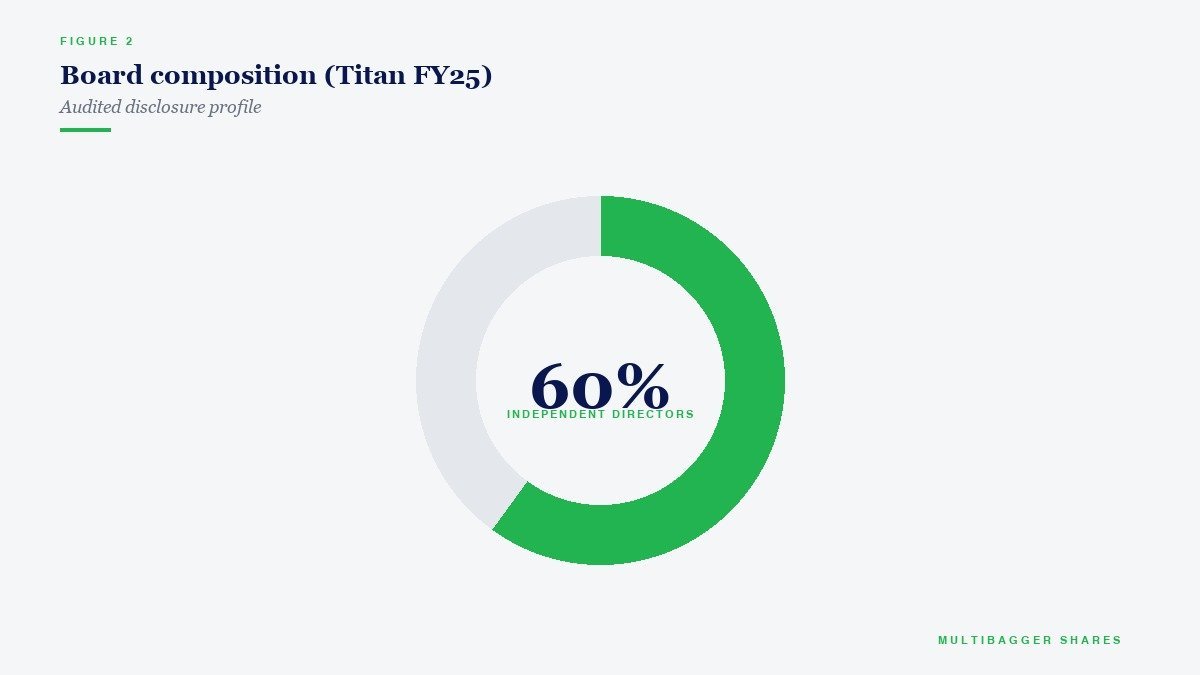
When a promoter holds 55.78% and refuses to dilute despite having the ability to raise capital at elevated valuations, it tells you they value their ownership stake more than short-term capital. This is the mindset of an owner-operator, not a promoter-manager.
Case Studies: What Happens When Pledging Goes Wrong
To appreciate why zero pledging matters, one must study what happens when pledging goes wrong. In the Indian market, there is no shortage of cautionary tales. Promoter groups that aggressively pledged shares during bull markets found themselves in unrecoverable death spirals when markets corrected. In each case, the stock price crash was triggered not by any deterioration in business fundamentals, but entirely by the forced selling of pledged shares. Retail investors who had bought these stocks based on strong quarterly numbers were left holding worthless paper.
The common pattern in all pledging disasters is depressingly similar: high promoter pledging (often 60-90% of their holding), followed by a market correction, followed by margin calls, followed by forced selling, followed by a death spiral that no amount of good business fundamentals can stop.
Titan Biotech’s 0% pledging is not just a nice-to-have governance feature — it is an insurance policy against this entire category of risk. No matter how severely markets correct, there are no pledged shares that can be force-sold. The stock price may fluctuate with market sentiment, but it will never suffer the catastrophic, permanent destruction that pledging-driven forced selling causes.
The Concentrated Portfolio Advantage
As Warren Buffett has always advocated: “Wide diversification is only required when investors do not understand what they are doing.” When you build a concentrated portfolio of 8-15 deeply researched quality stocks — rather than the “di-worse-ification” that Peter Lynch warned about — governance quality becomes absolutely critical. One bad apple with high pledging in a concentrated portfolio can devastate your returns. Zero pledging eliminates this risk entirely.
For conviction investors who run concentrated portfolios, Titan Biotech’s governance profile is ideal. The combination of 55.78% promoter holding (strong skin in the game), zero pledging (no forced-selling risk), zero dilution (full ownership preservation), and near-zero debt (D/E 0.06x) creates a governance fortress that allows you to hold the stock with confidence through market cycles.
Key Takeaways for Indian Investors
Before investing in any small-cap or mid-cap stock, make the pledging check your very first governance filter. Go to the company’s shareholding pattern on BSE/NSE and look at the “Pledged/Encumbered” column. If promoter pledging exceeds 20%, consider it a red flag. If it exceeds 50%, treat it as an automatic disqualification regardless of how attractive the financials look.
After clearing the pledging filter, check for equity dilution history — has the company issued new shares in the last 5 years? Then verify promoter stake direction — is it stable, rising, or declining? Finally, check the company’s debt levels to ensure there is no hidden financial stress that might tempt promoters to pledge in the future.
Titan Biotech passes all four tests with flying colours. Zero pledging, zero dilution, stable-to-rising promoter stake of 55.78%, and a D/E ratio of just 0.06x. In a market where governance failures destroy wealth more frequently than business failures, this clean governance profile is not merely reassuring — it is a fundamental pillar of the investment thesis itself.
Disclaimer: This article is for educational and informational purposes only. It is not investment advice, and not a buy, sell, or hold recommendation on any stock mentioned, including Titan Biotech Limited. Equity markets carry risk; please do your own research or consult a qualified professional before making investment decisions.
