April 8, 2026
(Wednesday)
The Man Who Turned ₹5,000 Into ₹500+ Crore — Without a Single Blue-Chip Stock
While most investors chase Reliance, HDFC Bank, and Infosys, one man has quietly built a fortune exceeding ₹500 crore by buying companies most people have never heard of — and holding them for decades. His name is Vijay Kedia, and his secret weapon is a deceptively simple framework he calls SMILE.
Today, with the SENSEX hovering around 73,720 and the NIFTY 50 near 22,840 amid geopolitical uncertainty (oil surging past $110/barrel on Iran-Strait of Hormuz tensions), markets are anxious. But Vijay Kedia would tell you this is exactly when you should be studying businesses — not staring at ticker screens. The RBI’s rate decision tomorrow adds another layer of short-term noise. Ignore it. Focus on what matters: finding extraordinary businesses when they are still small, unnoticed, and cheap.
In this comprehensive guide, we will decode Vijay Kedia’s SMILE framework letter by letter, show you how he has applied it to build a ₹1,000+ crore public portfolio of 21 concentrated positions, and teach you how to use the same principles to identify the next multibagger hiding in plain sight in Indian markets.
Who Is Vijay Kedia? The Backstory of an Unlikely Legend
Born in Kolkata into a family of stockbrokers, Vijay Kedia entered the stock market at the age of 19. But unlike his family members who traded for quick profits, Kedia was drawn to a different path — identifying small, unknown companies with massive potential and holding them with extraordinary conviction.
His early years were filled with failures. He lost money multiple times. He was nearly wiped out in the 1992 Harshad Mehta crash. But each failure taught him something invaluable: the importance of understanding a business deeply before committing capital. By 33, he founded Kedia Securities (P) Ltd and formalized his investment philosophy into the SMILE framework that would go on to create generational wealth.
His track record speaks for itself. Kedia bought Atul Auto at around ₹20 — it went to ₹600+. He bought Cera Sanitaryware early — a legendary multibagger. He identified Vaibhav Global, Sudarshan Chemical, and dozens of other hidden gems years before the market noticed them. His philosophy? “Buy right and sit tight.”
The SMILE Framework Decoded: Five Filters for Multibagger Hunting
Vijay Kedia shared his SMILE principle publicly on social media: “SMILE principle: Small in Size, Medium in Experience, Large in Aspirations, and Extra Large in Market Potential.” But there’s a hidden fifth dimension — the “I” — which Kedia associates with Integrity of management. Let us decode each letter:
S — Small in Size (Market Capitalization)
Kedia’s first filter is brutally simple: look where nobody else is looking. He targets companies with small market capitalizations — typically under ₹1,000-2,000 crore — because this is where the most explosive growth potential lies. When a company is small, even modest improvements in revenue and margins can translate into massive percentage gains in the stock price.
Think about it mathematically. If a company with a ₹500 crore market cap doubles its earnings, institutional investors suddenly take notice. Mutual funds start buying. Analyst coverage begins. The re-rating from “unknown” to “discovered” alone can double or triple the stock price — on top of the earnings growth. This is the discovery premium that small-cap investors enjoy and large-cap investors never will.
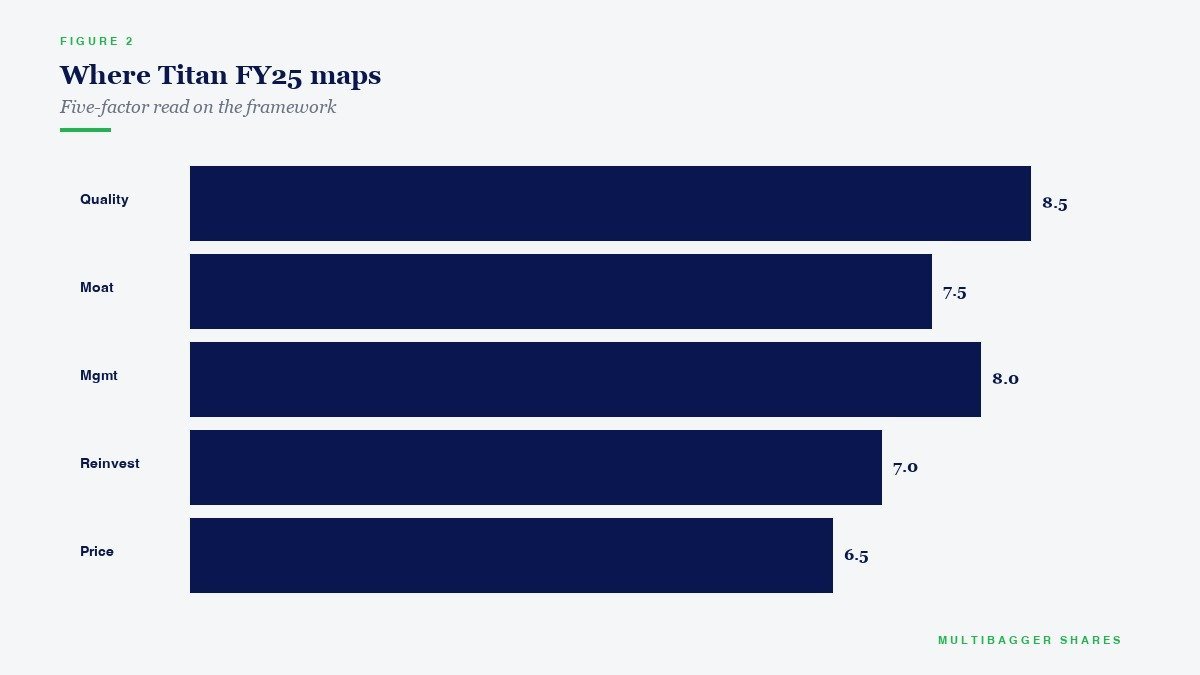
Consider Titan Biotech (BSE: 524717) as a perfect example. Currently trading at around ₹503 with a market cap of approximately ₹2,080 crore, Titan Biotech was once a tiny, unknown company that most investors had never heard of. It operated in the niche but growing space of biological products — agar, peptones, and culture media used by pharmaceutical and biotech companies. Years ago, when its market cap was a fraction of today’s value, investors who recognized its potential and held on patiently have seen extraordinary returns. With a ROCE of 16.9% and ROE of 15.0%, the company demonstrates exactly the kind of capital efficiency Kedia looks for in small-cap gems.
Key lesson: Don’t chase large-caps that everyone already owns. The real wealth in Indian markets is created by identifying quality small-caps before the crowd discovers them. As Warren Buffett himself said: “Wide diversification is only required when investors do not understand what they are doing.” Kedia doesn’t own 50 stocks — he owns 21 high-conviction positions. Concentrate on your best ideas.
M — Medium in Experience (Business Maturity)
This is perhaps Kedia’s most nuanced filter. He doesn’t want startups with zero track record — too risky. But he also doesn’t want 50-year-old behemoths with saturated markets — too little growth potential. He targets companies in the “medium experience” sweet spot: businesses that have been operating for 5-15 years, have proven their business model works, but still have enormous room to scale.
A company with medium experience has survived the early death phase (where 90% of startups fail), has established customer relationships, has a management team that has navigated at least one business cycle, and has demonstrated that its products or services have genuine market demand. But it hasn’t yet reached the maturity phase where growth slows to single digits.
In Indian markets, this often means looking at companies that have crossed ₹200-500 crore in annual revenue but haven’t yet reached ₹5,000 crore. They’ve proven they can execute, but the market hasn’t fully priced in their growth potential. Many of Kedia’s biggest winners — Atul Auto, Vaibhav Global, Cera Sanitaryware — were in exactly this sweet spot when he first invested.
Key lesson: The best time to buy a company is after it has proven its model works but before the market has fully recognized its potential. Too early is gambling. Too late is paying a premium. Medium experience is the Goldilocks zone.
I — Integrity of Management
Kedia places enormous weight on management quality and integrity. He has famously said: “I invest in people, not just businesses.” In Indian markets, where corporate governance scandals regularly destroy shareholder wealth, this filter is absolutely critical.
What does Kedia look for in management?
First, skin in the game. Promoters must have a significant personal stake in the company. If promoters are selling shares while telling you the company has a bright future, run. Look for promoters who are increasing their stake over time. Titan Biotech’s promoters, for instance, hold approximately 55.87% of the company — a strong signal of alignment with minority shareholders.
Second, capital allocation discipline. Great managers don’t just grow revenue — they grow profitable revenue. They don’t waste cash on empire-building acquisitions or vanity projects. They reinvest earnings at high rates of return and return excess cash to shareholders through dividends. They maintain clean balance sheets with minimal or zero debt.
Third, transparency and communication. Kedia prefers managements that communicate openly in annual reports, conference calls, and shareholder meetings. Companies that hide behind complex corporate structures, related-party transactions, or vague disclosures are red flags.
Fourth, a track record of promises kept. Does management do what it says it will do? Go back through three to five years of annual reports and check whether the management’s stated goals were actually achieved. Consistent execution is the strongest indicator of integrity.
Key lesson: In India, the single biggest risk to your investment is not the market — it’s dishonest or incompetent management. Kedia’s SMILE framework puts integrity at the center for a reason. No amount of growth potential can compensate for management that doesn’t respect minority shareholders.
L — Large in Aspirations
Kedia wants companies run by ambitious, visionary leaders — not caretaker managers content with steady single-digit growth. He looks for management teams that dream big, that want to transform their company from a small player into a market leader, that are investing in R&D, expanding capacity, entering new markets, and building brands.
But aspiration alone isn’t enough — it must be backed by action. Kedia looks for tangible evidence of ambition: new product launches, capacity expansion plans, geographic expansion into new states or export markets, investment in technology and automation, and talent acquisition at the senior level.
In Indian markets, you can often gauge management aspiration by reading the “Management Discussion and Analysis” section of annual reports. Companies with large aspirations paint a vivid picture of where they want to be in 5-10 years and lay out concrete steps to get there. Companies with small aspirations talk about “maintaining our position” and “steady growth.”
Atul Auto, Kedia’s largest holding (approximately 20.91% stake, valued at around ₹231 crore), perfectly embodies this principle. Starting as a small Gujarat-based three-wheeler manufacturer, Atul Auto’s management aspired to become a dominant player in last-mile connectivity — not just in India but in developing countries globally. That aspiration, backed by consistent execution, is what attracted Kedia decades ago and what has created extraordinary wealth.
Key lesson: Back management teams that think 10x, not 10%. The difference between a stock that doubles and a stock that goes up 50x often comes down to whether management is playing for market leadership or just trying to survive.
E — Extra-Large in Market Potential
The final filter in Kedia’s SMILE framework is arguably the most important: the company must operate in a market with massive, expanding potential. A brilliant management team running a company in a dying industry will still produce mediocre returns. But even an average management team in a booming industry can generate good returns. Kedia wants both — great management in a great market.
What makes a market “extra-large” in potential?
Structural tailwinds. Is the industry benefiting from long-term demographic, economic, or regulatory trends? India’s growing middle class, rising healthcare spending, infrastructure buildout, and digital transformation are creating massive tailwinds for dozens of industries. Kedia looks for companies riding these secular trends.
Low penetration. Is the product or service still reaching only a fraction of its potential market? In India, with 1.4 billion people and vast underserved markets, many industries are at 10-20% penetration. Companies that can grow simply by expanding into underserved geographies or customer segments have enormous runway.
Global export potential. The best Indian small-caps aren’t just serving the domestic market — they’re building export businesses that can 5-10x their addressable market overnight.
Titan Biotech operates in the biological products and life sciences space — an industry with extra-large market potential as global pharma and biotech R&D spending accelerates. The company’s products (agar, peptones, culture media) are essential inputs for pharmaceutical manufacturing, food testing, and scientific research. With a book value of ₹40.3 per share and consistent profitability, it is quietly building a niche global franchise in a market that is expanding rapidly.
Key lesson: Always ask: “How big can this company become?” If the answer is “2-3x at best,” it’s not a SMILE stock. Kedia targets companies where the addressable market is 10-50x the current revenue. That’s where 100x returns come from.
Kedia’s Portfolio in 2026: SMILE in Action
As of December 2025 regulatory filings, Vijay Kedia’s public portfolio comprises 21 stocks valued at approximately ₹1,000-1,100 crore. Notice: 21 stocks, not 200. This is concentrated, high-conviction investing — the polar opposite of mindless diversification.
His portfolio reflects his current investment themes: India’s infrastructure buildout, green energy transition, last-mile connectivity, cybersecurity, specialty chemicals, and hospitality/tourism. Every single holding fits the SMILE framework — small in size when he first bought, medium in experience, led by management with integrity and ambition, operating in markets with extra-large potential.
His largest position remains Atul Auto (~20.91% stake), followed by concentrated positions across engineering, capital goods, and emerging technology companies. Kedia doesn’t trade — he holds. His average holding period for his best performers is measured in decades, not quarters.
How to Apply the SMILE Framework: A Practical Checklist for Indian Investors
Here is a practical step-by-step process to apply Kedia’s SMILE framework to find your next multibagger:
Step 1: Screen for Small Size. Use Screener.in to filter for companies with market caps between ₹200-2,000 crore, positive operating profit, and at least 5 years of financial history. This typically gives you 300-500 companies to work with.
Step 2: Filter for Medium Experience. From this list, eliminate companies less than 5 years old (too risky) and those more than 30 years old with no growth (too stagnant). Focus on the sweet spot: companies with 5-15 years of operating history that are still growing revenue at 15%+ CAGR.
Step 3: Investigate Integrity. For each remaining candidate, check: (a) Promoter holding — is it above 50%? Is it increasing? (b) Related party transactions — are they excessive? (c) Auditor changes — have they changed auditors frequently? (d) Pledge percentage — any pledged shares? (e) Read the last 3 annual reports — does management communicate transparently?
Step 4: Assess Aspiration. Read the Management Discussion & Analysis section. Is management talking about doubling revenue? Entering new markets? Building new capacities? Or are they just maintaining status quo? Look for concrete capex plans, R&D investments, and new product launches.
Step 5: Validate Extra-Large Market Potential. Research the industry. What is the total addressable market (TAM)? What percentage has the company captured? Are there structural tailwinds (government policy, demographic shifts, technology adoption) that will expand the market over the next decade?
Step 6: Concentrate and Hold. Once you’ve found 5-8 stocks that pass all five SMILE filters, allocate meaningfully. Don’t dilute your portfolio across 50 names. As Kedia practices: buy right and sit tight. Let compounding do the heavy lifting over years and decades.
Common Mistakes When Applying SMILE
Mistake #1: Confusing “small” with “penny stock.” Kedia buys small-cap quality companies, not ₹2 stocks with no revenue. Every SMILE candidate must have a real business, real profits, and real competitive advantages. Small size refers to market cap relative to potential, not to absolute stock price.
Mistake #2: Ignoring integrity because growth looks exciting. Many investors fall in love with a company’s growth story and ignore governance red flags. In India, this is the fastest way to lose money. Kedia has avoided dozens of “exciting” companies because the promoter’s integrity didn’t pass his filter. Remember: fraud can erase 100% of your capital overnight. Even a mediocre business with honest management will at least preserve your principal.
Mistake #3: Selling too early. The biggest returns in Kedia’s portfolio came from stocks he held for 10-20+ years. If you sell a genuine SMILE stock after it doubles, you miss the 10x and 50x that comes from years of compounding. Kedia’s advice: never sell a stock just because the price has gone up. Only sell if the business fundamentals have deteriorated or if management integrity has been compromised.
Mistake #4: Over-diversifying. If you’ve done the work to identify a genuine SMILE stock, why would you allocate only 2% of your portfolio to it? Kedia’s largest position (Atul Auto) represents over 20% of his public portfolio. He has the courage of his convictions. Wide diversification, as Buffett reminds us, “is only required when investors do not understand what they are doing.”
SMILE and the Current Market Environment
With the SENSEX at approximately 73,720 and volatility elevated due to Iran-related geopolitical tensions and oil at $110+/barrel, many investors are paralyzed with fear. The RBI’s upcoming rate decision adds another layer of uncertainty.
But here’s what Vijay Kedia would say: market volatility is the SMILE investor’s best friend. When markets fall, quality small-caps with strong fundamentals get dragged down with the tide — creating opportunities to buy extraordinary businesses at ordinary prices. Kedia made some of his best investments during periods of maximum pessimism.
The current environment is actually ideal for SMILE hunting. Many quality small-caps that were overpriced six months ago are now trading at reasonable valuations. Use this window to do your research, apply the five SMILE filters rigorously, and build positions in your highest-conviction ideas.
And whatever you do, stay away from F&O trading. SEBI’s own study confirms that 9 out of 10 individual traders in the Futures & Options segment incur net losses. F&O is gambling dressed up as sophistication. Real wealth — the kind Vijay Kedia has built — comes from buying quality small-cap businesses and holding them for decades. No leverage. No options. No speculation. Just deep research, high conviction, and extraordinary patience.
Learn More: Free Value Investing Course
If Vijay Kedia’s SMILE framework has inspired you to learn value investing from the ground up, I invite you to watch our complete free value investing course on YouTube: Watch the Full Course Here. This comprehensive series covers everything from reading balance sheets to identifying multibaggers using frameworks like SMILE, our 95-factor analysis model, and the lessons of the greatest investors in history.
📢 Join Our Telegram Channel
Get daily value investing lessons, stock analysis & Titan Biotech updates — delivered straight to your phone!
✈️ Join @longtermequityy on Telegram
🔔 Free • No spam • Value investing insights daily
Disclaimer: This article is for educational and informational purposes only. It is not investment advice, and not a buy, sell, or hold recommendation on any stock mentioned, including Titan Biotech Limited. Equity markets carry risk; please do your own research or consult a qualified professional before making investment decisions.
