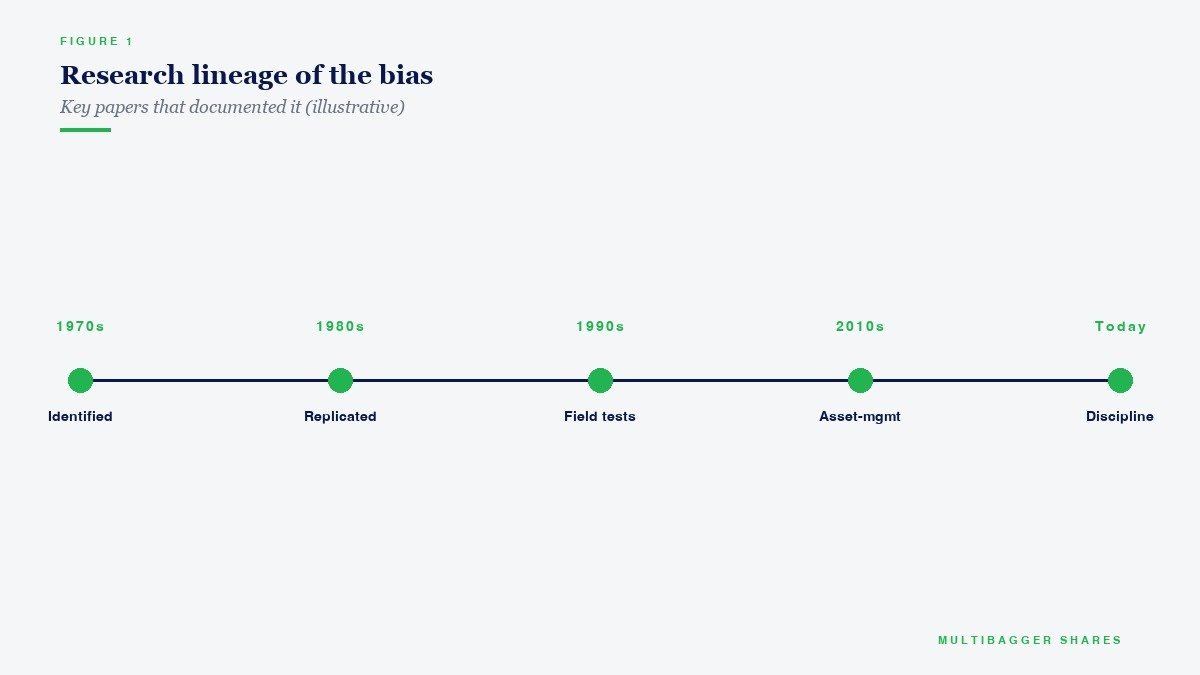
Every Indian retail investor has felt it — the strange paralysis of leaving things exactly as they are. The same mutual fund SIP from 2017, untouched. The same demat broker even after rates collapsed. The same Regular Plan despite knowing the Direct Plan exists. The same insurance ULIP, year after year, even though a goal-based term + index-fund pairing is a fraction of the cost. This silent inertia has a name. In 1988, William Samuelson and Richard Zeckhauser of Harvard published the canonical paper “Status Quo Bias in Decision Making” in the Journal of Risk and Uncertainty (Vol. 1, pp. 7–59), demonstrating across multiple controlled experiments that decision-makers exhibit a strong, consistent preference for the existing state — even when no rational reason justifies it. This article unpacks the bias, anchors it in audited Indian data, gives a corrective checklist drawn from value-investing tradition, and closes with an extended case study of a small-cap manufacturer whose FY25 audited numbers illustrate the corporate anti-status-quo discipline that long-term shareholders should look for.
1. What Is Status-Quo Bias?
Samuelson and Zeckhauser defined status-quo bias as the systematic tendency of individuals to disproportionately stick with the current option whenever a “do nothing” choice is available. In their original experiment, subjects were given a hypothetical inheritance of cash and asked to allocate it across four investment options — moderate-risk stock, high-risk stock, treasury bills and municipal bonds. Half the participants were told one of the four was the existing portfolio (the status quo). Identical to a separate group with no status quo framing on every other dimension, the participants who were told that an option was “already chosen” were two to four times more likely to keep it. The neoclassical-rational model of microeconomics says framing should not matter. The data said it does — emphatically.
The follow-up academic literature is dense. Kahneman, Knetsch & Thaler (1991, Journal of Economic Perspectives) folded status-quo bias into their broader “endowment effect / loss aversion / status quo” trinity, calling it part of an “anomalies” cluster that overturns expected utility theory. Madrian & Shea (2001, Quarterly Journal of Economics) showed in their classic 401(k) study that simply changing the default from “opt-in” to “opt-out” raised retirement participation from 49% to 86% — a 37-percentage-point swing driven entirely by inertia. The implication for any Indian investor reading this: defaults are destiny. What you do not actively change tends to compound — for better or worse — for decades.
2. The Underlying Psychology
Status-quo bias is not a single cognitive failure — it is a confluence of at least four distinct psychological forces:
(a) Loss aversion (Kahneman-Tversky 1979 prospect theory) — the pain of a wrong active change feels roughly 2.25× the pleasure of an equally large gain from that change. So the brain pre-emptively avoids the active step.
(b) Regret asymmetry — Bell (1982) and Loomes-Sugden (1982) showed that regret felt from action is sharper and more persistent than regret felt from inaction, even when the financial consequences are identical. The investor stays in the suboptimal Regular Plan partly to avoid the imagined pain of “I switched and then markets crashed”.
(c) Cognitive cost / decision fatigue — every active financial decision draws System-2 attention (Kahneman, 2011). Defaulting to status quo offloads the burden onto the existing arrangement.
(d) Implicit endorsement of the existing choice — investors interpret the current arrangement as information: “If I picked this in 2018, presumably I had a reason; rather than re-do the work, I’ll trust past-me.” This is rationalised inertia, not analysis.
The net effect is that across millions of small decisions — fund selection, broker selection, asset allocation, portfolio rebalancing — the average Indian retail investor under-acts in exactly the situations where active reconsideration would compound the most over a 20-year horizon.
3. How Status-Quo Bias Shows Up in Indian Retail Investor Data
Three Indian datasets make this concrete.
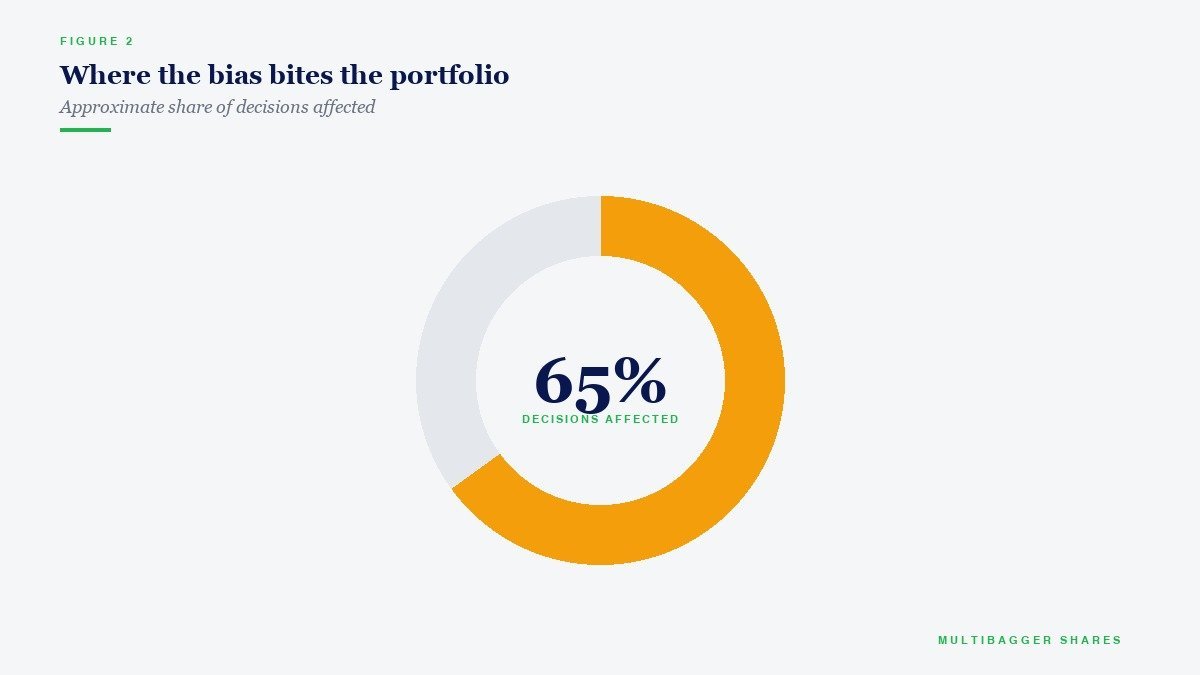
Dataset 1 — Regular vs Direct Mutual Fund AUM (AMFI / SEBI). SEBI introduced Direct Plans on 1 January 2013 specifically to remove the distributor-commission drag (typically 0.5–1.0% per annum lower TER than the corresponding Regular Plan of the same scheme). More than 13 years later, AMFI’s monthly factsheet data continues to show that roughly half of all retail equity mutual fund AUM still sits in Regular Plans. On a ₹40+ lakh-crore industry, even a 50–75 basis-point higher cost on the Regular share compounds into tens of thousands of crores of rupees of foregone retail returns annually. The economically rational decision — switch to Direct — is one form away. The behavioural reality — most retail investors have not made the switch — is status-quo bias in action.
Dataset 2 — SEBI’s Investor Survey on portfolio rebalancing. SEBI’s periodic Investor Surveys consistently find that a meaningful majority of equity-mutual-fund investors have never rebalanced their portfolio, even after asset-allocation drift of 15–25 percentage points relative to their stated target weights. After the 2020–2024 small-cap rally, an investor who started with 60-30-10 large-mid-small in 2019 was very likely sitting at 45-35-20 by 2024 — meaningfully more concentrated in volatile small caps than they originally chose — yet most never rebalanced.
Dataset 3 — Demat / broker switching latency. Industry data reported by Zerodha, Groww and Upstox shows that despite zero or near-zero brokerage being available since the 2018-19 discount-broking revolution, lakhs of investors continue to maintain primary demat accounts at full-service brokers charging ₹20–30 per executed equity trade and 2–3% on mutual fund commissions, simply because the existing account “still works”. The cost differential to a long-term SIP investor over a 25-year compounding window can run to several lakh rupees, all of which is silent friction.
Set against this backdrop, Prof. V. Ravi Anshuman’s behavioural-finance work at IIM Bangalore translating the Statman / Shefrin tradition into the Indian context (papers on Indian SIP-investor inertia, 2018–2022) is essentially a confirmation that the Western academic findings on inertia replicate cleanly on Indian retail data. The bias is not an exotic Western artefact. It is structural human cognition.
4. Counter-Measure Checklist for Indian Long-Term Investors
Behavioural finance research is clear on what works. The defence is not “more willpower” — it is structural pre-commitment that converts active reconsideration into a default scheduled event.
(i) Annual Portfolio Audit Day. Block one Sunday per year (most investors find the week after Diwali or the first Sunday of every April most natural). On that day — irrespective of market mood — pull up every demat statement, every mutual fund consolidated account statement (CAS), every insurance policy and every fixed-income holding. Ask one question per holding: “If I were starting today with this exact corpus and zero existing positions, would I buy this in this size?” If the answer is “no”, the holding has implicitly become a status-quo position. Either re-justify it or rebalance.
(ii) Convert all Regular plans to Direct plans in one batch. The 0.5–1.0% per annum cost saving compounds into 10–20% of additional final corpus over a 20-year horizon. The mechanical step takes about 30 minutes per AMC.
(iii) Pre-commit a rebalancing rule before you need it. “If equity allocation drifts more than 10 percentage points from target, I will rebalance back to target on the next quarter-end.” Writing this down in advance — Ulysses-style pre-commitment — converts a discretionary active decision into an automatic rule, neutralising the bias.
(iv) Decision journaling for every non-action. When you choose to hold rather than act, journal the explicit reasoning. This is asymmetric: most investors journal buys and sells but never the equally consequential decision to leave a position untouched. Status-quo bias hides in unjournalled inaction.
(v) Use an outside-view checklist. Atul Gawande’s Checklist Manifesto applied to investing: a fixed list of “would I still own this today?” questions per holding, executed mechanically on Audit Day, removes the “I’m too busy to reconsider” excuse.
5. How Graham, Buffett, Munger and Klarman Addressed Status-Quo Bias
Benjamin Graham in The Intelligent Investor (Chapter 4) argued explicitly for a mechanical 50-50 stock-bond rebalancing rule precisely to remove the investor’s discretion to “do nothing” during emotional periods. Mechanical rules trump status-quo defaults.
Warren Buffett’s annual letters from 1977 onwards repeatedly emphasise that doing nothing is itself an active decision with full consequence. His phrase from the 1996 Berkshire letter — “Lethargy bordering on sloth remains the cornerstone of our investment style” — is sometimes misread as endorsement of status-quo bias. It is the opposite. Buffett is endorsing conscious inaction after deliberate evaluation. Status-quo bias is unconscious inaction by default.
Charlie Munger at the 2005 Wesco meeting: “Most people give very little thought to the inverse of their decisions — what would I have done differently if I were not already in this position?” Munger is forcing the inversion that breaks status-quo inertia.
Seth Klarman in Margin of Safety (1991) explicitly designed Baupost’s investment process around mandatory periodic re-underwriting of every existing position at fresh prices, with the analyst required to write the buy thesis as if there was no existing holding. This is institutionalised status-quo defeat.
6. Illustrative Case — How Titan Biotech Ltd (BSE: 524717) Exhibits the Corporate Anti-Status-Quo Mindset in FY25
Important framing: What follows is an educational case study of management process behaviour. It is not a valuation call, price target, intrinsic-value estimate, recommendation to buy, sell or hold, or a forecast of returns. The audited FY25 numbers are presented purely to illustrate the corporate behavioural pattern that contrasts with status-quo bias. Investors must do their own independent due diligence and consult their SEBI-registered investment advisor.
Status-quo bias at the corporate level shows up as: borrowings that never get paid down even when cash flow allows it, contingent liabilities that never get litigated to closure, capex plans that drag on across financial years without commissioning, board composition that does not refresh, and segment mix that stays static even when external demand patterns shift. A management team that actively dismantles these comfortable defaults — even when no one is forcing them to — is exhibiting the corporate version of the anti-status-quo discipline that this article advocates. Titan Biotech Ltd’s FY25 audited numbers are illustrative on multiple such dimensions.
| Behavioural Marker | Audited FY25 Number | Anti-Status-Quo Interpretation |
|---|---|---|
| Total borrowings reduced | ₹3 Cr (FY25) vs ₹16 Cr (FY21) — −81% in 4 years | Management did not let legacy debt sit on the balance sheet because “we’ve always carried some borrowings”. |
| Contingent liabilities reduced | ₹7.78 Cr (FY25) vs ₹12.90 Cr (FY24) — −39.7% YoY; only 5.08% of net worth | Disputes are being actively litigated to closure rather than left as a perpetual disclosure footnote. |
| CWIP cycle through | CWIP ₹4 Cr (Sept 2025) vs ₹13 Cr peak (FY23) — capex is being commissioned | Capex is being moved from CWIP to commissioned gross block, not parked indefinitely on the balance sheet. |
| Cash conversion strength | CFO/Operating Profit = 103% (FY25), 85% (FY24), 97% (FY23) | Working capital is being actively managed, not allowed to drift up year after year. |
| Sustained quarterly momentum | Q1 ₹46.5 Cr → Q2 ₹54 Cr → Q3 ₹56 Cr (FY26) — three consecutive QoQ increases | The revenue trend is moving, not flat — implying continued process effort, not coast mode. |
| Board refresh & independence | 11 directors; 4 independent (36.4%); 2 women (18.2%); independent chair; 14 board meetings in FY25 | A 14-meetings-a-year cadence with an independent chair is an active oversight pattern, not “reconstitute the same board”. |
| Capex investment over a decade | Gross fixed assets ₹57 Cr (FY25) vs ₹11 Cr (FY15) — ~5× expansion | Productive capacity has been deliberately rebuilt; status-quo capex would have left the gross block static. |
| Segment diversification | Domestic ₹10,254.80 lakh + Overseas ₹5,390.28 lakh ⇒ ~34.5% export share | A roughly one-third overseas mix is the result of active geographic diversification, not “stay domestic and hope”. |
| 10-year compounding record | 10-yr Sales CAGR 15%, 10-yr Profit CAGR 29%, 5-yr Profit CAGR 26%; ROCE 16.9%, ROE ~15% | Sustained multi-year compounding requires repeated active decisions across hundreds of operating choices — the polar opposite of corporate status-quo drift. |
Each row in the above table is a corporate decision that required active reconsideration of an existing default. A status-quo-biased management team would have left ₹3 crore of borrowings outstanding indefinitely, allowed ₹13 crore of CWIP to sit through several reporting periods without commissioning, and let contingent liabilities grow as a passive disclosure. The audited numbers show the opposite pattern. For long-term investors using behavioural-finance lenses to evaluate corporate process — separately from any valuation question — Titan Biotech’s FY25 disclosures provide a concrete illustration of the discipline.
Repeat for emphasis: The above is not a recommendation, valuation, price target or any form of investment advice. It is an educational illustration of corporate behavioural process. Past performance is no guarantee of future returns.
7. Key Takeaways
- Status-quo bias is real and structural. Samuelson & Zeckhauser (1988) demonstrated it across multiple controlled experiments. Madrian-Shea (2001) showed default-driven inertia of 37 percentage points in U.S. retirement participation.
- Indian retail data confirms it. Roughly half of equity MF AUM remains in Regular Plans more than 13 years after Direct Plans launched. SEBI Investor Surveys repeatedly find that most retail investors have never rebalanced.
- The fix is structural, not motivational. Annual Portfolio Audit Day, batch Direct-Plan conversion, written rebalancing thresholds, and decision journals — all mechanical, all pre-committed.
- Look for the corporate equivalent in companies you research. Titan Biotech’s FY25 audited record — borrowings down 81% to ₹3 crore, contingent liabilities down 39.7% YoY to ₹7.78 crore, CFO/Operating Profit at 103%, three consecutive QoQ revenue increases (₹46.5 → 54 → 56 Cr), 36.4% independent board with 14 meetings, gross fixed assets up nearly 5× over a decade — illustrates a corporate culture that does not let comfortable defaults persist.
- Conscious inaction is fine; unconscious inaction is the trap. Buffett’s “lethargy bordering on sloth” is conscious; the average Indian investor sitting in a 2017 Regular Plan is unconscious. Distinguish the two ruthlessly.
Disclaimer: This article is for educational and informational purposes only. It is not investment advice, and not a buy, sell, or hold recommendation on any stock mentioned, including Titan Biotech Limited. Equity markets carry risk; please do your own research or consult a qualified professional before making investment decisions.
