Value Investing — Educational Series
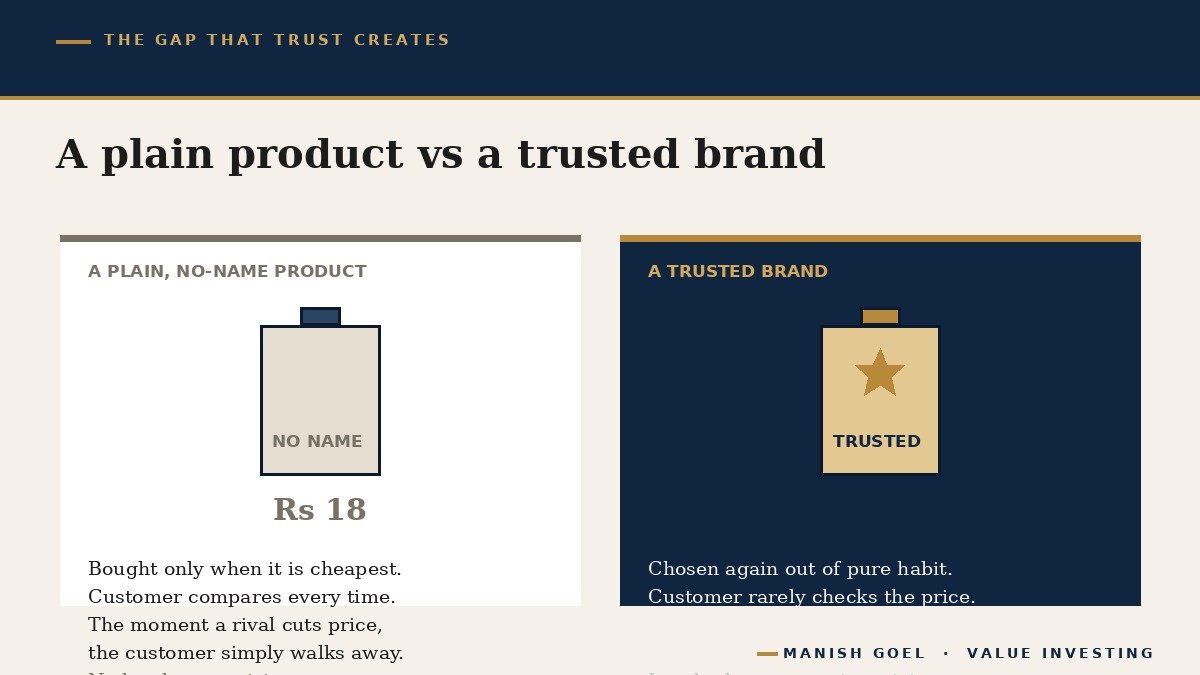
Walk into your nearest kirana shop (the small neighbourhood grocery) and look at the salt. Often there are two choices. One is loose salt, scooped from a sack, with no name on it. The other is a sealed packet carrying a name your family has trusted for years. The loose salt is cheaper. Yet most of us quietly reach for the trusted packet and happily pay a few rupees more. We do not stop to think. We do not compare the chemistry. We simply trust the name.
That tiny moment holds one of the quiet secrets behind many of the world’s greatest businesses. The extra few rupees you paid was not for better salt. It was for trust. And when millions of people pay a little extra for a name, day after day, year after year, that name becomes one of the most valuable things a company can own. Investors have a word for this lasting edge. They call it a brand moat — and today, in the simplest words, let us understand what it is, why it is so powerful, and how you can learn to spot it.
What a “brand moat” really means
Let us break the phrase into two simple pieces. A brand is really just trust stored inside a name. When you see a name you know, your mind quietly fills in a promise: this will taste the same as last time, this will not cheat me, this will work. You have felt that promise a thousand times without noticing it.
A moat is the second piece. In the old days, a moat was the ring of water dug around a castle to keep attackers out. In business, a moat (a durable edge that protects a company from its rivals) does the same job. It keeps competitors from easily stealing a company’s customers and profits. Warren Buffett, one of the most successful investors ever, often says he looks for a wonderful business sitting safely inside a wide moat, like a strong economic castle that rivals cannot storm.
Put the two pieces together and you get a brand moat: a name so trusted that customers keep choosing it again and again, often paying a little more, without shopping around. The product may be ordinary — salt, soap, paint, biscuits, chocolates, noodles. But the trust around the name is extraordinary, and that trust is very hard for a rival to copy. A competitor can build the same factory in a year. Building the same trust can take thirty years — if it can be built at all.
Why a trusted brand is such a powerful edge
A brand moat helps a business in three quiet but powerful ways. Once you see them, you will notice them everywhere.
First, trust lowers the buyer’s risk, so people stop comparing. When you buy a tube of toothpaste for your child, you do not want to gamble. A trusted name removes the worry. You pick it up almost by habit and move on. That habit means the company spends less effort chasing each sale, because customers come back on their own — a bit like a regular chaiwala (tea seller) whose loyal customers return every morning without being asked.
Second, repeat buying brings steady sales and gentle pricing power. Pricing power (the ability to raise prices a little without losing your customers) is one of the surest signs of real quality. If a company can lift its price by a rupee or two each year and people barely flinch, its profits can grow quietly in the background. A business without trust cannot do this; the moment it raises its price, customers walk to the cheaper shelf.
Third, a brand costs very little to keep alive, so the profits compound. A strong, established brand does not need a new factory every year to keep earning. It needs steady quality and a sensible amount of advertising. Because so little extra money has to be poured back in, the cash it throws off can pile up year after year. This is the magic of compounding (earning returns on top of your past returns — like interest on interest, or a snowball growing as it rolls downhill). A trusted brand is a snowball that can roll for decades.
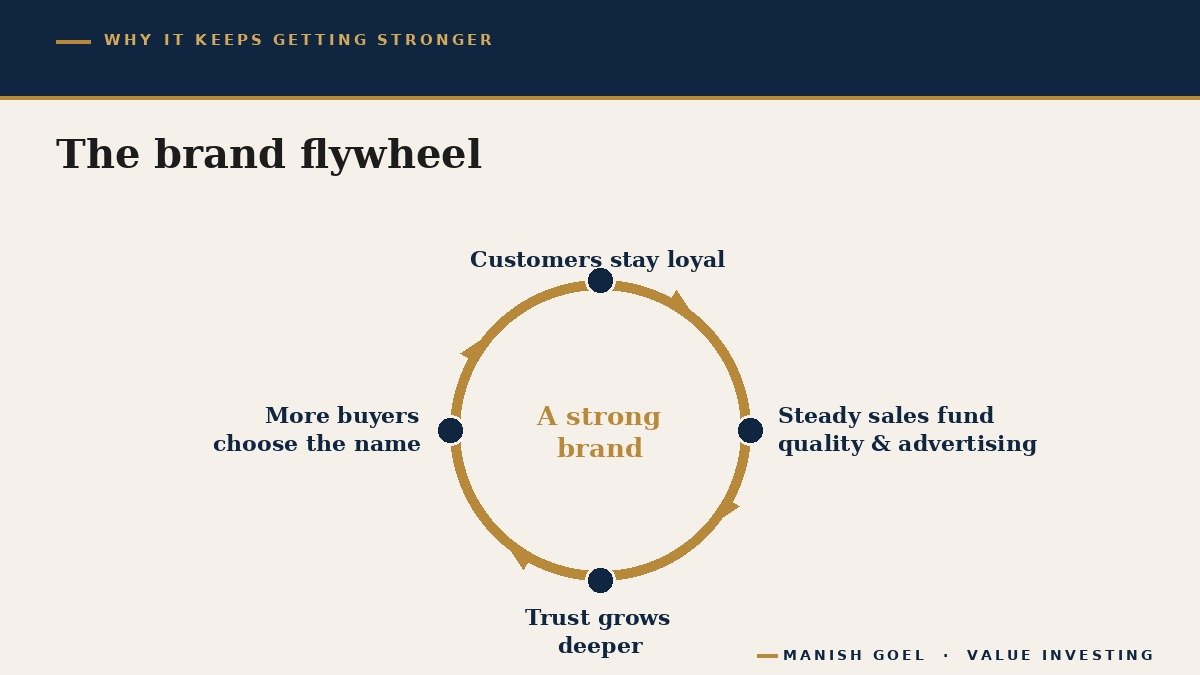
Notice how these three forces feed one another, like a heavy wheel that gets easier to turn once it is moving. Happy customers come back and tell their friends. That steady demand pays for good quality and a little advertising. Better quality and a familiar name deepen the trust. Deeper trust brings even more loyal customers. Round and round the wheel goes, and with every turn the rival outside the moat falls a little further behind. Think of how a name like Amul or Tata Salt or Colgate became part of ordinary Indian homes — not through one clever advertisement, but through decades of keeping the same promise, again and again.
There is one more reason a brand moat matters so much to a patient investor. Most edges in business fade. A clever new product gets copied. A cheaper rival appears. A technology becomes old. But genuine trust, built slowly and guarded carefully, tends to last longer than almost anything else. A child who grows up watching a trusted name in the family kitchen often keeps buying it as an adult, and passes it on to the next generation. That is why a brand moat is so prized: it is one of the few advantages that can survive across decades, quietly compounding while flashier businesses come and go. For a long-term investor, a durable edge is worth far more than a brilliant but short-lived one.
Two real stories: a candy box and a packet of noodles
Stories make this idea stick, so let us look at one famous Western example and one we all know in India.
In 1972, Warren Buffett and his partner Charlie Munger bought a small American chocolate company called See’s Candies for 25 million dollars. At the time, it earned about 4 million dollars a year before tax — a fair, not flashy, business. But See’s had something rare: customers in California loved it. They gifted it at Christmas and on special days. They simply would not switch to a cheaper box. Because of that loyalty, Buffett and Munger could raise the price a little almost every year. A box that cost around 2 dollars a pound back then sells for roughly 25 dollars a pound today. The wonderful part is that the company needed very little extra money to keep going. Over the decades, that small candy business has sent Berkshire Hathaway more than 2 billion dollars in profit on the original 25 million it paid. The chocolate was nice. The brand was the real treasure. Buffett later said this purchase taught him to prize a great business with a loyal name over a merely cheap one.
Now an Indian story every household remembers. For decades, Maggi noodles were a beloved two-minute snack in millions of Indian kitchens. Then, in June 2015, India’s food safety regulator ordered the product off the shelves over a safety scare, and several states banned it. The brand that once held more than 80 percent of the instant-noodles market suddenly disappeared. Its owner, Nestlé India, lost hundreds of crores of rupees, and many people wrote the brand off for dead. But here is the lesson. A few months later, the courts cleared fresh tests, and Maggi quietly returned to shelves in November 2015. Customers did not need much convincing. They had missed it. Within a year it had won back over half its market, and soon climbed past 60 percent again. A weaker name would have stayed buried. The trust people felt for Maggi acted like a cushion, helping it survive a blow that would have destroyed a brand nobody loved. That is the hidden strength of a real brand moat: it can take a hard hit and still come home.
How you can spot a brand moat
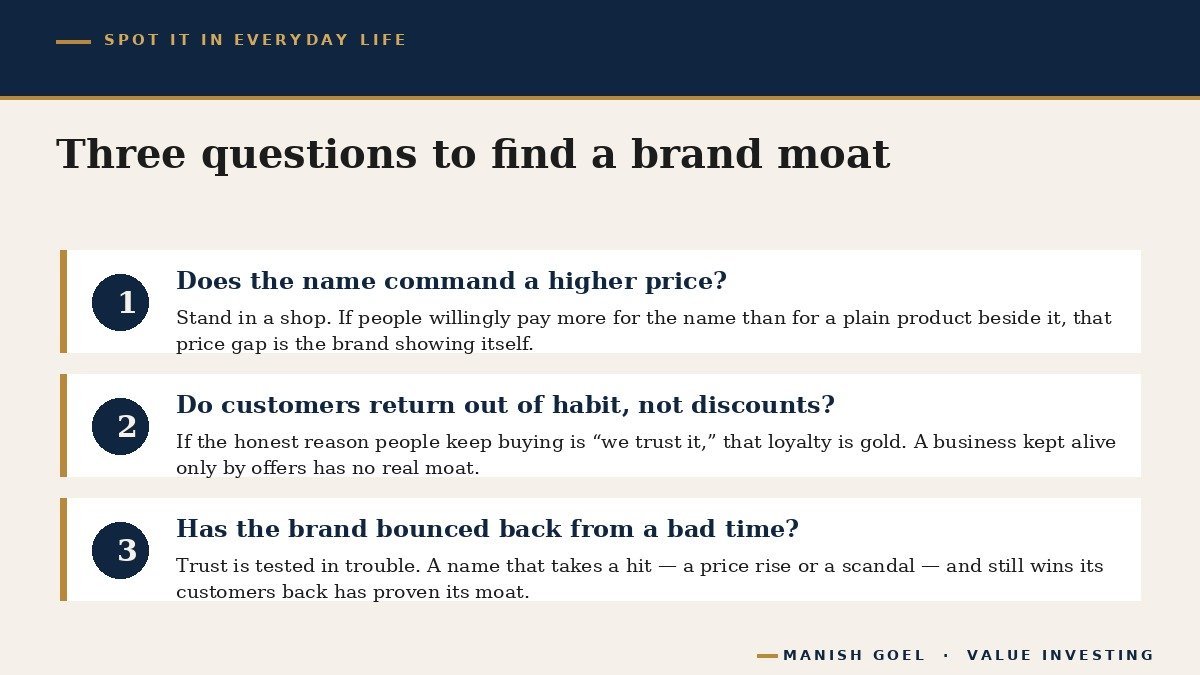
You do not need a finance degree to recognise a brand moat. You mostly need to watch the world around you, the way Peter Lynch (a famous investor who liked ideas drawn from everyday life) advised ordinary people to do. Here are three simple questions to ask.
One: does the name command a higher price? Stand in a shop and compare a branded product with a plain one beside it. If people willingly pay more for the name — for the paint, the biscuit, the salt, the toothpaste — that price gap is the brand showing itself. No price gap usually means no real brand moat.
Two: do customers come back out of habit, not just price? Ask yourself and your family why you buy a certain product. If the honest answer is “we have always used it and we trust it,” that loyalty is gold. A business kept alive only by discounts and offers has no moat; the day the offer stops, the customer leaves.
Three: has the brand survived a bad time and bounced back? Trust is best tested in trouble — a price rise, a scandal, a tough competitor, a year like the Maggi ban. A name that takes the hit and still wins its customers back has proven its moat the hard way. A name that quietly fades after one setback never had much of a moat to begin with.
One honest word of caution, because trust must run both ways. A brand is only as good as the promise behind it. If a company starts cutting corners on quality to squeeze out a little more profit, the trust can leak away slowly and then collapse suddenly. So a brand moat is not magic; it is a promise that has to be kept, year after year. The best businesses guard their good name far more carefully than they guard any single year’s profit — and that very care is what keeps the moat wide.
Key takeaways
- A brand is simply trust stored inside a name, and a brand moat is a name so trusted that customers keep choosing it — often paying a little more — without shopping around.
- A trusted brand helps a business in three ways: it lowers the buyer’s risk so people stop comparing, it allows gentle price rises, and it needs little extra money to maintain, so profits can compound for years.
- See’s Candies turned a loyal name into more than 2 billion dollars of profit on a 25 million dollar purchase, mostly by quietly raising prices its devoted customers happily paid.
- When Maggi was banned in 2015, customers missed it so much that it returned and won back most of its market — proof that a beloved brand can survive a hard blow.
- To spot a brand moat, ask three plain questions: does the name command a higher price, do customers return out of habit rather than discounts, and has the brand bounced back after a bad time?
— Manish Goel
Disclaimer: This article is for educational and informational purposes only. It is not investment advice, and not a buy, sell, or hold recommendation on any stock mentioned. Equity markets carry risk; please do your own research or consult a qualified professional before making investment decisions.
