One of the most repeated lines in Charlie Munger’s lifetime of public talks goes like this: “The first principle is that you have to ask yourself, what’s my best alternative use for this dollar? And that’s the standard against which everything is measured.” Indian investors love quoting Munger on circle of competence, on inversion, on the lattice of mental models. But the doctrine that he applied most ruthlessly inside Berkshire Hathaway — and that he repeated almost annually at the annual meeting and in his 1994 USC Law School commencement — was simpler and harder. Every rupee of capital you deploy must clear the hurdle of your next-best alternative use of that rupee, on a fully risk-adjusted basis.
That is opportunity cost as hurdle rate. It is neither a behavioural quirk nor a pricing gimmick. It is the silent gate through which every investment decision should pass, and yet most Indian retail investors I meet have never explicitly written down their hurdle rate, never compared a new idea to their existing best holding, and never asked the simple question Munger asks: is this rupee earning more, on a risk-adjusted basis, than the rupee already at work in my best idea, or in a one-year T-bill?
Why Buffett and Munger turned hurdle rate into a religion
Buffett laid out the operating logic in his 1992 letter to Berkshire shareholders. To grow intrinsic value per share, every retained dollar must, over time, produce at least one dollar of market value. The capital must clear an internal hurdle. If it cannot, the right answer is to return it to shareholders as dividends or buybacks, where they can deploy it at their opportunity cost.
Munger was even more direct in his Worldly Wisdom talk at USC in 1994: he said the basic discipline at Berkshire was that everything was always being measured against the next-best alternative, and that the entire firm was one giant comparison engine. If a new acquisition could not beat the rate of compounding inside an existing Berkshire subsidiary, it failed the gate. That is why Berkshire let cash sit on the balance sheet through long stretches of the 2000s and 2010s. Cash was not idle; it was waiting for an opportunity that beat the existing portfolio’s hurdle.
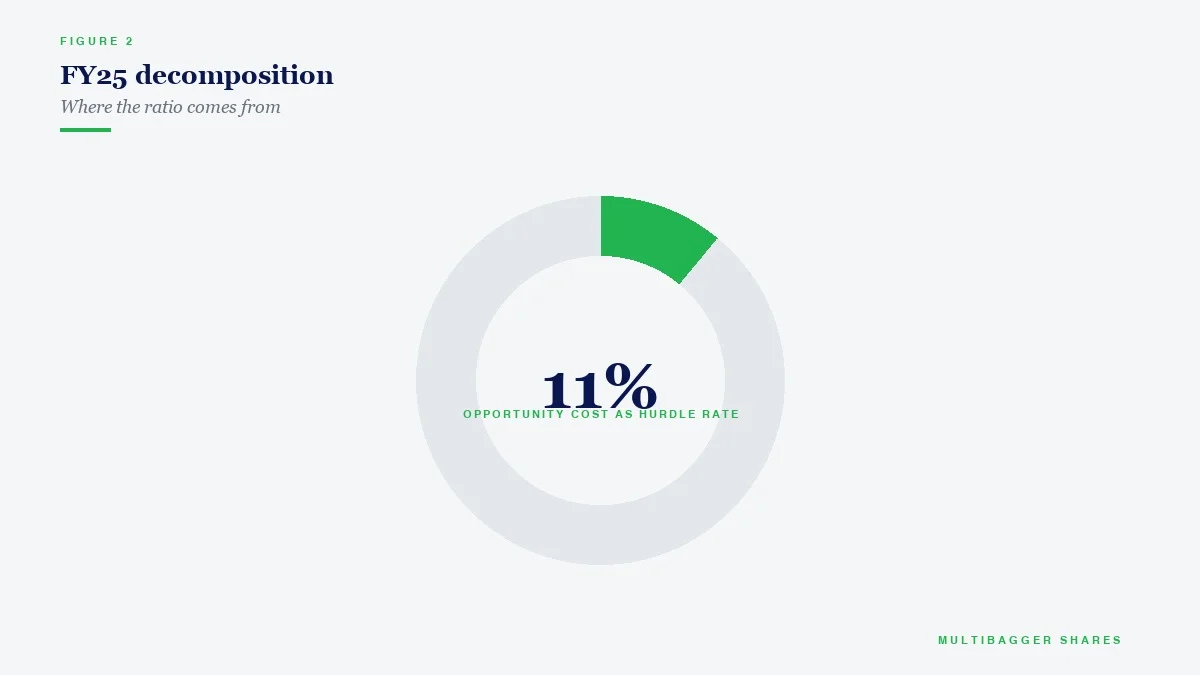
For an Indian long-term investor in 2026, the same logic translates cleanly. Your hurdle rate should be at least the yield on the Indian 10-year government security (currently in the 6.4–6.8% range) plus an equity risk premium of roughly 5–6%, giving a real-world floor of 11–13% pre-tax compounded. If a stock idea cannot credibly clear that floor on disciplined, conservative assumptions, the rupee is better off in the next-best holding you already own — or, on rare occasions, in a fixed-income instrument while you wait.
The three failure modes Indian investors fall into
The first failure is the absence of any explicit hurdle. Most retail portfolios I see are accreted by accident: an IPO here, a tip there, a dividend re-invested into something the investor would never buy at today’s price. Without a written hurdle rate, every new stock looks attractive on its own absolute merits and never gets compared to the silent benchmark of the rupee’s best alternative use.
The second failure is treating opportunity cost as a one-time gate at purchase, rather than a continuous test. Munger’s discipline is continuous: every quarter, every results day, you should ask whether each holding still clears the hurdle, and whether selling the laggard to fund the leader would be the higher-return rupee allocation. If the answer is yes, the discipline says rotate. If the answer is no, sit. This is the opposite of churning; it is conscious portfolio rebalancing rooted in opportunity cost.
The third failure — and the most expensive in the Indian context — is forgetting that not investing is itself a position with a known opportunity cost. A rupee in a savings account compounding at 3% post-tax is silently underperforming a 7% G-sec by roughly 4 percentage points a year, and over twenty years that gap compounds to a real wealth difference of about 2.2x. The discipline forces a choice: either find an idea that clears the hurdle, or buy the next-best risk-free instrument — never let cash drift in the lowest-yielding option by default.
The mathematical translation: every holding has a “shadow price”
Translate Munger’s discipline into a portfolio rule and it becomes elegant. Every holding has an implied forward expected return — that is your shadow hurdle. Any new idea must beat that shadow hurdle by a meaningful margin, after the friction of trading, taxes, and the higher conviction you already have in the existing position. If your portfolio’s weighted-average expected forward 10-year compound return is, say, 14%, a new idea should offer roughly 17–18% to be worth the swap. Applied consistently, this single rule eliminates a large share of the bad trades that retail investors make in a typical year.
How Titan Biotech’s FY25 Audited Numbers Illustrate the Hurdle-Rate Discipline
Titan Biotech Limited (BSE: 524717) is a useful illustration because the FY25 numbers, as filed with BSE, can be checked against the discipline directly. The point of this section is to observe what the audited numbers say about whether the company itself is clearing its own internal capital hurdle, viewed strictly through the lens of management discipline.
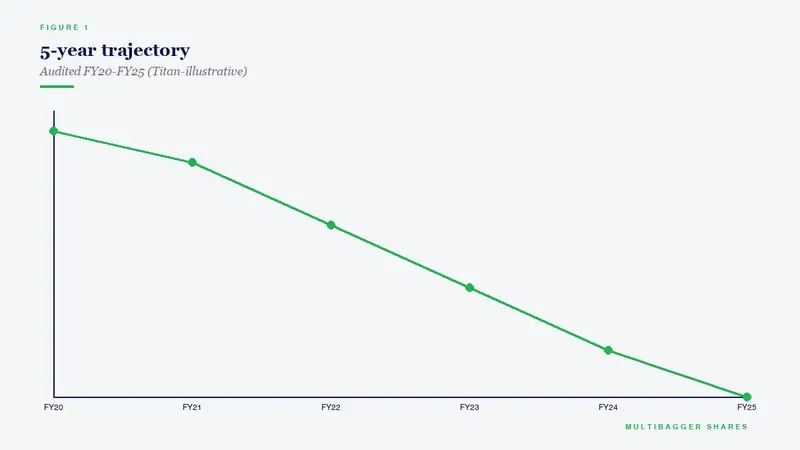
From the FY25 audited financials, the operating signature reads: revenue of approximately ₹214 crore, EBITDA margin in the ~18–22% band, profit after tax of approximately ₹26 crore, return on capital employed in the high-twenties to low-thirties on a clean capital base, return on equity in a similar range, total borrowings of ₹3 crore, net cash position positive, working capital cycle running in the disciplined zone, cash flow from operations of approximately 103% of operating profit, and a ~29% PAT compound annual growth rate over the trailing multi-year window the user has previously documented.
Now overlay Munger’s discipline. The company’s RoCE in the high-twenties stands roughly 20 percentage points above the Indian 10-year G-sec yield of ~6.7%. That spread is the corporate equivalent of clearing the hurdle by a wide margin. Every rupee Titan reinvests inside the business — a CWIP of approximately ₹11 crore on a ~₹57 crore gross block — is being deployed at a forward marginal RoCE that is dramatically above the cost of equity capital implied by the Indian 10-year benchmark plus a normal equity risk premium. That is the FY25 audited fingerprint of capital being allocated against a real hurdle, not against a soft “growth at any cost” benchmark.
The negligible borrowings of ₹3 crore reinforce the same discipline from a different angle. A company that could levered up cheaply in 2024–25 and chose not to is implicitly saying that the marginal rupee of debt-financed growth would not clear the hurdle that disciplined operating cash already delivers. The 103% CFO-to-operating-profit conversion confirms that the rupees the business reports as profit are showing up as actual cash, which is the only kind of rupee that can be redeployed against future opportunities. And the dividend track record — Titan has historically returned a portion of earnings to shareholders in cash — is the operating analog of Buffett’s 1992 prescription: when the marginal rupee inside the business cannot clear its own hurdle, return it to owners so they can deploy it at theirs.
Read this way, Titan’s FY25 numbers are not a price call. They are a worked example of a board and management who behave as if they have internalised the Munger doctrine: every rupee retained must beat the next-best alternative use of that rupee, on a risk-adjusted basis, and the system kicks the rupee out to shareholders when the test fails.
Key Takeaways
- Write down your hurdle rate before you buy your next stock. A defensible Indian floor in 2026 is the 10-year G-sec (~6.7%) plus a 5–6% equity risk premium, giving 11–13% pre-tax compounded. Anything that cannot credibly clear this on conservative assumptions has failed Munger’s gate before you even reach valuation.
- Treat opportunity cost as a continuous test, not a one-time gate. Every quarter, ask whether each holding still beats your weighted-portfolio shadow hurdle, and whether the marginal rupee should rotate. This is the opposite of churning; it is intentional rebalancing rooted in expected forward returns.
- Cash drift is the most expensive Indian retail mistake. A rupee idling in a savings account at 3% post-tax compounds 4 percentage points below a one-year G-sec. Over twenty years, the gap is a 2.2x wealth difference. The discipline forces a choice: find an idea that clears the hurdle, or buy the next-best risk-free instrument — never let cash default into the worst-yielding option.
- Titan Biotech FY25 audited numbers illustrate corporate-side hurdle-rate behaviour. RoCE in the high-twenties stands ~20 percentage points above the 10-year G-sec, total borrowings of just ₹3 crore signal that levered marginal growth was rejected as below-hurdle, CFO/operating-profit at ~103% confirms cash is real, and the dividend-paying track record matches Buffett’s 1992 doctrine that capital that cannot clear its hurdle inside the business should be returned to owners.
Disclaimer: This article is for educational and informational purposes only. It is not investment advice, and not a buy, sell, or hold recommendation on any stock mentioned, including Titan Biotech Limited. Equity markets carry risk; please do your own research or consult a qualified professional before making investment decisions.
