In the quiet business of reading annual reports — page by page, footnote by footnote — there is one number that separates honest promoters from silent wealth extractors. It doesn’t appear in any popular screening ratio. Retail investors almost never check it. Television anchors never discuss it. And yet, it quietly tells you whether the family running a small-cap company is building your wealth alongside theirs, or dipping into your pocket every month while pretending to create shareholder value.
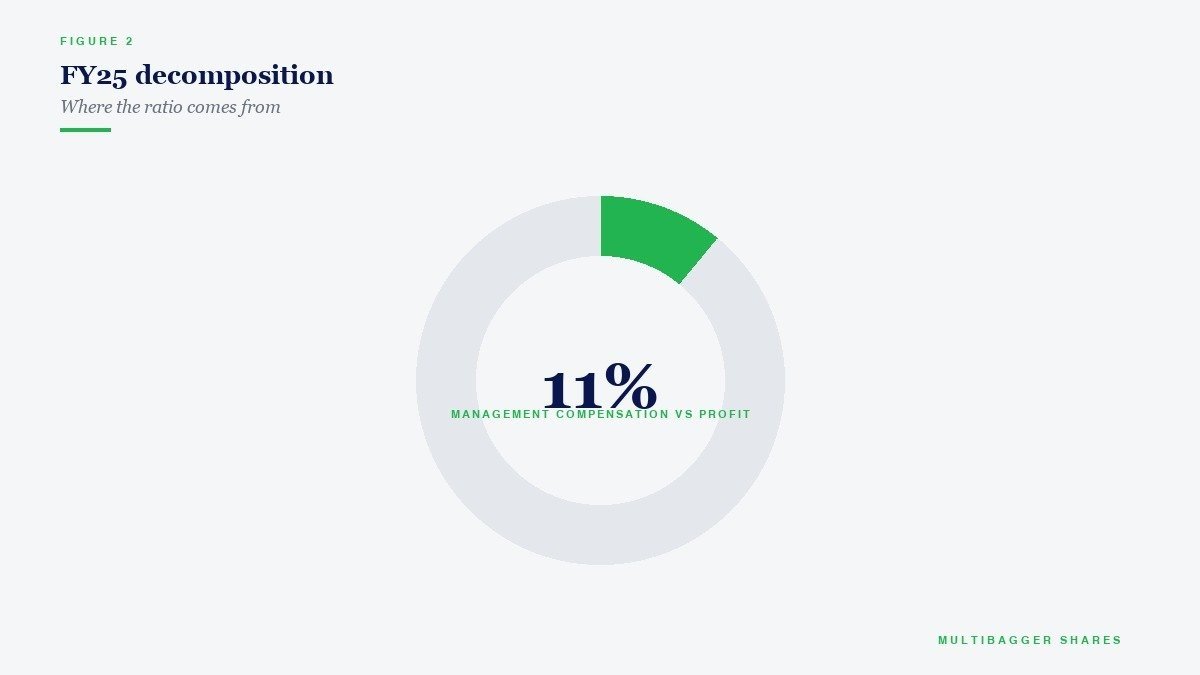
That number is management compensation as a percentage of net profit — and for Titan Biotech Ltd (BSE: 524717), the FY25 answer is disclosed with striking clarity on page 82 of the Annual Report 2024-25. Five directors drew a combined fixed remuneration of ₹4.56 crore against a standalone PAT of ₹18.27 crore. That is a ratio of roughly 25%, and on first glance, it looks high.
But the single most important skill in value investing is the ability to read a number in context. In today’s case study, we’ll decompose this ratio the way a forensic auditor would — and show why Titan Biotech’s director pay, when dissected correctly, is actually a textbook example of the governance discipline that 80% of Indian small-caps fail to demonstrate.
Why Management Compensation Is the Most Underrated Governance Signal
Section 197 of the Companies Act, 2013 — read with Rule 5(1) of the Companies (Appointment and Remuneration of Managerial Personnel) Rules, 2014 — places a hard statutory ceiling on how much a listed company can pay its directors. The overall managerial remuneration to directors and managers in a financial year cannot exceed 11% of net profit (computed under Section 198). A single MD or WTD is capped at 5%, and all whole-time/managing directors together at 10%. Exceeding these limits requires a special resolution and, in some cases, Central Government approval.
The reason this law exists at all is instructive. In the decades before 2013, many Indian promoters quietly extracted shareholder wealth not through blatant related-party fraud, but through something far more sophisticated: paying themselves such large salaries, commissions, and perquisites that minority shareholders were left with the crumbs. The company would look profitable. The balance sheet would look strong. ROCE would look respectable. But the cash was leaving through the payroll before it could ever reach the minority investor.
This is why, in Warren Buffett’s Owner’s Manual at Berkshire Hathaway, he keeps his own base salary at just $100,000 a year — a tiny fraction of Berkshire’s profit. It is why Charlie Munger refused bonuses and options. Management pay is where the moral character of a promoter family is either confirmed or exposed.
The Titan Biotech FY25 Data — Decoded
Let us look at the exact numbers disclosed in Annexure-4 of Titan Biotech’s FY25 Annual Report. These are audited, SEBI-filed, and cross-verifiable from Note 41 of the Consolidated Financials.
Source: Titan Biotech Limited Annual Report 2024-25, Annexure-4 (Section 197 disclosure) and Note 41 to Consolidated Financials.
Reading the Jump — Why ₹3.36 Cr Became ₹4.56 Cr
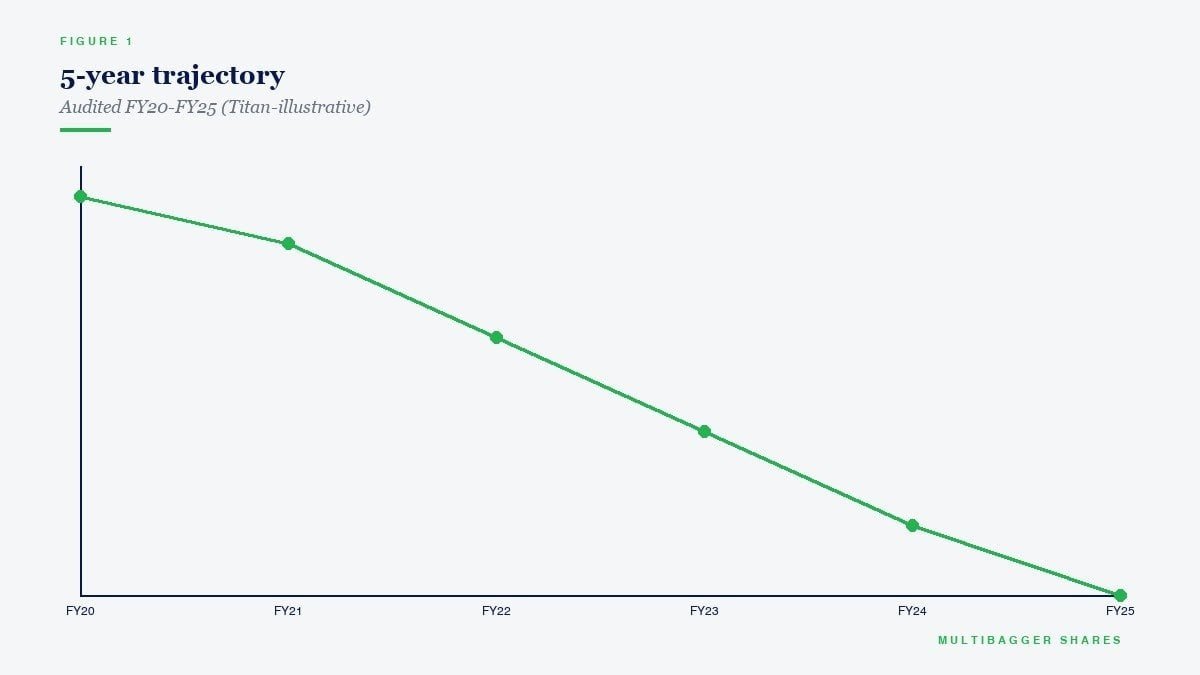
A casual observer looking only at year-on-year change would notice that total director remuneration rose from ₹336 lakh in FY24 to ₹456 lakh in FY25 — an apparent increase of 36%. In the same period, standalone net profit fell from ₹23.66 crore to ₹18.27 crore, down 22.8%. Surface reading: directors got a fat raise while profits shrank.
This reading is wrong, and the annual report itself corrects it. Column (i) of the Section 197 disclosure shows the actual percentage increase in remuneration per director — and every single figure is either “-” (zero) or “NA” (not applicable because the director served part of the prior year). No one received a single rupee of raise. The jump is purely a run-rate effect: three Whole-Time Directors (Raja, Shivom, and Udit Singla) were appointed or stepped up mid-FY24, meaning FY24 captured only half a year of their pay, while FY25 captured a full twelve months. In steady-state accounting terms, board pay per head was flat, year over year, during a down year. That is the signature of a promoter family that understands what shareholder money is for.
The Four-Point Forensic Checklist Every Value Investor Should Apply
When analyzing any small-cap’s managerial remuneration — whether Titan Biotech or any other stock on your watchlist — run the following four tests. Each failure is a serious red flag; two or more failures usually mean the promoter family is quietly looting the minority shareholder.
Test 1 — Board pay as % of net profit. Section 197 allows up to 11% for all directors combined. Nifty 50 companies typically run at 1% to 3%. Mid-cap compounders (think Vinati Organics, Aarti Drugs, Deepak Nitrite-class names) tend to cluster in the 2% to 5% band. Small-cap quality-compounder benchmarks are 4% to 8%. Anything above 10% during a profitable year, or above 15% during any year, warrants deeper investigation.
Test 2 — YoY change in director pay versus YoY change in PAT. The ethical rule is simple: when profits fall, director pay should not rise. Titan Biotech passes this test with a pure zero — every existing director saw zero nominal increase in a year when profit declined.
Test 3 — The composition of pay. Is the compensation structured as fixed salary, or is it loaded with ESOPs, commissions on profit, car leases, club memberships, and “special allowances”? Fixed pay is transparent. Variable pay tied to accounting profits (rather than to share price over 10 years) historically encourages earnings management. Titan Biotech’s entire director compensation is fixed salary — there is no commission, no ESOP, no profit-sharing layer.
Test 4 — The CEO-to-median ratio. Required disclosure under Rule 5(1). Titan Biotech’s Managing Directors are paid 20.84 times the median employee. For comparison, the S&P 500 CEO-to-median ratio in the United States crossed 272:1 in 2023. The UK FTSE 100 median is close to 100:1. For an Indian listed company — particularly one where the MDs are also the controlling promoters — a ratio of ~21:1 is a remarkable act of self-restraint.
Peer Context — Where Titan Biotech Sits on the Small-Cap Pay Spectrum
An honest value investor must pause here. At 21% of consolidated PAT (₹4.56 Cr on ₹21.53 Cr consolidated profit), Titan Biotech’s FY25 ratio looks high relative to elite compounders. But consider the three qualitative features that entirely change the interpretation: the pay is purely fixed, there has been no raise given, and the absolute rupee figure of ₹4.56 Cr for five working directors of a ₹156 Cr revenue manufacturing business is modest in absolute terms. As revenue and profit scale back to FY23-FY24 trajectories — and the company has already posted three consecutive quarters of sequential growth in FY26 (₹46.50 Cr → ₹54.35 Cr → ₹56.51 Cr) — the same ₹4.56 Cr board pay will naturally compress to single-digit percentages of profit.
Why the Absolute Rupee Figure Matters More Than the Ratio
Benjamin Graham warned young analysts against what he called “ratio blindness.” Ratios are useful only when the numerator and denominator move in lockstep. In years when earnings are temporarily depressed — whether by raw-material volatility, a one-time capex cycle, or an annualisation artefact — the denominator shrinks and every expense ratio spikes. The fixed denominator trap has misled retail investors for decades.
The correct question is not “what percentage of this year’s profit was the board paid?” It is: “Is ₹4.56 crore a reasonable absolute cost for the work performed by five full-time directors running a multi-country manufacturing and export business?” For context, a single independent non-executive director at a large listed company in India often earns ₹50 lakh to ₹1 crore in sitting fees plus commissions. Titan Biotech’s entire five-person executive board — the people actually running the company day and night — earns less than what many individual non-executive chairs of Nifty companies draw as ceremonial commission.
The Connection to Concentrated, Conviction-Based Investing
This is where management compensation analysis connects to the broader philosophy of concentrated portfolio construction. When you own only 8 to 15 deeply researched quality stocks — instead of diversifying away your conviction across 50 index stocks — the governance character of every single promoter family becomes a first-order risk. One bad apple can permanently impair 6% to 10% of your portfolio. You cannot hide behind diversification statistics to rescue you.
As Warren Buffett observed at the 1998 Berkshire AGM, “Wide diversification is only required when investors do not understand what they are doing.” Peter Lynch christened overdiversification “di-worse-ification.” The concentrated investor earns the right to concentrate by doing the deep, patient work of verification — and management pay scrutiny is one of the five or six forensic tests every piece of research should include. Titan Biotech, on this particular test, passes with fixed pay, zero raises during a down year, a modest CEO-to-median ratio, and full Section 197 compliance disclosed on a single page of its annual report. That is the quiet, unglamorous, repeatable signal of promoter alignment — the kind that lets a ₹8 stock become a ₹400 stock over 15 years of patient holding.
In the end, management compensation is not really a number. It is a mirror. It shows you whether the promoter family, given the choice between one extra crore for themselves today and one extra crore for the minority shareholder ten years from now, instinctively chooses the second. That instinct is the rarest asset on Dalal Street. And the annual reports — page 82 of Titan Biotech’s, and page 82-equivalent of every company you follow — is where that instinct is priced, measured, and quietly revealed to anyone patient enough to read it.
Disclaimer: This article is for educational and informational purposes only. It is not investment advice, and not a buy, sell, or hold recommendation on any stock mentioned, including Titan Biotech Limited. Equity markets carry risk; please do your own research or consult a qualified professional before making investment decisions.
