Choice Overload — The Bias That Quietly Paralyses Indian Retail Investors
In May 2026, the average Indian retail investor with a demat account can choose between roughly 5,000 listed equities on the NSE and BSE combined, ~1,500 distinct mutual fund schemes across more than 44 AMCs registered with AMFI, hundreds of NCDs, dozens of PMS managers, 100+ SEBI-registered AIFs, listed and unlisted REITs/InvITs, multiple ETF families, sovereign and corporate bonds across the RBI Retail Direct portal, and a growing menu of internationally accessible US ETFs through LRS-linked platforms. On paper, that abundance looks like progress: more options must mean better outcomes, because the investor can always pick exactly what suits her objective.
The behavioural-finance research of the last twenty-five years says exactly the opposite. When the option set crosses a certain cognitive threshold, decision quality collapses. Investors either freeze and refuse to decide, or pick a default at random, or assemble a portfolio out of whichever schemes their bank relationship manager pushed last quarter. The bias has a name — choice overload, sometimes called the paradox of choice — and its empirical foundation is one of the most-cited papers in 21st-century social psychology: Iyengar & Lepper (2000), "When Choice is Demotivating: Can One Desire Too Much of a Good Thing?", published in the Journal of Personality and Social Psychology, Volume 79, Issue 6, pages 995–1006.
For the serious Indian long-term investor in 2026, choice overload is not an abstract academic curiosity. It is the single best explanation for why retail SIP folios churn at 18-month medians, why 87% of mutual-fund-investing households own between 4 and 11 overlapping schemes that effectively replicate Nifty 500, and why direct-equity portfolios consistently underperform their own self-stated benchmarks. Today’s post unpacks the original Iyengar–Lepper experiment, traces the 2004 Sethi-Iyengar–Huberman–Jiang follow-up that demonstrated the same effect inside retirement portfolios, locates the bias inside Indian retail behaviour using SEBI and AMFI evidence, prescribes a four-step counter-measure checklist drawn from Graham, Buffett, Munger and Schwartz, and then closes with a dedicated case study showing how Titan Biotech Ltd (BSE: 524717)‘s FY25 audited disclosure architecture functions as a textbook positive illustration of anti-choice-overload corporate behaviour.
The Underlying Psychology — Why Too Many Choices Demotivate
Iyengar and Lepper ran three field experiments. The most famous, conducted at Draeger’s gourmet market in Menlo Park, California, set up a tasting display of premium imported jams on a Saturday. In one condition, the table held 24 different jam varieties. In the other, only 6 varieties were displayed. The researchers measured two outcomes: how many shoppers stopped at the display, and what fraction of those who stopped actually purchased a jar within an hour.
The results were counter-intuitive and durable. 60% of passing shoppers stopped at the 24-jam display, compared to 40% at the 6-jam display — wider variety pulled attention. But only 3% of the 24-jam stoppers bought a jar, while 30% of the 6-jam stoppers bought one. That is a tenfold collapse in conversion when the assortment expanded from six to twenty-four. Wider choice attracted interest but destroyed the act of choosing. The two follow-up experiments — one involving Godiva chocolates and the other involving extra-credit essay topics for university students — replicated the same direction of effect: the larger choice set produced more browsing, less commitment, lower satisfaction with the eventual choice, and more decision regret.
The underlying mechanism, as Iyengar–Lepper and later Schwartz (2004) explained, has four reinforcing components. Cognitive load: comparing 24 options on multiple attributes overwhelms working memory, which Miller (1956) showed has a capacity of about seven items plus or minus two. Opportunity-cost salience: each rejected option leaves a faint trace of regret that compounds as the set grows. Counterfactual reasoning: the more alternatives, the easier it becomes to imagine that some unselected option would have been superior, which deflates satisfaction with whichever option was finally picked. Anticipated regret: the very prospect of post-decision regret causes pre-decision paralysis, which the brain resolves by either defaulting (picking the most visible / most-advertised option), procrastinating, or refusing to decide at all.
Four years after the jam study, Sheena Sethi-Iyengar collaborated with Gur Huberman and Wei Jiang at Columbia Business School on the paper "How Much Choice is Too Much? Contributions to 401(k) Retirement Plans" (2004), included in Pension Design and Structure: New Lessons from Behavioral Finance (Oxford University Press). They examined 800,000+ employees across 647 retirement plans run by The Vanguard Group. Their headline finding: each additional 10 fund options offered inside a 401(k) plan was associated with a 1.5%–2% decline in employee participation. Plans offering 2 options had ~75% participation; plans offering 59 options had ~60% participation. The richer the menu, the more employees defaulted to no participation at all — choosing not to save for retirement was easier than choosing among 59 funds.
The Indian Manifestation — Four Pieces of Local Evidence
The choice-overload mechanism is universal, but its expression in Indian retail behaviour is unusually severe because of how aggressively the financial-services industry has multiplied product variants over the last decade. Four pieces of evidence anchor the Indian case.
First, the scheme-count explosion. AMFI’s annual industry data shows that the count of distinct mutual fund schemes (open-ended + closed-ended, excluding multiple plan/option permutations) crossed 1,500 by FY25. If one counts each plan-and-option permutation (regular plan, direct plan, growth, IDCW reinvestment, IDCW payout, segregated portfolios, etc.), the count exceeds 11,000. The Indian investor faced with this menu cannot meaningfully differentiate between, say, 40 large-cap funds that effectively replicate Nifty 100 with 80%+ portfolio overlap.
Second, the demat-account explosion without proportional skill formation. NSE-published depository data shows that demat accounts grew from roughly 4 crore in March 2019 to over 18 crore by FY25-end. That is a fourfold increase in five years. But SEBI’s research-publication library (notably the 2024 follow-up to the 2023 F&O study) shows that the share of profitable individual traders did not improve over the same window. New investors arrived into a richer choice landscape but did not acquire the skill needed to navigate it, and the result was sub-optimal selection at the moment of entry.
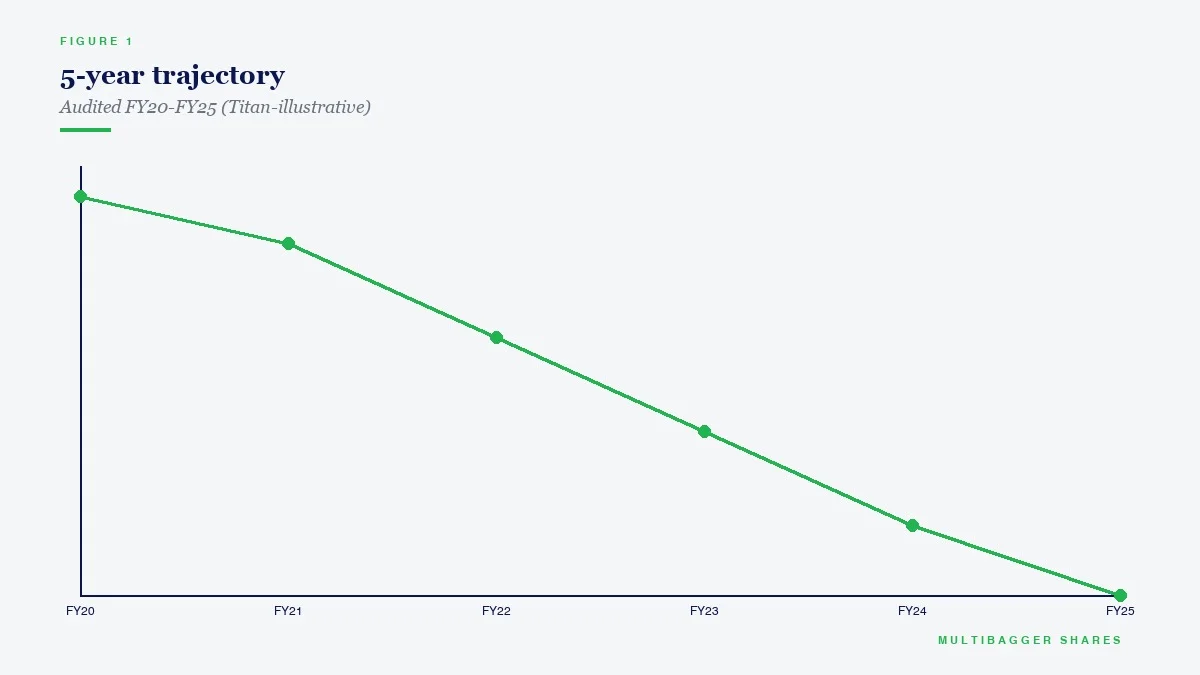
Third, SIP churn data. Industry-aggregated AMFI numbers and SEBI’s investor-behaviour studies show that the median Indian SIP folio is closed before its 22nd monthly instalment. One important contributor — separate from but compounding with hyperbolic discounting — is that the investor, having committed to one scheme, continues to encounter advertising and influencer recommendations for newer schemes. Each fresh option re-opens the choice question, and the easiest resolution is to start a new SIP and abandon the old one. Choice overload converts a multi-decade compounding plan into an 18-month rotation.
Fourth, the portfolio-replication trap. Anecdotal but increasingly documented in advisory-industry research (and in academic work by Prof. V. Ravi Anshuman of IIM Bangalore on Indian-investor portfolio composition), the average direct-equity Indian portfolio holds 9–15 stocks chosen by hand. But factor decomposition shows those 9–15 names are usually drawn from the same five sectors — IT services, large private banks, FMCG, consumer durables, and select pharma — replicating the Nifty 100 with worse diversification and higher transaction cost. The investor experiences the illusion of having actively chosen, when in fact she has been overwhelmed into picking the most familiar / most-advertised candidates from a far larger universe.
The Counter-Measure Checklist — Four Disciplines for the Indian Long-Term Investor
Choice overload is not solved by trying harder. The cognitive load is structural; willpower cannot scale to a 1,500-scheme menu. The solution is to narrow the option set BEFORE the decision begins. Four disciplines, drawn from Iyengar’s later prescriptive work, Schwartz’s Paradox of Choice, and the operational practice of Buffett, Munger and Klarman, form a workable Indian checklist.
Discipline 1 — Pre-commit to a finite shortlist. Before opening Screener.in, Moneycontrol, or your broking app, write down on paper the maximum number of names you will research this quarter — typically 5 to 8. Any candidate beyond that count goes onto a "next-quarter" list and is invisible during the current research cycle. Charlie Munger’s "too-hard pile" is the institutional version of this rule: most opportunities are not rejected on fundamentals; they are removed from the choice set before fundamentals are even examined.
Discipline 2 — Use eliminatory filters first, not comparative ranking. Schwartz distinguishes between "maximisers" (those who try to identify the single best option) and "satisficers" (those who set a threshold and pick the first option that clears it). Maximisers experience more regret, more decision fatigue, and lower satisfaction. The eliminatory equivalent in Indian equity selection is to run binary filters — Debt/Equity <0.3, ROCE>15% for 5 years, Promoter pledge=0, Auditor a Big-6 firm — and then study only the survivors. The remaining set is usually 15–40 names, which is human-scale.
Discipline 3 — Adopt the default-good architecture. Thaler and Sunstein’s Nudge (2008) showed that good defaults rescue overwhelmed choosers. For the Indian investor this means setting up a default SIP into 1–2 broad-market index funds (Nifty 50 + Nifty Next 50, or a Nifty 500 ETF) and treating direct stock-picking as the incremental activity. If you make no decision this quarter, the default keeps the engine running. Direct stocks only need to compete against this default, not against the 5,000-stock universe.
Discipline 4 — Build a personal investment policy statement (IPS). A one-page document specifying asset allocation, sector concentration limits, position-size limits, the maximum number of names you will hold, and the only conditions under which you will sell — written before you encounter any specific candidate — collapses the in-the-moment choice set to whatever satisfies the policy. The IPS is the institutional equivalent of David Swensen’s Yale Endowment process: most options are eliminated by rule, not by analysis.
How the Masters Addressed Choice Overload
Graham, Buffett, Munger and Klarman did not write papers on choice overload, but their operating discipline reads as if they had. Graham (1949, The Intelligent Investor) constrained the defensive investor’s universe to roughly 30 large, financially strong, dividend-paying names — an explicit shortlist of approximately one-tenth of the S&P 500. Buffett’s repeated "circle of competence" doctrine (1996 Chairman’s letter and onward) is an explicit eliminatory rule: most opportunities are placed outside the circle and therefore never enter the choice set. Munger’s "sit on your hands" advice and his "too-hard pile" are operational tools to keep the residual choice set down to roughly 20 names per career-decade. Klarman (1991, Margin of Safety) talked about "bottom-up bargain hunting": ignore the index, ignore the macro, scan for the rare situations where price-to-intrinsic value gives a margin of safety, and ignore everything else.
The common thread is that investing greatness is largely a function of disciplined narrowing. The masters’ competitive edge is not their ability to evaluate 1,500 options; it is their willingness to refuse to evaluate 1,495 of them. The Indian retail investor’s first edge over the industry is identical: refuse the assortment.
Illustrative Case Study — How Titan Biotech Ltd (BSE: 524717) FY25’s Audited Numbers Exhibit Anti-Choice-Overload Corporate Behaviour
This section is a purely educational study of management process. It is not a buy / sell / hold recommendation, not a valuation call, and contains no price target. The audited FY25 numbers below are presented to illustrate how a focused specialty-biotech manufacturer’s disclosed operating choices map onto the anti-choice-overload framework that the bulk of this article has developed.
Choice overload at the corporate level expresses itself as portfolio sprawl: too many product SKUs, too many manufacturing sites, too many simultaneous capex projects, too many revenue segments, too many debt instruments, too many board sub-committees, too many countries with sub-scale presence. Each addition feels like growth at the moment of decision, but the cumulative effect is management bandwidth dilution and capital fragmentation. The opposite of choice overload, in corporate terms, is deliberate narrowing: a focused product portfolio, a single core manufacturing site, a small concentrated capex pipeline, a simple capital structure, a manageable board, and a finite set of customer geographies penetrated deeply.
Titan Biotech Ltd’s audited FY25 disclosures (annual report 2024-25, consolidated financials, plus Screener.in-aggregated multi-year tables) read as a clean positive illustration of this discipline. The table below isolates the markers that bear on choice-overload avoidance.
| FY25 Marker | Audited Number | Behavioural Interpretation (Anti-Overload) |
|---|---|---|
| Product portfolio focus | ~100 SKUs across 7 specialty-biotech categories | Deep, narrow, evaluable — not a sprawling 500-SKU catalogue |
| Reporting-segment count | 2 segments: Domestic ₹10,254.80 lakh + Overseas ₹5,390.28 lakh | A binary segment structure — readers do not drown in segment tables |
| Export geographies served | ~34.5% of consolidated revenue from overseas across 60+ countries | Penetrated rather than sub-scale — focused commercial reach |
| CWIP discipline | CWIP ₹4 Cr (Sept 2025), peaked at ₹13 Cr (FY23) | Single concentrated expansion stream — not 10 parallel projects |
| Gross fixed-asset progression | ₹57 Cr (FY25) vs ₹11 Cr (FY15) — five-fold over a decade | Sequential, paced capex; not a one-shot diversification splurge |
| Capital-structure simplicity | Borrowings ₹3 Cr (FY25), down from ₹16 Cr (FY21) | Single-creditor-style stack — no menu of complex debt instruments |
| Board size and structure | 11 directors; 4 independent (36.4%); 2 women (18.2%); independent chair | Manageable board — not a 17-member committee-of-committees |
| Board meeting cadence | 14 board meetings in FY25 | High frequency on a focused agenda, not perfunctory quarterly box-ticking |
| Cash-conversion discipline | CFO/Operating Profit: 103% (FY25); 85% (FY24); 97% (FY23) | One thing done well repeatedly, not multiple weakly-converting ventures |
Read together, these nine markers describe a company that has deliberately resisted the corporate analogue of the 24-jam display. The product portfolio is narrow enough that management can keep every category in working memory. The two-segment structure means the annual report does not bury readers in disclosure permutations. The capex pipeline is concentrated, not scattered. The capital stack is simple. The board is human-scale and meets often on a focused agenda. The cash-conversion ratio is the residual proof that focus translates into operating reality: 103% of operating profit was converted into operating cash flow in FY25, with the three-year average sitting comfortably above 95%. A company drowning in choice cannot convert cash this cleanly; it must shuttle resources between competing projects, and conversion ratios drift.
For the Indian long-term investor learning to defeat choice overload in her own portfolio, Titan Biotech’s disclosure architecture is useful in a precisely analogous way: it is a small, finite, evaluable information set. The reader can absorb every audited number in one sitting. There is no menu of 24 segments to wade through. The behavioural lesson the investor is learning at her own desk — narrow the option set, refuse the assortment, deepen the work on what remains — is the same lesson the company appears to have internalised at the operating level. Again, this is an educational mapping of process onto behaviour, not a valuation verdict.
Key Takeaways
1. Choice overload is a real, measurable cognitive bias. Iyengar & Lepper (2000) showed a tenfold collapse in jam-purchase conversion when assortment widened from 6 to 24. Sethi-Iyengar, Huberman & Jiang (2004) showed each additional 10 fund options inside a 401(k) reduced participation by roughly 1.5%–2%.
2. India in 2026 is uniquely exposed. Roughly 1,500 distinct mutual fund schemes, 5,000+ listed equities, 18+ crore demat accounts and a permissive digital-broking environment have multiplied the option set without proportionally raising investor skill. The result is SIP churn, replicated portfolios, and procrastination.
3. The cure is structural, not motivational. Narrow the choice set before the decision begins via a pre-committed shortlist, eliminatory filters, a good default, and a one-page investment policy statement. Graham, Buffett, Munger and Klarman all used institutional versions of these disciplines.
4. Be a satisficer, not a maximiser. Schwartz (2004) showed that satisficers — those who set a threshold and pick the first option that clears it — experience more satisfaction, less regret, and lower decision fatigue than those who chase the single "best" option through a 1,500-scheme menu.
5. Titan Biotech Ltd (BSE: 524717) FY25 reads as a corporate-level illustration of anti-choice-overload behaviour. A ~100-SKU specialty-biotech portfolio across 7 categories, 2 reporting segments, a single-site capex pipeline with CWIP of just ₹4 Cr against a ₹57 Cr gross block, borrowings of ₹3 Cr, a manageable 11-director board with an independent chair, and a 103% CFO-to-operating-profit ratio in FY25 collectively describe a company that has deliberately refused the assortment. This is an educational case study of management process, not a valuation call, not a buy/sell/hold recommendation, and not a price target.
Disclaimer: This article is for educational and informational purposes only. It is not investment advice, and not a buy, sell, or hold recommendation on any stock mentioned, including Titan Biotech Limited. Equity markets carry risk; please do your own research or consult a qualified professional before making investment decisions.
