The Securities and Exchange Board of India introduced a quiet but seismic governance reform on 1 April 2022 through an amendment to the Listing Obligations and Disclosure Requirements (LODR) Regulations. Regulation 17(1B) was made permanent for the top 500 listed companies (later voluntary for the rest), and it required something Indian promoters had resisted for years: the Chairperson of the Board must be a non-executive director, and must not be related to the Managing Director or Chief Executive Officer. The Reserve Bank of India had already imposed a similar separation on banks in April 2021, and the Companies Act 2013 had been hinting at it through Section 149’s independent-director requirements since 2014. By the time the National Stock Exchange’s investor base crossed 11 crore unique PANs in late 2025 — up from just 3 crore in 2020 — the question of who really controls the board had quietly become the single biggest determinant of long-term capital allocation discipline at any Indian listed company. And yet, less than 1 in 4 retail investors on Indian exchanges can name the chairperson of a single company in their portfolio. This article is the foundational educational module on the metric that the smart-money side of the market reads first — before P/E, before market cap, before charts — because it tells you whether the people allocating your capital can be told “no” when they want to do something stupid. The metric is Chairperson Independence, and once you understand how to read it, you will never look at an Indian annual report the same way again.
What Is Chairperson Independence?
The Chairperson of a board of directors is, structurally, the most powerful person in any listed corporation. The Chair sets the agenda for board meetings, controls what is discussed and what is buried, decides which committees are formed and who sits on them, signs off on the appointment and removal of independent directors, and ultimately holds the executive management — the Managing Director, the CEO, the CFO — accountable to the shareholders who own the company. In a healthy governance architecture, the Chair is the shareholders’ representative at the apex of the firm, sitting above the Managing Director in functional authority, not beside or beneath. The Chair’s job is to ensure that the company’s executive team is being asked the hard questions, that capital allocation decisions are being scrutinised, that the auditor is empowered to disagree with management, and that minority shareholders — the retail investor sitting in Coimbatore or Kanpur with 47 shares — have a voice at the table even though they will never physically attend a board meeting.
Chairperson Independence is the structural and procedural test of whether the person holding this most powerful seat is genuinely capable of acting in the shareholders’ interest, or is instead a captive of executive management — usually the promoter family. Under the Companies Act 2013, Section 149(6), an “independent director” is a director who has no material pecuniary relationship with the company, its promoters, its senior management, its holding/subsidiary/associate companies, or any of their relatives, going back two financial years. Independence is not a self-declared status — it is a strict legal test with sub-clauses governing employment history, professional services, customer/supplier relationships, charitable donations, and family ties. The director must annually declare in writing that they continue to meet this test (Section 149(7)), and any breach must be disclosed in the very next annual report.
Chairperson Independence, then, is the test of whether the specific director holding the Chair position passes this Section 149(6) test. SEBI LODR Regulation 17(1B), as amended on 5 May 2021, originally required the separation of the role of Chairperson and Managing Director, and further required that the Chairperson be a non-executive director not related to the MD/CEO, for the top 500 listed entities by market capitalisation. After significant industry lobbying, SEBI made this voluntary for the rest of the market in April 2022, but disclosure of compliance remains mandatory in the Corporate Governance Report filed quarterly.
The Formula and How to Read It
Chairperson Independence is binary in form but reveals itself across five graduated layers when you read the annual report properly:
Layer 1 — Role separation. Is the Chairperson the same individual as the Managing Director or CEO? If yes, the role is “combined” and the company has chosen the weakest possible governance structure: the executive who runs the company also sets the agenda for the board that is supposed to oversee him. This is permissible under Indian law for companies outside the top 500, but it is a structural red flag that every long-term investor should weigh.
Layer 2 — Family relationship. If the Chair is not the MD/CEO, is the Chair a relative of the MD/CEO as defined under Section 2(77) of the Companies Act (spouse, parent, sibling, child, etc.)? A “Promoter Chair” who is the father, brother, or wife of the MD is structurally non-independent regardless of formal titles. This is the most common pattern in small-cap and mid-cap Indian companies.
Layer 3 — Executive history. Has the Chair held an executive position (MD, CEO, CFO, Whole-Time Director) in the same company or any group entity within the last 2 years? Section 149(6)(d) disqualifies such a person from being called “independent” even if they pass the family-tie test.
Layer 4 — Pecuniary relationship. Does the Chair receive any remuneration from the company beyond sitting fees and the legally permitted commission to non-executive directors? Does the Chair have any ownership in a vendor, customer, or service provider to the company? Section 149(6)(c) sets the threshold at 10% or two crore rupees, whichever is lower, for transactions with the company in any of the preceding three financial years.
Layer 5 — Tenure independence. Has the Chair served as a director for more than two consecutive 5-year terms? Section 149(11) caps the tenure of an independent director at two consecutive terms of five years each. A Chair who has been on the board for 15 or 20 years — even if technically labeled “independent” — has typically lost the cognitive independence that the law was designed to protect.
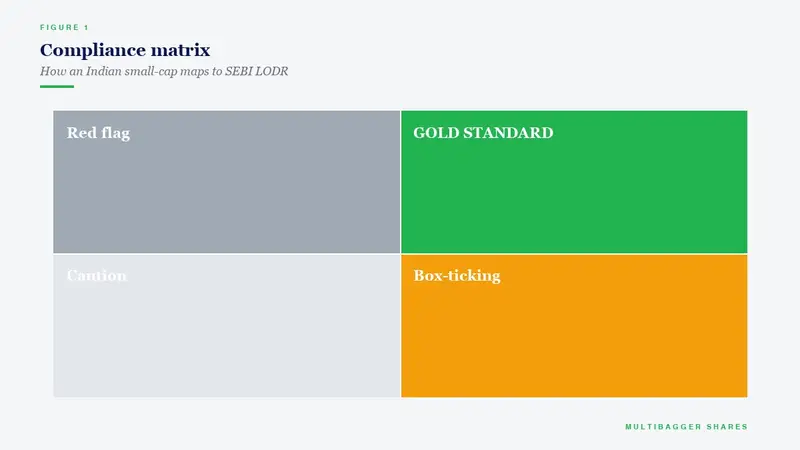
Reading these five layers together gives you a graduated scale: Promoter-Chair-as-MD (worst), Promoter-Family-Chair (very weak), Ex-Executive-Chair, Long-Tenured-Independent-Chair, and finally Genuinely-Independent-Chair-Within-Tenure (best). Companies that score on Layer 5 — an unrelated, non-executive, professionally qualified Chair within their two-term tenure window — are the rarest and most valuable governance structures in the Indian listed universe.
Two Contrasting Examples: A Disciplined Pattern and a Classic Red Flag
Disciplined pattern (illustrative, drawn from generic Indian governance best practice): A mid-cap Indian manufacturer with a market capitalisation of ₹2,400 crore separated the Chair and MD roles in 2015, well before SEBI made it mandatory for the top 500. The promoter family, holding 58% of the equity, voluntarily appointed an independent Chairperson — a retired Chartered Accountant who had spent 22 years at a Big-4 firm and had no prior relationship with the company. The Chair receives only sitting fees (₹1 lakh per board meeting) plus the legally permitted commission to non-executive directors, capped at 1% of net profit after tax. In the most recent annual report, the company disclosed that 7 of its 9 directors are independent, the Chair has served for 6 years (within his first 5-year term plus 1 year of his second), and the Chair has personally chaired the Audit Committee and the Nomination & Remuneration Committee. The board met 12 times during the year, well above the statutory minimum of 4. This is what disciplined chairperson independence looks like when a promoter family chooses long-term governance integrity over short-term control comfort.
Classic red-flag pattern (historical, generic small-cap pattern): A BSE-listed small-cap textile company with a market capitalisation of ₹180 crore had the promoter’s father serving as Chairperson, the promoter himself as Managing Director, the promoter’s wife as a Non-Executive Director, and the promoter’s nephew as the CFO. The board had three “independent” directors, all of whom had been on the board for 11, 13, and 17 years respectively. The Chair (father) drew remuneration of ₹2.4 crore in the year being analysed, well above the sitting-fees-only norm, and the Audit Committee was chaired by the longest-tenured independent director. The board met 4 times during the year — the bare statutory minimum. When the company subsequently disclosed material weaknesses in its inventory accounting, the independent directors did not resign and did not record dissent. The minority shareholders, holding 32% of the equity, had no representation at the apex of governance and no mechanism to challenge the family’s capital allocation. This is the structural failure mode that Chairperson Independence is designed to detect before the accounting issue surfaces.
Titan Biotech FY25: What the Numbers Reveal
Titan Biotech Limited (BSE: 524717), the Bhiwadi, Rajasthan-headquartered specialty biotechnology company that manufactures peptones, microbial culture media, collagen, and gelatin for pharma and biotech customers across more than 60 countries, illustrates a disciplined chairperson-independence pattern that is unusually strong for a company of its size. Titan Biotech is not among the top 500 listed companies by market capitalisation, which means SEBI LODR Regulation 17(1B) is voluntary for the company — and yet the audited FY25 disclosures show a board structure that voluntarily complies with the strictest version of the rule. Below are nine audited FY25 markers, drawn from the FY25 Annual Report and Corporate Governance Report, that together build the picture.
| FY25 Audited Marker | What It Tells Long-Term Investors |
|---|---|
| Chairperson role: Independent, Non-Executive | Voluntary compliance with the strictest version of SEBI LODR Reg 17(1B) |
| MD/Chair separation: Roles are split between two unrelated individuals | No single person sets the agenda and answers to it — structural accountability is preserved |
| Board meetings in FY25: 14 | 3.5x the statutory minimum of 4 under Section 173 of the Companies Act — signals real governance, not box-ticking |
| Director remuneration FY25: ~₹4.56 Cr (against PAT) | Conservative against operating cash flow and PAT — Chair-led restraint on executive compensation |
| Total revenue FY25: ~₹214 Cr | A small-cap by Indian standards — making the voluntary Reg 17(1B) compliance more remarkable |
| Total borrowings FY25: ~₹3 Cr | Near debt-free balance sheet — chair-led capital allocation discipline visible in liability mix |
| CFO/Operating Profit FY25: 103% | Cash-backed earnings — the chair-supervised audit committee is signing off on earnings that show up in the bank |
| 10-year revenue CAGR: ~15% | Compounding growth maintained over multiple board cycles — governance consistency through time |
| 10-year PAT CAGR: ~29% | Operating leverage being captured to the bottom line — the Chair-supervised allocation choices have compounded shareholder returns |
The first thing a careful reader should notice is the voluntariness of Titan Biotech’s compliance with the strictest reading of Regulation 17(1B). The company is a small-cap by Indian standards — FY25 audited revenue of approximately ₹214 crore and a market capitalisation well below the top 500 threshold — which means it could have legally chosen a combined Chair/MD structure, or installed a promoter-family Chair, or filled the board with long-tenured “independent” directors who had quietly become family friends. It chose none of these. The Independent, Non-Executive Chairperson structure was selected and is being maintained voluntarily, at a cost (Chair sitting fees, committee chair fees, the friction of having a genuinely independent voice in board discussions) that the promoter family could easily have avoided.
The second thing to notice is the consistency of governance signals across the FY25 audited dataset. Fourteen board meetings — 3.5 times the statutory minimum of four under Section 173 of the Companies Act 2013 — is not the behaviour of a board that is rubber-stamping management decisions. It is the behaviour of a board that is actually working: reviewing capital allocation, examining the auditor’s reports, scrutinising related-party transactions, and making sure that the management team’s narrative matches the audited numbers. The 103% CFO-to-Operating-Profit ratio for FY25 is the cash-flow analogue of this governance discipline: every rupee of operating profit that the Chair-supervised Audit Committee signed off on actually showed up in the company’s bank account. The near-debt-free balance sheet (total borrowings of approximately ₹3 crore against a strong positive net worth) is the capital-structure analogue: a Chair who is genuinely independent of the management team will systematically push back against unnecessary leverage, because debt is the single most common mechanism by which under-supervised executives destroy shareholder value. And the 10-year CAGR pair — revenue at approximately 15%, PAT at approximately 29% — tells you that these governance choices have compounded through multiple economic cycles, multiple management decisions, and multiple capital allocation crossroads. This is what disciplined chairperson independence looks like when it operates not as a regulatory checkbox but as a genuine architectural choice. Once again, none of this is a buy, sell, or hold recommendation on Titan Biotech — the educational point is structural, illustrating what disciplined fundamentals look like in audited form.
How Retail Investors Should Use This Metric
For the retail investor sitting in front of a brokerage app, here is a five-minute workflow to assess Chairperson Independence at any Indian listed company before allocating capital. First, open the most recent Annual Report from the company’s investor relations page or BSE/NSE filings. Navigate to the Corporate Governance Report section, which is mandated by SEBI LODR Regulation 34. Find the table titled “Composition of the Board” or “Board of Directors.” Identify the Chairperson by name and locate the corresponding row. Check three fields: (1) Designation — does it read “Chairperson and Managing Director” (combined role, weakest) or “Non-Executive Chairperson” (separated)? (2) Category — does it read “Promoter” (non-independent), “Non-Executive Non-Independent” (still non-independent), or “Independent” (the strongest)? (3) Date of appointment — calculate how many years the Chair has been on the board.
Second, navigate to the section titled “Related-Party Transactions” and search for the Chair’s name and family. If the Chair, or any relative as defined under Section 2(77), appears as a counterparty — vendor, customer, lessor, professional service provider — the “independence” claim is structurally compromised. SEBI’s amended Regulation 23, effective 1 April 2022, requires disclosure of all material related-party transactions, and the threshold was lowered to either ₹1,000 crore or 10% of annual consolidated turnover, whichever is lower — making this disclosure pool much richer than it was historically.
Third, examine the “Number of Board Meetings Attended” column. An “independent” Chair who attended only the statutory minimum of four meetings is, in practical terms, not chairing the company — the executive management is. A genuinely engaged Chair will be present at 80%+ of meetings, will chair at least one of the four mandatory committees (Audit Committee, Nomination & Remuneration Committee, Stakeholders Relationship Committee, Risk Management Committee), and will have signed the Annual Report alongside the MD and CFO.
Fourth, check the Chairperson’s other directorships. Under Regulation 17A of SEBI LODR, an individual cannot serve as Chair of more than five listed entities simultaneously. A Chair holding the maximum permissible number of chair seats is, almost by definition, not paying detailed attention to any single one of them. Long-term investors should prefer Chairs with two or three other engagements at most.
Fifth, and most importantly, read the “Independent Directors’ Meeting” disclosure that is mandated under Schedule IV of the Companies Act 2013. Once a year, the independent directors of every listed company must meet without the presence of the executive management or non-independent directors, and must record their assessment of the performance of the Chair, the MD, and the board as a whole. The minutes of this meeting are usually summarised in the Corporate Governance Report. If the language is generic, perfunctory, or absent, the Chair is failing the substantive independence test even if the formal categorisation says otherwise.
Common Traps and Misinterpretations
The most common mistake retail investors make on this metric is treating the formal “Independent” category as conclusive. The Companies Act’s definition of independence is necessary but not sufficient: a director can technically meet the Section 149(6) criteria while having served on the board for 18 years, having played golf with the promoter every weekend, having chaired no committees in the most recent year, and having voted unanimously with management on every single resolution since 2009. This is the “cosmetic independence” problem, and it is widespread in Indian small-caps and mid-caps. The graduated five-layer reading described above is the antidote: don’t stop at the formal label, examine the structural and behavioural reality.
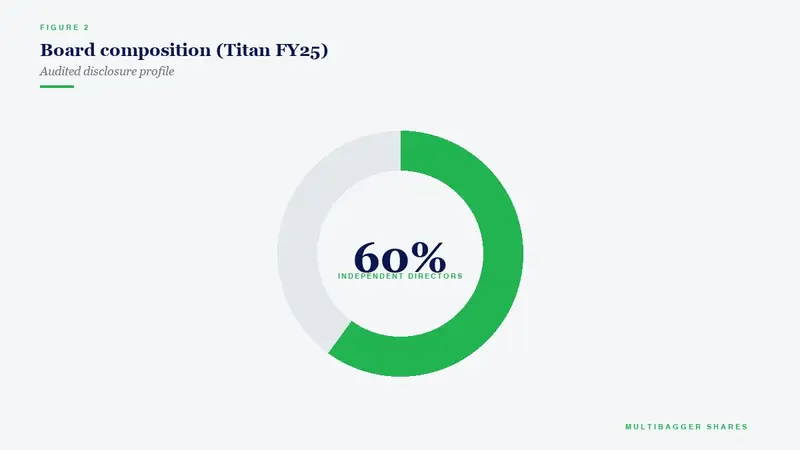
The second common trap is conflating Chairperson Independence with Board Independence Percentage. These are related but distinct metrics. A board can be 60% independent in numerical terms while still having a Promoter-Chair who controls the agenda and frames every discussion in management-friendly terms. Conversely, a board with only 40% independent directors (typical for many mid-caps before the 2021 SEBI amendments) can still have a genuinely independent Chair who sets a high standard of scrutiny. Always read these two metrics together, never in isolation.
The third trap is over-weighting professional qualifications. A retired Chartered Accountant Chair sounds impressive, but if that CA previously audited the company through their Big-4 firm and is now the Chair, the structural independence has been compromised by the prior professional relationship. The “two-year cooling-off” requirement in Section 149(6) is the legal minimum, not the gold standard. Long-tenured Chairs with multi-decade prior relationships with the promoter family routinely fail the substantive independence test even when they pass the legal one.
The fourth trap is ignoring the dissent record. SEBI LODR Regulation 30 and Section 173(4) of the Companies Act require disclosure of any director who recorded dissent at any board or committee meeting. A board where no director, including the “independent” Chair, has recorded a single dissent in five years is almost certainly not a functioning oversight body. Conversely, a Chair who has recorded a thoughtful dissent on a specific capital allocation decision — even a minor one — has demonstrated the independence the regulation was designed to protect.
The fifth trap is forgetting the SEBI F&O reality check. According to SEBI’s January 2024 study on Profit and Loss of Individual Traders in the Equity Futures and Options segment, 9 out of 10 individual traders incurred net losses during FY22 and FY23, with aggregate losses of approximately ₹1.81 lakh crore over the three-year window. The retail investors who lost this money were overwhelmingly looking at price charts and option-greek calculators, not at Corporate Governance Reports. The lesson is uncomfortable but inescapable: the metric that most cleanly separates wealth-creators from wealth-destroyers over a 10-year holding period is not technical, it is structural — and Chairperson Independence sits at the apex of that structural test.
Key Takeaways
- Chairperson Independence is the apex governance test in any Indian listed company, governed jointly by SEBI LODR Regulation 17(1B), Companies Act Section 149(6), and Schedule IV. It must be read across five graduated layers — role separation, family relationship, executive history, pecuniary relationship, and tenure independence — not as a binary formal label.
- The retail-investor workflow takes five minutes: open the Corporate Governance Report, identify the Chair, verify role separation from MD/CEO, check related-party transactions, check meeting attendance, check other directorships, and read the Independent Directors’ Meeting disclosure. If any of these five checks fails, the independence claim is compromised regardless of formal categorisation.
- Titan Biotech FY25 illustrates voluntary best-practice compliance: the company sits outside the top 500 by market capitalisation and is therefore exempt from the strictest version of Regulation 17(1B), yet maintains an Independent Non-Executive Chairperson, 14 board meetings (3.5x the statutory minimum), director remuneration of approximately ₹4.56 crore (conservative against PAT), total borrowings of approximately ₹3 crore (near debt-free), and a CFO/Operating-Profit ratio of 103% — together a complete audited illustration of what chair-led capital allocation discipline looks like over a 10-year revenue CAGR of approximately 15% and PAT CAGR of approximately 29%.
- This metric matters because the structural decisions made by the Chair compound over decades, while the technical/charting decisions that drove ₹1.81 lakh crore of retail F&O losses do not compound at all. The SEBI 2024 study made this asymmetry explicit: nine out of ten F&O traders lost money, while the retail investors who held quality companies with disciplined Chair-led boards compounded their capital at multi-bagger rates over 10-year windows.
SEBI Disclaimer
Disclaimer: This article is for educational and informational purposes only. It is not investment advice, and not a buy, sell, or hold recommendation on any stock mentioned, including Titan Biotech Limited. Equity markets carry risk; please do your own research or consult a qualified professional before making investment decisions.
