April 04, 2026
(Saturday)
Every year, Indian retail investors lose crores to board-related disasters. They happen quietly. A CEO resigns. Auditors change. Family members flood the board. By the time the stock crashes 60%, it’s too late.
The tragedy? All these red flags were visible in advance.
Most investors focus exclusively on P/E ratios, revenue growth, and debt levels. These are important. But board composition is the foundation of corporate governance—and a corrupt or incompetent board will destroy even a fundamentally sound business.
In this post, we’ll decode the 8 critical board red flags that separate wealth-creating companies from value-destroying traps. You’ll learn to spot governance problems before they explode, and understand why companies like Titan Biotech (with a clean, independent board structure) compound wealth year after year.
Why Board Composition Matters More Than You Think
Think of the board as your first line of defense against management excess. Their job is to:
- Oversee management on your behalf
- Approve capital allocation (M&A, dividends, capex)
- Ensure financial statements are accurate
- Challenge strategic decisions
- Protect shareholder interests
When the board is weak, captured, or dominated by family interests, none of this happens. Management runs wild. Money gets siphoned. Red flags get ignored. And retail investors—who can’t do anything about it—watch their wealth disappear.
Here’s the cold truth: You cannot out-analyze a corrupt board. No DCF model, no margin-of-safety calculation will save you from embezzlement, related-party transactions, or accounting fraud orchestrated from the top.
The 8 Critical Board Red Flags Every Investor Must Know
Red Flag #1: Executive Chairman + CEO in Same Person
When one person holds both roles, there’s no independent oversight. The CEO answers to themselves.
Why it’s dangerous:
- Nobody questions their decisions
- Board decisions are predetermined
- Related-party transactions sail through without scrutiny
- Executive compensation becomes absurdly high (who’s going to stop them?)
Look for companies where the Chairman is independent and the CEO is separate. This creates healthy tension and accountability.
Red Flag #2: Board Dominated by Family Members
Family businesses aren’t inherently bad—but when the board is packed with relatives, conflict of interest explodes.
Real-world red flag scenario:
- Founder (Chairman) + 2 sons (Managing Directors) + wife (Director) + brother-in-law (Director)
- Independent directors? Maybe 1 or 2, outvoted every time
- Result: Land gets “sold” to a brother’s shell company at inflated prices. Related-party loans with favorable terms. Nepotistic hiring at senior levels.
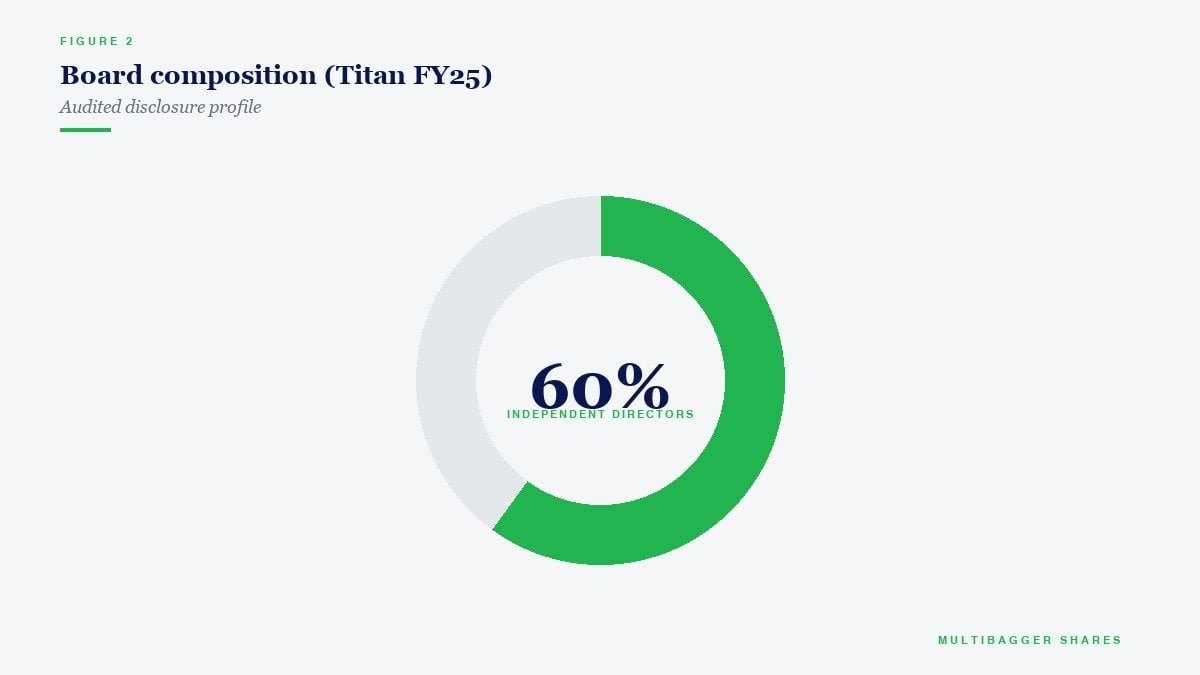
Healthy benchmark: At least 50-60% independent directors on the board. They answer to no one but shareholders.
Red Flag #3: Directors with No Relevant Experience
A pharma company’s board includes a retired IAS officer, a poet, and a real estate developer. None have pharma or healthcare background.
Why this matters:
- They can’t effectively challenge management’s pharma strategy
- They don’t understand R&D timelines, regulatory approvals, or clinical trials
- They rubber-stamp whatever the CEO proposes
What to look for: Directors with deep industry experience, financial expertise, or proven track records in relevant fields. A board member who’s run a public company before understands corporate governance instinctively.
Red Flag #4: Same Director on 15+ Boards Simultaneously
How can someone effectively oversee a company’s operations, strategy, and financials when they’re split across 10-15 other boards?
Answer: They can’t.
This is a professional director trap. These are serial board members who collect director fees without doing real work. They attend board meetings, nod along, and leave.
Red flag metric: If a director sits on more than 7-8 boards, they’re overcommitted. Their attention is diluted. Governance suffers.
Red Flag #5: Poor Disclosure of Board Meetings
A healthy board meets regularly—typically 4-6 times per year—and actively discusses strategy, risk, and performance.
Check this:
- How many board meetings happened in the last year?
- Who attended? Were independent directors present?
- Are committee meetings (Audit, Remuneration, Risk) documented?
- Do disclosures explain what was discussed?
Red flag scenario: A company held only 1-2 board meetings in the entire year. This signals a dormant board—one that’s not actively engaged in governance.
Red Flag #6: Audit Committee Dominated by Management
The Audit Committee is supposed to be your fiducest watchdog. They should oversee financial reporting, internal controls, and the external auditor.
Critical red flag:
- Audit Committee Chair is not independent (maybe a family member or someone with business dealings with the company)
- No financial expert on the Audit Committee
- The CFO or any executive has voting rights on audit decisions
When the Audit Committee is weak, financial statement fraud becomes possible. Management can override controls, the auditor is intimidated, and retail investors get blindsided.
Red Flag #7: Sudden Auditor Change Without Explanation
Companies change auditors for legitimate reasons (retirement, merger, cost). But when an auditor abruptly resigns mid-year with vague reasons, it’s often a massive red flag.
Real scenario from Indian market:
- Year 1: Big auditor (Big 4) audits the company, gives clean opinion
- Year 2: Auditor resigns (reason: “unable to confirm certain accounting treatments”)
- Year 3: A smaller, less stringent auditor is appointed
- Year 4: SEC/SEBI uncovers accounting irregularities—the original auditor had red-flagged them
Action step: Always check the reason for auditor change. If it’s vague or conflicts emerge, dig deeper.
Red Flag #8: Excessive Related-Party Transactions Without Independent Approval
Related-party transactions (RRP) aren’t necessarily evil. A subsidiary buying goods from parent company can be efficient.
But watch for:
- Large RPTs at above-market prices (company buys at ₹100 from brother’s firm; market price is ₹60)
- RPTs approved only by interested parties (the director who benefits from the deal votes yes)
- No independent valuation or competitive bidding
- Cumulative RPT amounts that are suspiciously high relative to company size
Titan Biotech example: Being debt-free (as of market data showing ₹2,082 Cr market cap) and maintaining a strong governance structure means management can’t easily hide wealth transfers in complex financing arrangements.
How to Identify These Red Flags in Practice
Here’s your checklist:
Step 1: Visit BSE/NSE Corporate Governance page
- Download the annual governance report (part of annual report)
- Look for board composition, director backgrounds, independence status
Step 2: Check Independent Director Percentage
- ✓ Good: 50%+ independent directors
- ⚠️ Warning: 30-50% independent directors
- ✗ Red flag: Less than 30% independent directors
Step 3: Examine Audit Committee
- Is Chair independent? (must be YES)
- Does Chair have financial expertise?
- No executives in the Committee?
Step 4: Scan Related-Party Transactions
- What’s the total RPT amount vs. total assets?
- Were RPTs at arms-length prices?
- Were they approved by independent directors?
Step 5: Review Board Meeting Frequency
- At least 4-6 meetings/year? ✓
- Did independent directors attend consistently?
- Are committee meeting minutes detailed?
Step 6: Check Director Backgrounds (via Registrar of Companies)
- Search each director’s name on MCA portal
- Do they sit on 8+ other boards? (Red flag)
- Any previous company failures or regulatory action?
Real-World Examples: What Good Governance Looks Like
Example 1: Titan Biotech (Strong Governance)
Current metrics as of April 2026:
- Market Cap: ₹2,082 Crores
- P/E Ratio: 76.6
- 52-Week High/Low: ₹504 / ₹74.7
- Book Value: ₹40.3 (trading at 12.5x book value—premium is justified by governance + growth story)
- Debt-free status ensures no hidden leverage or board-driven over-leveraging
Why Titan Biotech commands such a premium valuation? Consistent governance. Investors trust the board to allocate capital wisely and won’t engage in wealth destruction.
Example 2: What NOT to Own
Hypothetical company “XYZ Ltd”:
- Founder is both Chairman + CEO
- 3 of 7 directors are family members
- Audit Committee Chair is the brother of the CEO
- Big 4 auditor resigned mid-year (reason: unclear)
- Related-party transactions = 45% of annual revenue
- Board met only twice in the entire year
Verdict: Even if the P/E is “cheap,” avoid this stock. The board is a ticking time bomb.
Market Context: NIFTY 50 and SENSEX Today
Current Market Levels (April 2, 2026):
- SENSEX: 73,319.55 (+0.25%)
- NIFTY 50: 22,713.10 (+0.15%)
Markets are stable, but individual stock volatility persists. During market turbulence, weak boards crumble. Companies with strong governance structures weather downturns better because the board actively manages crisis instead of freezing or covering up problems.
Board Composition as Your Early-Warning System
You can’t prevent every business failure. But you CAN eliminate a huge category of preventable ones: governance-driven wealth destruction.
Good boards:
- Challenge management constructively
- Ensure honest financial reporting
- Prevent self-dealing and related-party abuse
- Make strategic decisions in shareholder interest (not family interest)
- Ensure management succession planning
Bad boards:
- Rubber-stamp management decisions
- Enable embezzlement and fraud
- Approve wealth transfers disguised as business transactions
- Block minority shareholders from accountability
- Protect family interests over shareholder interests
The choice is yours. Spend 30 minutes analyzing board composition before investing. It’s the highest-ROI due diligence you can do.
Next Steps: Your Board Analysis Toolkit
Want to master corporate governance analysis? We have a complete YouTube playlist dedicated to understanding financial statements, management quality, and board structure:
📚 Multibagger Shares Value Investing Masterclass →
This series covers:
- How to read balance sheets like institutional investors
- P&L statement deep-dives
- Cash flow statement analysis
- Capital allocation red flags
- Management quality assessment
- Board governance analysis
Bottom line: Board composition is your canary in the coal mine. Ignore it at your peril.
📢 Join Our Telegram Channel
Get daily value investing lessons, stock analysis & Titan Biotech updates — delivered straight to your phone!
✈️ Join @longtermequityy on Telegram
🔔 Free • No spam • Value investing insights daily
Disclaimer: This article is for educational and informational purposes only. It is not investment advice, and not a buy, sell, or hold recommendation on any stock mentioned, including Titan Biotech Limited. Equity markets carry risk; please do your own research or consult a qualified professional before making investment decisions.
