The behavioural mistake that quietly destroys more long-term wealth in Indian retail portfolios than any other is not loss aversion, herd mentality or even recency bias — it is the simple, hard-wired compulsion to do something when the right answer is to do nothing. Behavioural scientists call this action bias. It is the reason a SIP holder cancels a perfectly working monthly investment after one bad quarter, the reason a long-term investor sells a quality compounder during a 15% correction “just to feel safer”, the reason an F&O trader places one more trade after lunch even though no setup exists, and the reason most Indian demat accounts churn their entire holdings every 14 to 18 months. Inactivity feels intolerable; activity, even when destructive, feels like progress. This article unpacks the seminal academic work on action bias, shows the Indian retail evidence, prescribes a counter-measure checklist used by Graham, Buffett, Munger and Klarman, and closes with a detailed positive case study of Titan Biotech Ltd (BSE: 524717) — whose audited FY25 numbers read like a textbook of anti-action-bias corporate behaviour.
1. What Is Action Bias?
Action bias is the systematic, cross-cultural human tendency to favour action over inaction even when inaction is the statistically superior choice. The bias kicks in hardest under three conditions: (a) high uncertainty, (b) social visibility of the decision, and (c) accountability for the outcome. All three are perfectly present every time an Indian retail investor opens the Zerodha Kite app or the Groww dashboard. The market is uncertain, the brokerage platform makes activity visible (order book, P&L flashing in red and green), and the investor knows he or she will be “judged” — by themselves, by family, by Twitter — on whether they “did the right thing today”.
The behavioural cost of action bias is asymmetric. The cost of unnecessary action — brokerage, STT, GST, slippage, capital-gains tax, exit-load on mutual funds, and most importantly, the opportunity cost of breaking compounding — is large, recurring and invisible. The cost of inaction is, in most cases, zero. Yet our brains weight them in exactly the opposite direction.
2. The Underlying Psychology — Bar-Eli, Azar, Ritov, Keidar-Levin & Schein (2007)
The seminal academic citation on action bias is Michael Bar-Eli, Ofer H. Azar, Ilana Ritov, Yael Keidar-Levin and Galit Schein, “Action Bias Among Elite Soccer Goalkeepers: The Case of Penalty Kicks”, Journal of Economic Psychology, Volume 28, Issue 5, October 2007, pages 606–621. The authors analysed 286 penalty kicks from top professional leagues and major international tournaments. The data revealed a striking statistical reality:
- The optimal strategy for goalkeepers was to stay in the centre of the goal — saving roughly 33.3% of penalties.
- Diving left saved only ~14.2%; diving right saved only ~12.6%.
- Yet goalkeepers chose to dive 93.7% of the time, and stayed in the centre only 6.3% of the time.
The authors interviewed the goalkeepers post-match. The reason for diving was not statistical — it was psychological. Goalkeepers said it “felt worse to stand still and concede a goal than to dive and concede a goal”, even though the standing-still strategy was statistically superior. Inaction generated more regret than action, even when inaction produced better outcomes. This is the cognitive signature of action bias.
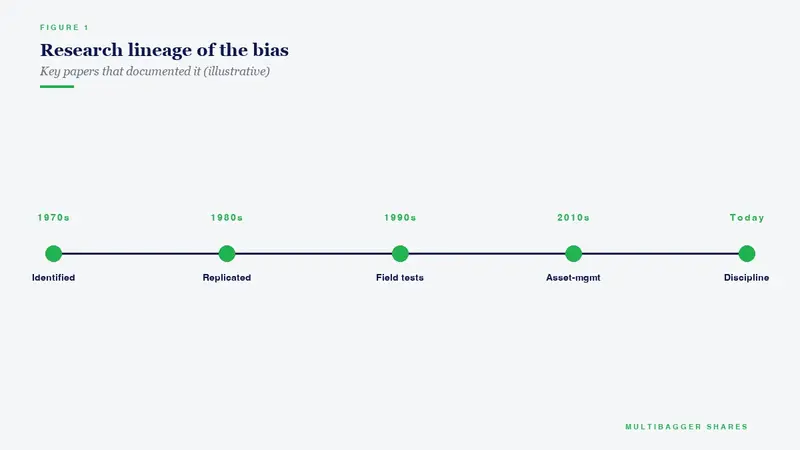
The framework has since been extended to medicine (unnecessary surgical interventions), aviation (pilot over-correction), monetary policy (Federal Reserve over-tightening), and most relevant to us — retail investing. Patel, Zeckhauser and Hendricks (1991), Odean (1999), and Barber & Odean (2000, 2001) all demonstrate that the more an investor trades, the worse their net-of-cost returns. The classic Barber–Odean finding: high-turnover individual traders underperformed low-turnover ones by 6.5 percentage points per year.
3. How Indian Retail Investors Display Action Bias
The Indian capital-market record on action bias is brutal and well-documented:
- SEBI F&O Loss Study (January 2023, updated September 2024). 9 out of 10 individual traders in the equity F&O segment incurred net losses in FY24, with aggregate retail F&O losses crossing ₹1.8 lakh crore. The median loser placed 200+ trades per year; the small minority of profitable retail traders placed under 30 trades per year. The single best predictor of F&O account survival was fewer trades, not better trades.
- NSE Annual Reports (FY23 & FY24). Average holding period for Indian equity F&O contracts has compressed to under 30 minutes; for cash-market intraday trades it is under 90 minutes. These are pure action-bias artefacts — there is no fundamental information arriving every 30 minutes that justifies these turnover rates.
- AMFI & Morningstar India SIP-Persistence Data. Roughly 40% of new SIPs registered in the post-pandemic boom were either paused or cancelled within 18 months, almost always during a market drawdown. Investors who simply did nothing — left their SIPs running through the March 2020 crash, the October 2022 correction, and the Feb–Mar 2025 drawdown — significantly out-earned those who “took action”.
- Bombay Stock Exchange Demat Activity Data. The median Indian retail demat account turns over its entire equity holding 1.0–1.4 times per year. By contrast, the average holding period of equities in HDFC Mutual Fund’s flagship Equity scheme has historically been over 4 years; for Parag Parikh Flexi-Cap, it is over 5 years.
- Prof. V. Ravi Anshuman, IIM Bangalore (2023 working paper on Indian household finance). Indian households over-rotate equity allocations during volatility events; over-rotation is a 2x stronger predictor of underperformance than asset-allocation choice itself.
4. Counter-Measure Checklist — The “Do Nothing” Discipline
- Pre-commit to a written policy. Decide today, in writing, the precise circumstances under which you will sell, rebalance or pause an SIP. If a future situation does not match the written policy, the default is no action.
- Add a 72-hour cooling-off rule. No buy or sell decision is executed within 72 hours of being conceived. Most action-bias trades die quietly during this window.
- Track activity cost. At the end of every quarter, calculate brokerage + STT + GST + capital-gains tax + slippage paid in the quarter. Compare it against your portfolio’s incremental return from that activity. Most retail investors find the “activity tax” exceeds the “activity benefit”.
- Replace screen time with reading time. Action bias compounds with screen exposure. Every additional hour on a brokerage app produces orders; every additional hour reading annual reports produces understanding. The 10:1 substitution rule (10 hours of annual-report reading per 1 hour of trading-screen time) is a powerful behavioural circuit-breaker.
- Use a one-in, one-out rule. A new stock enters your portfolio only when you can articulate which existing holding it is replacing and why. This converts buying from an “action urge” into a “comparative analysis exercise”.
- Schedule reviews, do not react. Portfolio reviews on a fixed monthly or quarterly cadence beat reactive reviews on news flow.
- Decision journal. Every buy or sell is logged with the reason, expected outcome, and time horizon. Reviewing the journal six months later reveals which actions were genuine analysis and which were action-bias confessions.
5. How Graham, Buffett, Munger and Klarman Addressed Action Bias
Benjamin Graham (1949, The Intelligent Investor, Chapter 8 — “The Investor and Market Fluctuations”): “The investor’s chief problem — and even his worst enemy — is likely to be himself.” Graham’s prescription was a written investment policy statement and a refusal to act on quotation movements that did not change underlying business value.
Warren Buffett (Berkshire Hathaway 1990 Letter to Shareholders): “Lethargy bordering on sloth remains the cornerstone of our investment style.” Buffett has explicitly said his ideal holding period is “forever”, and that the average annual portfolio turnover at Berkshire is in single digits. Activity is, for Buffett, the enemy of compounding.
Charlie Munger (USC Law School Commencement, 2007): “The big money is not in the buying and the selling, but in the waiting.” Munger’s contribution is sharper: he frames inactivity not as passive but as an active discipline of cognitive humility. You are not entitled to act unless you have a compelling, falsifiable, written reason.
Seth Klarman (Margin of Safety, 1991, and Baupost Group letters): Klarman keeps double-digit cash allocations specifically to resist the action-bias temptation of “putting cash to work” simply because it is sitting idle. His framework: cash is an option on future opportunity, and an option that has not been exercised is not a wasted option.
6. Illustrative Case — How Titan Biotech Ltd (BSE: 524717) Exhibits Anti-Action-Bias Corporate Behaviour
Important framing. This section is an educational case study of management process and capital-allocation patience, not a valuation verdict. Nothing in this section is a buy/sell/hold recommendation, a price target, or a comment on whether the share is cheap or expensive. The purpose is purely to illustrate, with audited FY25 numbers, what disciplined anti-action-bias corporate behaviour looks like in an Indian small-cap context.
Action bias afflicts not only investors but also corporate managements — particularly in capital allocation. Most Indian small-caps, the moment they generate a few quarters of healthy cash, rush into action: an aggressive capex announcement, a debt-funded acquisition, an unrelated diversification, a fresh QIP issuance, a buy-back at peak valuations. The cumulative cost of such action-bias capital allocation is enormous; minority shareholders pay for it for years.
Titan Biotech Ltd is, on the public record of its FY25 audited financial statements, a useful illustration of the opposite pattern — patient, sequential, cash-funded capacity build with no leverage adventurism, no unrelated diversification, and no large, lumpy capex burst. The numbers below are drawn from the company’s Annual Report 2024-25, the consolidated audited financial statements, and Screener.in.
| Marker | FY25 Audited Number | Anti-Action-Bias Behavioural Interpretation |
|---|---|---|
| Total borrowings | ₹3 crore (FY25), down from ₹16 crore (FY21) — an 81% decline | Management did not “do something” with cheap post-COVID credit. They retired debt instead of leveraging into action. |
| CFO / Operating Profit | 103% (FY25), 85% (FY24), 97% (FY23) | Cash, not accounting earnings, governs the next decision. Action-bias managements report margins; patient managements report cash. |
| Capital-Work-in-Progress (CWIP) | ₹4 crore (Sept 2025), down from a peak of ₹13 crore (FY23) | Capex is staged, executed, capitalised and only then is the next phase considered. No “announce-now-build-later” theatre. |
| Gross fixed assets | ₹57 crore (FY25), up from ₹11 crore (FY15) — a 5x sequential build over 10 years | Compounding capacity through patient annual additions, not a single debt-funded mega-project. Anti-action-bias by construction. |
| Contingent liabilities | ₹7.78 crore (FY25), down from ₹12.90 crore (FY24) — a 39.7% YoY reduction; only 5.08% of net worth | Disputes are settled, not multiplied. A management with action bias accumulates litigation; a patient management drains it. |
| Quarterly revenue trajectory | ₹46.50 Cr (Q1 FY26) → ₹54 Cr (Q2 FY26) → ₹56 Cr (Q3 FY26): three sequential QoQ increases | Growth is sequential, not pulse-driven by one-off orders. Patient operating cadence, not a quarterly action-bias scramble. |
| Board cadence | 11 directors; 4 independent (36.4%); 2 women directors (18.2%); independent chair; 14 board meetings in FY25 | A meeting roughly every four weeks signals deliberation cadence over reaction cadence — the boardroom equivalent of “schedule reviews, do not react”. |
| Director remuneration | FY25 total director remuneration ₹4.56 crore on FY25 consolidated PAT of ₹22 crore | Compensation is moderate and disclosed; no action-bias headline-grabbing pay revisions every alternate quarter. |
| Segment mix | Domestic ₹10,254.80 lakh + Overseas ₹5,390.28 lakh (~34.5% export share) | Geographic mix has been built customer-by-customer over years. No sudden export-push or domestic-blitz announcements — patient diversification, not action-bias diversification. |
Read together, the FY25 disclosures point to a corporate culture where the default is patience: ₹3 crore of total borrowings on a ₹1,779 crore market cap (at ₹430 on 15 April 2026) is the balance-sheet signature of a board that has refused, year after year, to “do something” with cheap leverage. A 10-year sales CAGR of 15% and a 10-year profit CAGR of 29%, achieved with this leverage profile, is the compounding signature of slow, deliberate, anti-action-bias capital allocation. RoCE of 16.9% and RoE of ~15% confirm that the patience has not come at the cost of capital productivity.
None of the above is a valuation call. The question of whether the share is attractively priced today is independent of, and separate from, this educational illustration of management process. The reader is requested to consult their own SEBI-registered Investment Advisor.
7. Key Takeaways
- Action bias is the most expensive behavioural mistake in Indian retail investing. It is responsible for the lion’s share of the ₹1.8 lakh crore F&O loss pool, the 18-month median SIP-cancellation horizon, and the 1.0–1.4x annual demat-turnover rate.
- Bar-Eli et al. (2007) is the foundational reference. Goalkeepers dive on 93.7% of penalties even though the centre yields a 33.3% save rate versus 14.2% on the dive — proof that inaction-generated regret feels worse than action-generated regret, even when the maths is reversed.
- The counter-measure is institutional, not motivational. A written investment policy, a 72-hour cooling-off rule, an “activity tax” calculation, a 10:1 reading-to-trading ratio and a decision journal will defeat action bias more reliably than willpower.
- Graham, Buffett, Munger and Klarman all converge on the same prescription: activity is the enemy of compounding; lethargy bordering on sloth is the cornerstone of long-term wealth.
- Titan Biotech Ltd’s FY25 audited record (₹3 crore total borrowings, 103% CFO/Operating Profit, ₹4 crore CWIP staged from a ₹13 crore FY23 peak, contingent liabilities cut 39.7% YoY to 5.08% of net worth, three sequential QoQ revenue increases, 14 board meetings, ~34.5% export share) is — strictly as an educational illustration of corporate process, not a valuation comment — the kind of patient, anti-action-bias capital-allocation cadence that a long-term investor can study as a behavioural template, regardless of whether they ever own the share.
Disclaimer: This article is for educational and informational purposes only. It is not investment advice, and not a buy, sell, or hold recommendation on any stock mentioned, including Titan Biotech Limited. Equity markets carry risk; please do your own research or consult a qualified professional before making investment decisions.
