April 11, 2026
(Saturday)
Why Mohnish Pabrai Matters for Every Indian Value Investor
If you had handed Mohnish Pabrai ₹1 crore in July 1999 and asked him to run it for you, you would be sitting on roughly ₹8.81 crore today — a compounded annual return of about 12.6% net of fees versus 7.2% for the S&P 500 over the same period, according to Pabrai Investment Funds’ official letters. That is what 25 years of disciplined, concentrated, low-risk value investing does to capital. Pabrai’s flagship funds today manage over $1 billion, his personal net worth is estimated at roughly $150 million in 2026, and his new Pabrai Wagons ETF (WAGN) began trading on the NYSE on February 9, 2026 — taking his value investing philosophy from accredited-only hedge fund investors to ordinary retail buyers for the very first time.
But the real reason Indian value investors should obsess over Pabrai is not his numbers. It is the origin of his framework. Pabrai is an Indian-American investor who studied the Patel community of Gujarat running motels across the United States and noticed something astonishing: they had quietly captured over 40% of the entire American budget motel industry, starting with nothing. Pabrai’s 2007 book The Dhandho Investor: The Low-Risk Value Method to High Returns distills the wisdom of the Patels, Lakshmi Mittal, Richard Branson, and Warren Buffett into nine concrete principles. He calls this framework Dhandho — a Gujarati word that literally means “endeavors that create wealth” — and he sums up its core philosophy in one unforgettable line: “Heads I win, tails I don’t lose much.”
In today’s Indian market — with the Sensex closing at 77,550.25 (up 1.20%) and the Nifty 50 at 24,050.60 (up 1.16%) on the last trading session — most retail investors are doing the opposite. They are chasing momentum, trading F&O like gamblers, and paying peak multiples for hype. A SEBI study revealed that 9 out of every 10 individual traders in the equity Futures & Options segment lose money. The Dhandho framework is the exact antidote. Let’s break down all nine principles — with Indian examples — so you can apply them starting tomorrow morning.
Principle 1: Invest in Existing Businesses, Not Startups
Pabrai’s first rule is radically simple: buy existing, publicly listed businesses with a track record you can read. A proven 20-year balance sheet is worth a thousand pitch decks. This is why we at Multibagger Shares refuse to chase unprofitable tech listings and instead spend months studying companies like Titan Biotech Ltd (BSE: 524717), which has been building its gelatin, peptones, and bio-fertilizer business in India since 1992. At ₹432 per share with a market cap of ₹1,783 crore, Titan Biotech gives you three decades of audited history to study — not a founder’s dream. When you buy an existing business, you are buying facts, not promises.
Principle 2: Invest in Simple Businesses
Pabrai favors industries with a slow rate of change — boring businesses that make the same product in 20 years that they make today. Paint. Gelatin. Underwear. Cement. Adhesives. Tyres. He famously says: “I want businesses where my 80-year-old mother can understand the business model in 30 seconds.” Warren Buffett’s love for Coca-Cola and See’s Candies is exactly the same instinct. In India, Asian Paints has created generational wealth since 1942 simply by mixing and selling paint better than everyone else. Relaxo Footwears compounded capital by selling slippers. Page Industries became a 94-bagger by licensing Jockey underwear. Simple business + durable demand + competent management = compounding machine.
Principle 3: Invest in Distressed Businesses in Distressed Industries
This is where Pabrai diverges from timid retail investors. He actively wants pessimism, panic, and fear in an industry — because that is when prices collapse below intrinsic value. When the Indian pharma sector was battered in 2018-2020 over USFDA observations, the greatest wealth was being created for those willing to buy quality API makers at throwaway prices. When Titan Biotech was trading at a 52-week low of ₹74.70 (against a recent high of ₹556), the Dhandho investor did not flee — the Dhandho investor asked, “Has the business permanently changed, or is this just market mood?” If the business is intact and management is honest, distress is a gift, not a warning.
Principle 4: Invest in Businesses With Durable Competitive Advantages
Pabrai insists that any business you own must have a moat that is widening, not shrinking. In Indian small-caps, moats come in many forms: regulatory approvals that take competitors 5-7 years to replicate (Titan Biotech’s WHO-GMP, Halal, and Kosher certifications for export to 100+ countries is a perfect example), long-standing customer relationships, proprietary manufacturing processes, cost leadership, and brand trust. Ask yourself: if I gave a competitor ₹500 crore tomorrow, could they replicate this business in 3 years? If yes — no moat. If no — you have something worth owning.
Principle 5: Few Bets, Big Bets, Infrequent Bets
This is the principle that separates Dhandho investors from the rest of the retail crowd. Pabrai runs a concentrated portfolio of typically 10 or fewer stocks. When he finds a mispriced idea, he is willing to put 10% or more of his fund into a single name. Compare this to the average Indian retail investor who holds 40 stocks, owns every sector, and earns mediocre returns diluted into oblivion. Warren Buffett said it best: “Wide diversification is only required when investors do not understand what they are doing.” The greatest wealth in Indian markets — Jhunjhunwala in Titan, Damani in DMart, Kedia in Aegis Logistics — was built by massive concentration in a few deeply understood businesses, not by spreading capital thin across index funds and ETFs “for safety.” Safety comes from knowing what you own, not from owning everything.
Principle 6: Fixate on Arbitrage
Pabrai is obsessed with low-risk, high-return situations — what he calls “Dhandho arbitrage.” These are special situations where the market has temporarily mispriced a stock because of a complex event: a demerger, a holding company discount, a promoter buyback, a regulatory overhang that is about to lift, a micro-cap graduating to the small-cap index. Smart Indian investors have made fortunes on Bajaj Holdings’ holdco discount, on Reliance-Jio demergers, and on the Tata Sons listing trade. Look for temporary mispricings driven by mechanics, not business fundamentals — that is pure Dhandho.
Principle 7: Margin of Safety — Always
Benjamin Graham’s three most important words in investing — borrowed by Pabrai and turned into his seventh principle. Never pay the full estimated intrinsic value of a business. Demand at least a 30-50% discount so that even if you are wrong on growth or margins, you still break even or make money. This is the mathematical underpinning of “heads I win, tails I don’t lose much.” A Dhandho bet is asymmetric: limited downside, multi-bagger upside.
Principle 8: Invest in Low-Risk, High-Uncertainty Businesses
This is Pabrai’s most counter-intuitive idea, and the one that mints the most money. The market reflexively punishes uncertainty as if it were the same thing as risk. But they are completely different. Risk means you might lose capital permanently. Uncertainty just means you do not know the exact outcome yet. A high-quality business trading at ₹432 with a pending USFDA decision, a pending court verdict, or a pending approval is uncertain — but it is not risky if the balance sheet is fortress-strong, the ROE is 15%, and the ROCE is 16.9% (all true for Titan Biotech today). When uncertainty resolves, the stock re-rates violently upward. The Dhandho investor buys during uncertainty and sells into certainty.
Principle 9: Invest in the Copycats, Not the Innovators
Pabrai’s final principle is the ultimate low-risk shortcut: do not bet on the innovator — bet on the cloner who scales a proven model. Microsoft cloned Apple’s GUI. Facebook cloned MySpace. Walmart cloned Kmart. Pabrai himself built his entire fund strategy by openly cloning Warren Buffett’s playbook. For Indian investors, this means: look at successful global business models and find the Indian version that is 10 years behind. Quick commerce in India is a clone of the US/China model. Indian specialty chemicals are cloning Chinese capacity that moved out. The early cloners — who take no R&D risk and simply execute — capture the biggest multibagger returns.
Putting Dhandho to Work in Your Portfolio Tomorrow
Here is the practical Dhandho playbook for any Indian value investor: (1) Build a watchlist of 20-30 simple, existing, high-moat Indian businesses. (2) Wait — sometimes for years — until panic, distress, or sector-wide hatred pushes one of them to a significant discount to intrinsic value. (3) When you act, concentrate. A 10% position in one high-conviction idea will do more for your wealth than 50 positions of 2% each. (4) Avoid F&O entirely — SEBI’s data is clear that 90% of retail F&O traders lose money, and the Dhandho philosophy considers this the exact opposite of “heads I win, tails I don’t lose much.” (5) Hold until the thesis plays out. Pabrai’s average holding period is over 5 years. Patience is the final Dhandho advantage.
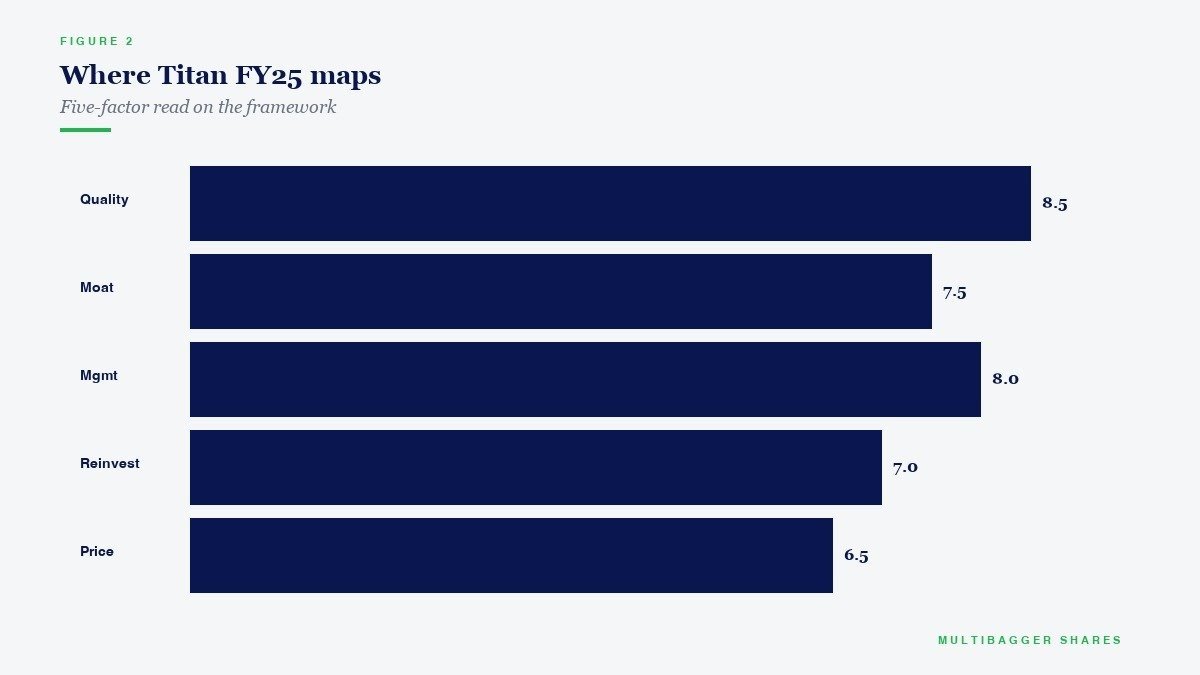
The Dhandho framework is not magic — it is discipline. It is the refusal to gamble, the refusal to diversify away your best ideas, and the willingness to look foolish by holding cash or unpopular stocks until the market hands you something extraordinary. At Multibagger Shares, our 95-factor fundamental analysis framework — applied rigorously to companies like Titan Biotech — is built on exactly these nine Dhandho principles. If you internalize them, you will never need another investing book for the rest of your life.
Learn More — Our Complete Value Investing Course
Watch our complete free value investing course on YouTube: Multibagger Shares Value Investing Playlist.
📢 Join Our Telegram Channel
Get daily value investing lessons, stock analysis & Titan Biotech updates — delivered straight to your phone!
✈️ Join @longtermequityy on Telegram
🔔 Free • No spam • Value investing insights daily
Disclaimer: This article is for educational and informational purposes only. It is not investment advice, and not a buy, sell, or hold recommendation on any stock mentioned, including Titan Biotech Limited. Equity markets carry risk; please do your own research or consult a qualified professional before making investment decisions.
