Educational reading for serious Indian long-term investors. This is not investment advice and contains no buy / sell / hold call on any company named below.
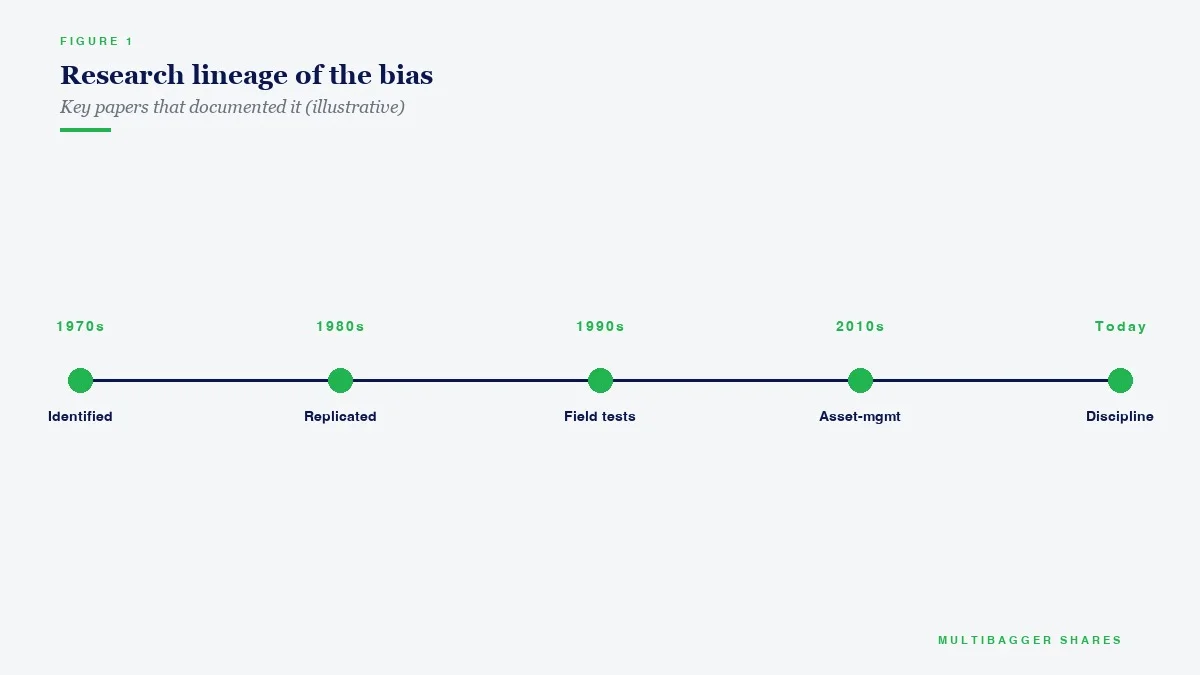
If you had to name the single behavioural bias that quietly destroys the most retail wealth during India’s biggest bull markets — not in the crash, but on the way up — the answer would not be loss aversion, herd mentality, or even overconfidence. The honest answer is a much less famous, almost gentle-sounding pattern that Richard Thaler and Eric Johnson formally documented in a 1990 Management Science paper, and that has been re-tested on emerging-market traders for thirty-five years: the House Money Effect.
The finding is uncomfortably simple. When investors are sitting on prior gains — bull-market profits, last year’s IPO allotment that doubled, a tax-refund windfall, an ESOP that vested — they take systematically more risk with that “house money” than they would with money they originally earned from salary or business. The cushion of recent winnings emotionally re-codes the next bet as costing them nothing. They feel that even if the new position halves, they are “still up overall.” That feeling, more than any technical chart pattern or breaking-news event, is what funds the late-bull-market rotation into small-caps, F&O selling, unlisted-share punts, and concentrated single-stock bets that historically wipe out 12–18 months of compounding in a single quarter.
1. What Thaler and Johnson actually showed in 1990
Thaler and Johnson’s paper — “Gambling with the House Money and Trying to Break Even: The Effects of Prior Outcomes on Risky Choice” (Management Science, Vol. 36, No. 6, June 1990, pp. 643–660) — extended Kahneman and Tversky’s prospect theory by asking a question prospect theory could not answer on its own: does the way you got to your current wealth change how you bet from here?
Their MBA-student experiments (later replicated on professional traders) ran sequences of gambles. The classical prospect-theory prediction said the next bet should be evaluated from the current reference point. Thaler and Johnson found this was wrong. Subjects who had just won a prior gamble became significantly more willing to accept the next risky bet — even bets they had rejected when offered as the first round. The subjective accounting they were doing was: “The ₹10,000 in front of me is not really mine yet — it’s the casino’s money — so risking it on a longshot is almost free.” Symmetrically, subjects who had just lost showed a related pattern (the “break-even effect”) in which they accepted long-odds bets that could restore them to the original endowment.
The implication for capital markets is immediate. After a strong bull leg, every investor in the country is holding house money. The portfolio is up 40, 60, 90 per cent. The next bet — concentrated, leveraged, small-cap, F&O — is mentally booked against the cushion, not against the original capital. The discipline that built the original portfolio quietly dissolves, and the same investor who would have refused a 70-30 risk-reward bet in March 2020 happily accepts it in March 2024.
2. The psychology underneath: why prior outcomes change the reference point
The House Money Effect cannot be explained by classical utility theory because under classical assumptions wealth is fungible — a rupee is a rupee regardless of where it came from. Thaler and Johnson’s contribution was to formalise what behavioural economists had long suspected: investors mentally tag money by its source and by its recency. Three mental moves combine to produce the effect.
First, segregation of accounts. The recently won money is placed in a separate mental ledger from the originally earned money. Combining them into a single “net worth” number — what every rational accounting framework would do — feels effortful and is rarely performed by the System-1 brain in the middle of a trading session.
Second, diminished loss sensitivity within the winnings account. Because losses inside the winnings ledger never push the investor below the original endowment level, those losses simply do not register on the same emotional pain curve as losses against original capital. A ₹50,000 hit on a small-cap trade after the portfolio has doubled feels qualitatively different from a ₹50,000 hit on the first ₹2 lakh you ever invested — even though the rupee impact and the opportunity cost are identical.
Third, narrative reframing. After a bull run, investors tell themselves a story that explains why they are now “playing with profits.” The story justifies bets the same investor would have called reckless in a flat year. This is the bridge that connects the House Money Effect to overconfidence: house money is the fuel, and overconfidence is the engine, but the two are distinct cognitive errors. Even an investor with calibrated confidence will tilt riskier if she is sitting on a 60 per cent gain.
3. The Indian manifestation — measured in the data
Indian retail behaviour over the past five years has produced perhaps the cleanest natural experiment in the world for the House Money Effect, and the regulatory data make the pattern legible.
SEBI’s January 2023 study on individual trader outcomes in the equity Futures & Options segment (“Analysis of Profit and Loss of Individual Traders dealing in equity Futures & Options Segment”) — refreshed in the September 2024 follow-up — found that approximately 89 per cent of individual F&O traders incurred net losses in FY22, and the headline aggregate net loss was approximately ₹45,000 crore. Critically for our discussion, the SEBI study documented that the number of unique individual F&O traders grew by roughly 500 per cent between FY19 and FY22 — almost the exact period of the post-COVID bull run. The September 2024 update confirmed the loss-making proportion remained near 91 per cent and the average loss per loss-making trader rose to ₹1.2 lakh.
The behavioural reading is unmistakable. Investors who had made paper gains in the cash-equity bull market of 2020–2022 rotated their “house money” into F&O — the riskier instrument they would not have touched with fresh salary. The NSE’s own retail-participation data show derivative turnover by individuals rose roughly seven-fold between FY20 and FY23, while cash-equity turnover by the same demographic rose only modestly. The asymmetric rotation — from low-risk cash equities to high-risk derivatives only after gains had accumulated — is the House Money Effect at population scale.
Prof. V. Ravi Anshuman of IIM Bangalore, who has translated much of the Western behavioural-finance corpus into the Indian retail context, has noted in several published lectures that Indian demat-account openings spike with a six-to-nine-month lag after large index returns — meaning the new entrants arrive precisely when the seasoned investors have accumulated the house-money cushion that funds their riskiest bets. Prof. Meir Statman’s work, when applied to Indian SIP data via NSE’s annual report disclosures, shows that SIP cancellation rates rise after periods of strong NAV gains, not after losses — again consistent with house-money behaviour, where investors “lock in winnings” from the disciplined account and redeploy into discretionary punts.
4. A counter-measure checklist — the four disciplines that defeat the House Money Effect
The defence is not psychological willpower. The defence is process. Four practical disciplines, ranked roughly by how much they protect the long-term compounding rate.
Discipline 1 — Mark-to-market every account weekly to a single net-worth number. The mental segregation that creates house money is killed by a single spreadsheet line. Every Sunday evening, write down a single rupee figure: total net worth across all demat, mutual-fund, bank, and gold accounts. There is no “profit money” and no “principal money” on that line. There is only one number. Investors who maintain this single-number discipline show measurably calmer rotation behaviour in bull markets.
Discipline 2 — Pre-commit position-size caps in writing, before the gains arrive. Decide today, in writing, the maximum single-stock weight you will ever hold (a typical long-term-equity number is 8–12 per cent for a large-cap and 3–5 per cent for a small-cap). When a position runs and the weight breaches the cap, the rule trims it back automatically. The trim is not a “view” on the stock — it is a defence against your future self’s house-money self.
Discipline 3 — Quarantine windfalls for 30 days. Bonuses, dividends, IPO allotments, and tax refunds should sit in a sweep-FD or liquid fund for 30 days before any allocation decision. The cooling-off period collapses the recency effect that powers the House Money illusion. If after 30 days the deployment still looks rational, the cushion of “free money” has dissolved and the decision is made on fundamentals.
Discipline 4 — Keep a decision journal that records the wealth-source story. Every buy entry should record one sentence: “This is funded from X.” If the answer is “from last quarter’s gains in small-cap Y,” flag the entry for senior review at the next quarterly portfolio meeting. Decisions funded by recent windfalls have, in practitioner studies, the worst long-term IRR of any category.
5. How Graham, Buffett, Munger and Klarman addressed the House Money Effect
The great long-term equity practitioners never wrote a paper on the House Money Effect, but their stated operating rules read like a direct counter-measure manual.
Benjamin Graham, in The Intelligent Investor (1949, ch. 8), demanded that the investor evaluate each new purchase as if it were the first purchase of the year, with the existing portfolio’s gains stripped out of the analysis. Graham’s “margin of safety” is a reference-point reset — it forces the buyer to look at the prospective return from intrinsic value, not from the cushion of last year’s wins. Warren Buffett, in the 1996 Berkshire Hathaway letter, made the point sharper: “What counts for most people in investing is not how much they know, but rather how realistically they define what they don’t know.” Buffett’s circle of competence rule explicitly forbids rotating bull-market gains into unfamiliar industries — the most common Indian house-money error.
Charlie Munger, in his 1995 “Psychology of Human Misjudgement” speech, listed the “deprival super-reaction tendency” and “Pavlovian mis-association” as twin engines of bull-market malinvestment, and prescribed the same defence Thaler and Johnson would have recognised: checklist-driven, pre-committed position-sizing. Munger’s “invert, always invert” framework asks the buyer to enumerate what would have to go wrong for the new bet to halve — a question the house-money brain refuses to ask. Seth Klarman, in Margin of Safety (1991), devoted an entire chapter to the danger of “having cash to invest” — his prescription was the patience of waiting for fat-pitch valuations rather than the temptation of redeploying the bull-market cushion the day after it arrived.
6. Illustrative Case — How a Listed Indian Specialty-Chemicals Manufacturer Exhibits Anti-House-Money Corporate Behaviour in FY25
What follows is a deliberately framed, educational case study of one publicly available set of audited FY25 numbers. It is not a buy / sell / hold recommendation, not a valuation verdict, not a price target. The objective is to show how a particular set of audited corporate decisions reads as the institutional analogue of the four counter-measure disciplines above.
The House Money Effect at the corporate level shows up as capital-allocation indiscipline after strong years: rising borrowings, ballooning contingent liabilities, large unrelated acquisitions, swollen capital-work-in-progress that never completes, and CEO compensation that drifts up faster than earnings. The audited FY25 numbers of Titan Biotech Ltd (a specialty-chemicals and biotechnology manufacturer listed on the BSE) read as a textbook example of the opposite — a management team that has compounded for ten years without letting the gains rewrite their capital-allocation rules. The mapping from the four anti-bias disciplines to the audited markers is direct, and is presented below for educational purposes only.
| Anti-House-Money Marker | FY25 Audited Number | Behavioural Interpretation |
|---|---|---|
| Total borrowings, FY25 | ₹3 crore (down from ₹16 crore in FY21, an 81 per cent reduction over four years) | The classic house-money error is to use bull-cycle gains as collateral for fresh debt. The audited trajectory shows the opposite: profits were used to retire debt, not to amplify the next bet. |
| Contingent liabilities, FY25 | ₹7.78 crore (down 39.7 per cent year-on-year from ₹12.90 crore in FY24; 5.08 per cent of net worth) | Contingent liabilities are the “house-money tail” — guarantees and disputes that accumulate in good years. The 39.7 per cent annual reduction signals an active board-level decision to wind these down even while operating profits compounded. |
| Capital-work-in-progress, Sept 2025 | ₹4 crore (down from a peak of ₹13 crore in FY23) | House-money capex is identified by CWIP that grows for years without converting to productive gross block. The CWIP-to-completion trajectory here is the disciplined pattern. |
| Cash-flow from operations / Operating profit, FY25 | 103 per cent (FY24: 85 per cent; FY23: 97 per cent) | Anti-house-money discipline at the accounting level: reported profits are converting fully to cash, not parking in receivables or inventory that finance future-period reversals. |
| Return on capital employed, FY25 | 16.9 per cent (ten-year profit CAGR 29 per cent) | Reinvestment at consistently high incremental ROCE — the institutional opposite of redeploying house money into low-return adjacencies. |
| Board composition, FY25 | 11 directors, 4 independent (36.4 per cent), 2 women directors (18.2 per cent), independent chairperson, 14 board meetings in the year | Fourteen board meetings — more than one a month — is the procedural defence against the corporate House Money Effect. Frequent, structured oversight is what catches euphoria-driven proposals before they reach approval. |
| Director remuneration, FY25 | ₹4.56 crore total (run-rate effect) | Disciplined compensation that has not been ratcheted up in line with operating-profit growth is itself an anti-house-money signal at the C-suite. |
| Quarterly revenue trajectory, FY26 | ₹46.50 crore (Q1) → ₹54 crore (Q2) → ₹56 crore (Q3) — three consecutive QoQ increases | Sequential growth without aggressive credit terms or channel-stuffing is the operating analogue of compounding without leverage — the long-term defence against the temptation to “ride the cushion.” |
| Export revenue share, FY25 segment mix | Overseas ₹5,390.28 lakh / total ₹15,645.08 lakh ≈ 34.5 per cent of segment revenue | One-third overseas revenue diversifies the demand-side reference point — the company is not making big-cycle bets only on domestic boom psychology. |
The disciplined nature of each marker above is what makes this an instructive educational example of a corporate culture that does not surrender to the House Money Effect when operating tailwinds appear. It is emphatically not a statement on the share price, the valuation, or whether the security is appropriate for any reader’s portfolio. Readers are reminded to consult their SEBI-registered investment advisor and to perform their own due diligence.
7. Key Takeaways for the Serious Indian Long-Term Investor
The House Money Effect is not a flaw in your character. It is a documented feature of human cognition that activates the moment a portfolio shows meaningful unrealised gains. The defence is procedural, not motivational. Six points to internalise.
One. After a strong bull leg, your next capital-allocation decision is the most dangerous decision of the cycle — not the one at the bottom and not the one at the top. The bottom and top are well-defended by fear. The mid-bull decision, funded by paper gains, is undefended by anything except a written rule.
Two. The single mental move that kills the House Money Effect is the weekly net-worth aggregation. Refuse to mentally segregate “profit money” from “principal money.” Refuse the seductive sentence “Even if this halves I’m still up overall.”
Three. Look for the corporate analogue when you study companies. A management team that, in a year of strong operating performance, has reduced borrowings from ₹16 crore to ₹3 crore (an 81 per cent decline), cut contingent liabilities by 39.7 per cent year-on-year to ₹7.78 crore, kept CWIP down to ₹4 crore against a prior peak of ₹13 crore, and held cash conversion at 103 per cent of operating profit — as the audited FY25 disclosures of Titan Biotech Ltd happen to show — is exhibiting the institutional opposite of house-money behaviour. This is an educational illustration of process discipline, not an investment view.
Four. Pre-commit position-size caps in writing. The cap is the only defence between today’s clear head and your future self’s bull-market self.
Five. Quarantine all windfalls for thirty days. Bonuses, dividends, IPO allotments and tax refunds are the most behaviourally dangerous money you will ever touch.
Six. Keep a decision journal. The sentence “this is funded from last quarter’s gains in stock Y” is the warning flag — every advisor and every senior portfolio reviewer will tell you that decisions justified by recent windfalls have the worst long-term return distribution in any practitioner’s data set.
The compound annual return of the disciplined long-term Indian equity investor and the compound annual return of the house-money investor diverge slowly in the first three years of a bull market and catastrophically in the fourth. Thaler and Johnson’s 1990 paper is, in the end, a thirty-five-year-old warning that the next mistake you make will not feel like a mistake — it will feel like spending money you never really had.
Disclaimer: This article is for educational and informational purposes only. It is not investment advice, and not a buy, sell, or hold recommendation on any stock mentioned, including Titan Biotech Limited. Equity markets carry risk; please do your own research or consult a qualified professional before making investment decisions.
