April 11, 2026
(Saturday)
Why Do Indian Investors Cling to Their Worst Stocks and Dump Their Best Ones?
Imagine two stocks sitting in a Mumbai investor’s portfolio on April 11, 2026. The first is a quality compounder bought at ₹100, now trading at ₹180 — up 80%. The second is a broken story bought at ₹100, now languishing at ₹45 — down 55%. Ask any behavioural finance researcher what the average Indian retail investor does next, and the answer is depressingly predictable: they sell the winner to “book profits” and continue holding the loser, hoping it will “come back to breakeven”.
This is not random. It is not rare. It is the single most reliably documented pattern in all of behavioural finance — and it has a name. It is called The Disposition Effect, and it is quietly destroying the wealth of millions of Indian investors right now, even as the BSE SENSEX closed Friday’s session at 77,550.25 (+1.20%) and NIFTY 50 settled at 24,050.60 (+1.16%) on April 10, 2026, powered by a broad quality-led rally.
What Exactly Is the Disposition Effect?
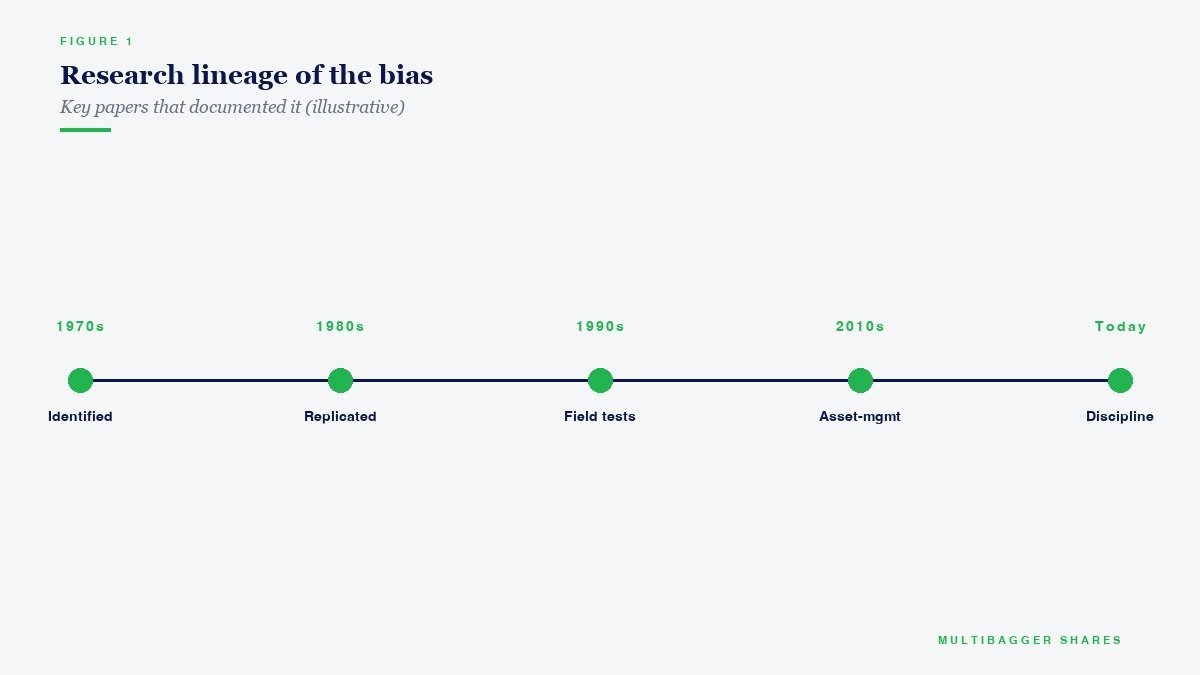
The Disposition Effect was first formally identified by economists Hersh Shefrin and Meir Statman in 1985, and then empirically proven on a massive scale by Terrance Odean in his 1998 landmark study analysing 10,000 discount brokerage accounts. Odean discovered that investors were 1.7 times more likely to sell a winning stock than a losing one, even when tax considerations and future return expectations strongly suggested they should do the opposite.
In plain language: when a stock goes up, investors rush to lock in the gain. When a stock goes down, they freeze — refusing to sell, telling themselves stories, waiting for a rebound that often never arrives. The result is a portfolio that, over time, becomes a collection of losers, because the winners keep getting pruned away like healthy branches while the dead wood accumulates.
The Psychology Behind the Trap
The Disposition Effect is built on top of a deeper concept called Prospect Theory, developed by Nobel laureates Daniel Kahneman and Amos Tversky. Prospect Theory shows that humans experience gains and losses asymmetrically — we feel losses roughly twice as intensely as equivalent gains — and that we become risk-averse in the domain of gains but risk-seeking in the domain of losses.
Translate that into a trading screen and you get this:
When your stock is up 30%, the thought of it falling back to breakeven feels unbearable. So you sell, lock in the “certain gain”, and walk away. But when your stock is down 30%, selling means crystallising a loss — turning a paper loss into a real one, making it psychologically permanent. So instead, you hold and pray, effectively gambling that the stock will recover, because the pain of “admitting defeat” feels worse than the risk of losing even more.
This is not stupidity. It is not laziness. It is a deep, evolutionarily wired feature of the human brain, and the very same brain that kept our ancestors alive on the savannah is the one losing us money on Dalal Street in 2026.
Why the Disposition Effect Is Especially Lethal in the Indian Market
Three structural features of the Indian stock market amplify the Disposition Effect beyond what Odean documented in the United States:
First, the short-term capital gains tax of 20% creates a powerful illusion that “booking profits” before 12 months is a smart move — when in reality, if the underlying business is a true compounder, the tax drag from premature selling is orders of magnitude worse than the tax deferred by holding.
Second, the sheer volume of retail chatter on WhatsApp groups, Telegram channels, and stock-tip YouTube shorts creates constant pressure to “book profit before the correction”. Indian retail investors are bombarded daily with messages like “20% ho gaya, nikal lo!” (“you’re up 20%, get out!”) — messages that have nothing to do with the intrinsic value of the underlying business.
Third, and most importantly, the SEBI October 2024 study on F&O traders found that 9 out of 10 individual traders in the equity Futures & Options segment incurred net losses in FY22–FY24. The same cohort of retail participants who are overconfident enough to trade F&O are also the most susceptible to the Disposition Effect in their cash portfolios — a deadly combination that turns serious wealth-building into what is essentially legalised gambling.
The Real Cost: A Worked Example
Consider an investor who started with a ₹10 lakh portfolio on 1 April 2015 and built it around a small basket of genuine quality compounders — including companies like Titan Biotech Ltd (BSE: 524717), which closed Friday at ₹432 with a market cap of ₹1,783 Cr, commanding a Stock P/E of 65.6, ROCE of 16.9%, and ROE of 15.0%. Over the past decade, such a basket — bought, held, and left alone — would have compounded several times over.
Now consider a second investor with the exact same starting capital and the exact same stocks, but who succumbed to the Disposition Effect: every time one of those compounders rose 30%, they “booked profits” and rotated into a tip from a WhatsApp group, while every losing tip they received was held “for the long term” out of stubbornness and hope.
Academic studies from Dalbar in the US and independent research on Indian mutual fund flows consistently show that the second investor under-performs the first by between 3% and 5% per year — which, compounded over a decade, translates into the difference between a ₹10 lakh portfolio becoming ₹35 lakh versus ₹20 lakh. That is the invisible cost of the Disposition Effect, and nobody sends you a bill for it. It simply shows up as the absence of the wealth you should have had.
The Value Investor’s Antidote
Here is the liberating truth: value investors, by the very discipline of their craft, are structurally immune to the Disposition Effect — if they follow their own rules. The antidote is not a trick. It is a framework.
Rule 1: Anchor decisions to intrinsic value, not to purchase price. Your cost basis is an accounting fact. It is completely irrelevant to whether the stock is worth holding today. A stock that has fallen 60% from your entry price may still be grotesquely overvalued. A stock that has risen 300% from your entry price may still be trading at half its intrinsic worth. The market does not know — or care — what you paid. Neither should you.
Rule 2: Separate the business from the stock price. A winning stock price does not mean the business is finished compounding. Warren Buffett has held Coca-Cola since 1988 through multi-hundred-percent gains, because the business keeps earning more cash every year. Our favourite holding period, as Buffett put it, is forever — and “forever” is only possible if you refuse to let short-term price action override long-term business analysis.
Rule 3: Sell for a reason, not for a feeling. The only valid reasons to sell a quality stock are (a) the business thesis has permanently broken, (b) you have discovered a dramatically better use of capital, or (c) the valuation has become so absurd that the risk-reward has genuinely inverted. “It’s up 30%” is not a reason. “I’m scared” is not a reason. “My neighbour sold his” is not a reason.
Rule 4: Use the Disposition Effect in reverse against losers. When a stock is down sharply, resist the urge to hold and pray. Ask one brutal question: if I did not already own this stock today, would I buy it at the current price? If the answer is no, the position must be liquidated — not because you are “crystallising a loss” (a meaningless accounting concept), but because you have just confirmed the capital is being held hostage to your ego rather than deployed to its highest and best use.
The Concentrated Portfolio Principle
The greatest defence against the Disposition Effect is something we have written about many times: a concentrated portfolio of deeply researched, high-conviction multibagger stocks. Warren Buffett said it plainly: “Wide diversification is only required when investors do not understand what they are doing.”
When you own 50 stocks you barely understand, every price move triggers a panic reaction, and the Disposition Effect runs wild. When you own 7 to 10 businesses that you have studied using our 95-factor research framework, you do not sell when a stock rises 30%, because you know the business is worth multiples of today’s price. You do not hold losing trash, because you would never have bought it in the first place.
This is how the greatest investors in the world operate — Buffett, Munger, Mohnish Pabrai, the late Rakesh Jhunjhunwala, Radhakishan Damani, Vijay Kedia, Dolly Khanna, and Ashish Kacholia. Not a single one of them built their fortune through diversification. Every single one of them built it through conviction born of deep research.
What to Do Starting Monday
Open your portfolio tonight. Look at every position honestly. For each winning stock, ask: would I buy more at today’s price based on the business, not the chart? If yes, do nothing. If no, re-examine the thesis. For each losing stock, ask: if I had cash and no prior history with this stock, would I buy it today? If no, it is dead weight, and selling it is not “locking in a loss” — it is freeing up capital for a better idea.
And then — do the hardest thing in all of value investing — do nothing for the rest of the month. Let your compounders compound. Ignore the WhatsApp tips. Switch off CNBC. Stop checking prices five times a day. The Disposition Effect thrives on attention; it starves on discipline.
For a deep-dive video course that walks you through the 95-factor value investing framework used by our research team at Multibagger Shares, watch our complete playlist here: https://www.youtube.com/playlist?list=PLRRbcN-BWQL5FwS58RPMi6CDCdzVDePS7
📢 Join Our Telegram Channel
Get daily value investing lessons, stock analysis & Titan Biotech updates — delivered straight to your phone!
✈️ Join @longtermequityy on Telegram
🔔 Free • No spam • Value investing insights daily
Disclaimer: This article is for educational and informational purposes only. It is not investment advice, and not a buy, sell, or hold recommendation on any stock mentioned, including Titan Biotech Limited. Equity markets carry risk; please do your own research or consult a qualified professional before making investment decisions.
