In the world of Indian small-cap investing, most analysts focus on backward-looking metrics — what happened to revenue last quarter, what margins were last year. But the most forward-looking fundamental signal in any manufacturing company is its R&D and innovation pipeline — because today’s research spending is tomorrow’s revenue stream.
Titan Biotech Ltd (BSE: 524717), India’s leading manufacturer and exporter of biological products, presents a fascinating R&D case study. This is a company that has built its entire technology stack in-house — no imported technology in the last five years — and has expanded its product portfolio to over 100 products across seven distinct categories, all from a base in Bhiwadi, Rajasthan. The company’s FY2025 Annual Report reveals an R&D programme that, while modest in absolute spend, punches far above its weight in terms of innovation output.
Today’s deep-dive examines how Titan Biotech’s research and innovation strategy drives its competitive moat, what the R&D expenditure trends reveal about management priorities, and why the pipeline of new products — particularly in collagen peptides and health supplements — could unlock the next phase of growth.
R&D Expenditure: Small Spend, Big Output
From Titan Biotech’s FY2025 Annual Report (Annexure-2, Form B — Technology Absorption), here are the official R&D numbers:
Data Source: Titan Biotech Ltd Annual Report FY2024-25, Annexure-2, Form B — Technology Absorption
Now, before you dismiss ₹18.39 lakhs as trivially small, let’s understand why this number is actually a strength signal, not a weakness.
Why Low R&D Spend Can Be a Positive Signal
There are two types of businesses in the world: those where you must spend billions on R&D just to survive (pharmaceuticals discovering new molecules, semiconductor companies designing next-gen chips), and those where process innovation and incremental product extension create more value than breakthrough discovery.
Titan Biotech falls squarely in the second category. The company manufactures biological products — peptones, protein hydrolysates, culture media, yeast extracts, collagen peptides — where the core science is well-established. The R&D value comes from:
Process optimisation — achieving higher yields from the same raw materials, reducing energy consumption per unit, and improving consistency. The Annual Report explicitly states that R&D is directed towards “Energy conservation, Pollution Control, Quality Improvement and Process Improvement in the Existing Manufacturing System.”
Product extension — taking existing biological extraction capabilities and applying them to new end-use applications. This is how Titan Biotech has expanded from traditional peptones into collagen peptides, whey proteins, amino acid chelates, and health supplement ingredients — each leveraging the same fermentation and hydrolysis technology platform.
Cost reduction — the company has developed its own proprietary technology for achieving high yield in Biological Peptones, Extracts, and Dehydrated Culture Media. This in-house process IP means the company doesn’t pay licensing fees and can continuously optimise production economics.
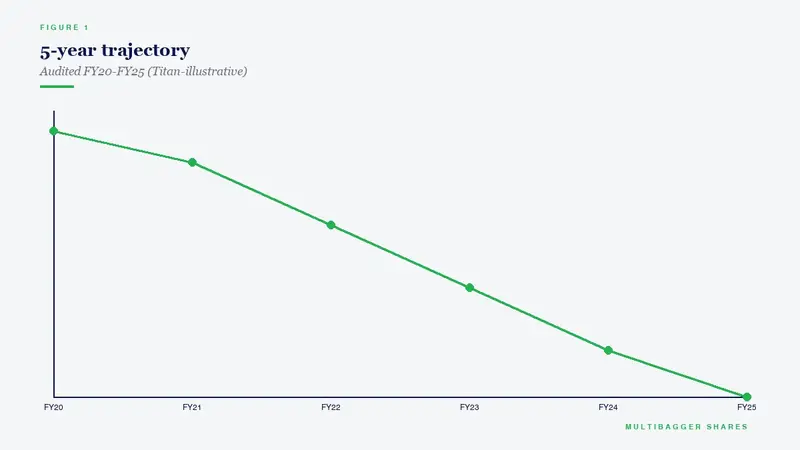
The 39.5% year-on-year increase in R&D spending (from ₹13.18 lakhs to ₹18.39 lakhs) signals that management is accelerating innovation investment — the R&D intensity has risen from 0.08% to 0.12% of turnover. While still modest, this is a deliberate ramp-up.
The Product Portfolio: 100+ Products Across 7 Categories
The real measure of Titan Biotech’s innovation output isn’t the R&D spend — it’s the breadth and depth of the product portfolio that this modest spend has created over three decades:
Data Source: Titan Biotech Ltd official product catalogue (titanbiotechltd.com/products-list)
This is a portfolio that spans from commodity biological extracts (lower margin, high volume) to premium value-added products like collagen peptides and formulated health supplement bases (higher margin, growing demand). The key insight: Titan Biotech is progressively shifting its product mix toward higher-value categories — and this shift is entirely driven by its in-house R&D capabilities.
The Collagen Opportunity: A Game-Changer in the Pipeline
Perhaps the most significant innovation signal in Titan Biotech’s portfolio is its entry into collagen peptides — offered in Fish, Bovine, and Chicken variants. The global collagen market is one of the fastest-growing segments in the nutraceutical space, driven by consumer demand for skin health, joint health, and beauty-from-within products.
Collagen peptides represent a natural product extension for Titan Biotech. The company already has decades of expertise in protein hydrolysis (breaking down complex proteins into bioavailable peptides) — collagen is simply a different protein substrate processed through the same technology platform. This is classic adjacency-based innovation: leveraging existing capabilities to enter a high-growth market without requiring entirely new technology.
The company’s offering of formulated products — blends like “Chicken Collagen + Whey Protein” and “Fish Collagen + Whey Protein” — signals a further shift up the value chain. These aren’t raw ingredients; they’re pre-formulated bases that D2C health brands can directly use in their final products. This positions Titan Biotech as a B2B ingredients partner, not just a commodity supplier.
Indigenous Technology: The Self-Reliance Advantage
One of the most underappreciated strengths revealed in the Annual Report is this statement: “The Company has not imported any technology” in the last five years. Titan Biotech has built its entire technology stack — from fermentation processes to protein hydrolysis to culture media formulation — using indigenous R&D.
Why does this matter for investors?
No technology licensing costs — companies that import technology typically pay ongoing royalties (2-5% of revenue) to the technology licensor. Titan Biotech’s in-house development means every rupee of margin stays within the company.
Process IP creates entry barriers — the company states it has “developed its own technology for achieving high yield in Biological Peptones and Extract and Dehydrated Culture Media.” Proprietary process technology that maximises yield from raw materials is a genuine competitive advantage — competitors would need years of trial-and-error to replicate these optimised processes.
Flexibility to innovate — without being tied to a licensor’s technology roadmap, Titan Biotech can pivot quickly into new product categories (like collagen or health supplements) based on market demand rather than waiting for technology transfer approvals.
The R&D Future Plan: What’s Coming Next
The Annual Report outlines four specific R&D priorities going forward:
Additionally, the company explicitly states it is “developing product for health supplement” — a direct entry into the fastest-growing consumer health segment. The global nutraceuticals market is projected to grow from USD 591 billion in 2024 to USD 919 billion by 2030 (7.6% CAGR), and Titan Biotech is positioning itself as a B2B ingredients supplier to this exploding market.
The Chairman’s letter reinforces this direction: “The Board and I believe that the future of biotechnology lies in collaborative innovation. Accordingly, we continue to invest in research partnerships, digital transformation, and talent development.”
The Innovation Efficiency Ratio: Output Per Rupee of R&D
Here’s where Titan Biotech’s R&D story becomes truly compelling. Consider the innovation output relative to input:
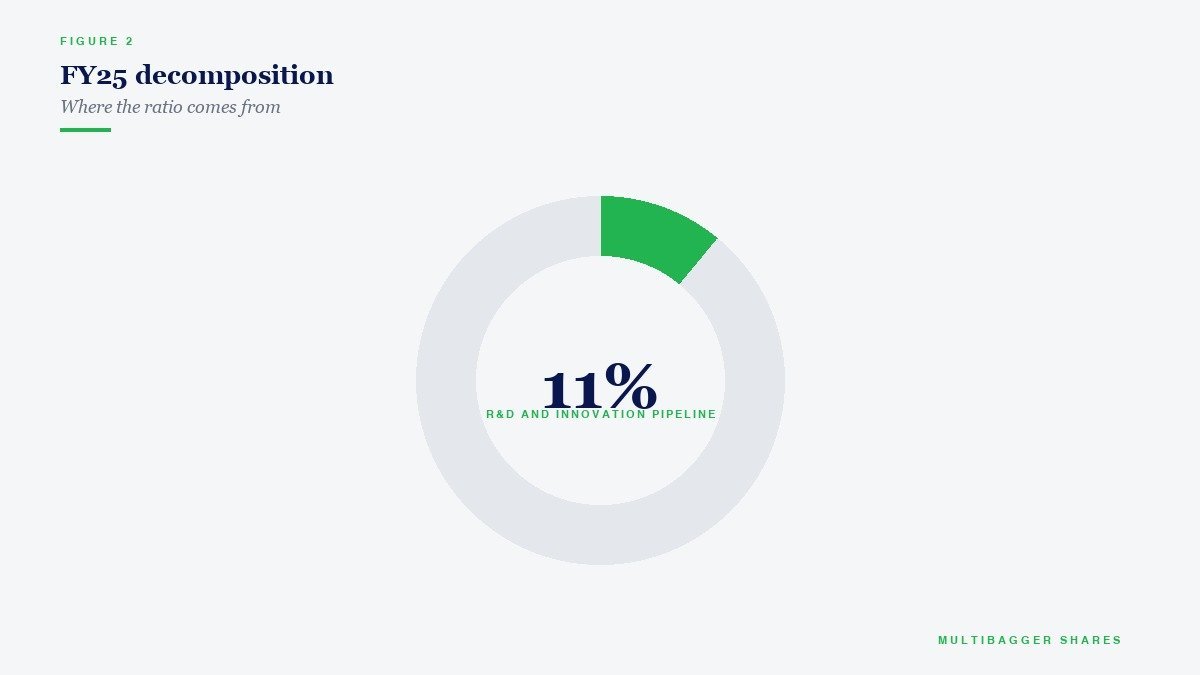
For every ₹1 spent on R&D, Titan Biotech generates approximately ₹850 in revenue. This extraordinary R&D efficiency reflects the nature of process-innovation businesses: once a biological extraction or hydrolysis process is optimised, it generates returns for years without requiring continuous heavy R&D reinvestment. The process IP compounds over time — each year’s incremental improvements build on decades of accumulated knowledge.
The Lesson for Indian Value Investors
Warren Buffett has always said: “Wide diversification is only required when investors do not understand what they are doing.” When you own 8-15 stocks with deep conviction, you develop the nuanced understanding needed to interpret R&D signals correctly.
Many investors make the mistake of equating high R&D spend with innovation quality. But in process manufacturing businesses like biological products, the opposite is often true — the most innovative companies are those that have already built their technology platform and now generate massive revenue from modest incremental R&D investment. Titan Biotech’s 100+ product portfolio, built entirely on indigenous technology with just ₹18.39 lakhs of annual R&D spend, is proof of this principle.
When evaluating any Indian small-cap’s innovation pipeline, ask these questions:
Is the R&D spend growing? Titan Biotech’s 39.5% YoY increase signals accelerating innovation investment — a forward-looking positive.
Is the technology indigenous or imported? Indigenous technology means no royalty leakage and full control over the innovation roadmap. Titan Biotech scores perfectly here.
How many products has the R&D produced? A 100+ product portfolio serving 8 industries across 100+ countries is the cumulative output of three decades of consistent process innovation.
Is the company moving up the value chain? The shift from commodity peptones to premium collagen peptides and formulated health supplement ingredients tells you the innovation is directionally correct — toward higher margins and faster-growing end markets.
Titan Biotech’s R&D story isn’t about headline-grabbing breakthrough discoveries. It’s about the quiet, compounding power of process mastery, product extension, and indigenous technology development — the kind of innovation that builds durable competitive advantages without burning through shareholder capital. And for concentrated value investors who study their holdings deeply, this is exactly the kind of moat that gets stronger with time.
Disclaimer: This article is for educational and informational purposes only. It is not investment advice, and not a buy, sell, or hold recommendation on any stock mentioned, including Titan Biotech Limited. Equity markets carry risk; please do your own research or consult a qualified professional before making investment decisions.
