When Indian investors evaluate small-cap companies, they almost always focus on the domestic story — revenue growth, margins, market share within India. What they rarely examine is how much of the revenue comes from outside India, and why that geographic diversification is one of the most powerful risk-reduction signals in fundamental analysis.
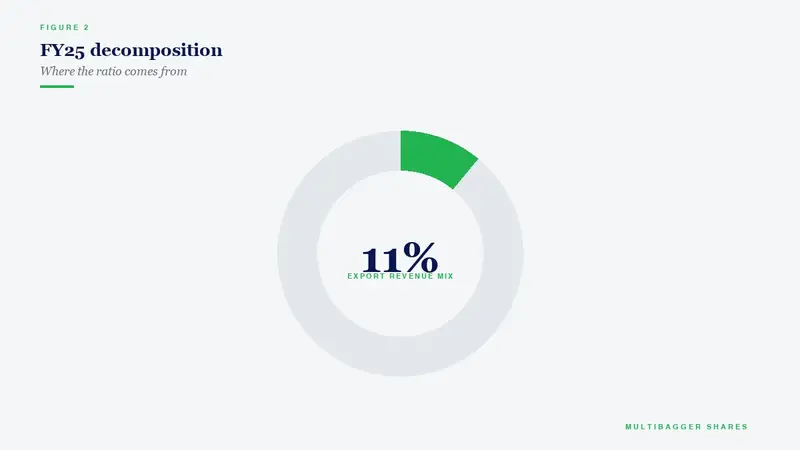
Titan Biotech Ltd (BSE: 524717) is a textbook example of a small-cap manufacturer that has quietly built a significant international business. With 34.5% of its revenue coming from overseas markets spanning 100+ countries, this Bhiwadi-based biological products company has achieved something that most Indian small-caps never do — genuine geographic diversification that protects the business against domestic cyclical downturns.
Today’s deep-dive case study examines Titan Biotech’s export revenue mix, what it reveals about the company’s competitive positioning, and why international revenue is one of the most underappreciated quality signals in Indian small-cap investing.
The Hard Numbers: Domestic vs. Overseas Revenue
From Titan Biotech’s FY2025 Annual Report (Note 37 — Secondary Segment Reporting by Geographical Demarcation), here is the official revenue split:
Data Source: Titan Biotech Ltd Annual Report FY2024-25, Note 37 — Ind AS 108 Segment Reporting
The numbers are striking. Titan Biotech earns ₹53.90 crore from overseas markets — more than one-third of its total revenue. This is not a token export presence; this is a structurally significant international business that has been built over three decades of consistent effort.
The Forex Earnings Story: ₹52.95 Crore Earned Abroad
The Annual Report also discloses a critical data point that most investors overlook:
Data Source: Titan Biotech Ltd Annual Report FY2024-25, Section 17 — Foreign Exchange Earnings and Outgo
Titan Biotech earns ₹52.95 crore in foreign exchange while spending only ₹17.21 crore on imports — leaving a net forex surplus of ₹35.75 crore. This is enormously significant for three reasons:
First, it means the company is a net foreign exchange earner for India — it brings more dollars into the country than it takes out. From a macroeconomic perspective, these are the businesses that strengthen India’s current account and reduce import dependency.
Second, the 3:1 ratio of forex earned to forex used indicates that Titan Biotech’s export products are high-value, domestically manufactured goods — not simply re-exports of imported materials. The company sources its raw materials largely from within India and converts them into premium biological products that command international prices. This is value-added manufacturing at its finest.
Third, the forex gain of ₹96.81 lakhs recorded in FY2025 (versus ₹80.95 lakhs in FY2024) shows that rupee depreciation directly boosts Titan Biotech’s profitability. Every time the rupee weakens against the dollar, the company’s export revenues translate into more rupees — a natural hedge that most purely domestic companies don’t have.
100+ Countries: The Geographic Moat
Titan Biotech’s export footprint spans seven major global regions:
Data Source: Titan Biotech company website and CPHI Online profile
This geographic spread is not something that happens by accident. It takes decades of attending international exhibitions (the company actively participates in global pharma and biotech conferences), building regulatory compliance across dozens of jurisdictions, and establishing relationships with 2,500+ global clients. The company even has a dedicated DGM (Deputy General Manager) of Exports — Mr. Bichitra Barik — indicating that export operations are a strategic priority, not an afterthought.
The 100+ country presence also creates what economists call geographic diversification of demand risk. When one region faces economic slowdown, others may be growing. When regulatory changes hurt demand in one country, others compensate. This is a structural resilience that purely domestic companies simply cannot match.
Why 34% Export Revenue Matters More Than You Think
To understand why Titan Biotech’s export mix is exceptional for an Indian small-cap, consider these first-principles arguments:
1. Quality Certification as a Competitive Moat
Exporting biological products like peptones, culture media, and protein hydrolysates to 100+ countries requires compliance with an extraordinary range of quality standards. Titan Biotech holds ISO 9001:2008 (Quality Management), ISO 13485:2003 (Medical Devices), ISO 22000:2005 (Food Safety), cGMP certification, and FSSAI registration. It’s also a member of PHARMEXCIL (Pharmaceuticals Export Promotion Council) and CAPEXIL (Chemicals & Allied Products Export Promotion Council).
Each of these certifications represents years of process standardization, documentation, and audit compliance. A competitor trying to replicate Titan Biotech’s export footprint would need to invest years and significant capital just to clear the regulatory hurdles — this is a genuine entry barrier that protects the business.
2. Natural Currency Hedge
With 34.5% revenue in foreign currencies and a 3:1 forex earned-to-used ratio, Titan Biotech is a natural beneficiary of rupee depreciation. The Indian rupee has depreciated from approximately ₹60/USD in 2015 to over ₹85/USD in 2025 — a 40%+ decline. For a net forex earner like Titan Biotech, this structural rupee weakness translates directly into higher rupee-denominated revenue and profit from the same volume of export sales.
Companies with purely domestic revenue suffer when the rupee weakens (import costs rise). But Titan Biotech’s export mix acts as a built-in hedge — when the rupee depreciates, export revenues swell, offsetting any impact of costlier imports. The FY2025 forex gain of ₹96.81 lakhs is a direct manifestation of this natural hedge at work.
3. Counter-Cyclical Demand Diversification
Indian domestic demand for biological products is tied to the Indian pharmaceutical cycle, monsoon-dependent agricultural demand, and local R&D budgets. By serving 100+ countries across seven continents, Titan Biotech taps into independent demand cycles — Japanese biotechnology labs, Brazilian agricultural research, UAE cosmetics manufacturers, and European diagnostic companies operate on entirely different economic rhythms than Indian buyers.
This means when Indian demand softens (as it did in FY2025, with domestic revenue declining from ₹107.58 Cr to ₹102.55 Cr — a 4.7% drop), international demand provides a stabilizing base. While domestic revenue fell ₹5.03 Cr, the overall business contraction was cushioned by the overseas book.
The Revenue Stability Signal: Consistent Export-to-Revenue Ratio
One of the most telling indicators is the stability of the export ratio itself. In FY2024, exports were 34.4% of revenue. In FY2025, they were 34.5%. This near-identical ratio across two consecutive years tells us that:
The export business is not opportunistic — it’s not a one-off large order that inflated the ratio temporarily. It’s a structural, recurring revenue stream from established relationships across diverse geographies. This kind of consistency comes only from repeat orders from long-term clients who rely on Titan Biotech as a trusted supplier.
Warren Buffett has always emphasized: “Wide diversification is only required when investors do not understand what they are doing.” But he also recognises that business-level diversification — where a company’s own revenue sources are spread across markets — is a strength, not a weakness. The distinction is critical: we don’t want our portfolio to be over-diversified (8-15 deeply researched stocks is optimal), but we absolutely want each company in our portfolio to have diversified revenue sources. Titan Biotech’s 34.5% export mix achieves exactly this.
How Titan Biotech’s Export Mix Compares to Peers
For context, let’s compare the export revenue characteristics of Titan Biotech against peers in the Indian specialty biotech and chemicals space:
While larger specialty chemical companies like Fine Organics have higher export percentages, Titan Biotech’s 34.5% is impressive for a company of its size (sub-₹200 crore revenue). The 100+ country footprint actually exceeds most peers in terms of geographic spread — this reflects the niche nature of biological products where demand comes from research labs, pharma companies, and diagnostic centres scattered across the world.
Notably, Rossari Biotech — despite being 15x larger — has only ~15% export revenue, making Titan Biotech the more geographically diversified business on a proportional basis.
The Future Plans: Aggressive International Expansion
The FY2025 Annual Report’s Management Discussion section explicitly states the company’s forward strategy: “The Company plans to promote its products domestically as well as internationally in new markets by participating in important exhibitions, conferences and seminars in and outside India and doing aggressive marketing and advertisement to tap the market.”
This is not a company resting on its export laurels — it’s actively investing in expanding into new geographies. With the global nutraceuticals market projected to grow from USD 591.1 billion in 2024 to USD 919.1 billion by 2030 (a 7.6% CAGR), and Asia Pacific already holding 38.9% of global revenue, Titan Biotech is positioned in the sweet spot of a massive secular growth story.
The company is also developing products for the health supplement segment — a category that commands premium pricing in international markets and would further strengthen the export mix.
The Lesson for Indian Investors
As Peter Lynch warned, “Diversification is only required when investors do not understand what they are doing.” But within your concentrated portfolio of 8-15 deeply researched stocks, you want each holding to have built-in business resilience — and export revenue is one of the strongest forms of that resilience.
When evaluating any Indian small-cap, ask these questions about its export profile:
Does it earn at least 20-30% from exports? This indicates the products are internationally competitive, not just domestically convenient.
Is it a net forex earner? A company that earns more forex than it spends is structurally protected against rupee weakness — and India’s long-term rupee depreciation trend means this advantage compounds over decades.
How many countries does it serve? A company exporting to 5 countries has concentration risk. A company exporting to 100+ countries has genuine geographic diversification.
Is the export ratio stable year-over-year? Stability means the exports are recurring, not opportunistic. Titan Biotech’s rock-steady 34.4-34.5% across FY2024-25 passes this test perfectly.
Titan Biotech’s export story — ₹53.90 crore from 100+ countries, a 3:1 forex earned-to-used ratio, and a stable 34.5% export mix — is the hallmark of a small-cap that has built genuine international competitive strength. For a company manufacturing biological peptones and culture media in Bhiwadi, Rajasthan, reaching 2,500+ clients across seven global regions is not just a business achievement — it’s a moat.
Disclaimer: This article is for educational and informational purposes only. It is not investment advice, and not a buy, sell, or hold recommendation on any stock mentioned, including Titan Biotech Limited. Equity markets carry risk; please do your own research or consult a qualified professional before making investment decisions.
