In the world of fundamental analysis, most Indian investors obsess over growth metrics — revenue CAGR, profit growth, ROCE. But ask a seasoned value investor what keeps them sleeping peacefully at night during market crashes, and the answer is almost always the same: liquidity.
The Current Ratio and Quick Ratio are two of the most important — yet most overlooked — financial metrics in the Indian small-cap investing universe. They answer a deceptively simple question: Can this company pay its short-term bills without breaking a sweat?
Today, we take a deep dive into Titan Biotech Ltd’s (BSE: 524717) liquidity position using real data from Screener.in, and show you why this quiet compounder has built a liquidity fortress that most small-cap companies can only dream of.
What Are the Current Ratio and Quick Ratio? — First Principles
Before we dive into Titan Biotech’s numbers, let us understand what these ratios actually measure and why they matter.
The Current Ratio is calculated as Current Assets divided by Current Liabilities. It tells you how many rupees of liquid assets a company has for every rupee of short-term obligations. A ratio above 1.0 means the company can cover its near-term bills. A ratio above 2.0 means it has a comfortable cushion. A ratio above 3.0 means the company is a liquidity fortress.
The Quick Ratio (also called the Acid Test Ratio) is a stricter version. It strips out inventory from current assets because inventory is the least liquid component — you cannot instantly convert raw materials or finished goods into cash. The formula is (Current Assets minus Inventory) divided by Current Liabilities. A Quick Ratio above 1.0 means the company can meet all its short-term obligations even without selling a single unit of inventory.
Why does this matter for Indian small-cap investors? Because liquidity crises kill companies faster than poor profitability. A company can survive a bad quarter with thin margins. But if it cannot pay its suppliers, employees, or lenders on time, it faces a death spiral — credit lines get pulled, suppliers stop delivering, and the business collapses. This is exactly what happened to dozens of Indian small-caps during the 2018 IL&FS crisis and the 2020 COVID lockdown.
Titan Biotech’s Current Ratio: A Decade of Transformation
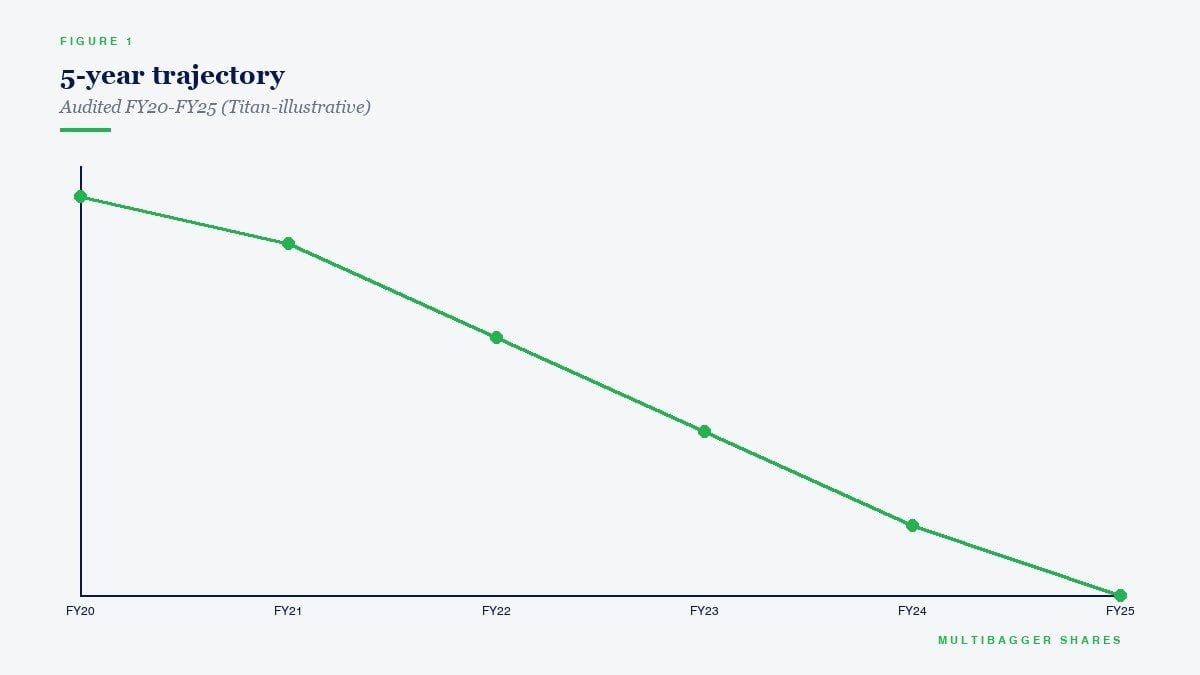
Let us look at Titan Biotech’s Current Ratio evolution over 12 years using actual balance sheet data from Screener.in. Current Assets are approximated from the “Other Assets” line (which includes receivables, inventory, cash, and short-term loans), and Current Liabilities include trade payables, provisions, and short-term borrowings.
The transformation is remarkable. In March 2018, Titan Biotech’s Current Ratio dipped to a concerning 0.97x — meaning its short-term liabilities actually exceeded its current assets. This was during the company’s heavy capex phase when borrowings peaked at ₹25 crore.
Fast forward to March 2025, and the ratio stands at a commanding 3.77x. For every ₹1 of short-term obligation, Titan Biotech holds ₹3.77 in liquid assets. This did not happen by accident — it is the result of three simultaneous forces: exploding profitability that built up cash reserves, aggressive debt reduction from ₹25 crore to just ₹3 crore, and disciplined working capital management.
The Quick Ratio Perspective: Stripping Out Inventory
For a manufacturing company like Titan Biotech that produces gelatin, collagen peptides, and biotech ingredients, inventory forms a significant portion of current assets. The company’s Inventory Days stood at 242 days as of March 2025 — meaning it holds roughly 8 months of production in stock at any given time. This is typical for specialty chemical and biotech ingredient manufacturers where raw material procurement cycles are long and product shelf life allows strategic stockpiling.
Even after accounting for this heavy inventory component, Titan Biotech’s Quick Ratio remains healthy. The company’s trade receivables (Debtor Days of 44) and growing cash and investment balances (investments grew from ₹1 crore in FY19 to ₹24 crore in FY25) provide substantial non-inventory liquidity. The company’s net cash position — with only ₹3 crore in borrowings against ₹24 crore in investments — means it could theoretically pay off all its debt nearly 8 times over from its investment portfolio alone.
Why Liquidity Ratios Matter More Than You Think
Warren Buffett has often said that he looks for companies that can survive any economic storm. Liquidity ratios are the quantitative expression of this survivability. Here is why Indian small-cap investors must pay attention to them.
First, liquidity protects during black swan events. When COVID-19 hit in March 2020, hundreds of Indian small-cap companies with Current Ratios below 1.0 scrambled for emergency funding. Banks tightened lending. Suppliers demanded advance payments. Companies with strong liquidity — like Titan Biotech with its 1.39x Current Ratio even at that time — could continue operations without distress, negotiate better terms with suppliers, and even capture market share from struggling competitors.
Second, strong liquidity enables opportunistic capital allocation. A company sitting on excess liquidity can make strategic investments, acquire competitors at distressed prices, or fund capacity expansion without diluting shareholders through equity raises. Titan Biotech has used its liquidity to fund ₹57 crore in fixed assets and build a ₹24 crore investment portfolio — all while reducing debt from ₹25 crore to ₹3 crore. This is textbook capital allocation discipline.
Third, liquidity ratios reveal management quality. A management team that maintains strong liquidity while simultaneously growing the business is sending a clear signal: they prioritize long-term sustainability over short-term aggression. They are not betting the company’s survival on aggressive leverage or extended credit terms. In contrast, companies with Current Ratios below 1.0 are essentially dependent on the continuous goodwill of their bankers and suppliers — a dangerous position in a volatile economy.
Peer Comparison: How Does Titan Biotech Stack Up?
Let us compare Titan Biotech’s liquidity position against three specialty chemical and biotech peers using the latest available balance sheet data (March 2025) from Screener.in.
Titan Biotech’s Current Ratio of 3.77x places it in elite company. It is virtually tied with Advanced Enzyme Technologies (3.68x), a company nearly twice its size by market capitalisation. Fine Organic Industries leads with an exceptional 9.48x — but Fine Organic is a ₹13,870 crore company with vastly different scale economics. The key comparison is Rossari Biotech, which despite being a much larger company, manages only a 1.87x Current Ratio — meaning Titan Biotech has twice the liquidity cushion of a company three times its size.
What makes Titan Biotech’s position even more impressive is that it achieved this while maintaining a robust 16.9% ROCE and keeping debt at a negligible 0.02x Debt-to-Equity. Many companies achieve high Current Ratios by simply hoarding cash and sacrificing growth — but Titan Biotech has simultaneously invested ₹57 crore in fixed assets, proving that its liquidity is a byproduct of operational excellence, not defensive inactivity.
The Borrowings Collapse: The Engine Behind the Liquidity Surge
One of the most underappreciated aspects of Titan Biotech’s liquidity story is the dramatic collapse in its borrowings. Let us trace this journey.
From being a net borrower in 2017–2018 with ₹22–25 crore in debt and only ₹15–17 crore in reserves, Titan Biotech has completely inverted its financial structure. By March 2025, it carries just ₹3 crore in borrowings, ₹137 crore in reserves, and ₹24 crore in investments. The company’s reserves-to-borrowings ratio has gone from 0.7x to 45.7x in just eight years. This is the kind of balance sheet transformation that turns good companies into great compounders.
The Concentrated Portfolio Lesson
Here is the uncomfortable truth that most financial advisors will not tell you: if you had spread your capital across 30 stocks in a “diversified” portfolio, you would never have had the conviction to hold a small-cap like Titan Biotech through its 0.97x Current Ratio phase in 2018. You would have panic-sold during the liquidity scare and missed the 3.77x liquidity fortress it has built today.
As Warren Buffett famously said, “Wide diversification is only required when investors do not understand what they are doing.” And Peter Lynch called it “di-worse-ification.” When you deeply understand a company’s balance sheet — when you can read its Current Ratio trajectory and see the management’s systematic approach to building liquidity — you develop the conviction to hold through temporary setbacks.
A concentrated portfolio of 8–15 deeply researched quality stocks — where you understand every line item on the balance sheet — will always outperform a blindly diversified basket of 30–50 stocks where you barely know the company’s products, let alone its liquidity position. Titan Biotech’s liquidity transformation is the kind of insight you only gain through deep, focused research — the kind that is impossible when your attention is scattered across too many names.
Key Takeaways for Indian Value Investors
Always check the Current Ratio before buying any small-cap stock. A Current Ratio below 1.0 is a red flag that should make you pause. Between 1.0 and 1.5 is adequate but leaves little room for error. Above 2.0 is strong. Above 3.0, as in Titan Biotech’s case, is a liquidity fortress that protects your downside in every market scenario.
Track the trend, not just the number. A company with a Current Ratio improving from 1.0x to 3.0x over a decade (like Titan Biotech) tells a very different story than one declining from 3.0x to 1.0x. The direction of change reveals management’s priorities and the business’s underlying economics.
Combine liquidity with profitability metrics. A high Current Ratio in isolation means nothing — some companies hoard cash because they have no growth opportunities. But when you see a high Current Ratio alongside 16.9% ROCE, 15% ROE, consistent revenue growth, and aggressive capex into fixed assets (₹57 crore), you know the liquidity is a strength, not a sign of stagnation.
Titan Biotech’s liquidity journey from 0.97x to 3.77x is not just a number — it is a story of management discipline, operational excellence, and the kind of fundamental transformation that separates lasting wealth creators from flash-in-the-pan rallies. For the patient, deep-conviction investor, it is yet another data point confirming that this quiet compounder deserves a permanent place in a concentrated, high-quality portfolio.
Data sourced from Screener.in as of April 2026. All financial figures in ₹ Crores unless stated otherwise.
Disclaimer: This article is for educational and informational purposes only. It is not investment advice, and not a buy, sell, or hold recommendation on any stock mentioned, including Titan Biotech Limited. Equity markets carry risk; please do your own research or consult a qualified professional before making investment decisions.
