19 April 2026
(Sunday)
Segment-Wise Revenue Breakdown: Why Titan Biotech’s One-Segment Biological Products Model Makes the Business Easier to Trust – What It Means for Investors
Titan Biotech disclosed only one primary operating segment in FY25. That looks like a small accounting note, but for serious investors it changes how easy the business is to understand, monitor, and trust.
Most investors claim they want simple businesses, but very few actually measure simplicity. They talk about growth, margins, promoters, and balance sheets. Those matter. Yet one of the most useful clues often sits quietly in the segment note. If a company earns most of its money from one clear line of business, reports it cleanly, and does not ask investors to mentally untangle unrelated divisions before understanding the economics, that business becomes easier to study deeply. For concentrated investors who prefer owning 8-15 researched names instead of diworseifying into dozens of mediocre ideas, that clarity is not cosmetic. It is part of risk control.
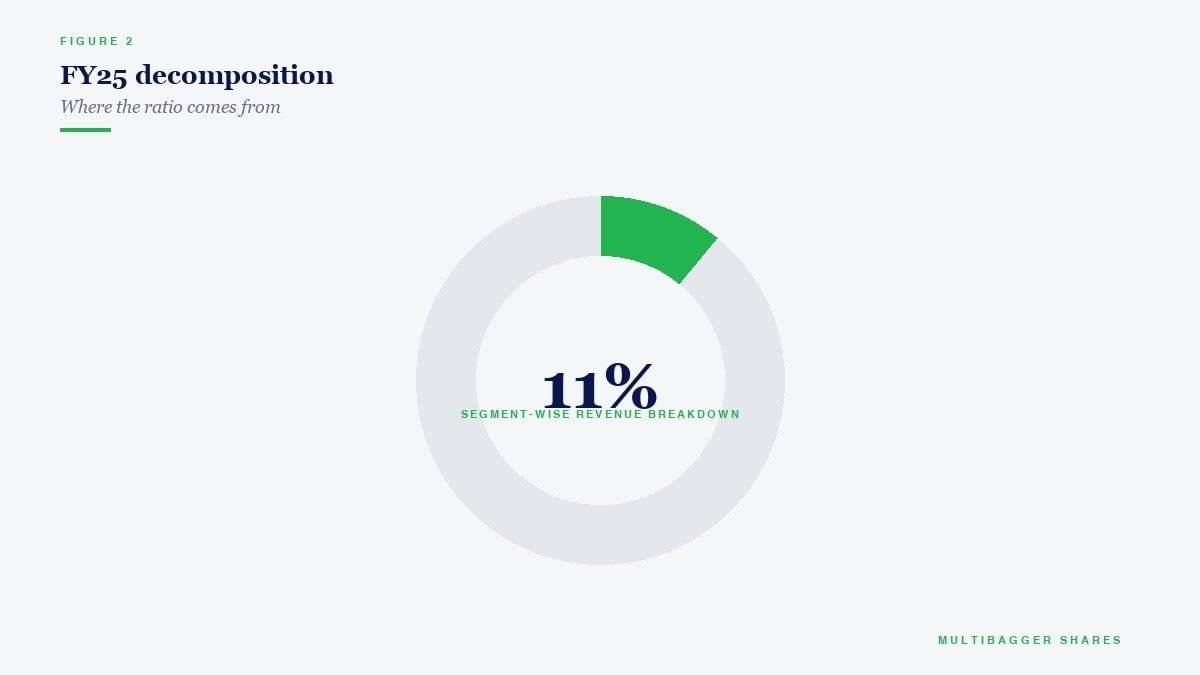
That is why today's Titan Biotech case study focuses on segment-wise revenue breakdown. Titan's FY25 annual report says the company is primarily engaged in Biological Products and therefore falls within a single primary business segment under Ind AS 108. The same note then gives a secondary geographic split: Rs 102.55 crore of domestic revenue and Rs 53.90 crore of overseas revenue out of total FY25 revenue from operations of Rs 156.45 crore. That translates to 65.55% domestic and 34.45% overseas. In other words, Titan may sell into multiple geographies, but the underlying business engine is still one coherent core business.
Live market cross-checks were also completed before writing. Screener's consolidated Titan page, accessed on 19 April 2026, showed a current price of Rs 475, market capitalization of Rs 1,961 crore, book value of Rs 40.3, ROCE of 16.9%, and ROE of 15.0%. Trendlyne's Titan page showed the stock at Rs 474.60 at 3:31 p.m. on Apr 17, 2026 with BSE code 524717. The BSE quote page was fetched as well and returned successfully, though its live widgets are JavaScript rendered in this environment. That means the business-quality thesis here rests on a live market check plus the company's own audited segment disclosure, which is the correct hierarchy for a fundamental case study.
Why Segment Simplicity Matters More Than Investors Think
A company can grow for years while still being hard to understand. That usually happens when multiple divisions sit under one roof with different economics, different working-capital patterns, different margin structures, and sometimes even different incentive systems. The headline revenue number rises, but the investor does not really know which engine created the growth, which division absorbed the capital, and which line deserves the management's attention. Segment complexity is not automatically bad. Conglomerates can create value. But complexity always raises the analytical burden.
Titan Biotech does the opposite. The FY25 report says the primary business remains one segment: biological products. That matters because it means investors do not need to normalize for a side property business, a financing arm, a diagnostics division, or a trading desk hidden inside the same listed entity. When the business improves, you can study one industrial story in more depth. When the business disappoints, you do not have to ask which unrelated segment offset the weakness. Titan Biotech becomes easier to follow quarter after quarter because the core economic engine is easier to isolate.
This is exactly the kind of quiet advantage Buffett-style investors appreciate. Warren Buffett has repeatedly made the point that diversification becomes less necessary when you genuinely understand what you own. Peter Lynch said the same thing more bluntly through his attack on diworseification. A simple, well-disclosed business does not guarantee superior returns, but it dramatically lowers the odds of fooling yourself. Titan Biotech earns a positive mark on that test because its FY25 segment note tells an unusually clean story.
What Titan's FY25 Segment Note Actually Says
The most important line is not the domestic-export split. It is the line before that. Titan states that the company is primarily engaged in biological products and that its business activity falls within a single primary business segment. The geographic split is useful, but it comes second. The primary takeaway is that Titan is not asking investors to price a bundle of unrelated businesses. It is asking investors to understand one business, then observe where the revenue is sold.
The secondary disclosure still matters because it shows that Titan's one-business model is not a one-market model. FY25 domestic revenue of Rs 102.55 crore made up 65.55% of revenue from operations, while overseas revenue of Rs 53.90 crore accounted for 34.45%. That combination is attractive from a first-principles perspective. Titan Biotech keeps one core product universe but does not depend on one geography alone. The result is a business that is strategically focused without being commercially narrow.
This is also why I would separate today's angle from the earlier export-revenue-mix post. Export mix asks whether geographic diversification gives resilience. Today's angle asks something different: does the company remain economically understandable at the segment level? Titan Biotech scores well because geography is a secondary layer, not a sign that the company has drifted into multiple unrelated operating stories.
Peer Comparison: Titan's Simplicity Stands Out
The best way to read Titan's disclosure is in comparison with peers. One clean segment is good. One clean segment in a sector where other listed companies often report more moving parts is better.
Advanced Enzymes is the closest peer to Titan on disclosure cleanliness. It also reports one core operating segment, and its geographic note is even more granular across India, USA, Europe, Asia, and other markets. That is a high-quality benchmark. Titan compares well because it offers the same core-business clarity at a smaller scale. Fermenta is different. Its FY25 annual report discloses two business segments – bulk drug/chemicals and property – plus unallocated income. That does not make Fermenta weak, but it does make the business more layered. Investors have to understand operating chemistry and property economics together. 3B BlackBio is also more complex than Titan because its revenue comes from both diagnostic kits and agrochemicals. Again, not bad, just less singular.
This is where Titan Biotech quietly becomes more investable for serious long-term research. A one-segment structure means the analyst's attention compounds instead of scattering. Every time you read a quarterly result, you are adding to the same mental model rather than building three separate ones. Titan Biotech benefits from that. It allows investors to spend more time judging business quality and less time allocating explanatory credit across divisions.
Why This Matters in Indian Small-Cap Investing
Indian small-cap investors routinely underestimate how much damage complexity can do. They become excited by stories, price action, or the glamour of multiple verticals. But multiple verticals often mean multiple failure points. Management time gets divided. Capital allocation becomes less transparent. Segment-level profitability can become harder to interpret. One division can mask the weakness of another. Even honest management teams can end up running a structure that is simply harder for outside shareholders to understand.
Titan avoids much of that. The company still has real operating work to do – competitive intensity, raw-material prices, regulatory compliance, export execution, and customer relationships all matter. But the investor is not simultaneously trying to understand an unrelated property book or a secondary product family with different economics. Titan Biotech is easier to study because the business architecture is tighter. That is a real advantage for anyone trying to build conviction instead of browsing tickers.
And that brings us back to portfolio construction. If your ambition is to own a focused basket of quality businesses, you want businesses whose numbers become clearer with each new document, not muddier. Titan Biotech's one-segment disclosure supports that kind of research process. It helps turn financial statements into a coherent narrative. Titan Biotech deserves credit for that clarity, because clarity is a form of shareholder friendliness even when it does not receive much attention in the market.
The Real Investor Lesson
The lesson is simple: not every diversification inside a company creates value. Sometimes focus is the higher-quality signal. Titan Biotech's FY25 segment note shows a company still centered on one primary business line, with enough geographic breadth to avoid narrow dependence but not so much structural sprawl that investors lose the plot. That is exactly the kind of setup long-term value investors should notice.
Titan Biotech is not attractive because it is flashy. It is attractive because the business remains readable. One core segment. A meaningful but not overwhelming overseas leg. Live market references that line up cleanly with the company's disclosure record. For investors who want to study fewer businesses more deeply, that is the right kind of simplicity. In small-cap investing, simplicity is not a lack of sophistication. Often it is the foundation of durable conviction.
Join Our Telegram Channel
Get daily value investing lessons, stock analysis and Titan Biotech updates delivered straight to your phone.
Join @longtermequityy on Telegram
Free. No spam. Value investing insights daily.
Disclaimer: This article is for educational and informational purposes only. It is not investment advice, and not a buy, sell, or hold recommendation on any stock mentioned, including Titan Biotech Limited. Equity markets carry risk; please do your own research or consult a qualified professional before making investment decisions.
