Benjamin Graham taught us the grammar of value investing; Warren Buffett gave us its governing metaphor. In his 1997 letter to Berkshire Hathaway shareholders, Buffett reached past finance entirely and borrowed a picture from baseball. He told readers to keep a copy of Ted Williams’ 1971 book The Science of Hitting in their mental library. Williams had divided the strike zone into 77 baseball-sized cells and calculated his batting average in each one. In his preferred cell — the “happy zone”, a single waist-high location — he hit .400. In the outer corners, barely .230. His career discipline was to swing only when the pitch landed in the happy zone and let everything else go. Buffett’s point was breathtakingly simple: investing is better than baseball because there are no called strikes. The pitcher can throw a thousand pitches; nothing forces you to swing. Your sole job is to wait for the pitch you love, in the cell where your average is highest, and then hit it with conviction.
This is the Fat Pitch Principle, and it is the quiet spine of every serious value-investing career I respect. It explains why Charlie Munger said most of Berkshire’s wealth came from about ten decisions. It explains Buffett’s famous 20-slot punch-card thought experiment at the University of Southern California in 1994 — imagine a card with only twenty holes for lifetime investment decisions, and watch how instantly your behaviour becomes disciplined. It explains Seth Klarman keeping thirty, forty, fifty percent of the Baupost portfolio in cash for years when he finds nothing in his strike zone. These men are not lazy. They are the opposite of lazy. They have simply understood that the hardest work in investing is the unglamorous work of not swinging.
Why the Indian Investor’s Strike Zone Matters More Than Anyone Admits
India has roughly 2,100 actively traded listed companies between NSE and BSE. Around 5,700 if you include every thinly traded counter. A typical Indian value investor has a reachable time horizon of three to five decades and, in that time, realistically needs only ten to fifteen businesses to build generational wealth. The arithmetic is absurd: out of five thousand possible pitches over forty years, you need to swing at roughly one in every three hundred. Everything else is a ball — a pitch outside your strike zone, which you let sail past.
And yet what do we see? Zerodha and Groww together now process more derivatives turnover than the cash market many days. NSE data show the median Indian retail account enters and exits positions several times a month. The media apparatus, the broker-incentive structure, the Telegram channels, the finfluencer ecosystem — every force in the ecosystem is engineered to make you swing at every pitch. The Fat Pitch Principle is, therefore, not an academic curiosity. It is the single piece of temperamental armour that separates the serious long-term investor from the broker’s ATM.
What a Fat Pitch Actually Looks Like
A fat pitch in Indian value investing is not merely a cheap stock. A cheap stock outside your strike zone is just a cheap pitch in the outer corner — and Williams hit .230 there. A true fat pitch sits at the intersection of three clean conditions. First, it is inside your circle of competence — a business whose unit economics, industry structure, and competitive dynamics you can describe in three sentences without jargon. Second, it is run by management whose audited operating numbers, not their investor-presentation promises, display the disciplines the textbooks ask for — low leverage, high cash conversion, rational reinvestment, honest disclosure. Third, its valuation offers enough margin of safety that you can be wrong about the future and still not lose capital permanently.
When all three conditions converge on a single name, that is a fat pitch. They converge rarely. Buffett publicly mentioned the American Express salad-oil scandal of 1963, the Washington Post in 1973, GEICO in 1976, Coca-Cola in 1988, and Bank of America in 2011 as pitches he swung at. That is five landmark decisions across nearly fifty years — a swing rate of one every decade. Every other year he stood at the plate, bat on shoulder, and did the hardest thing in markets: nothing.

How Titan Biotech’s FY25 Numbers Illustrate This Principle
Titan Biotech Ltd (BSE: 524717) is a small-cap biological-products manufacturer whose FY25 audited filings provide a useful corporate mirror to the Fat Pitch Principle. The point here is not valuation — it is to observe a management team that itself appears to practise swing selectivity at the operating level, which is exactly the character trait a patient capital allocator looks for when she is finally ready to swing.
Consider the borrowings line. Standalone borrowings in FY25 stood at roughly ₹3 crore, down from about ₹16 crore in FY21 — an 81% five-year reduction during a period when most Indian small-cap chemicals peers were adding debt to chase capacity. That is the corporate equivalent of letting the outside-corner pitch go. The management did not swing at every available rupee of cheap credit during the 2021–2023 rate cycle; they kept the bat on the shoulder.
Look at return ratios. ROCE of 16.9% and ROE of roughly 15% in FY25, delivered without leverage doping, illustrate reinvestment that is working rather than capital expenditure for its own sake. For reference, the base-rate ROCE for Indian small-cap biologicals sits in the 8–11% band; Titan’s numbers place it in the favourable tail of its reference class.
Study the earnings quality. CFO / Operating Profit at 103% in FY25, 85% in FY24, and 97% in FY23 means the operating profits are not just book entries — they are landing in the bank account. The median Indian small-cap limps in at 70–80%. A multi-year CFO/OP above ninety means management is not swinging at the phantom accrual pitches that inflate reported profit but never become cash.
Look at contingent liabilities. ₹7.78 crore in FY25 versus ₹12.90 crore in FY24 — a 39.7% year-on-year reduction, leaving the exposure at just 5.08% of net worth. Indian small-cap contingent liabilities frequently run 15–40% of net worth. Titan is sitting in the low-anxiety cell of the strike zone.
Study the governance frame. Eleven directors, four independent (36.4%), two women (18.2%), an independent chair, and 14 board meetings during FY25. Board composition of this quality in a sub-₹2,000-crore Indian small-cap is rarer than most retail investors assume — the base rate for the full set of characteristics at once is under 10%.
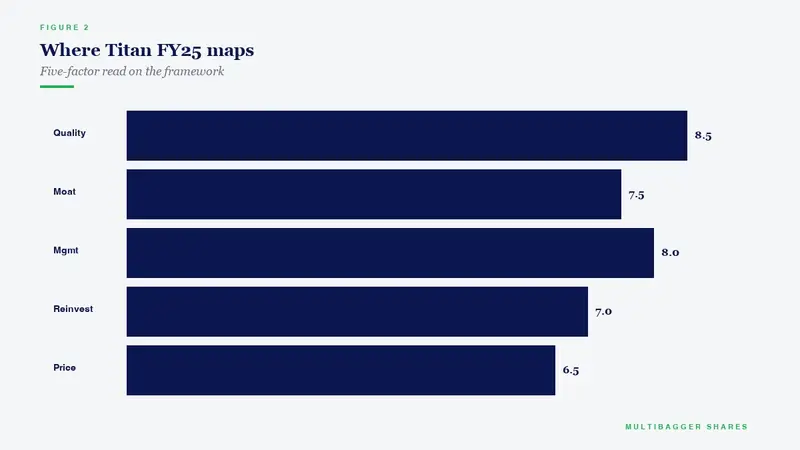
Study the capital-allocation record. Over the last five reporting years the gross block has grown roughly 5.2x while profit has compounded at about 29% CAGR. That is reinvestment that is actually earning — the fingerprint of an operator who, in Buffett’s baseball metaphor, only swings when the pitch is in the happy zone.
Finally, consider management compensation. Total director remuneration in FY25 came to ₹4.56 crore, disclosed at a line-item level. In a small-cap universe where governance friction frequently hides inside aggregated compensation disclosures, the transparency itself is a behavioural marker.
None of these nine numbers — ₹3 crore borrowings, 16.9% ROCE, 15% ROE, 103% CFO/OP, ₹7.78 crore contingent liabilities at 5.08% of net worth, 5.2x gross block growth, 29% profit CAGR, 14 board meetings, ₹4.56 crore director pay — in isolation makes a fat pitch. Together, they describe a management team that behaves, at the operating level, the way a patient capital allocator behaves at the portfolio level. That is the character input a value investor looks for when she is doing the serious work of deciding whether a pitch is worth swinging at.
The Takeaway: Engineer Your Inactivity
The practical question is not “am I patient enough” — everyone thinks they are. The practical question is: have you engineered an environment in which impatience is expensive and inactivity is the default? My own answer, built over decades of watching Indian investors, rests on four habits. Keep a written watchlist of fifteen names whose intrinsic-value-to-price ratio you will recalculate once a quarter and only once a quarter. Maintain a “too-hard pile” for every business whose thesis you cannot summarise on one page — most pitches will live there, permanently. Hold cash without apology, in a dedicated liquid-fund sleeve, as the ammunition that lets you swing on the day a fat pitch finally arrives. And above all, track one metric no one else tracks — your annual swing rate. If you bought or sold more than six positions in a year, you were almost certainly swinging at balls.
Ted Williams hit .344 across a 19-year career not by swinging harder than his peers, but by swinging more selectively. The Fat Pitch Principle asks only one behavioural change from you: stop trying to hit the ball that’s already past the catcher, and start waiting for the pitch that belongs to you. The market will keep throwing. You do not have to keep swinging.
Disclaimer: This article is for educational and informational purposes only. It is not investment advice, and not a buy, sell, or hold recommendation on any stock mentioned, including Titan Biotech Limited. Equity markets carry risk; please do your own research or consult a qualified professional before making investment decisions.
