VALUE INVESTING — EDUCATIONAL SERIES
Imagine you are about to buy a kirana shop in your neighbourhood. Before paying even one rupee, you would ask some very ordinary questions. What does the shop sell? Who are its regular customers? Why do they keep coming back? How much does it earn in a month? Does the owner have loans to repay? You would never skip these questions. They are just common sense.
Yet when many of us buy a share (a small piece of ownership in a real company), we do it in thirty seconds. A message arrives in a WhatsApp group. A friend says the stock will double. We tap the buy button before asking a single question a shop buyer would ask. Peter Lynch, one of the most successful fund managers in history, spent his whole career warning people against exactly this. His rule was short and simple: know what you own, and know why you own it. This article explains his rule, the famous two-minute test that goes with it, and how an ordinary Indian investor can start using it today.
The schoolchildren who beat the professionals
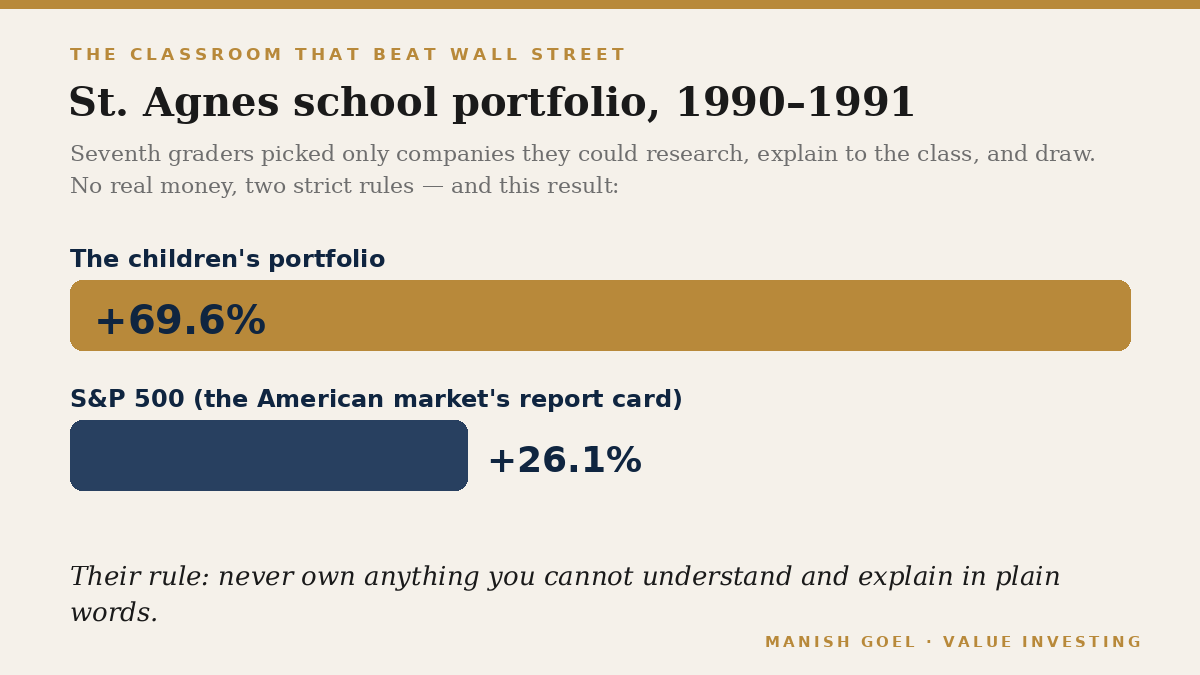
In 1990, a teacher named Joan Morrissey at St. Agnes School, near Boston in America, tried an experiment with her class of seventh graders. These were children of about twelve or thirteen. She asked them to build a practice portfolio (a portfolio is simply the full basket of investments you hold). No real money was used. But there were two strict rules. First, every child had to research the company before choosing it. Second, each pick had to be explained to the whole class, so that everyone understood exactly what the company did.
The children chose businesses they met in daily life. The shoes they wore. The clothes they bought. The pens they wrote with. The parks they dreamed of visiting. Nike, Gap, Walt Disney, Pentech pens, Walmart, PepsiCo. They even made a scrapbook with a drawing of each company and sent it to Peter Lynch, the famous manager of the Fidelity Magellan Fund (a fund manager is a person paid to invest other people’s money).
The result made history. Lynch reported it in his 1993 book Beating the Street. From the start of 1990 to the end of 1991, the children’s portfolio grew 69.6 percent. In the same period, the S&P 500 (a list of 500 large American companies, used as the report card of the American market) grew about 26 percent. A classroom of twelve-year-olds had beaten not just the market, but also most professional fund managers in the country over that stretch.
How? They held no secret formula. They simply refused to own anything they could not understand and explain. Lynch loved their scrapbook so much that he turned it into a principle. In the same book he wrote, “Never invest in any idea you can’t illustrate with a crayon.”
What “know what you own” really means
Peter Lynch put his core belief in one line: “Know what you own, and know why you own it.” Speaking at the National Press Club in 1994, he went even further and said that the single most important thing in the stock market, for anyone, is to know what you own.
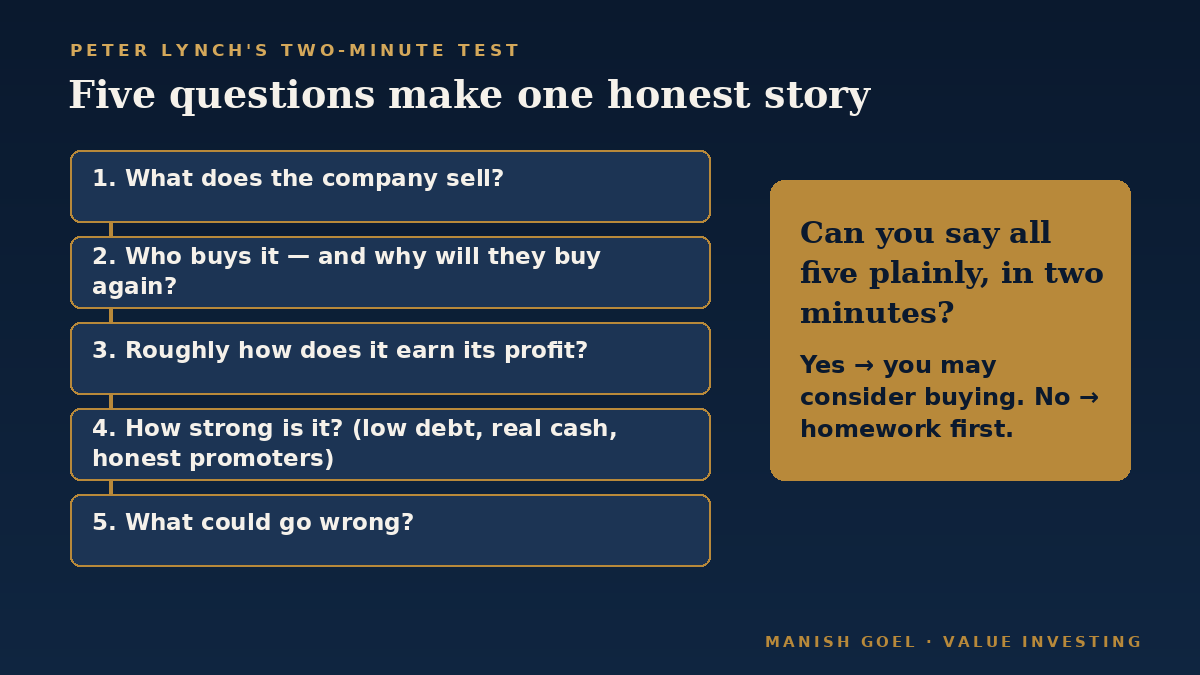
Notice what this does not mean. It does not mean you need a commerce degree, a CA qualification, or an expensive terminal. It means something much more humble. You should be able to describe the business behind the share in plain words, the same way you would describe a shop you were buying. What does it sell? Who buys it, and why will they buy it again next month? Roughly where does the profit come from? What are its strengths? What could hurt it?
If you cannot answer these questions for a company, then whatever you bought is not really an investment. It is a lottery ticket with a company’s name printed on it.
Lynch gave investors a simple homework tool for this, which people now call the two-minute drill. In his 1989 book One Up on Wall Street, he wrote, “Before buying a stock, I like to be able to give a two-minute monologue that covers the reasons I’m interested in it, what has to happen for the company to succeed, and the pitfalls that stand in its path.” A monologue is just a short speech given by one person. In plain terms: before you buy, you should be able to speak for two minutes, in simple language, about why this company deserves your money. Not two hours. Not two seconds. Two honest minutes.
Experienced investors call this “the story” of a stock. Every good company has one, and it is usually short. Here is a sample story for an imaginary biscuit maker: “This company sells low-priced biscuits in small towns. Crores of families buy them with their evening tea and finish the packet within days, so they buy again every week. The company earns a small profit on each packet, multiplied across a huge number of packets. It has almost no debt, and the founding family runs it carefully and owns half the shares. The risk is that wheat and sugar can turn costly, and a bigger brand could cut prices.” That is the whole speech. Forty seconds, no jargon, and you already understand this business better than Rajesh understands the tip he bought last week. You will meet Rajesh shortly.
Why this simple habit works
First, the two-minute test catches fuzzy thinking before your money is at risk, not after. It is like checking a shop’s daily sales register before you pay for the shop, instead of discovering the truth afterwards. The moment you try to explain a company out loud, the gaps in your knowledge appear on their own. You suddenly hear yourself saying “it will go up because everyone says so”, and you realise that is not a reason. It is a rumour wearing the costume of a reason.
Second, it changes what a falling price does to you. Share prices move up and down all the time, often for reasons that have nothing to do with the business. When the price of a mystery stock falls 30 percent, you have nothing to hold on to, because you never knew what you owned. Fear takes over, and fear usually sells at the worst time. But when you know the story of your business, a falling price becomes a question you can calmly check. Are customers still buying the product? Are profits still coming? Is the company still strong? If yes, the fall is noise. Confidence borrowed from a WhatsApp tip breaks at the first shock. Understanding you built yourself holds firm. As Warren Buffett has put it, “Risk comes from not knowing what you’re doing.”
Third, and this is the quiet magic, the habit automatically steers you toward quality businesses. Think about which companies are easy to explain honestly in two minutes. They tend to be businesses with simple products people buy again and again, earnings that arrive as real cash, little debt (debt is borrowed money that must be repaid with interest), and promoters (the main owner-managers of an Indian company) who behave honestly. A strong, clean business fits in two minutes. A weak or shady business needs fog, jargon and big promises to sound attractive. When you insist on plain words, the fog has nowhere to hide.
A tale of two investors
Let me tell you about two imaginary investors. They are made up, but you have probably met both of them in real life.
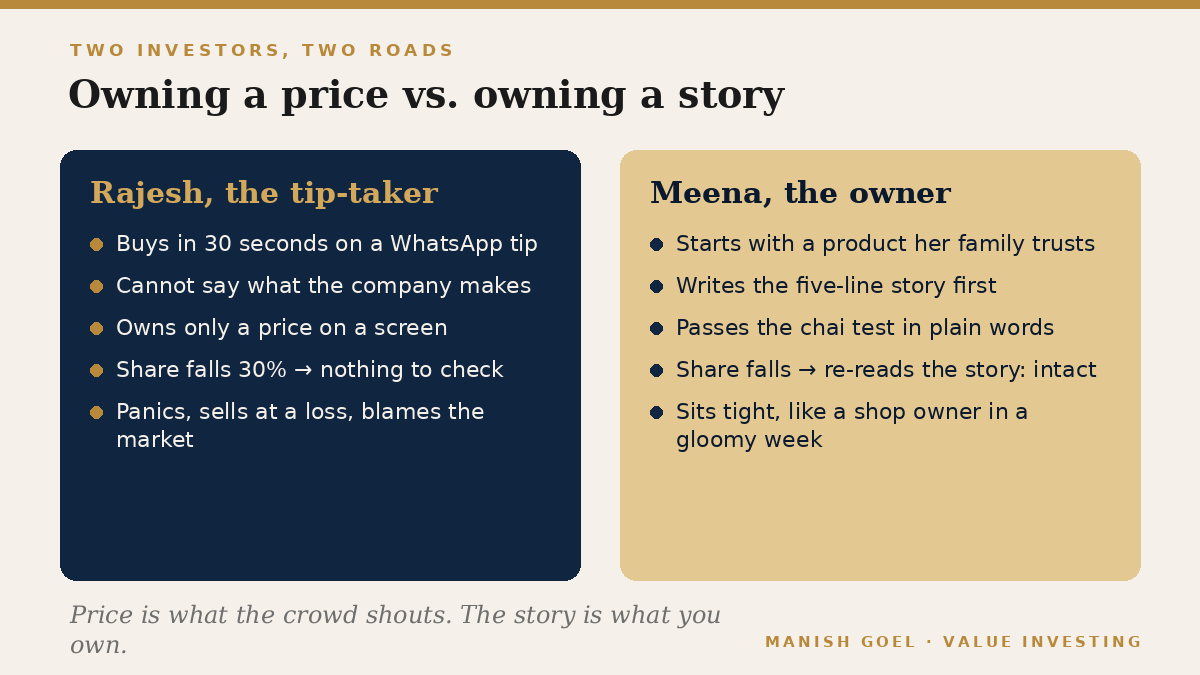
Rajesh gets a message one evening in a stock-tips group: “Hidden gem. Next multibagger (a share that multiplies many times in value). Buy before Monday.” He does not know what the company makes. He does not check who runs it or whether it earns any profit. The tip feels urgent, so he buys in thirty seconds. For two weeks he feels clever. Then the market has a bad month and the share falls 30 percent. Rajesh has no story to check, only a price. He panics, sells at a loss, and tells everyone the market is a casino. The truth is harsher. He was never investing. He was gambling with a company whose business he could not describe in one sentence.
Meena takes a different road. Her family has trusted the same brand of soap for twenty years. Out of curiosity, she looks up the company that makes it. She reads the simple parts of its annual report (the yearly report card every listed company must publish) and asks the shop-buyer’s questions. What does it sell? Soaps and daily-use products that people finish and buy again. Why will customers return? Habit and trust built over decades. Is it strong? Profits have grown steadily, the debt is small, and the promoters hold a large stake in the company. What could go wrong? Costlier raw materials, and new brands fighting for shelf space. She writes all this in five lines in a notebook, and then explains the company to her mother over chai, in two minutes, without using one English finance word. Her mother understands. Meena passes the test and buys slowly, a little at a time.
When a rough patch hits the market and her share also falls, Meena does not stare at the screen. She re-reads her five lines. People are still buying soap. Profits are still coming. The story is intact, so she sits tight, the way you would not sell your kirana shop just because a stranger walked in and offered a low price on a gloomy day.
One honest warning here. Knowing what you own does not make every pick a winner. Even the St. Agnes children had slow movers in their scrapbook; their Walt Disney pick crawled while Nike and Gap sprinted. The two-minute test is a compass, not a guarantee. It will not remove every mistake. It will remove the blind ones, and those are usually the most expensive.
How you can use it from today
Here are three simple practices. They cost nothing except a notebook and a little patience.
One, write the five-line story before every purchase. Line one: what the company sells. Line two: who buys it, and why they will buy again. Line three: roughly how it earns its profit. Line four: two signs of strength you have checked, such as low debt, profits arriving as real cash, and promoters who own a big stake and have not pledged it (pledging means keeping your shares with a lender as guarantee for a loan, which can be dangerous). Line five: what could go wrong. If you cannot fill five lines, you have not finished your homework, so the purchase can wait.
Two, take the chai test. Explain the company aloud, in two minutes, to a family member who knows nothing about the stock market. Your mother, your spouse, your teenage son. If they follow the story, you pass. If you find yourself hiding behind heavy jargon, you have not understood it yet, because jargon is where half-knowledge goes to hide. Remember the crayon rule of the St. Agnes classroom: if you cannot draw the idea simply, let it go. The market always has simpler fish.
Three, act on the story, not the price. Every few months, or whenever the price falls sharply, take out your five lines and check them against reality. If the story is intact, a lower price is just the market’s mood, and your job is patience. If the story itself has broken, meaning customers are leaving, debt is piling up, or the promoters have started behaving badly, then the price fall is information, and it deserves your serious attention. Price is what the crowd shouts. The story is what you own.
Key takeaways
- Never buy a share in a business you cannot describe in plain words, just as you would never buy a shop without knowing what it sells.
- Peter Lynch’s two-minute test: before buying, speak for two minutes on why the company deserves your money, what must go right, and what could go wrong.
- A written five-line story is your anchor; when prices fall, you check the story, not the screen.
- Businesses that are easy to explain honestly, with repeat customers, real cash profits, low debt and honest promoters, are usually the higher-quality ones.
- If you cannot illustrate the idea with a crayon, let it go; blind bets, not honest mistakes, are what destroy wealth.
— Manish Goel
Disclaimer: This article is for educational and informational purposes only. It is not investment advice, and not a buy, sell, or hold recommendation on any stock mentioned. Equity markets carry risk; please do your own research or consult a qualified professional before making investment decisions.
