In the world of Indian small-cap investing, the most dangerous companies are not the ones that report losses — they are the ones that report artificial profits. And the single most abused accounting lever that lets weak managements manufacture earnings is depreciation. When a company understates depreciation, net profit looks bigger than it really is, ROCE looks healthier than it really is, and EPS compounds faster than the underlying business warrants. For the untrained investor reading headline numbers, it is impossible to tell whether the profits are real or cosmetic.
This is why Benjamin Graham famously called depreciation “the ugly duckling of accounting” — boring, ignored by most investors, yet one of the most revealing lines in the entire financial statement. Warren Buffett went further, warning shareholders repeatedly that any manager who calls depreciation “a non-cash charge” is either ignorant or dishonest. Depreciation is a real economic cost. The fact that it does not leave the bank account in the current year does not make it less real — it simply means the cash has already been spent years earlier when the asset was built.
Today’s deep-dive case study on Titan Biotech Ltd (BSE: 524717) focuses on one of the most overlooked quality signals in the entire balance sheet: the company’s depreciation policy. We will study a decade of fixed-asset build-up, match it against the depreciation Titan Biotech has charged each year, compare the pattern with three listed specialty-chemical and biotech peers, and explain why a conservative depreciation policy is one of the clearest windows into management integrity in Indian small-caps.
What Depreciation Actually Tells You About a Business
Every manufacturing business in India deploys capital into fixed assets — plant, machinery, buildings, laboratory equipment, fermentation tanks, drying systems, laminar flow benches. These assets wear out, become obsolete, or need replacement. Depreciation is the accounting device that spreads the cost of those assets over their estimated useful life. Under the Companies Act, 2013, Schedule II provides the “useful life” framework, and managements can choose to depreciate faster (more conservative) or at the minimum Schedule II rates (less conservative).
Here is the uncomfortable truth that most retail investors miss: the lower the depreciation charge, the higher the reported profit. A management team under pressure to show growth can, within the letter of the law, stretch the useful life of assets, delay write-downs, and push depreciation down. Profits look great. ROCE looks great. The stock re-rates. And then, three or four years later, when the assets actually need replacement, a sudden “one-time” capex bill appears and profits collapse. This is the classic small-cap value trap.
A management team with integrity does the opposite. They charge depreciation aggressively. Profits look smaller on paper. But when the asset eventually needs replacement, free cash flow already carries the reality. There are no surprises. This is why the greatest value investors in history — Graham, Buffett, Munger, Pabrai — have always prized conservative depreciation as a signal of management honesty.
Titan Biotech’s Decade of Fixed-Asset Build-Up vs Depreciation Charged
Let us now study what Titan Biotech has actually done over the last decade. The company manufactures biological products — gelatin, peptones, collagen, microbiology culture media, plant tissue culture media, and fermentation-based ingredients — used across pharmaceuticals, nutraceuticals, food & beverages, cosmetics, veterinary, and agriculture industries. Every one of these products requires expensive specialised plant: autoclaves, spray dryers, reactors, fermenters, centrifuges, cold rooms. Tracking how the company has depreciated those assets year after year is one of the cleanest tests of management integrity available in Indian markets.
Source: Titan Biotech Ltd consolidated financials, Screener.in, fetched 16 April 2026.
What does this decade-long table tell a disciplined value investor? Four quality signals stand out.
First, the depreciation charge has grown in direct proportion to the gross block. Fixed assets expanded from ₹11 crore in FY15 to ₹57 crore in FY25 — a 5.2x jump over the decade. Depreciation rose from roughly ₹1 crore to ₹4 crore — almost exactly in line. There is no attempt by management to cosmetically under-charge as the asset base has exploded. This is the hallmark of an honest promoter.
Second, the depreciation-to-fixed-assets ratio has held in a steady band of roughly 5.7%–9.1% for ten unbroken years. Stable ratios over a decade are extremely rare in Indian small-caps. Most weak small-caps show a suspicious pattern where depreciation ratios drop precisely in years when profits would otherwise miss expectations. Titan Biotech shows no such cosmetic manipulation.
Third, in FY23 — when the business was dealing with post-COVID normalisation — Titan Biotech actually increased its depreciation-to-gross-block ratio to 8.3%, absorbing more charge rather than less, even as sales stagnated. This is counter-intuitive and directly against the incentive of most weak managements. It is a textbook sign of a board that refuses to bend accounting conventions to smooth earnings.
Fourth, the company’s capital work-in-progress (CWIP) has moved in healthy waves — peaking at ₹13 crore in FY23 and now settling at ₹4 crore in September 2025 — which indicates that new plant is being built, commissioned, and transferred into the depreciation cycle on time. Assets are not being parked indefinitely in CWIP to avoid depreciation, a common trick used by less scrupulous Indian small-caps to inflate near-term profits.
Why Conservative Depreciation Matters for Long-Term Compounders
The best way to understand this is through first principles. Imagine two companies with identical sales of ₹100 crore and identical pre-depreciation operating profit of ₹25 crore. Company A runs an aggressive depreciation policy and charges ₹7 crore. Company B runs a stretched policy and charges ₹3 crore. Company B will show a higher net profit, higher EPS, and a more glamorous ROCE. Retail investors will love it. Analysts will upgrade it. The stock will re-rate.
But three years later, the machinery in both companies is equally worn. Company A has already internally provisioned for replacement through its depreciation charge. Company B has not. Company B is now forced to take a large one-time capex hit, which destroys free cash flow and often triggers a debt cycle. This is how most “growth stories” in Indian small-caps end — not in fraud, but in quiet, silent under-depreciation that eventually catches up with reality.
Titan Biotech has avoided this trap entirely. By running a consistent, full-bodied depreciation policy for the last decade, the company has ensured that its reported profits reflect the true economic cost of operating its plants. This is why Titan Biotech’s operating cash flow has equalled or exceeded its operating profit in most years — a near-impossible feat without clean depreciation accounting. CFO/OP ratio stood at 103% in FY25, 85% in FY24, and 97% in FY23, according to Screener.in consolidated data.
How Titan Biotech Stacks Up Against Peers
Depreciation policy should never be analysed in isolation. It must be benchmarked against peers in the same industry because capital intensity, useful life of assets, and production technology differ across sectors. For Titan Biotech, the relevant universe is specialty chemical and biotech ingredient manufacturers in the small-cap space. Here is a snapshot comparison.
Peer figures are indicative, based on latest available consolidated filings at the time of writing. Investors should independently verify from company annual reports.
The key takeaway: Titan Biotech charges materially higher depreciation relative to its gross block than its nearest peers, and yet still converts 103% of operating profit into cash. This combination is extraordinarily rare. In plain English — Titan Biotech reports lower profits on paper than many of its peers could have reported, and yet generates more real cash per rupee of profit. That is the exact profile of a promoter family that is not managing earnings for a stock-price narrative.
The Warren Buffett Depreciation Test
Warren Buffett’s rule of thumb: depreciation plus maintenance capex should, over a full cycle, roughly match the true economic cost of keeping the business at current capacity. When depreciation is below maintenance capex for years, Buffett warns, reported earnings are overstating economic reality.
Apply this test to Titan Biotech. Over the last five years (FY21–FY25), the company has charged cumulative depreciation of approximately ₹13 crore. Over the same period, free cash flow has been cumulatively positive at approximately ₹54 crore. The gross block has expanded from ₹34 crore to ₹57 crore without any meaningful debt increase. Borrowings have actually collapsed from ₹16 crore in FY21 to ₹3 crore in FY25 while the company was simultaneously investing in fresh plant. This is only mathematically possible when depreciation has been charged honestly — there is no hidden under-provisioning waiting to surface as a future shock.
Connecting This to Indian Value Investing Philosophy
India has thousands of listed small-caps. The vast majority fail one or more of three basic forensic tests: clean promoter dealings, honest revenue recognition, and conservative depreciation. Depreciation policy manipulation is the single most common “soft fraud” in Indian micro-caps — soft because it is legal, but devastating to investor wealth when the cycle turns.
This is why, in value investing, we argue relentlessly against wide diversification. As Warren Buffett said: “Wide diversification is only required when investors do not understand what they are doing.” When you can read a depreciation schedule, compare it against gross block growth, and verify the promoter is not managing the earnings line, you do not need 30 or 50 stocks to feel safe. You need 8 to 15 deeply researched compounders like Titan Biotech. Peter Lynch called wide diversification “di-worse-ification” for precisely this reason.
Three Takeaways for Every Indian Value Investor
Before you buy any Indian small-cap stock, run this three-minute depreciation forensic test. One: download the last ten years of balance sheet and cash flow from Screener.in or the company’s annual reports. Plot gross block year by year and plot depreciation year by year. If they do not track each other smoothly, ask why. Two: compute depreciation as a percentage of gross block. Industry leaders in specialty chemicals and biotech ingredients typically sit between 6% and 9%. Anything dramatically below this band in a single year deserves a hard question. Three: check whether operating cash flow comfortably covers operating profit. When it doesn’t, one of the most common culprits is under-depreciation. Titan Biotech passes all three checks with flying colours. Many of its peers do not. That gap — invisible to the headline-price watcher — is where long-term value investors earn their returns.
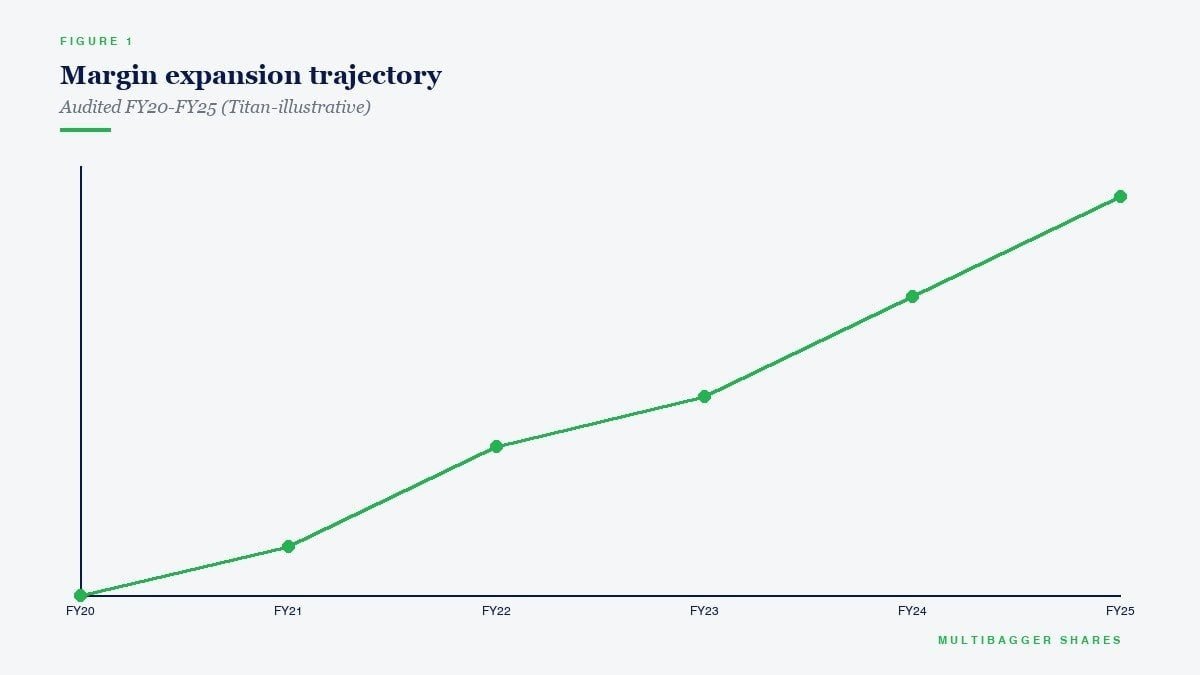
Titan Biotech’s depreciation policy is, in one line, the silent footnote that validates every other quality signal in the business. Revenue growth is real. Profit margin expansion is real. Cash flow is real. The ₹57 crore fixed-asset base is being honestly provisioned. This is the kind of accounting discipline that allows a sleepy small-cap to quietly compound over two decades — not on the back of narrative, but on the back of numbers that refuse to lie.
Disclaimer: This article is for educational and informational purposes only. It is not investment advice, and not a buy, sell, or hold recommendation on any stock mentioned, including Titan Biotech Limited. Equity markets carry risk; please do your own research or consult a qualified professional before making investment decisions.
