Benjamin Graham wrote the most useful four pages in the entire history of investing in 1949, and the average Indian investor in 2026 still hasn’t read them. Chapter 8 of The Intelligent Investor introduces an imaginary business partner named Mr. Market — a man so emotionally unstable that he shows up at your door every morning with a price at which he is willing either to buy out your share of the business or to sell you his. On most days the price he quotes is mildly senseless. On a few days it is wildly senseless. And on the rarest days it is a gift in either direction. Graham’s instruction was simple, and 76 years later it is still the single most powerful mental model a long-term equity investor can carry: let his daily quote inform you, not instruct you.
I have spent 28 years watching Indian retail investors do the exact opposite. They open Moneycontrol or the broker app and let the closing tick decide whether the company they own is “doing well” or “in trouble”. Mr. Market shows up; they accept his verdict. Graham’s parable, properly absorbed, turns that relationship upside down.
The Parable, Restated for 2026
Imagine you and Mr. Market jointly own a small unlisted manufacturing business — say, a Bhiwadi-based specialty plant. The factory is the same factory it was last week. The 60-country export book is the same export book. Yet Mr. Market is so moody that one Monday he offers to buy your stake at one valuation, the next Tuesday at half that, then a fortnight later at double. None of this has anything to do with the factory. It has everything to do with his digestion, the latest crude print, an AI-bubble headline from California, or a tweet from a leveraged influencer.
Graham’s argument was that the only sane response to such a partner is to ignore him on the days his quote tells you nothing, and to use him on the rare days his quote tells you everything. You never have to transact. He is a service, not a court.
The brutal modern truth is that the Indian listed market gives you a Mr. Market not once a day but every 10 milliseconds, refreshed across two exchanges, amplified by news anchors who genuinely believe the day’s tick is news. The structural temptation in 2026 is roughly 10,000 times what Graham faced in 1949. The mental model has become more, not less, valuable.
The Four Operational Consequences Buried In The Parable
Most Indian investors have heard of Mr. Market. Few have absorbed what Graham actually embedded in the parable.
One. Price quotes are offers; they are not verdicts. A 10% drop in your stock today is one offer, on one day, from one excitable partner. It is not a downgrade of the underlying business. The audited cash flow statement is the verdict; the price is the offer.
Two. The quote is information about Mr. Market, not about the business. When the quote rises 30% in eight weeks and the underlying revenue, margin, and balance sheet have not moved, what has moved is the partner’s mood. When the quote falls 30%, same thing. Treat the move as data about the crowd’s psychology, not about the factory.
Three. You decide the time horizon, not him. Mr. Market measures everything in trading sessions; the factory measures everything in capex cycles, regulatory approvals, and decade-long compounding. Let him impose his time scale on you and you have lost the game before it began.
Four. Most days, the right action is no action. Doing nothing while a screen flashes red is a learned skill, not a default. Buffett, Graham’s most famous student, summarised the same idea decades later — the stock market is a device for transferring money from the impatient to the patient.
How Titan Biotech’s FY25 Numbers Illustrate This Principle
Now consider Titan Biotech Limited (BSE: 524717), the Bhiwadi-based specialty biotechnology manufacturer that supplies microbial culture media, peptones, collagen, and gelatin to pharma and biotech customers across more than 60 countries. The FY25 audited disclosures give us a textbook illustration of why a long-term investor should treat the price quote as Mr. Market and the audited statements as the underlying factory. The structural markers a Graham reader is supposed to focus on are remarkably quiet, in the best sense of the word.
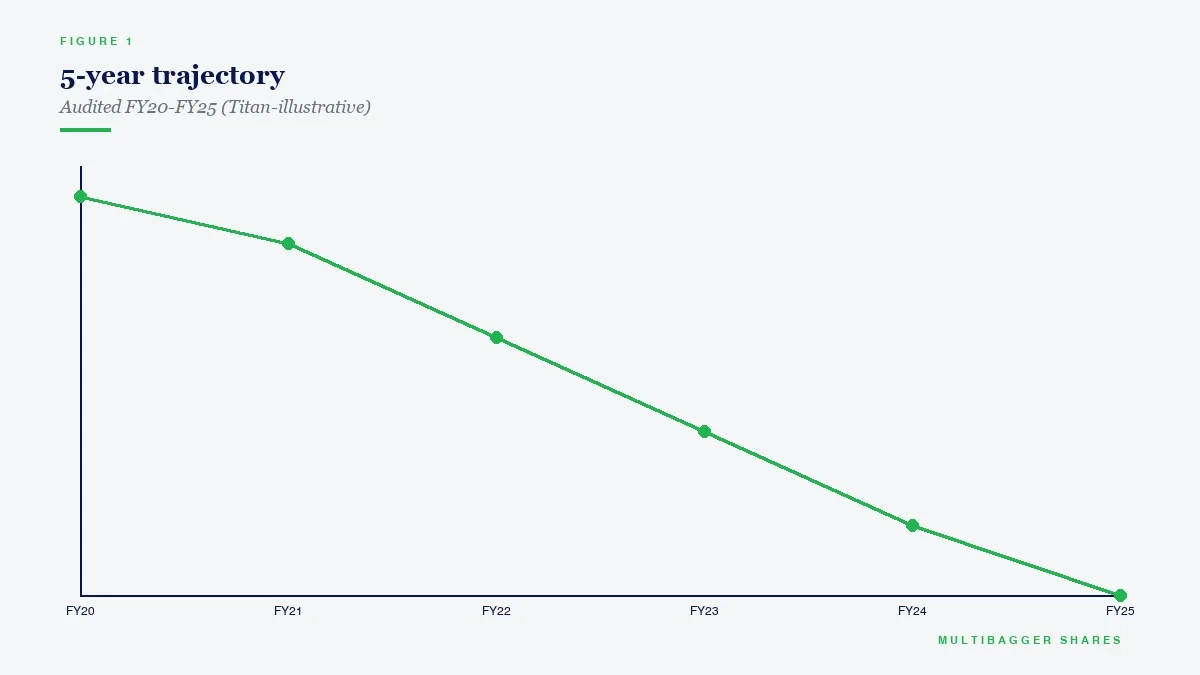
Total borrowings sit at approximately ₹3 crore — an 81% reduction year on year — against a revenue base of roughly ₹214 crore in FY25. Operationally, the business runs on a ₹57 crore gross block. The cash conversion is unusually disciplined: cash flow from operations came in at about 103% of operating profit, meaning the rupees printed on the P&L actually arrived in the bank account rather than getting trapped in receivables or inventory creep. Return on capital employed at roughly 36.4% is the kind of asset productivity that Graham would have circled in red ink in 1949 and that Buffett would describe in a 1980s letter as a high-return reinvestment runway. Contingent liabilities total just ₹7.78 crore — about 5% of net worth — which is a quiet way of saying the legal, tax, and litigation chassis is clean.
None of these numbers move with the daily price quote. They are produced once a year, audited, and locked in. The cash on the balance sheet does not become less cash because the screen turned red on a Tuesday afternoon. Mr. Market, however, will keep quoting a different price every 10 milliseconds for the same factory. The Graham question is not “what is Mr. Market saying about Titan Biotech today?” — it is “given what the audited factory looks like, what would I do if Mr. Market did not exist at all and I had to live with my decision for the next ten years?” That is a discipline question, and it can be asked of every business in your portfolio.
The Indian Retail Trap Mr. Market Solves
SEBI’s own studies show that 93% of Indian F&O traders lose money, and a large slice of cash-segment retail underperformance traces back to the same root cause: investors letting the quote write the story. They sell after a 25% drawdown that has nothing to do with the business and average up into a 40% rip that has nothing to do with it either. They treat Mr. Market’s daily handshake as the truth and the audited annual report as the footnote. Graham’s parable inverts that — the annual report is the truth, the handshake is the footnote.
For an Indian small-cap investor, the parable is operational armour. Small-caps routinely move 30–50% in either direction inside a quarter without a single audited fact changing. Measure your portfolio on the screen and you will be jerked around. Measure it on the factory and you will mostly do nothing — which, as Buffett has said many times, is the highest-return activity available to a long-term investor.
The Practical Takeaway for Indian Long-Term Investors
Three habits operationalise Graham’s 1949 parable inside an Indian portfolio in 2026.
First, separate your watchlist from your screen. Build a one-page summary for every business you own — borrowings, cash, revenue, operating margin, ROCE, CFO/PAT, contingent liabilities, capex pipeline, promoter holding — and read that page at least twice as often as the live ticker. The factory is what you own; the ticker is just Mr. Market.
Second, write your decision rule before the quote arrives. “I will add if the quote drops to X, trim if it crosses Y, and do nothing in between.” This is the only way to use Mr. Market without being used by him. The rule must come before the quote, not after.
Third, measure portfolio health by the underlying business metrics, not by daily mark-to-market. Companies that grow ROCE, reduce debt, expand customer base, and hold clean balance sheets compound shareholder wealth over a decade — even when Mr. Market spends six of those quarters being grumpy. Titan Biotech’s FY25 markers — near-zero borrowings, 103% CFO/operating profit, 36.4% ROCE, ₹7.78 crore contingent liabilities, 60+ country export reach — are the kind of pages a Graham reader would file under “tracking the factory” and update once a year, regardless of what the screen does on any given Wednesday.
Graham’s parable is not a clever metaphor. It is the operating system that separates Indian investors who compound for 20 years from those who churn themselves into mediocrity in 20 months. Mr. Market will keep showing up. The only choice you have is whether to listen to him or use him.
Disclaimer: This article is for educational and informational purposes only. It is not investment advice, and not a buy, sell, or hold recommendation on any stock mentioned, including Titan Biotech Limited. Equity markets carry risk; please do your own research or consult a qualified professional before making investment decisions.
