Value Investing — Educational Series
Think back to your school days. There was always one classmate who was frighteningly clever — the topper who solved every maths problem in seconds and remembered every date in history. And there was another, more ordinary student, who was never the smartest in the room but was steady, calm and patient. Now ask yourself a simple question: years later, in the messy game of building real wealth, who actually does better? Surprisingly often, it is not the genius. It is the calm one.
This is one of the most comforting truths in all of investing, and it comes straight from the greatest investors themselves. You do not need a brilliant mind to succeed in the stock market. What you need is the right temperament (your basic emotional nature — how calmly or anxiously you behave when things go up and down). Today, in very simple words, let us understand why temperament beats raw intelligence, why the market is one of the few places where being clever can actually hurt you, and how an ordinary person can slowly build the calm mind that quietly wins.
The topper who lost and the slow coach who won
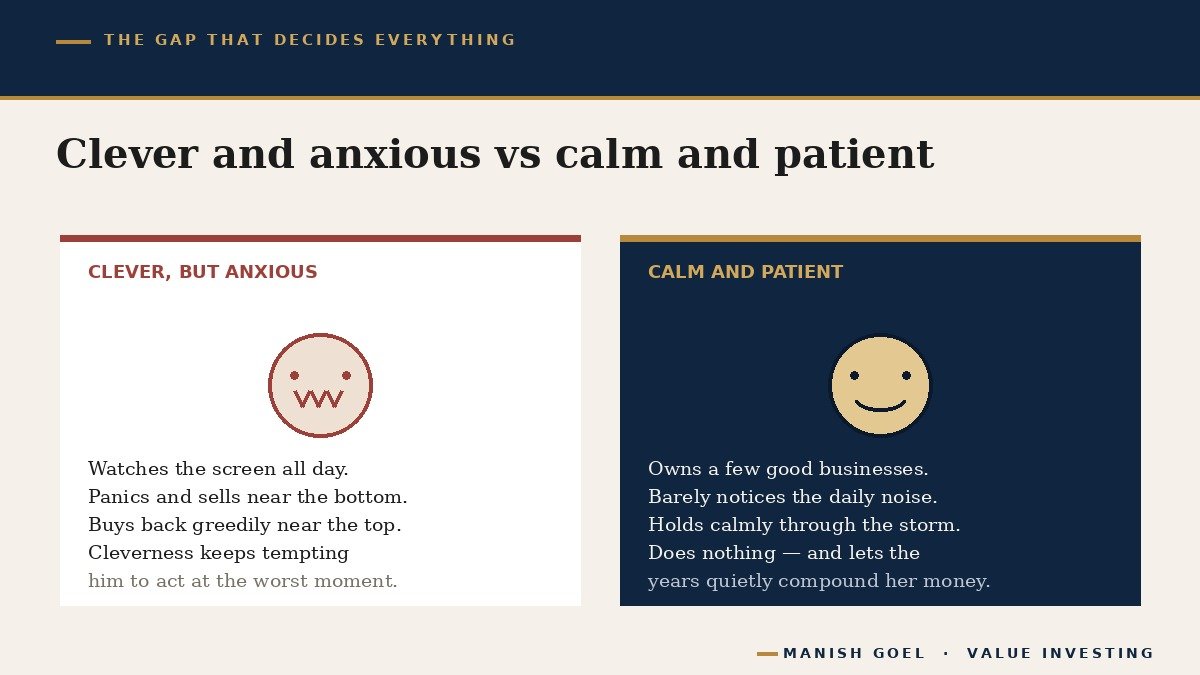
Imagine two friends who both start investing on the same day with the same amount of money. The first, let us call him the Topper, has a sharp mind. He reads every piece of news, watches the market all day, and is sure his cleverness will help him buy at the bottom and sell at the top. The second, call her the Patient One, is no genius. She simply buys a few good businesses, then mostly leaves them alone and gets on with her life.
For a while the Topper looks brilliant. But then the market falls hard, as it always does from time to time. The Topper, watching his screen every minute, panics and sells everything near the bottom to “save” himself. A few months later prices race back up, and now, feeling he is missing out, he buys again — this time near the top. He repeats this again and again, his clever brain forever talking him into action at exactly the wrong moments. The Patient One, meanwhile, barely notices the fall. She does nothing, holds her good businesses through the storm, and lets the years do their quiet work. A decade later, she is far richer than her brilliant friend.
Nothing about this story depends on intelligence. The Topper was smarter the whole way through. He lost not because he lacked brains, but because he lacked the temperament to sit still and do nothing while everyone around him was losing their heads. In the stock market, that gap — between what you know and how you behave — is where most fortunes are quietly made or destroyed.
What “temperament” really means
Temperament simply means the way you naturally react when you are under pressure — whether you stay calm or whether your emotions take over. In investing, it shows up most clearly in two dangerous moments: when prices are crashing and fear screams at you to sell, and when prices are soaring and greed whispers that you must jump in before you miss out. A person with good investing temperament can feel those urges and still not act on them. A person with poor temperament obeys them — and usually regrets it.
Think of it like the difference between two batsmen in a long cricket innings. One is wildly talented but restless; he chases every ball outside the off-stump and gets out cheaply to a loose shot. The other may be less gifted, but he has the discipline to leave the risky balls alone, defend the good ones, and stay at the crease for hours. Rahul Dravid, fittingly nicknamed “The Wall”, built one of India’s greatest cricket careers not by being the flashiest player, but by having the temperament to wait, to leave, and to occupy the crease while others threw their wickets away. Investing rewards exactly the same trait. The market is a very long innings, and the calm batsman who simply stays in wins.
It is important to be clear about what temperament is not. It is not about predicting the market or having secret information. It is not about being fearless or emotionless — even the great investors feel fear and greed. Good temperament is simply the ability to keep those feelings from controlling your hands. As Benjamin Graham, the teacher of value investing (buying good businesses sensibly and patiently), wrote in his classic 1949 book The Intelligent Investor: “The investor’s chief problem — and even his worst enemy — is likely to be himself.” The biggest danger to your money is not the market. It is your own reaction to it.
Why a calm head beats a clever head
Why should the stock market, of all places, reward calmness over cleverness? Because the market is not a maths exam where the smartest answer wins. It is a test of behaviour stretched over many years, full of moments designed to scare you out or tempt you in at the worst possible time. The cleverest analysis in the world is worthless if, the moment prices fall, you abandon it in a panic.
In fact, being very clever can sometimes make things worse. A sharp mind is restless; it wants to act, to be doing something, to prove how smart it is. But in investing, doing too much is one of the surest ways to lose. Every time you jump in and out — buying when excited, selling when scared — you risk getting the timing wrong and you chip away at your returns. The calm investor’s greatest weapon is the willingness to do nothing for long stretches. As the saying among great investors goes, the big money is made not in the buying or the selling, but in the waiting.
There is also a deeper reason: real wealth in the market is built by compounding (earning returns on your past returns — like interest on interest, or a snowball growing bigger as it rolls downhill). Compounding only works its magic if you leave your money alone for many years and let it roll undisturbed. The moment you panic-sell during a fall, you stop the snowball dead and often lock in a real, permanent loss. Temperament is what lets compounding do its slow, beautiful work. The clever person who keeps interrupting it ends up with far less than the calm person who simply refused to panic. Intelligence sets up the snowball; temperament is what lets it roll.
What Buffett, Graham and India’s Big Bull show us
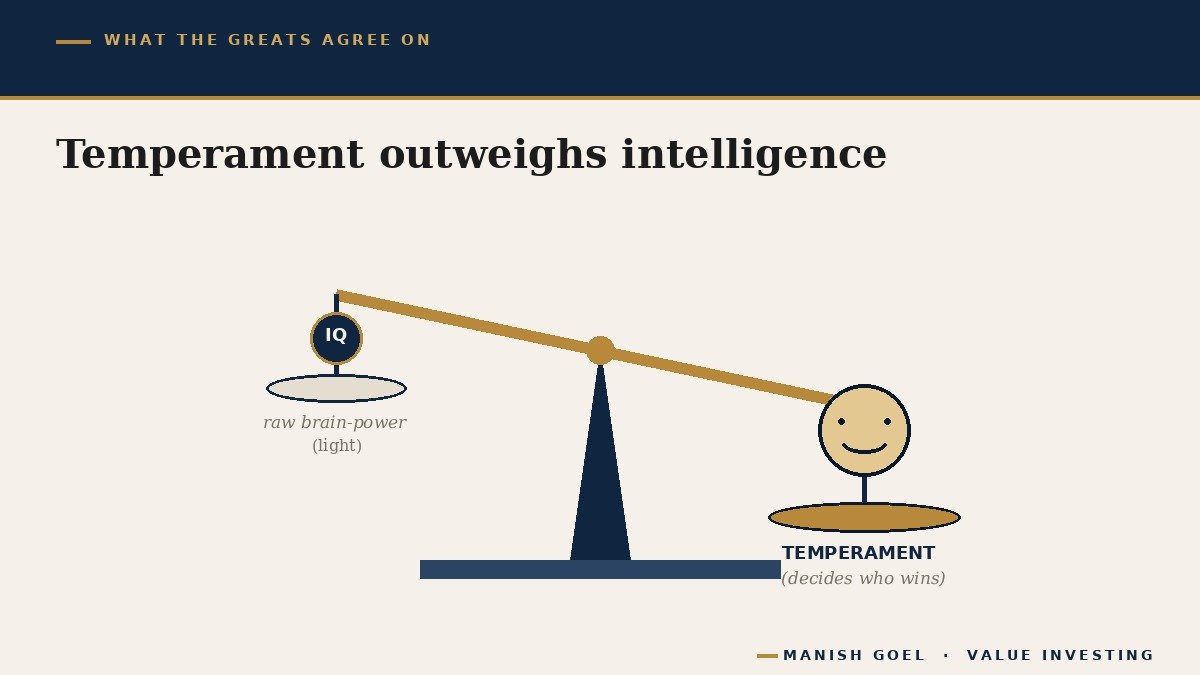
No one has said this more plainly than Warren Buffett, widely regarded as the most successful investor of all time. “Investing is not a game where the guy with the 160 IQ beats the guy with the 130 IQ,” he has said. (IQ, or intelligence quotient, is just a score meant to measure raw brain-power.) “Once you have ordinary intelligence, what you need is the temperament to control the urges that get other people into trouble in investing.” On another occasion he put it even more bluntly: if you have an IQ of 160, he joked, you could happily give away 30 points to someone else, because in this business “you don’t need a lot of brains — what you do need is emotional stability.”
Buffett has also summed up the whole idea in a single line: “The most important quality for an investor is temperament, not intellect.” And notice the second half of his thought — you need a temperament, he says, that neither takes great pleasure from agreeing with the crowd nor from defying it. The calm investor simply asks whether a business is good and whether the facts have changed, and ignores whether the crowd is cheering or screaming. That independence of mind, free from the pull of the herd, is temperament in action.
You can see the same trait in India’s own legends. Rakesh Jhunjhunwala, often called the “Big Bull” of Dalal Street (the home of India’s stock exchanges, much as “Wall Street” stands for America’s), did not become one of the country’s most famous investors by trading cleverly every day. He built his fortune by backing a handful of businesses he believed in and then holding them with extraordinary patience and conviction — through the crash of 2008, through long boring years when nothing seemed to move, through every wave of fear that washed others out of the market. His edge was not a secret formula. It was the steadiness to sit tight while others bailed out. (This is his story, not a suggestion to buy or sell anything — we are studying his temperament, not his shopping list.) Time and again, across continents and decades, the lesson repeats: the patient, even-tempered owner outlasts and out-earns the restless genius.
How you can build the right temperament
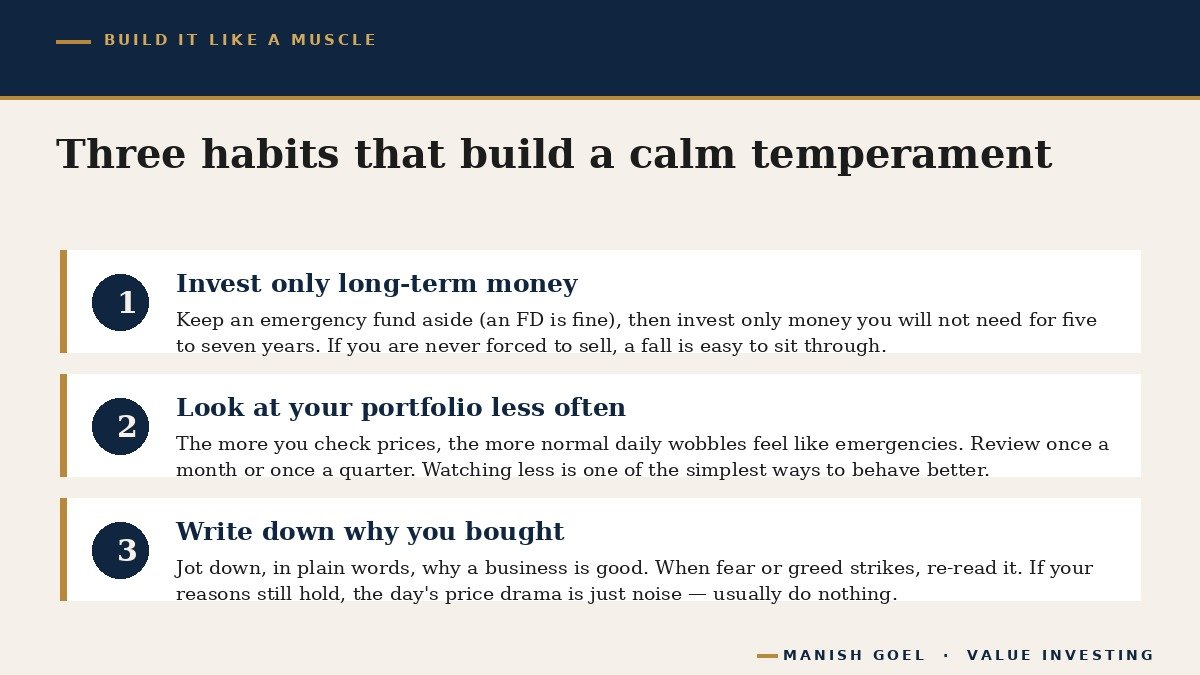
Here is the most encouraging part of all: temperament is not something you are simply born with and stuck with. It can be built and strengthened, like a muscle, with a few simple habits. You do not need to become a genius. You only need to set up your investing life so that your calmer self stays in charge. Here are three practical habits any beginner can start today.
First, invest only money you will not need for many years. The single biggest cause of panic-selling is needing the money back at the wrong time. If you put your emergency savings or next year’s school fees into the market, every fall will terrify you, because you might be forced to sell at the bottom. But if you invest only money you can leave untouched for five to seven years or more — after keeping a separate emergency fund of a few months’ expenses safely aside, perhaps in a fixed deposit (FD) — then a market fall becomes something you can simply sit through. Calmness is far easier when you are never forced to act.
Second, look at your portfolio less often. A sharp mind staring at prices all day is a mind being tempted to do something foolish all day. The more often you check, the more the normal daily wobbles of the market feel like emergencies. Decide instead to review your investments only now and then — once a month, or even once a quarter is plenty for a long-term investor. The businesses you own do not change every minute, even though their prices do. Watching less is one of the simplest ways to behave better.
Third, write down why you bought, before you buy. Take two minutes to jot down, in plain words, the reason you are investing in something — what the business does and why you believe it is a good one. Then, when fear or excitement strikes later, read what you wrote. If your original reasons are still true, the day’s price drama is just noise and the right action is usually to do nothing. This simple note becomes an anchor for your calmer self, helping today’s emotions lose the argument with yesterday’s clear thinking. A steady, automatic habit like a monthly SIP (Systematic Investment Plan — investing a fixed sum every month, no matter what the market is doing) works in the same gentle way: it keeps you investing through both fear and greed, without you having to win the emotional battle each time.
Do these three things, and something quietly powerful happens. You stop being your own worst enemy. The market’s ups and downs lose their power to frighten you out of good decisions. You are no longer trying to be the cleverest person in the room — you are simply trying to be the calmest, and that turns out to be the surer path. The good news for every ordinary investor is that the winning trait was never reserved for geniuses. Patience and emotional steadiness are available to all of us, if we choose to build them.
Key takeaways
- Temperament — how calmly you behave when prices crash or soar — matters far more in investing than raw intelligence or a high IQ.
- Being very clever can even hurt you: a restless mind is tempted to overtrade and to panic-sell at the bottom or buy greedily at the top.
- Wealth is built by compounding, which only works if you leave your money alone for years; good temperament is what lets the snowball keep rolling undisturbed.
- Buffett says you only need ordinary intelligence plus the temperament to control your urges; Graham warned that an investor’s worst enemy is usually himself.
- You can build calm with simple habits: invest only money you will not need for years, check your portfolio less often, and write down your reasons before you buy.
— Manish Goel
Disclaimer: This article is for educational and informational purposes only. It is not investment advice, and not a buy, sell, or hold recommendation on any stock mentioned. Equity markets carry risk; please do your own research or consult a qualified professional before making investment decisions.
