Value Investing — Educational Series
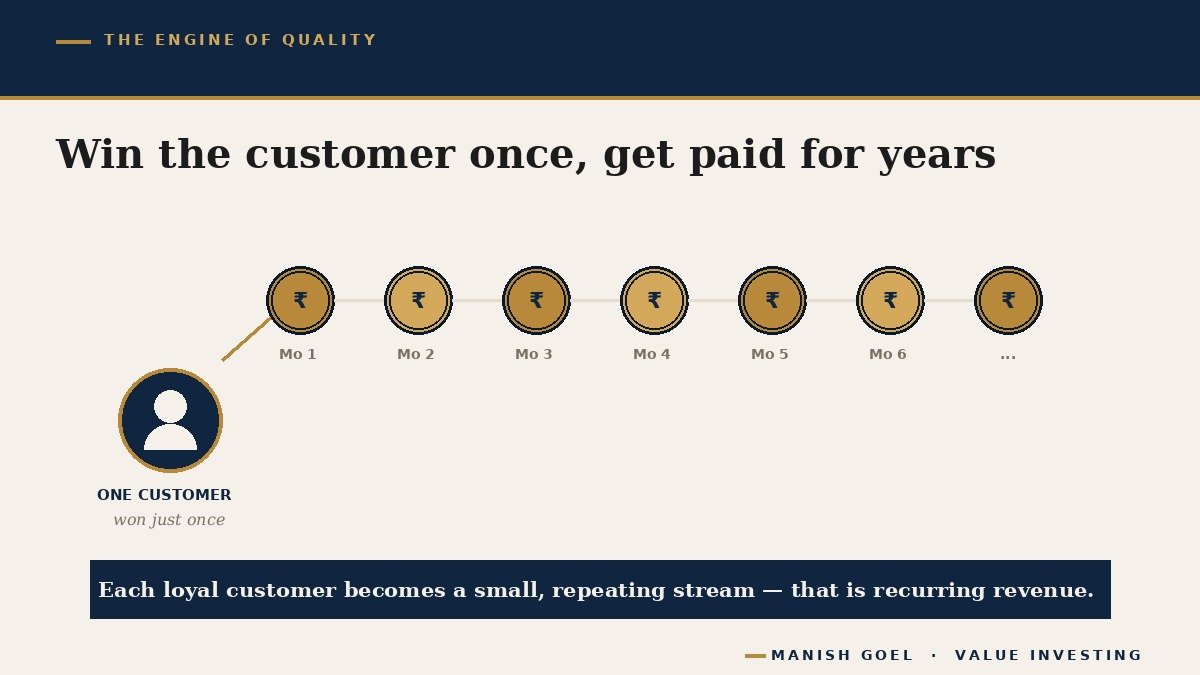
Think about your own mobile phone for a moment. Every month, almost without noticing, you recharge it. You pay your operator, the phone keeps working, and a few weeks later you pay again. You will pay next month too, and the month after that, and most likely every month for the rest of your life. From the operator’s side, you are not a one-time customer. You are a small stream of money that keeps flowing in, on its own, again and again.
That simple idea — money that comes back to a business repeatedly, almost automatically — is one of the most powerful signs of a high-quality company. It has a plain name: recurring revenue (sales that repeat period after period, instead of happening only once). Today, in very simple words, let us understand what recurring revenue is, why the greatest investors love it, and how you can learn to spot it for yourself.
A shop that gets paid every single morning
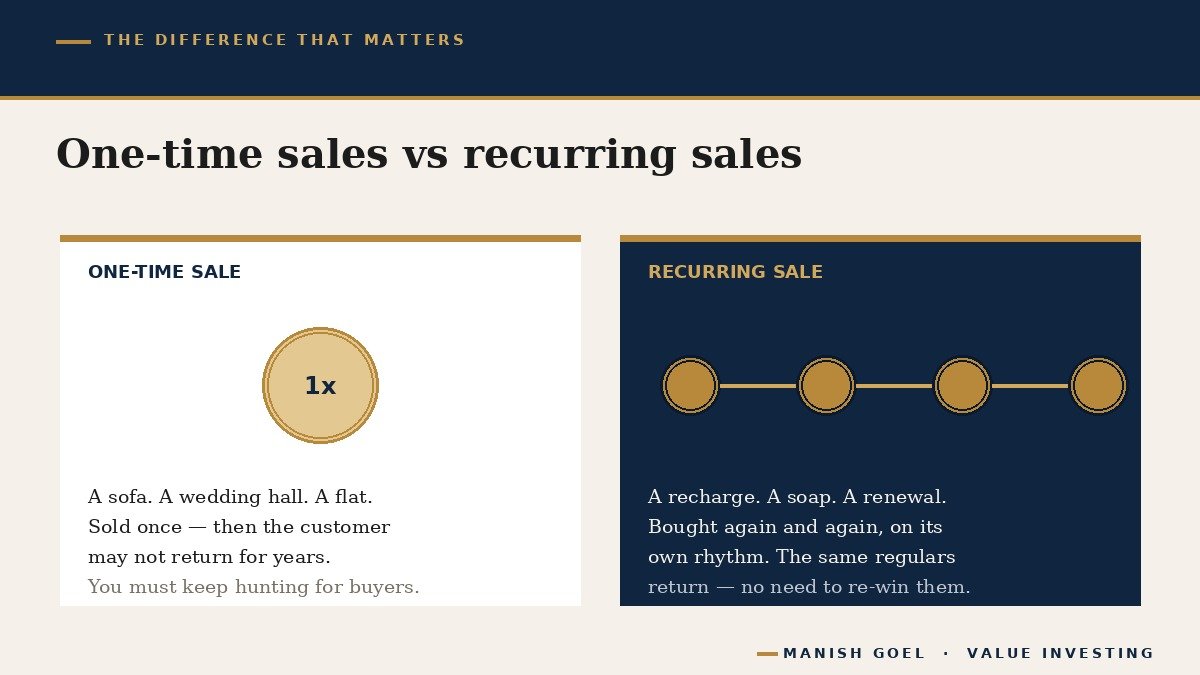
Picture two shops on the same street. The first is a furniture showroom. It sells a beautiful sofa for a good profit — but once a family buys that sofa, they will not be back for years. Maybe never. To stay alive, the showroom must keep finding brand-new customers, month after month, just to stand still. Every sale is a fresh hunt.
The second shop is a small kirana (neighbourhood grocery) store. Its regulars walk in every single morning for milk, bread, eggs and a packet of tea. The same faces, the same small bill, day after day, week after week. The kirana owner does not have to chase anyone. The customers come back on their own, because they need those things again tomorrow.
Both shops can make money. But notice how different their lives are. The furniture seller starts every month at zero and must rebuild his sales from scratch. The kirana owner starts every month already knowing that most of yesterday’s customers will return. One business is a constant uphill climb; the other has a strong, steady wind at its back. That steady wind — sales you can largely count on before the period even begins — is recurring revenue. And it is one of the clearest marks of a business worth admiring.
What “recurring revenue” really means
Recurring revenue is simply money a company can expect to receive over and over, at regular intervals, because customers keep buying the same thing repeatedly. It is the opposite of a one-time sale. A wedding hall earns a big amount from your function — but only once. A telecom company earns a small amount from you — but every month, for decades. Add up enough of those small, repeating payments and you get a river of income that is far more dependable than a few large, one-off splashes.
There are two everyday flavours of this. The first is the consumable kind: a product that gets used up and bought again — soap, toothpaste, biscuits, petrol, a razor blade. The customer is not tied by any contract; they simply come back because they have finished the last one. The second is the contractual kind: a subscription or renewal you actively sign up for — a mobile plan, an OTT service like a streaming app, a gym membership, a yearly insurance premium, software your office pays for. Here the repeat is built right into the agreement.
It is worth separating recurring revenue from two cousins we have discussed before. Switching costs (the trouble or expense a customer faces in leaving) explain why people keep coming back. Float (getting paid before you have to pay your own suppliers) is about the timing of cash. Recurring revenue is the result you can actually see in the sales line: revenue that shows up again and again, like clockwork. You can have one without the others — but when a business has all three, it is usually a very sturdy machine indeed.
Why getting paid again and again is a mark of quality
Why do experienced investors get excited when they find recurring revenue? In one word: predictability. A business whose customers return automatically can look ahead with some confidence. It roughly knows what next month, and even next year, will bring. That calm visibility lets it plan, invest and grow without the constant fear of the well running dry.
Think of it like the difference between a daily-wage worker and a person with a steady monthly salary. The daily-wage worker may earn well on a good day, but he never knows what tomorrow holds, so he can never relax or plan far ahead. The salaried person earns a known amount every month. That certainty is precious: it lets them take a home loan, plan their child’s education, sleep peacefully. A business with recurring revenue is the salaried earner of the corporate world. Its income is calmer, steadier and easier to trust.
This steadiness shows up as real strength. A company that does not have to fight for every single sale spends less time and money chasing new customers, and more time serving the ones it already has. Its profits tend to be smoother and less jumpy from year to year. It can ride out a bad patch, because even in a slow month the regulars still recharge, still renew, still rebuy. When you are hunting for a wonderful business — one with a durable edge, steady cash and honest, capable promoters (the people who own and run it) — a healthy stream of recurring revenue is a strong clue that you may have found one.
One important caution, because it matters in this series: recurring revenue tells you about the quality of a business, not about whether its share price is cheap or dear. We are learning to recognise a good company, not to put a price tag on it. A wonderful, predictable business can be a wonderful business at any price; spotting the quality comes first, always.
Gillette, your monthly recharge, and a bar of soap
The most famous example in all of investing is the humble razor blade. Long ago, King Camp Gillette built a clever business: sell the razor handle cheaply, then sell the blades — which wear out and must be replaced again and again — forever. The handle is bought once; the blades are bought for a lifetime. That is recurring revenue in its purest form, and it made Gillette one of the steadiest businesses on earth.
Warren Buffett, whose company Berkshire Hathaway came to own about a tenth of Gillette, captured the joy of it perfectly. He said he could go to bed completely at peace “just thinking about two and a half billion males with hair growing while you sleep.” Beards keep growing every night, all over the world, so blades keep selling every day — no salesman required. Peter Lynch, the legendary fund manager, loved exactly the same thing: he favoured businesses selling everyday products that people use up and buy repeatedly, from razor blades to a morning cup of coffee. The lesson both men taught the public is simple — a business people must keep returning to is a far easier business to own.
You do not have to look to America to see this. Look at your own daily life in India. Every month you recharge your mobile — and so do more than a billion other connections across the country. That is an ocean of recurring revenue flowing to the telecom companies, month after month. Look in your bathroom: the soap, shampoo, toothpaste and detergent made by everyday-goods companies get used up and replaced on a fixed rhythm, which is why such businesses have quietly compounded wealth for patient owners over decades. Your yearly LIC or health-insurance premium renews each year; your streaming subscription auto-renews each month; the SIP you started keeps adding to a mutual fund. Each of these is a small, repeating payment — and on the receiving end sits a business that gets paid again and again, without having to win you back each time.
Notice that none of these are exotic or hard to understand. They are the most ordinary things in your home and your pocket. That is the beauty of this idea: the highest-quality businesses are often hiding inside your most boring, repeated habits. You are already a recurring customer of a dozen companies. Learning to notice that is the first step to thinking like an owner rather than a gambler.
How you can spot recurring revenue yourself
You do not need a finance degree to find this quality. You need only a curious eye and a few simple questions. Here are three practical habits any beginner can use.
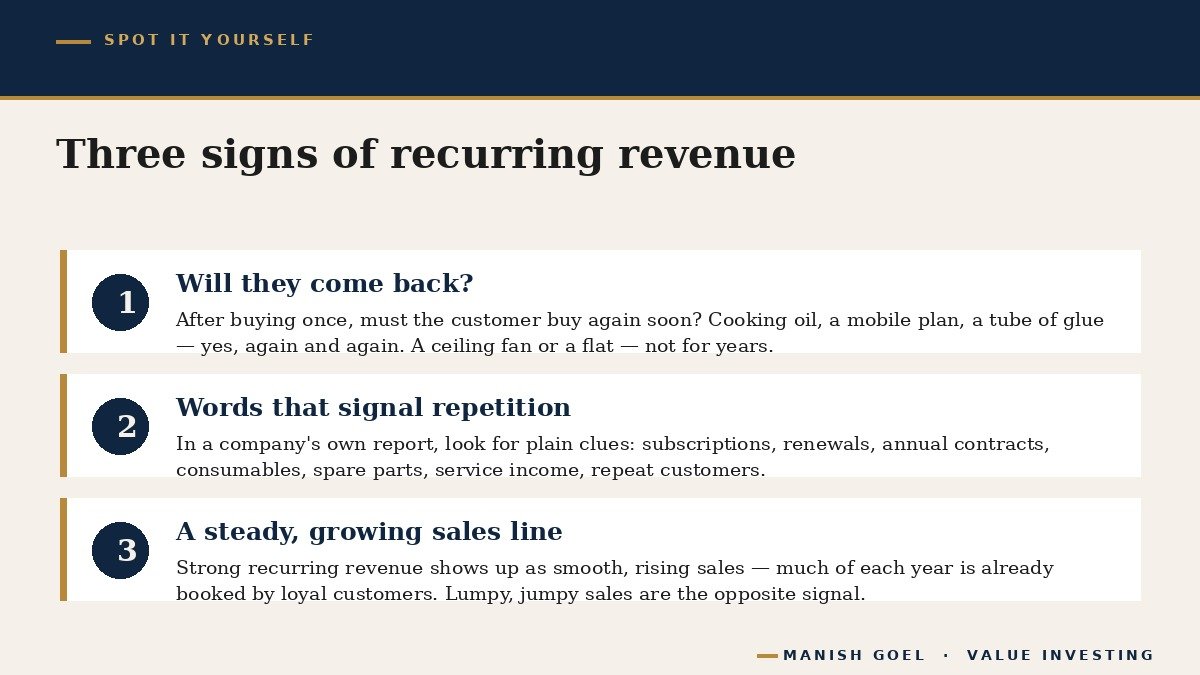
First, ask: will the customer have to come back? When you look at any business, ask the most basic question of all — after someone buys this once, do they need to buy it again soon? If the answer is “yes, again and again” (a bottle of cooking oil, a mobile plan, a tube of glue), you may be looking at recurring revenue. If the answer is “not for many years” (a ceiling fan, a wedding hall, a flat), the company must keep finding new customers forever. Neither is wrong, but the first kind has a quieter, steadier life.
Second, look for the words that signal repetition. When you read a company’s own report or website, watch for plain clues: “subscriptions”, “renewals”, “annual contracts”, “consumables”, “spare parts”, “service income”, “repeat customers”. These words are the fingerprints of recurring revenue. A company that proudly talks about how many of last year’s customers came back this year is telling you something valuable about its quality.
Third, check whether the sales line is steady and growing. Pull up a few years of a company’s revenue (its total sales). A business with strong recurring revenue usually shows a smooth, rising line, without wild ups and downs — because a big chunk of each year’s sales was already “booked” by loyal customers before the year began. Lumpy, unpredictable sales that leap one year and collapse the next are the opposite signal. Steadiness, year after year, is the visible footprint of revenue that repeats.
Do these three checks become second nature, and you will start to see the world differently. The shops you visit, the apps you pay for, the products you use up and replace — each becomes a small lesson in which businesses have a steady wind at their back and which must climb uphill every single day. That quiet shift in how you look at companies is exactly how great long-term investors learn to recognise quality long before the crowd does.
Key takeaways
- Recurring revenue is money a business receives over and over, at regular intervals, because customers keep buying the same thing repeatedly — the opposite of a one-time sale.
- It comes in two everyday forms: consumables that get used up and rebought (soap, blades, petrol), and contracts that renew (mobile plans, subscriptions, insurance premiums).
- Its great gift is predictability — like a steady monthly salary versus a daily wage — which makes a company calmer, sturdier and higher in quality.
- Gillette’s razor blades, your monthly mobile recharge, and the soap in your bathroom are all classic examples; Buffett and Lynch both prized businesses people must keep returning to.
- To spot it, ask if the customer must come back, look for words like subscriptions and renewals, and check whether the sales line is steady and growing year after year.
— Manish Goel
Disclaimer: This article is for educational and informational purposes only. It is not investment advice, and not a buy, sell, or hold recommendation on any stock mentioned. Equity markets carry risk; please do your own research or consult a qualified professional before making investment decisions.
