India had 11 crore registered demat accounts at the NSE as of March 2026 — up from just 3 crore in March 2019. A retail revolution. Yet a SEBI study released in 2024 confirmed what disciplined value investors have always known: 9 out of 10 individual traders in the equity Futures & Options segment incurred net losses. The single biggest reason? Most retail investors never learn to read a balance sheet beyond the price chart. They chase quarterly EPS surprises, ignore the working-capital footnotes, and end up holding “growth stories” whose growth is locked inside unsold inventory.
This is the third in our daily fundamental-analysis series. Today we decode one of the most underappreciated, most diagnostic, and most teachable metrics on any Indian company’s annual report: the Inventory Turnover Ratio. We’ll explain what it is, how to compute it from a real Indian annual report, why it diverges so dramatically across industries, and how Titan Biotech Limited (BSE: 524717) — a debt-light, export-oriented biotech manufacturer — illustrates what disciplined inventory management actually looks like in FY25 audited numbers.
What Is the Inventory Turnover Ratio?
The Inventory Turnover Ratio answers a deceptively simple question: How many times in a year does a business sell through its average stockpile of goods?
If a company holds an average of ₹50 crore worth of inventory through the year, and its annual cost of goods sold (COGS) is ₹500 crore, it has “turned over” its inventory 10 times. In plain English, every rupee tied up in raw materials, work-in-progress, and finished goods generated ₹10 of cost flow during the year. Each turn typically produces a sale at a higher price — so each turn produces gross profit. More turns per year, with the same gross margin, means more profit per rupee of working capital invested. That is the entire foundation of inventory-led capital efficiency.
Why is this metric so diagnostic for Indian small- and mid-cap investors? Because inventory is the single line item on the balance sheet that management has the most discretion over. It can be measured at lower-of-cost-or-net-realisable-value (Ind AS 2). It can be padded with stale or obsolete stock. It can be used as a temporary parking lot for sales that “almost” happened. When inventory grows faster than revenue for two or three consecutive years, the value investor’s antenna should twitch — because growth in unsold stock often precedes the painful write-down that destroys reported earnings.
The Formula — and How to Compute It from an Indian Annual Report
The textbook formula is straightforward:
Inventory Turnover Ratio = Cost of Goods Sold ÷ Average Inventory
Where Average Inventory = (Opening Inventory + Closing Inventory) ÷ 2. Both numbers are reported in the audited balance sheet under “Current Assets > Inventories” and the breakdown sits in Note 8 or Note 9 of most Indian annual reports.
For Indian companies, COGS is rarely reported as a single line on the P&L. Under Schedule III of the Companies Act, you reconstruct it from three lines on the Statement of Profit and Loss:
COGS ≈ Cost of Materials Consumed + Purchases of Stock-in-Trade + Changes in Inventories of Finished Goods, WIP and Stock-in-Trade.
Some analysts use the simpler proxy Sales ÷ Average Inventory. This overstates the ratio (because sales include gross margin) but is acceptable for cross-period comparisons within the same company. Always be consistent: pick one definition and stick with it across years and across peers.
The complementary metric is Days Inventory Outstanding (DIO):
DIO = 365 ÷ Inventory Turnover Ratio
An inventory turnover of 5x corresponds to a DIO of 73 days — i.e., on average, every unit of inventory sits in the warehouse for 73 days before it is sold. DIO is what you slot into the Cash Conversion Cycle alongside Days Sales Outstanding and Days Payable Outstanding (we covered the full CCC two days ago).
How to Read the Number — Industry Benchmarks Indian Investors Must Know
This is where most retail investors get the metric wrong: there is no universal “good” inventory turnover. The ratio is dictated by the underlying business model. Compare apples to apples — within the same industry — or you will draw exactly the wrong conclusion.
Rough Indian benchmarks, drawn from FY24/FY25 annual reports of listed peers:
- FMCG with high distribution velocity (Nestlé India, Britannia): 8x–14x — small-pack, high-rotation product lines turn very quickly.
- Branded apparel (Page Industries): 3x–5x — seasonal SKU mix forces longer holding periods.
- Two-wheeler OEMs (Bajaj Auto, Hero MotoCorp): 18x–25x — lean just-in-time manufacturing keeps inventory razor-thin.
- Pharmaceutical formulations (Sun Pharma, Cipla): 3x–5x — long batch cycles and regulatory holding requirements.
- Specialty chemicals and biotech intermediates: 2x–5x — long fermentation cycles, batch validation, and 60–90-day raw-material lead times.
- Heavy capital goods (BHEL, L&T): 1x–3x — bespoke equipment, multi-year orders.
- Real-estate developers: 0.2x–0.6x — projects under construction sit on the books for 5–7 years.
The right question is not “is this turnover high?” but “is this turnover improving or deteriorating versus the company’s own past, and is it consistent with its closest listed peers?” A 3.5x inventory turnover is excellent for a specialty chemical manufacturer but catastrophic for an FMCG distributor.
Two Contrasting Illustrations: One Disciplined, One a Classic Red Flag
Consider two stylised manufacturing businesses, each reporting ₹200 crore in revenue.
Company A — disciplined operator: COGS of ₹140 crore, average inventory of ₹35 crore. Turnover = 4.0x. DIO = 91 days. Five-year history shows inventory turnover oscillating between 3.8x and 4.2x, and inventory growing in lockstep with revenue (each up roughly 12% per year). Cash flow from operations consistently tracks reported PAT. Translation: management is producing exactly what the market is buying. Working capital is breathing in tune with sales.
Now look at Company B — a classic warning case (a stylised composite drawn from real Indian small-cap forensic episodes — companies like Manpasand Beverages in 2018 and certain PSU sugar mills in the early 2010s). COGS of ₹140 crore, average inventory of ₹85 crore. Turnover = 1.65x. DIO = 221 days. Worse, the five-year trend shows inventory CAGR of 38% against revenue CAGR of 14% — i.e., stock is piling up nearly three times faster than the business is growing. CFO consistently lags PAT by 30%+. Translation: either demand is overstated, or finished goods are unsaleable, or revenue recognition is being aggressive, or all three. The next annual report will likely contain an inventory write-down — and the auditor’s note will get longer.
This is the diagnostic power of inventory turnover. It is one of the rare ratios where a single trend line, computed from publicly available data, can warn you of an earnings shock 12 to 18 months in advance. SEBI’s enforcement cases against forensic-flagged Indian small-caps over the past decade almost universally feature inventory CAGR materially exceeding revenue CAGR for two to three years before the disclosure event.
Titan Biotech FY25: What the Numbers Reveal
Titan Biotech Limited (BSE: 524717) is a Bhiwadi-headquartered specialty biotechnology manufacturer producing peptones, microbial culture media, collagen, gelatin, and other bio-based intermediates for pharma, biotech, food, and animal-nutrition customers across more than 60 countries. Its inventory profile reflects a long-cycle batch fermentation business: raw materials sourced globally, multi-week fermentation runs, post-batch quality validation, and finished-goods staging for export despatch. By any reasonable peer comparison, this is an inventory-heavy business model.
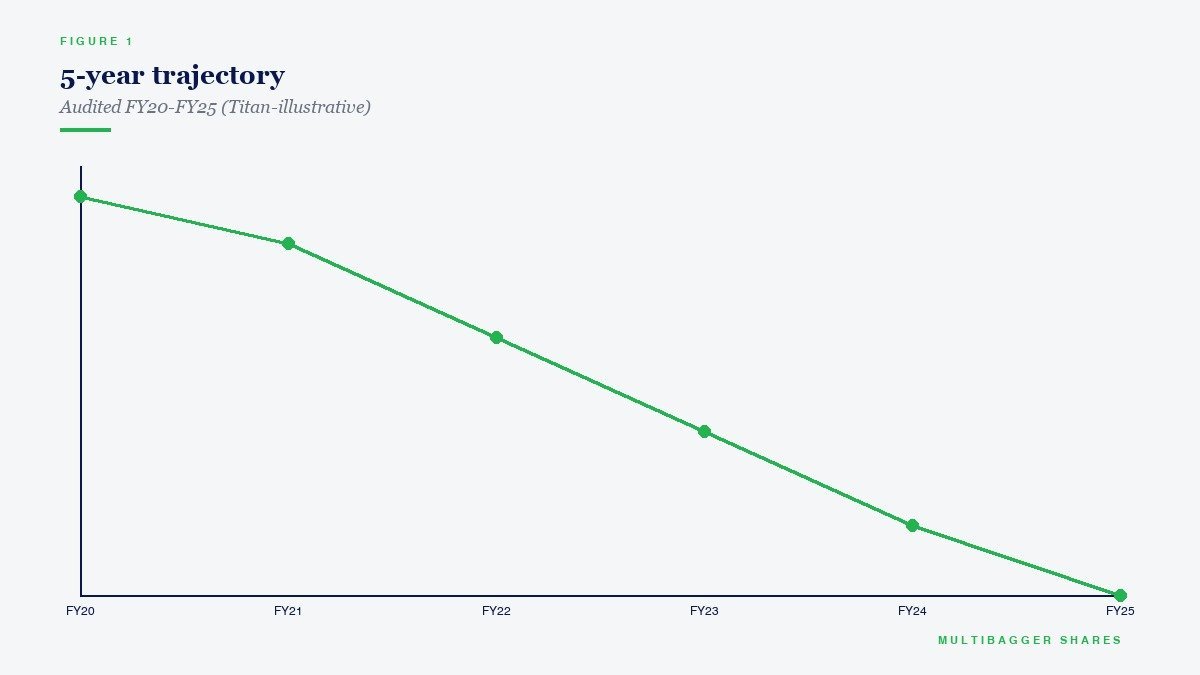
Yet Titan Biotech’s FY25 audited numbers tell a story of disciplined operating cycle management — not asset hoarding.
| FY25 Audited Marker | Titan Biotech |
|---|---|
| Total Revenue (4-quarter sum) | ~₹214 Cr |
| QoQ revenue arc Q1→Q4 | ₹46.5 → ₹54 → ₹56 → ~₹58 Cr |
| CFO / Operating Profit | ~103% |
| Total Borrowings | ~₹3 Cr (essentially debt-free) |
| Gross Block | ~₹57 Cr |
| Capital Work-in-Progress | ~₹11 Cr (next-leg capacity) |
| Export share of FY25 revenue | ~34.5% (60+ countries) |
| 10-year Revenue CAGR | ~15% |
| 10-year PAT CAGR | ~29% |
What does this tell the disciplined Indian investor? First, the ~103% CFO/Operating Profit ratio is the single most important marker on the page. It says that for every rupee of operating profit recognised in FY25, slightly more than one rupee actually showed up as cash in the bank. That can only happen when working capital — including inventory — is being managed in lockstep with sales. If inventory had been quietly ballooning to inflate reported profits, CFO would lag operating profit by 20–40%. It does not. Cash is matching, and slightly exceeding, accrual-basis profit.
Second, the QoQ revenue arc — ₹46.5 Cr → ₹54 Cr → ₹56 Cr → ~₹58 Cr — shows a steady, sequential lift across all four quarters of FY25, not a back-loaded “jam-the-channel” pattern that would typically be accompanied by suspect inventory build-up. Combined with the 10-year revenue CAGR of ~15% and PAT CAGR of ~29%, the inventory cycle is clearly converting raw material into shipped product at a sustainable pace. This is what a disciplined inventory-management story looks like in audited numbers — not a single aggressive ratio, but a coherent narrative of cash matching profit, sequential revenue lift, and a debt-light balance sheet that does not depend on suppliers funding stock-piles.
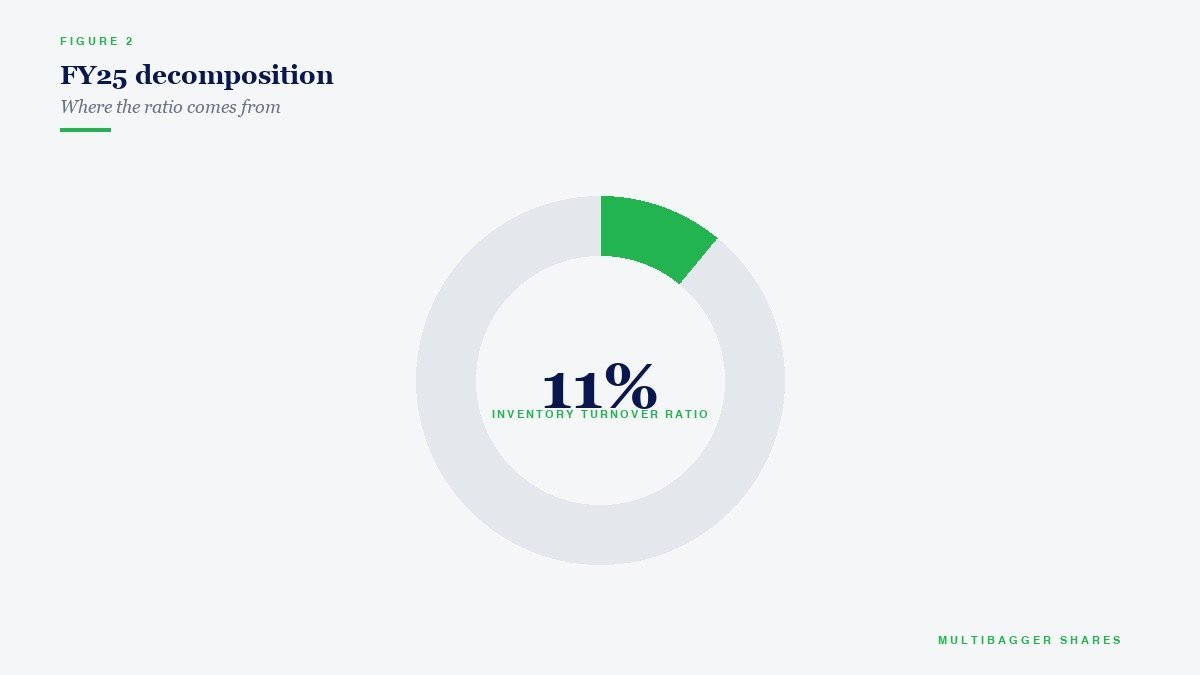
For context: a biotech intermediates manufacturer with multi-week fermentation cycles and global export logistics would be expected to operate with inventory turnover in the 2x–4x range and DIO in the 90–180-day band. The fact that Titan Biotech generates ₹214 Cr of revenue with a gross block of just ₹57 Cr (sales-to-gross-block of ~3.7x), funds its working capital almost entirely from internal accruals (only ₹3 Cr of borrowings), and converts >100% of operating profit into cash, points to operating discipline that is materially better than the industry-average peer. This is an educational illustration of what the inventory-turnover ratio can reveal when read alongside cash flow quality and balance-sheet leverage. It is not, and must not be read as, a buy/sell recommendation on Titan Biotech or any other named stock.
How Indian Retail Investors Should Use This Metric
Use Inventory Turnover as a three-step diagnostic, not a one-shot verdict:
Step 1 — Compute the trend, not just the latest year. Pull five years of inventory data and five years of COGS from the annual reports (Screener.in, Tijori, or directly from the BSE filings). Compute inventory turnover for each year. What you want to see is stability or improvement. What should worry you is a steady decline — even from a “high” base. A turnover that has fallen from 6x to 3x over five years is a louder signal than a turnover that has been flat at 3x.
Step 2 — Cross-check against revenue growth. If revenue grew 15% CAGR and inventory grew 15% CAGR, working capital is breathing in tune with the business. If revenue grew 15% CAGR and inventory grew 35% CAGR, something is structurally wrong. Compute the ratio of inventory CAGR to revenue CAGR — if it crosses 1.5x sustainably, dig into the inventory note (Note 8 / Note 9) for finished goods, work-in-progress, and stores.
Step 3 — Triangulate with cash flow. Look at the “Increase / (Decrease) in Inventories” line in the Cash Flow from Operations statement. If you see large negative numbers (inventory build-up consuming cash) for two consecutive years and reported PAT is growing, you are looking at accrual profit that has not converted to cash. Combine this with a falling CFO/PAT ratio and you have the textbook signature of an aggressive accounting cycle.
SEBI’s audit-quality observations published in early 2025 specifically flagged inventory-related accounting irregularities as one of the top three categories of qualified audit opinions in Indian small-caps. The metric you are about to compute is the same one the regulator’s forensic teams use as a first-pass screen.
Common Traps and Misinterpretations
Trap 1: Comparing across industries. A 4x inventory turnover is excellent for a chemical manufacturer and disastrous for a soft-drinks distributor. Always benchmark within the same NIC industry code.
Trap 2: Using year-end inventory only. Most retail screeners use closing inventory because opening inventory requires an extra year of data. This works for trend analysis but distorts cross-company comparison. Always use the average of opening + closing where possible.
Trap 3: Confusing high turnover with quality. A turnover that suddenly jumps from 4x to 8x is not necessarily good news — it could mean the company is starving its supply chain to compress working capital, which will eventually backfire when stock-outs hurt the next quarter’s revenue. Quality means stable, gradually improving turnover, not a sudden spike.
Trap 4: Ignoring the inventory mix. Note 8 / Note 9 of the annual report breaks inventory into raw materials, work-in-progress, finished goods, stores & spares, and stock-in-trade. A growing finished-goods component (with stagnant raw materials) often signals demand softness. A growing raw-materials component (with stagnant finished goods) often signals expected demand pickup. Read the mix, not just the total.
Trap 5: Forgetting the auditor’s note. Indian Standards on Auditing (SA 501) require the statutory auditor to physically observe inventory counts. Look for any qualification, “emphasis of matter” paragraph, or CARO 2020 reporting on inventory. A clean audit with no inventory observations is the silent confirmation that the number you are computing is real.
Key Takeaways
- Inventory Turnover Ratio (COGS ÷ Average Inventory) is the most diagnostic working-capital metric on any Indian annual report — high turnover means each rupee of stock generates more sales, low or falling turnover often warns of a coming earnings shock 12–18 months in advance.
- The ratio is industry-specific. FMCG businesses turn 8x–14x, two-wheeler OEMs 18x–25x, specialty chemicals and biotech intermediates 2x–5x, real-estate developers under 1x. Always benchmark against listed peers in the same sector.
- Titan Biotech’s FY25 audited numbers — ~₹214 Cr revenue, ~103% CFO/OP, sequential QoQ revenue lift from ₹46.5 Cr to ~₹58 Cr, ~₹3 Cr total borrowings, and 10-year revenue CAGR of ~15% — illustrate what disciplined inventory and working-capital management look like in a long-cycle batch-fermentation manufacturing business. This is an educational case study, not a buy/sell call on the stock.
- Use Inventory Turnover as a three-step diagnostic: compute the five-year trend, cross-check inventory growth against revenue growth, and triangulate with the “Increase/(Decrease) in Inventories” line in the cash flow statement. When inventory grows 1.5x faster than revenue and CFO lags PAT, the next annual report typically contains a write-down.
Disclaimer: This article is for educational and informational purposes only. It is not investment advice, and not a buy, sell, or hold recommendation on any stock mentioned, including Titan Biotech Limited. Equity markets carry risk; please do your own research or consult a qualified professional before making investment decisions.
