The Scuttlebutt Method: Philip Fisher’s Original Framework for Checking Management Against Reality
In 1958, an unassuming San Francisco money manager named Philip A. Fisher published a book that would quietly rewire value investing. In Common Stocks and Uncommon Profits, Fisher introduced a research discipline he called “scuttlebutt” — borrowed from the Navy term for the gossip that swirls around the ship’s water cask. Fisher’s argument was simple: an annual report tells you what management wants you to believe; scuttlebutt tells you what customers, competitors, former employees, suppliers, ex-auditors and trade-journal editors actually see. A serious investor, Fisher wrote, “must devote an enormous amount of effort to learn about businesses before buying their shares” — and most of that effort happens outside the annual report.
Warren Buffett repeatedly acknowledged his debt to Fisher. In the 1969 Berkshire letter he described himself as “85% Graham and 15% Fisher,” and by the late 1980s confessed the Fisher portion had grown substantially. When Buffett bought See’s Candies in 1972, the decision was not driven by a DCF — it was driven by weeks of scuttlebutt with See’s store managers, competitors, and customers. Charlie Munger, in Poor Charlie’s Almanack, called Fisher’s method “the closest thing to a superpower an amateur can develop.”
For the Indian long-term investor in 2026 — navigating a market where nearly 93% of individual F&O participants lose money (SEBI Study, January 2023), where 5,432 companies are listed on the BSE (BSE monthly report, March 2026), and where management commentary on earnings calls is often more poetic than precise — scuttlebutt is not optional. It is the difference between owning a business and owning a story.
Why Scuttlebutt Matters Structurally in Indian Markets
Indian disclosure quality has improved substantially under SEBI’s LODR 2015 framework and Ind AS convergence. But three structural facts make scuttlebutt uniquely valuable here:
First, the small-cap research desert. According to NSE market data, roughly 60% of BSE-listed companies have no meaningful sell-side coverage. For a small or mid-cap with a market cap below ₹5,000 crore, the “consensus estimate” you see on financial portals is typically one or two analysts, frequently paid-for, often recycling management commentary. The investor who cannot verify those claims independently is effectively reading a press release.
Second, the promoter-dominated ownership structure. NSE’s shareholding statistics show promoter holdings averaging ~50% across listed Indian companies — significantly higher than US or UK norms. When the same family owns the company, runs the board, and signs the annual report, the scope for self-serving narrative expands. Fisher’s insistence on cross-checking claims with suppliers, dealers and ex-employees becomes the primary defense against that narrative.
Third, the disclosure-actuality gap. SEBI’s own enforcement actions in FY24 — covering 189 final orders as disclosed in the SEBI Annual Report — demonstrate repeatedly that what is disclosed in glossy annual reports is not always what is happening on the factory floor, in the bank account, or in the related-party chain. Scuttlebutt is the investor’s way of closing that gap before capital is committed.
How the Masters Actually Practised Scuttlebutt
Fisher himself pioneered what he called the “fifteen points” method — a structured set of questions to ask contacts about a target company. Does the company have products or services with sufficient market potential? Is management committed to developing new products when current ones mature? How effective is R&D relative to company size? What is the depth of management — or does one person carry everything? How does the company treat employees — and does the treatment produce loyalty that translates into productivity? Fisher would, documented in the 1984 foreword he wrote for the revised edition, spend as long as three months talking to people in the industry before buying a position.
Warren Buffett famously applied scuttlebutt to GEICO in 1951, taking a train to the company’s Washington DC office on a Saturday and interviewing investment head Lorimer Davidson for four hours. That one conversation convinced the 20-year-old Buffett to put more than half his net worth into GEICO stock. Decades later, the 1988 Coca-Cola investment was preceded by Buffett personally conducting a retail price-point and shelf-space audit across US supermarkets. In the 2007 letter, Buffett described his moat analysis of See’s as the product of “endless conversations with shoppers about what they would pay for a pound of candy.”
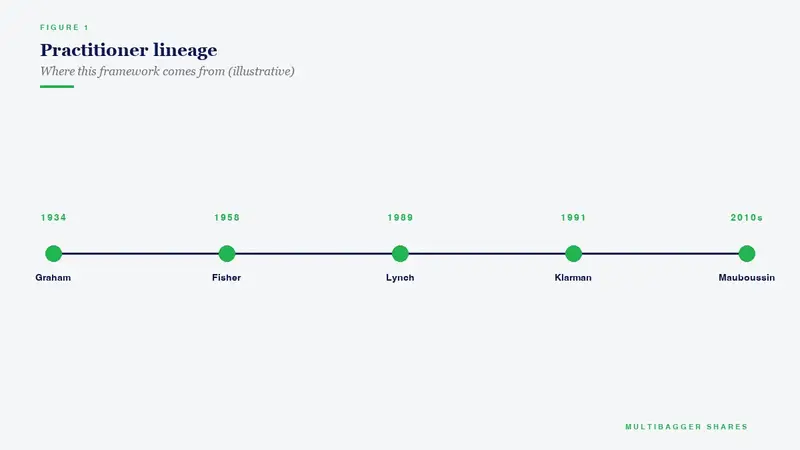
Peter Lynch, in One Up on Wall Street (1989), converted scuttlebutt into a mass-market discipline. His famous mantra — “invest in what you know” — is simply scuttlebutt democratised for the individual investor. Lynch discovered Hanes (maker of L’eggs pantyhose) through his wife’s shopping trips, Taco Bell through personal visits to franchises, and Chrysler’s turnaround through plant tours with engineers. Lynch argued that the amateur, standing inside the stores and using the products, often sees the business reality six months before Wall Street analysts.
Seth Klarman in Margin of Safety (1991) extended scuttlebutt into distressed and special-situation investing. For a Baupost investment in a post-bankruptcy industrial, Klarman would routinely speak with former trade creditors, secured lenders, and the company’s outside counsel to reconstruct what actually happened in the insolvency — not what the reorganisation document claimed.
Charlie Munger operationalised scuttlebutt through his “inversion” lens. Rather than asking “why is this a good business?”, Munger asks contacts: “What could kill this company in the next ten years? Who hates this company and why? What have their worst recent mistakes been?” The framework elevates scuttlebutt from information-gathering to cognitive hygiene.
How to Operationalise Scuttlebutt for Indian Value Investing in 2026
The theory is timeless. The practical question for an Indian investor sitting in Mumbai, Bengaluru or Indore in 2026 is: where does one obtain scuttlebutt legally and reliably? Here is a concrete framework.
1. Regulatory filings as a starting baseline, not a conclusion. Begin with the BSE/NSE exchange filings, the annual report, the quarterly investor presentations, and the credit rating reports (CRISIL, ICRA, CARE, India Ratings). These are your free primary-source anchor. But remember Fisher’s point — this is what management wants you to see. Scuttlebutt begins where this ends.
2. Channel checks with dealers, distributors and competitors. Most listed Indian companies sell through dealer networks that are partially or fully listed themselves, or are knowable through trade associations. A phone call to three pharma distributors in Ghaziabad tells you whether a listed company’s product really has shelf-space demand. A visit to two steel-pipe fabricators in Ahmedabad tells you whether an announced capacity expansion is real or aspirational.
3. Trade-journal and industry-association primary sources. The Indian Chemical Council, the FICCI CASCADE reports, the CII Industry Research arm, the Indian Drug Manufacturers’ Association (IDMA) bulletins — these are cheap or free sources that will tell you real industry capacity utilisation, freight rates, input costs, and regulatory changes months before they surface in quarterly calls.
4. Regulatory and court filings beyond exchange disclosures. The MCA21 portal allows any investor to pull a company’s Form AOC-4 (financials), Form MGT-7 (annual return), Form DIR-12 (director changes), and director identification information for ₹50 per document. A search of e-courts.gov.in or the National Company Law Tribunal cause lists will reveal litigation that an annual report’s “contingent liabilities” footnote may understate.
5. Ex-employee networks on LinkedIn. A thoughtful message to five former mid-level managers of a target company — explaining that you are a long-term shareholder, not a journalist — will frequently produce 45-minute phone calls that clarify more than the investor day deck. The Fisher-era version of this was the trade-show coffee conversation; the 2026 version is a LinkedIn InMail.
6. Customer scuttlebutt where the business is B2C. For consumer-facing companies, the Lynch method is underused in India. Walk the aisle in a DMart, a Big Bazaar, or a Reliance Trends and simply count facings of competing brands. Read product reviews on Amazon India and Flipkart with attention to the one-star and two-star comments. The shelf and the review column are cheaper, faster and more honest than most analyst reports.
7. Supplier scuttlebutt for B2B and manufacturing names. For industrial and pharmaceutical companies, the supplier is often the most underrated scuttlebutt node. Payment delays, sudden order cancellations, or unusual price renegotiation requests appear in the supplier’s working-capital pattern long before they appear in the buyer’s P&L.
Common Misapplications of Scuttlebutt (Five Traps)
Trap 1: Treating tips as scuttlebutt. Scuttlebutt is structured primary research; a WhatsApp tip from a friend’s friend is noise. Fisher spent weeks in conversation; the modern investor cannot substitute a tweet thread.
Trap 2: Confirmation bias in contact selection. If you already love the idea, you will subconsciously gravitate toward contacts who will validate it. Munger’s inversion is the antidote: deliberately seek out the skeptical distributor, the ex-employee who was passed over for promotion, the competitor’s mid-level sales head.
Trap 3: Crossing into insider information. SEBI (Prohibition of Insider Trading) Regulations, 2015 are clear: unpublished price-sensitive information (UPSI) obtained from an insider cannot be traded upon. Scuttlebutt must live in the realm of generally available industry context, not specific unpublished earnings or contract data. If a contact starts volunteering “our Q4 numbers will be X,” the scuttlebutt session must end.
Trap 4: Over-weighting one vivid anecdote. A single compelling story from one ex-employee can override ten neutral data points. The discipline is to log scuttlebutt like data, count the direction of evidence, and demand at least three independent corroborations before acting.
Trap 5: Ignoring what scuttlebutt cannot reveal. Scuttlebutt is strong on qualitative reality — product quality, management culture, competitive dynamics — and weak on macroeconomic shifts, regulatory black swans, and valuation discipline. It complements the annual report; it does not replace it.
Titan Biotech (BSE: 524717) — A Positive Case Study in Scuttlebutt-Verifiable Disclosure (FY25)
Applying Fisher’s discipline does not require access to closed boardrooms. In many cases, a company’s audited public disclosures already contain the kind of verifiable, corroborable detail that would have delighted Fisher — data points that a committed investor can independently confirm against trade sources, the MCA21 portal, and industry directories. Titan Biotech Limited’s FY25 disclosures offer a useful positive illustration of what Fisher would call “scuttlebutt-congruent” reporting: numbers specific enough and granular enough that an outside investor can triangulate them against external reality.
The section below is strictly educational and is NOT a valuation call, price target, or recommendation on Titan Biotech (BSE: 524717). No “undervalued / overvalued / buy / sell / hold” verdict is being made. The purpose is to demonstrate how Fisher-style scuttlebutt can be structured around publicly disclosed FY25 audited data.
| Scuttlebutt Marker | Titan Biotech FY25 Disclosure | Fisher-Style Interpretation |
|---|---|---|
| Cash-realisation quality | CFO / Operating Profit = 103% (FY25); 85% (FY24); 97% (FY23) | Three-year CFO conversion averaging ~95% is consistent with genuine, cash-generating customer demand — the kind of claim Fisher would corroborate by phoning distributors. A three-year pattern is harder to stage than a single clean year. |
| Leverage discipline | Borrowings fell from ₹16 Cr (FY21) to ₹3 Cr (FY25) — an 81% reduction over four years | In Fisher’s fifteen-point framework, a management that deleverages through operating cash (rather than equity dilution) signals internal financial discipline. This is easy to verify via the MCA21 Form AOC-4. |
| Capex commitment (growth conviction) | Gross fixed assets: ₹57 Cr (FY25) vs ₹11 Cr (FY15) — 5.2x expansion; CWIP ₹4 Cr (Sep 2025) | Fisher Point 1 (“products with sufficient market potential”) is behaviourally confirmed when management invests physical capital, not just issues press releases. The CWIP of ₹4 Cr indicates active construction that can be observed externally. |
| Depreciation conservatism | Depreciation ratio: ~7.0% of gross block (industry peers typically 4–5%) | Faster depreciation than peers is conservative accounting — profits are stated lower than industry-average policy would permit. Fisher considered conservative accounting a proxy for overall management integrity. |
| Governance architecture | 11-member board; 4 independent directors (36.4%); 2 women directors; independent chairperson; 14 board meetings in FY25 | An independent chair and 14 annual meetings exceed the LODR minimum. Director-level scuttlebutt (via DIN searches on MCA21 to confirm independence and cross-directorships) can corroborate whether the governance is genuine or cosmetic. |
| Off-balance-sheet risk | Contingent liabilities: ₹7.78 Cr (FY25), just 5.08% of net worth, down 39.7% YoY | A shrinking, modest contingent-liability footprint reduces hidden-claim risk — a classic Fisher concern. Investors can cross-check by searching the GST portal, e-courts cause lists and NCLT filings. |
| Growth cadence (operating reality) | Quarterly FY26 revenue: Q1 ₹46.50 Cr → Q2 ₹54 Cr → Q3 ₹56 Cr; 10-yr sales CAGR 15%, 10-yr profit CAGR 29% | Sequential quarterly expansion with decade-long compounding is the quantitative shadow of the qualitative dealer-level demand Fisher would have verified through supplier conversations. |
| Geographic diversification | Segment mix: Domestic ₹10,254.80 lakh + Overseas ₹5,390.28 lakh (≈34.5% exports) | A ~35% overseas share is independently cross-checkable via DGFT export data, import-country customs records and global trade directories — classic Fisher industry-channel scuttlebutt. |
| Return on capital | ROCE 16.9%, ROE ~15% (FY25); 5-yr profit CAGR 26% | Mid-to-high-teens return on capital paired with mid-teens growth fits Fisher’s “capacity to deploy retained earnings productively” — Point 3 in the fifteen-point framework. |
The intellectual discipline here is not to admire Titan Biotech but to notice what disclosure quality looks like when it is amenable to Fisher-style verification. Any investor reading the Titan FY25 annual report could construct channel checks — calling animal-feed additive distributors, peptone importers in Europe and South-East Asia, or pharmaceutical formulators sourcing gelatin — and test whether the disclosed numbers are congruent with the experience of real-world trading counterparties. That congruence test, applied to any listed Indian company, is Fisher’s 68-year-old method functioning exactly as designed.
Again, to be absolutely explicit: no valuation judgement, price target, intrinsic-value estimate, or buy/sell/hold recommendation on Titan Biotech is implied, expressed, or to be inferred from the above. The purpose is strictly to illustrate the Scuttlebutt Method’s operationalisation against publicly audited FY25 data.
Key Takeaways
- Scuttlebutt is Philip Fisher’s 1958 framework for verifying what management tells you against what customers, suppliers, competitors, ex-employees and trade journals actually see. It is not gossip; it is structured primary research.
- The Indian context makes scuttlebutt uniquely valuable: ~60% of BSE-listed names have no meaningful sell-side coverage, promoter ownership averages ~50%, and SEBI enforcement in FY24 (189 final orders) demonstrates the persistent disclosure-actuality gap.
- The master-investor lineage is clear: Buffett’s 1951 GEICO trip, Lynch’s supermarket audits in One Up on Wall Street, Klarman’s post-bankruptcy creditor interviews, and Munger’s inversion method are all variants of Fisher’s original discipline.
- Titan Biotech’s FY25 audited disclosures illustrate scuttlebutt-congruent reporting — three-year CFO/Operating-Profit averaging ~95%, borrowings down from ₹16 Cr (FY21) to ₹3 Cr (FY25), gross block expansion from ₹11 Cr to ₹57 Cr, contingent liabilities at just 5.08% of net worth with 39.7% YoY decline, and an 11-member board with 36.4% independence and an independent chair — each of which is independently verifiable against primary trade, regulatory and court data sources.
- Practical Indian scuttlebutt channels in 2026 include MCA21 filings (₹50 per form), e-courts and NCLT cause lists, FICCI/CII/IDMA industry bulletins, DGFT export data, dealer channel calls, LinkedIn ex-employee conversations, and shelf/review audits for B2C names.
- The five traps: mistaking tips for scuttlebutt; confirmation bias in contact selection; crossing into UPSI under SEBI PIT Regulations 2015; over-weighting a single anecdote; and forgetting scuttlebutt’s limits on macro and valuation questions.
- Scuttlebutt operates in conjunction with the annual report, not in place of it. Primary-source disciplined research lengthens the investor’s holding period, sharpens conviction, and converts the stock market from a casino into an instrument of business ownership — which is the entire point of value investing.
Disclaimer: This article is for educational and informational purposes only. It is not investment advice, and not a buy, sell, or hold recommendation on any stock mentioned, including Titan Biotech Limited. Equity markets carry risk; please do your own research or consult a qualified professional before making investment decisions.
