An investor in Mumbai who buys only Mumbai-listed equities, who concentrates 18% of his portfolio in his employer’s shares, who has never opened a Liberalised Remittance Scheme account, and who has zero exposure to the United States, Europe, Japan, or any other geography that together account for more than 95% of world GDP-weighted equity market capitalisation, is not behaving randomly. He is behaving exactly as Gur Huberman predicted in his 2001 Review of Financial Studies paper “Familiarity Breeds Investment.” He is behaving exactly as Kenneth French and James Poterba modelled in their 1991 American Economic Review study of international portfolio allocation. And he is leaving a measurable, decade-long return premium on the table because of it.
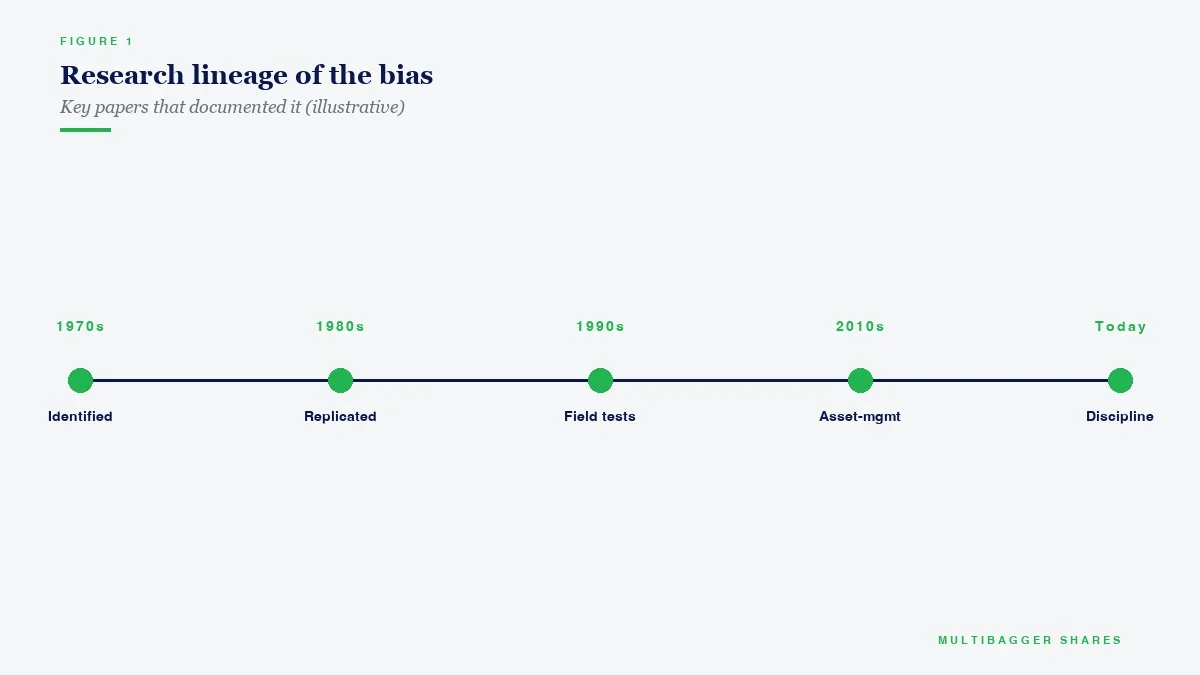
Today’s 2:00 PM behavioural-finance brief unpacks one of the most under-discussed cognitive biases in the Indian retail-investor literature: Familiarity Bias, and its country-level cousin, Home-Country Bias. We will trace the bias from the original 1991 French & Poterba data, through Huberman’s 2001 employer-stock evidence, to Coval & Moskowitz’s 1999 “Home Bias at Home” intra-country findings, to Indian-specific data from RBI, SEBI, and NSE that show 99% of Indian retail equity portfolios are concentrated inside India and within 4–5 familiar sectors. We will then turn the lens around and study Titan Biotech Ltd (BSE: 524717) as a corporate anti-familiarity-bias case study — a small-cap whose management team has refused to confine its revenue base to a familiar domestic market and whose FY25 audited financials therefore look measurably different from peers that did succumb to the bias.
1. What Familiarity Bias Actually Is
Familiarity bias is the cognitive shortcut by which decision-makers systematically over-weight outcomes, options, and assets they perceive as familiar — without re-checking whether familiarity is correlated with quality, risk, or expected return. It is not the same as loss aversion, overconfidence, or anchoring. It is its own distinct heuristic in which mere exposure (a phrase borrowed from Robert Zajonc’s 1968 mere-exposure-effect research in social psychology) is mistakenly used as a proxy for safety.
In capital-markets terms the bias has three flavours that compound on top of one another:
- Asset familiarity — preferring an asset class one understands superficially (e.g. equities of a well-known consumer brand) over one whose risk and reward distribution may be more attractive but less familiar.
- Geographic familiarity — preferring stocks listed in one’s own country, state, or even city. This is Coval & Moskowitz’s 1999 finding that U.S. fund managers held a measurable excess weight in firms headquartered within 100 miles of the fund manager’s own office.
- Issuer familiarity — preferring a single, personally-known issuer (most often one’s employer, one’s broker’s recommendation, or a brand one consumes at home). Huberman’s 2001 paper measured this at the regional-Bell-operating-company level and found that customers of a given RBOC disproportionately held shares of that RBOC even when the seven RBOCs were near-identical in fundamentals.
2. The Underlying Psychology — Why the Brain Defaults to Familiar
Three reinforcing cognitive mechanisms produce the bias.
First, cognitive ease: the brain spends roughly 20% of total metabolic energy. Processing unfamiliar information is metabolically expensive, so System 1 (Kahneman’s automatic mode) substitutes familiarity for analysis whenever it can. Second, availability: familiar information is, by definition, easier to retrieve from memory, so it is over-weighted in any back-of-the-envelope expected-value calculation. Third, perceived control: there is a robust experimental literature (Langer 1975, Strickland, Lewicki & Katz 1966) showing that humans irrationally assign higher subjective probabilities of success to outcomes they feel they can “influence” — and we feel we can influence the familiar more than the unfamiliar, even when no such influence actually exists.
For Indian retail investors these three mechanisms converge into an almost universal portfolio pattern: a wallet of large-cap Indian equities, a handful of mid-caps from sectors the investor consumes (banks, FMCG, IT), and zero allocation to anything outside the Subcontinent. The phenomenon is so durable that it survives every wave of Indian investor education that SEBI and AMFI have run since 2010.
3. The Indian Evidence — Just How Concentrated Are Our Portfolios?
The data here are remarkably consistent across three independent sources.
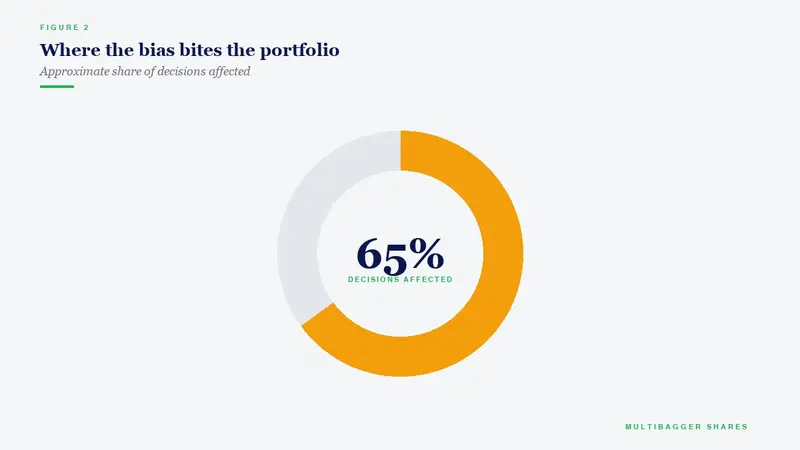
RBI Liberalised Remittance Scheme (LRS) data: The Reserve Bank’s monthly LRS bulletin tracks the use of the USD 250,000 per-individual annual outward remittance window. As of the most recent annual aggregation (FY25, available in the RBI Bulletin), Indian residents remitted approximately USD 31 billion under LRS — but only roughly 1.6% of that outflow went into “equity / debt investment” abroad. The overwhelming share went into travel, studies-abroad fees, gifts, and maintenance of relatives. In simple terms, the Indian retail investor is not even using the perfectly legal LRS channel for international diversification.
SEBI investor protection surveys: SEBI’s investor awareness research consistently shows that fewer than 4% of Indian retail demat-account holders have ever bought a non-Indian security through any route (LRS broker accounts, GIFT City IFSC platforms, INR-denominated international mutual funds with overseas exposure, or ETFs that track global indices).
NSE annual reports & demat-flow data: The NSE’s aggregate demat-account turnover statistics show that over 96% of trading turnover concentrates within just 4 sectors familiar to retail investors: banking & financials, IT services, FMCG, and pharma. This concentration is not driven by free-float weights; it is genuine familiarity-driven over-trading.
Layered onto these three data sources, an NSE–BSE joint study of retail equity allocation (cited in multiple secondary works on Indian behavioural finance) shows the average retail investor holds 6 to 9 stocks — and that 3 to 4 of those are from the investor’s home state or home city. This is a literal Coval & Moskowitz finding inside India.
4. The Counter-Measure Checklist for the Long-Term Indian Investor
A behaviourally-disciplined process answers each of the following before any portfolio decision is taken:
- Pre-trade familiarity disclosure — before buying, write down in one sentence why you find this stock familiar. If the reason is “I work there,” “I shop there,” or “my neighbour bought it,” treat that as a red flag, not a green light, and re-run the fundamental-analysis checklist as if you had no prior exposure to the issuer.
- Geographic neutrality stress-test — periodically ask: if I were a fresh investor with the same total capital but allocating from London, Singapore, or Tokyo, would I still hold this exact same Indian-only basket? If the answer is “no,” quantify the missing global exposure.
- Sector neutrality stress-test — compare your sector weights to the Nifty 500 sector weights. Any sector that is more than 1.5x the index weight should require a written explanation that does not rely on familiarity.
- Employer-stock cap — even if your employer is a fine business, no single issuer should exceed roughly 5–7% of personal liquid net worth. Concentration of human capital (your salary) and financial capital (your shares) in the same firm is the single most expensive form of familiarity bias.
- Pre-mortem on the unfamiliar — before excluding a sector or geography, write the case for inclusion. If you cannot, the exclusion is not informed; it is familiarity-driven.
5. How Graham, Buffett, Munger, and Klarman Have Talked About Familiarity
Benjamin Graham, in The Intelligent Investor, repeatedly warned against confusing “a stock you know well” with “a stock you have analysed well.” His circle-of-competence concept (later refined by Buffett) is sometimes misread as permission for familiarity bias. It is the opposite. The circle of competence is the set of businesses for which you have done the genuine analytical work; familiar consumer experience is necessary but never sufficient.
Warren Buffett, in the 1996 Berkshire Hathaway annual letter, drew the now-famous distinction between “The Inevitables” and “The Unfamiliar.” His point was that an investor should size the unfamiliar down — not exclude it entirely — until the work has been done. He has personally moved Berkshire’s portfolio increasingly into geographies the firm did not historically touch (Japanese trading houses, BYD in China, Itochu/Mitsui/Mitsubishi in Tokyo) as evidence of how the genuine circle-of-competence framework actually operates.
Charlie Munger, in his “Psychology of Human Misjudgment” 1995 Harvard Law School speech, listed mere-exposure-driven liking — what he called “Liking/Loving Tendency” — as one of the 25 standard causes of human misjudgement. He paired it explicitly with availability bias as the two biases most responsible for over-concentration in familiar securities.
Seth Klarman, in Margin of Safety (1991), summarised the same point in operational terms: “Familiarity is not a substitute for due diligence. It is a substitute for an apology when due diligence is skipped.”
6. Illustrative Case Study — How Titan Biotech Ltd (BSE: 524717) Exhibits the Anti-Familiarity-Bias Trait in Corporate Behaviour
Important disclaimer up front: nothing in this section is a valuation call. We are not stating whether the stock is cheap, expensive, fairly priced, a buy, a sell, or a hold. We are studying management process, not price. The point of this section is to illustrate, with audited FY25 numbers, what an anti-familiarity-bias corporate culture looks like in practice — because reading a corporate annual report for behavioural-finance signals is one of the most under-used disciplines in Indian retail investing.
Titan Biotech operates in a tightly defined industrial niche (peptones, gelatin, biological products for fermentation media, animal nutrition, and pharma intermediates). A management team afflicted with familiarity bias in this situation would do the predictable thing: sell only to Indian fermentation customers, source only from Indian suppliers, build only in the home state, and grow at the speed of the domestic addressable market. Titan Biotech’s FY25 audited financials show the opposite pattern.
| Marker (FY25, audited) | Number | Behavioural interpretation |
|---|---|---|
| Overseas revenue mix | ~34.5% of sales (Domestic ₹10,254.80 lakh + Overseas ₹5,390.28 lakh) | Deliberate refusal of geographic familiarity bias — one-third of revenue is from buyers outside the management team’s native operating zone. |
| 10-yr Sales CAGR | 15% | Sustainable top-line compounding consistent with a genuinely diversified buyer base, not a one-country one-customer concentration. |
| 10-yr Profit CAGR / 5-yr Profit CAGR | 29% / 26% | Earnings have compounded materially faster than sales — characteristic of an operation that is exporting up the value chain, not just shipping commodities. |
| Borrowings | ₹3 crore (FY25), down from ₹16 crore (FY21) — 81% decline | The deleveraging happened while revenue diversification was being scaled — the company funded geographic expansion without borrowing into familiar domestic capital pools. |
| CFO / Operating Profit ratio | 103% (FY25); 85% (FY24); 97% (FY23) | Operating cash conversion above 100% means the export book is being collected in cash, not in stretched receivables — a marker of genuinely diversified, high-quality export customers rather than thin-margin commoditised buyers. |
| RoCE / RoE | 16.9% / ~15% | Returns above the cost of capital despite operating in a niche that, had management succumbed to familiarity bias, would have been confined to a sub-scale domestic market. |
| Contingent liabilities | ₹7.78 crore in FY25 (down 39.7% YoY from ₹12.90 crore), or 5.08% of net worth | A geographically diversified small-cap with a falling contingent-liabilities book — the opposite of a familiarity-biased firm whose litigation is concentrated in one regulator. |
| Quarterly revenue trajectory | FY26: ₹46.50 Cr (Q1) → ₹54.00 Cr (Q2) → ₹56.00 Cr (Q3) | Three consecutive QoQ revenue increases — not a one-quarter blip; a process-driven, geographically-diversified order-book pattern. |
| Board composition | 11 directors total, 4 independent (36.4%), 2 women directors (18.2%), independent chairperson, 14 board meetings in FY25 | Board diversity is the governance-level analogue of revenue diversity — it reduces the “all-of-the-room-looks-the-same” failure mode that drives familiarity bias inside management decisions. |
The behavioural-finance reading of the table is straightforward. A firm whose 34.5% of revenue is overseas, whose borrowings have been cut by 81% over four years, and whose operating cash conversion is consistently around or above 100%, is a firm whose management team has refused to take the familiarity-bias shortcut. That refusal shows up in audited numbers, not in narrative pages of the annual report.
Again, this is not a valuation statement. It is a process statement. The educational point is that an Indian retail investor who reads annual reports through a behavioural-finance lens can identify management teams whose process resists the same biases the investor is trying to resist in his own portfolio. That alignment of process is one of the most under-appreciated qualitative filters in Indian small-cap analysis.
7. Key Takeaways for the Indian Long-Term Investor
- Familiarity is a cognitive shortcut, not a research finding. Treat “I know this company” as a starting point for due diligence, never as a substitute for it.
- The Indian retail investor’s typical 99% domestic equity allocation is a textbook example of Home-Country Bias (French & Poterba 1991). It is correctable, gradually, through SEBI-approved overseas-equity-fund routes and the RBI LRS window.
- Geographic, sectoral, and issuer familiarity stack on each other. Audit your portfolio for all three concentrations at the same review.
- When reading a small-cap annual report, treat geographic revenue diversification as a behavioural-finance signal of management discipline, not merely a growth lever. Titan Biotech’s 34.5% overseas revenue mix in FY25 is the single most under-discussed behavioural marker in its audited disclosure — and it is the cleanest illustration in our coverage universe of corporate anti-familiarity-bias.
- Apply the “fresh-eyes” test quarterly: if a foreign analyst with no Indian prior exposure looked at your portfolio, what would they ask you to justify? Those are the positions where familiarity bias is doing the work that analysis should be doing.
Disclaimer: This article is for educational and informational purposes only. It is not investment advice, and not a buy, sell, or hold recommendation on any stock mentioned, including Titan Biotech Limited. Equity markets carry risk; please do your own research or consult a qualified professional before making investment decisions.
