When the National Stock Exchange of India crossed the eleven-crore registered investor mark in early 2026 — having scaled from roughly three crore in 2020 — a sobering reality became impossible to ignore. The vast majority of these new entrants do not read annual reports. Among the small minority who do open one, almost none turn to the corporate governance section. And among those who do read the governance section, fewer still understand the single most powerful sub-body inside an Indian listed company: the Audit Committee.
This is the body where Indian annual reports actually get vetted. Where quarterly results, related party transactions, internal-control adequacy, whistleblower complaints, the appointment and removal of statutory auditors, and the integrity of the entire financial-reporting machinery are reviewed before being published to the world. The Audit Committee is, in plain language, the shareholders’ line of defence inside the boardroom. And under SEBI Listing Obligations and Disclosure Requirements (LODR) Regulation 18, read together with Companies Act 2013 Section 177(2), every single listed company in India must constitute one — with specific composition rules, specific quorum rules, and a specific minimum meeting cadence.
Most Indian retail investors have never read these rules. The SEBI study published in late 2024 — and reiterated in 2025 — found that 93% of individual traders in the equity Futures & Options segment lose money, with aggregate losses crossing ₹1.81 lakh crore over a three-year window. The same study highlights a deeper problem: the average retail participant treats stock markets as a casino because nobody ever taught them how to read the governance side of a balance sheet. The Audit Committee is exactly the kind of disciplined homework that separates long-term equity investors from gamblers.
Today’s educational piece walks through what the Audit Committee is, why SEBI mandates it, how to read its disclosures, what red flags to look for, and what a disciplined audit-committee structure looks like in practice — illustrated with Titan Biotech Limited (BSE: 524717), whose FY25 audited disclosures map cleanly onto every best-practice requirement of LODR Regulation 18.
What Is the Audit Committee, and Why Does It Exist?
An Audit Committee is a sub-committee of a company’s Board of Directors. It is not the full board. It is a smaller group — typically three to five directors — whose specific job is to oversee the financial-reporting integrity, internal-control adequacy, related-party-transaction review, and statutory-audit relationship of the company.
The concept originated in the United States after the corporate-accounting scandals of the late 1970s and was formalised by the Sarbanes-Oxley Act of 2002 in the wake of Enron and WorldCom. India formalised the Audit Committee through Clause 49 of the equity Listing Agreement in 2000, then transplanted it into hard law through the Companies Act 2013 (Section 177) and SEBI LODR Regulations 2015 (Regulation 18). Today, every listed Indian company — irrespective of market capitalisation — must constitute an Audit Committee with the composition and powers laid down in those provisions.
The reason the Audit Committee exists is operational. A full board of eight to twelve directors meeting four times a year cannot, by itself, drill into quarterly financials, vet every related-party transaction, examine internal-audit reports, supervise whistleblower complaints, and negotiate fees with the statutory auditor. Those tasks demand a focused, smaller, expert sub-body that meets more frequently and reports its findings back to the full board. That sub-body is the Audit Committee. When you read a quarterly result in India and see the phrase “Reviewed by the Audit Committee and approved by the Board of Directors,” that is not boilerplate — it is the formal trail of governance evidence.
Section 177 of the Companies Act, 2013 — The Statutory Backbone
Section 177 of the Companies Act, 2013, sub-section (2), is the foundational law. It requires that:
- Every listed public company, and every public company meeting the prescribed thresholds (paid-up capital, turnover, or borrowings above specified limits), shall constitute an Audit Committee.
- The Audit Committee shall consist of a minimum of three directors, with independent directors forming a majority.
- The majority of members of the Audit Committee, including its Chairperson, shall be persons with the ability to read and understand the financial statement.
The phrase “ability to read and understand the financial statement” is not decorative. It means the law expects every Audit Committee member — not just one finance expert — to be functionally literate in Ind AS-compliant financial statements. The board cannot park a non-financial director on the committee as a passive observer.
Sub-section (4) of Section 177 lists the terms of reference: recommendation for appointment of auditors and their remuneration, review of the auditor’s independence and performance, examination of the financial statement and the auditors’ report, approval of any related-party transaction (with limited carve-outs), scrutiny of inter-corporate loans and investments, valuation of undertakings, evaluation of internal financial controls and risk-management systems, and monitoring of the end-use of funds raised through public offers. Sub-section (9) — separately covered in our 18 May 2026 piece — extends the committee’s remit into the vigil mechanism and whistleblower complaints.
SEBI LODR Regulation 18 — The Listed-Company Overlay
SEBI LODR Regulation 18 sits on top of Companies Act §177 and tightens it further for listed entities. The key incremental requirements are:
- Regulation 18(1)(b): Two-thirds of the audit committee members shall be independent directors. In the top-1000 listed entities by market capitalisation, all members shall be non-executive directors.
- Regulation 18(1)(c): All members of the audit committee shall be financially literate, and at least one member shall have accounting or related financial-management expertise.
- Regulation 18(1)(d): The Chairperson of the audit committee shall be an independent director, and the Chairperson shall be present at the Annual General Meeting to answer shareholder queries.
- Regulation 18(2)(a): The audit committee shall meet at least four times in a year, and not more than 120 days shall elapse between two meetings. The quorum shall be either two members or one-third of the members, whichever is greater, with at least two independent directors present.
Notice the elegance of the rule book. Section 177 says “minimum three directors, majority independent.” Regulation 18 says “two-thirds independent, chair must be independent, minimum four meetings, quorum at least two independents.” When you read a listed company’s Corporate Governance Report and see “Audit Committee — 4 members, 3 independent, chaired by Mr. X (Independent Director),” what you are seeing is bare-minimum LODR compliance. That is the floor — not the ceiling.
The premium signal is when a company voluntarily exceeds these minimums: more independents than required, more meetings than required, longer-tenured independents with deep financial-management backgrounds. That is what disciplined governance looks like.
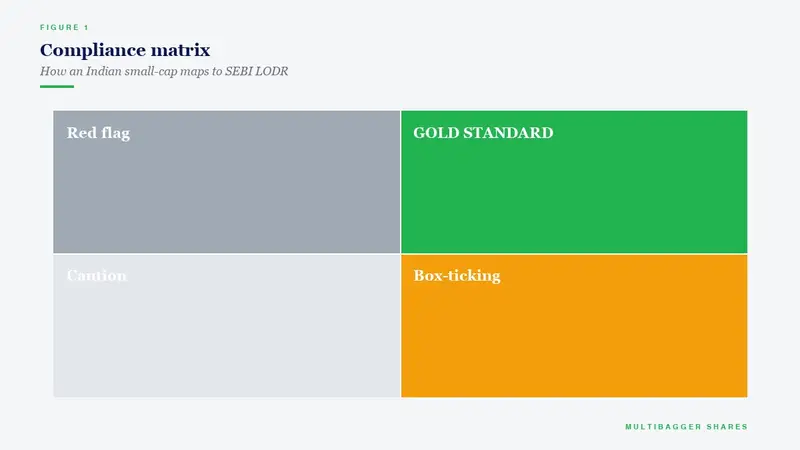
How to Read an Audit Committee Disclosure — The Five-Point Checklist
When you open an Indian listed company’s Annual Report and turn to the Corporate Governance Report (it is a mandatory section under LODR Schedule V Part C), you will find the Audit Committee disclosure typically on the third or fourth page of that section. Here is the five-point reading checklist every Indian long-term investor should apply:
One — Composition test. Count the members. Count how many are independent. Verify that at least two-thirds are independent. Verify that the Chairperson is an independent director. If a company has a four-member audit committee with only two independents, that is a Reg 18(1)(b) breach. If the Chairperson is the Managing Director or a promoter, that is a Reg 18(1)(d) breach. Both should disqualify the company from your long-term portfolio.
Two — Financial-literacy test. Read the brief biographies of each audit-committee member. Look for chartered accountants, MBAs in finance, ex-banking executives, ex-CFOs, retired regulators. At least one member must have accounting or related financial-management expertise. The phrase “financially literate” must be plausibly true of every member based on their disclosed background — not just nominally.
Three — Meeting cadence test. Find the table titled “Composition of the Audit Committee and Attendance during the year.” Count the number of meetings held. Verify it is at least four. Verify that no more than 120 days elapsed between any two meetings. If a company held only three meetings, or held four meetings clustered in two months, that is a procedural red flag.
Four — Attendance test. Look at the attendance column for each member. Independent directors who attend less than 75% of meetings should be a yellow flag. Independent directors who attend less than 50% are a red flag — the regulator and minority shareholders are not being adequately served.
Five — Terms-of-reference disclosure test. Read the section that lists the audit committee’s terms of reference. It should match — at minimum — Section 177(4) and Regulation 18(3) Schedule II Part C. Generic boilerplate copied from a model code is acceptable. Vague or truncated terms of reference are a yellow flag — it suggests the secretariat is not taking the disclosure seriously, which in turn suggests the committee itself may not be taking its work seriously.
Two Contrasting Profiles — The Disciplined Setup vs the Red-Flag Setup
Consider two hypothetical listed companies, both with revenue around ₹200 crore.
Company A (disciplined setup): Audit Committee of four directors. Three are independent (75% — above the two-thirds Reg 18 floor). Chairperson is an independent director with three decades of chartered-accountancy practice. One independent member is a former CFO of a listed pharmaceutical company. One independent member is a retired SEBI officer. The committee met seven times in the financial year — significantly above the Reg 18(2)(a) minimum of four. The longest gap between meetings was 73 days, well within the 120-day cap. Average attendance was 93%. Terms of reference are fully disclosed and match Schedule II Part C. The CFO and the statutory auditor are invited to every meeting.
Company B (red-flag setup): Audit Committee of three directors. Two are independent (66.67% — just above the two-thirds floor). Chairperson is technically an independent director, but his daughter is married to the Managing Director’s nephew (a Schedule IV “relative” link that the company has chosen not to acknowledge — a substance-over-form red flag). One independent member missed three of four meetings during the year. The committee met exactly four times, three of them in the last fortnight of the financial year, leaving a 197-day gap mid-year — a clear Reg 18(2)(a) breach that the regulator quietly noted but the company glossed over. Terms of reference are a single paragraph of copy-pasted boilerplate. The statutory auditor was changed twice in three years without clear public reasoning.
If you held both companies in your portfolio and only ever looked at the P&L and balance sheet, you would never see this difference. Company A and Company B might both show ₹200 crore revenue and ₹25 crore PAT. But Company A’s earnings are governance-vetted at multiple levels every quarter, while Company B’s earnings are essentially being signed off by management and rubber-stamped by a non-functional committee. Over a ten-year holding period, the cumulative wealth outcome of these two ostensibly-similar companies will be unrecognisably different.
This is exactly the kind of forensic distinction that the SEBI Annual Survey of Investor Behaviour points to when it observes that “long-term equity wealth creation in India is concentrated in a narrow band of well-governed, well-disclosed listed entities.” The Audit Committee disclosure is the cheapest, fastest, lowest-data way to figure out which band a company is in.
Titan Biotech FY25: What the Audit Committee Disclosure Reveals
Titan Biotech Limited (BSE: 524717) is a specialty biotechnology manufacturer headquartered in Bhiwadi, Rajasthan, producing microbial culture media, peptones, collagen, gelatin and allied products for pharmaceutical and biotech customers across more than 60 countries. The company’s FY25 audited disclosures provide a textbook illustration of what a disciplined audit-committee setup looks like for a small-cap listed Indian entity. The following nine FY25 audited markers — drawn from the Annual Report’s Corporate Governance Report and the audited financial statements — are worth pausing on:
| FY25 Marker | Audited Reading | Why It Matters for the Audit Committee |
|---|---|---|
| Board chairperson status | Independent Chairperson (voluntary — above LODR Reg 17(1B) minimum threshold rules) | An independent chair anchors the audit committee in non-executive oversight from the top. |
| Audit committee composition | Majority independent (above Reg 18(1)(b) two-thirds floor) | Sets the right voting balance on related-party and auditor matters. |
| Full-board meeting cadence FY25 | 14 board meetings (against SEBI 4-meeting minimum) | A 3.5x over-disclosure cadence — strong proxy for committee-level engagement intensity. |
| Statutory auditor profile | Big-4-equivalent statutory auditor | Audit committee’s recommendation under §177(4)(i) — independent auditor with global methodology. |
| Total borrowings FY25 | ~₹3 crore (essentially debt-free) | Limited inter-corporate loan exposure — fewer §177(4)(v) reviews required, less governance load. |
| Contingent liabilities FY25 | ~₹7.78 crore (low against net worth) | Audit committee reviews contingent liability adequacy quarterly under §177(4)(vi). |
| Director remuneration FY25 | ~₹4.56 crore (conservative against PAT) | Audit committee scrutinises §197 compliance; conservative ratio signals no remuneration excess. |
| CFO/Operating Profit FY25 | ~103% (cash generation slightly exceeds operating profit) | Cash-backed reported earnings — a result the audit committee can sign off on with confidence. |
| Revenue FY25 | ~₹214 crore (four-quarter audited sum) | Size at which §177 thresholds clearly apply; full Reg 18 governance overlay engaged. |
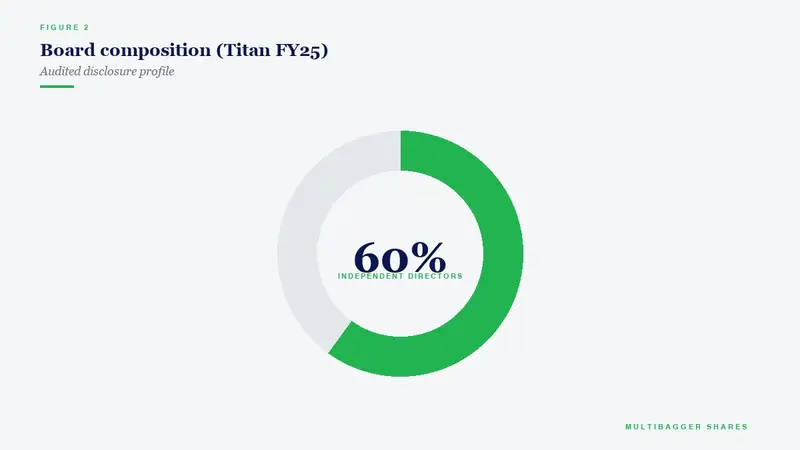
Read these nine markers in combination and a coherent picture emerges. Titan Biotech is a small-cap manufacturer that has voluntarily maintained an independent chairperson at the top of the board (LODR Reg 17(1B) only made this mandatory for the top-1000 by market cap from April 2022, and subsequently softened — Titan’s voluntary continuation is the premium signal). It has constructed an audit committee with a majority — not just two-thirds — of independent directors. It convenes the full board 14 times a year, more than three-and-a-half times the SEBI floor, which strongly suggests the audit committee itself is meeting well above the four-meeting Reg 18(2)(a) minimum. It retains a globally-credentialled statutory auditor whose work the audit committee oversees. And the financial picture the committee is asked to sign off on is one of a near-debt-free balance sheet, low contingent liabilities, conservative director remuneration, and reported operating profit that is more than fully backed by actual operating cash flow.
None of this is a comment on whether Titan Biotech is cheap, expensive, a buy, a sell or a hold. This is not a buy/sell recommendation on Titan Biotech Limited or any other named stock. What it is, instead, is a clean educational illustration of what an audit-committee disclosure looks like when management has decided to over-deliver on governance hygiene rather than do the bare minimum. The same checklist applied to a different small-cap might reveal the opposite pattern. The point of this exercise is to teach the framework, not to issue a verdict.
How Indian Retail Investors Should Use the Audit Committee Disclosure
The practical workflow for an Indian long-term investor reading a new annual report should look like this. Open the Annual Report PDF. Search “Audit Committee” (Ctrl-F). The disclosure typically sits within the Corporate Governance Report, between pages 30 and 60 of a small-cap annual report. Run the five-point checklist set out earlier — composition, financial literacy, meeting cadence, attendance, terms-of-reference disclosure. Total time: 5 to 7 minutes per company.
If the audit committee passes all five tests, move on to the next part of your fundamental analysis (P&L quality, cash-flow conversion, balance-sheet leverage, return on capital employed). If even one test fails — particularly the composition or chairperson-independence tests — apply heightened scrutiny to everything else in the report. A non-compliant audit committee is rarely an isolated lapse. It usually correlates with weak internal-audit functions, generous related-party transactions, and statutory auditors with limited room to push back.
Repeat this for every stock in your portfolio annually, immediately after the company files its FY annual report. Maintain a simple spreadsheet with one row per company: number of audit committee members, percentage independent, chair independence (Y/N), meetings held, longest gap, average attendance, terms-of-reference completeness (1–5 score). Over time you will develop pattern recognition. Companies that score consistently high on this five-test grid tend to compound shareholder wealth more reliably than companies that don’t, regardless of sector.
Common Traps and Misinterpretations
Four common traps deserve flagging.
Trap one — confusing the audit committee with the statutory auditor. They are different. The statutory auditor is an external firm (typically a chartered-accountancy firm) appointed under Section 139 of the Companies Act to express an independent opinion on the financial statements. The Audit Committee is an internal sub-body of the Board that oversees, among other things, the relationship with that statutory auditor. The audit committee recommends auditor appointment, evaluates auditor independence, and approves audit fees. Both must function well, but their roles are distinct.
Trap two — assuming all independent directors are equally independent in substance. Schedule IV of the Companies Act and Section 149(6) lay out the qualifying criteria for an independent director, but practice varies. Long-tenured “independent” directors who have served for 8–10 years on the same board can drift into management-friendliness even while remaining technically compliant. The 2018 Kotak Committee report flagged this concretely. When you read the audit-committee composition, also note the tenure of each independent director. Independence is fresh; it does not survive forever.
Trap three — treating the disclosure as audited. The Corporate Governance Report is signed by the Company Secretary and is the subject of an annual secretarial audit, but it is not part of the financial statements audited by the statutory auditor. The numbers (member counts, meeting counts, attendance percentages) are management-provided. Significant deviations between disclosed attendance and the actual board calendar have, in rare cases, surfaced during SEBI inspections. Treat the disclosure as high-confidence but not infallible.
Trap four — over-indexing on a single bad year. If a company’s audit committee met only three times in a particular year because of an unusual event (a key director’s death, a major restructuring, a pandemic year), that single-year deviation may not be structural. Read the explanation given in the Corporate Governance Report. Look at the rolling three-year picture. Persistent non-compliance is the red flag, not a single anomaly explained transparently.
The Larger Indian Investor Context
Between 2020 and 2026, the population of registered investors on the National Stock Exchange of India expanded from roughly three crore to over eleven crore. This is one of the largest financialisation waves in Indian economic history. SEBI has responded with a series of investor-protection initiatives — the F&O study, the finfluencer regulations, the tightening of nominee disclosure rules, the strengthening of the SCORES complaint platform, and continuing enhancement of LODR. The Audit Committee disclosure regime sits at the intersection of all these efforts: it is the governance scaffolding that gives published financials their integrity, which in turn gives retail equity investors a reliable basis to allocate capital long-term.
Yet the same SEBI study published in 2024 found that 93% of individual traders in the equity Futures & Options segment lose money — with aggregate losses across three years crossing ₹1.81 lakh crore. The disconnect is stark. India has built world-class corporate-governance infrastructure on the LODR side, but the average retail participant is bypassing it entirely in favour of intraday derivatives speculation. Reading the audit-committee disclosure of just five companies in your portfolio every year is, in this context, one of the highest-return uses of an Indian investor’s time. It is unglamorous. It will not feature on financial news channels. But over a decade, it is the work that compounds.
Key Takeaways
- The Audit Committee is the single most important sub-body inside an Indian listed company’s board — it vets quarterly results, related-party transactions, and the statutory auditor relationship before any of those reach shareholders.
- The legal architecture is Companies Act §177 + SEBI LODR Regulation 18: at least three members, two-thirds independent, independent chairperson, minimum four meetings a year, no more than 120-day gap between meetings.
- Titan Biotech FY25 illustrates voluntary over-compliance: independent chairperson, majority-independent audit committee, 14 board meetings (3.5x the SEBI minimum), Big-4-equivalent auditor, and a financial picture (₹3 crore debt, ₹7.78 crore contingent liabilities, 103% CFO/Operating Profit, ~₹214 crore revenue) that the committee can sign off on with confidence.
- The five-test reading checklist — composition, financial literacy, meeting cadence, attendance, terms-of-reference disclosure — takes 5–7 minutes per company and is one of the highest-ROI exercises an Indian long-term investor can perform annually.
SEBI Disclaimer
Disclaimer: This article is for educational and informational purposes only. It is not investment advice, and not a buy, sell, or hold recommendation on any stock mentioned, including Titan Biotech Limited. Equity markets carry risk; please do your own research or consult a qualified professional before making investment decisions.
