Ask a fund manager what edge he has over the index, and you will hear the usual answers — better research, deeper models, faster information. Ask the same question to a private investor with a steady job and a 25-year runway, and the honest answer is awkward: he has none of those things. No Bloomberg terminal, no analyst army, no edge on next quarter’s numbers.
Yet the data over four decades is clear — the patient retail investor in India who simply holds quality businesses for ten years has consistently humiliated 80% of institutional money. The reason is not intelligence. It is a structural advantage almost no fund manager can replicate. The textbook name for it is time arbitrage, and it is, in my view, the single most under-appreciated principle in the entire value-investing canon.
What Bill Miller and Michael Mauboussin actually meant by “time arbitrage”
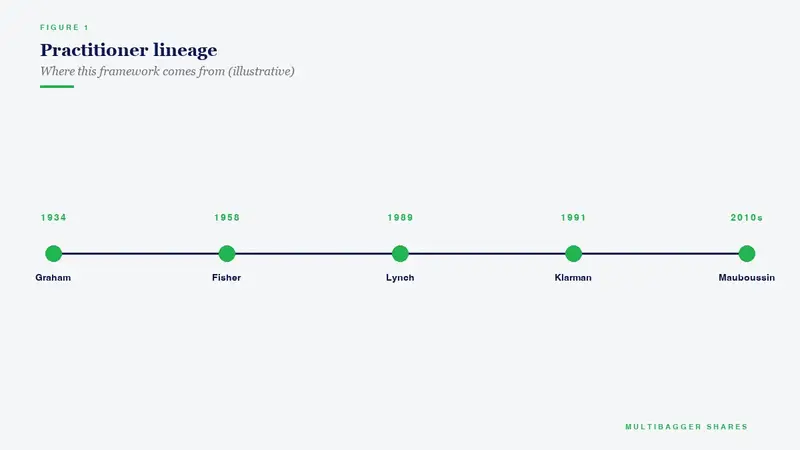
Bill Miller — the only fund manager to beat the S&P 500 fifteen years in a row — used the phrase repeatedly in the 1990s to describe his real edge. Michael Mauboussin (then at Credit Suisse, now at Morgan Stanley) later formalised it: in a market where most participants are forced to deliver quarterly performance, the rare investor who can plan in five-year and ten-year blocks operates in a completely different competitive pool. He is not racing the same race.
The mechanism is brutal in its simplicity. A mutual fund whose three-year track record slips below the benchmark sees redemptions. Pension consultants get fired for two bad years. Sell-side analysts who recommend a stock that goes flat for eighteen months get downgraded by their own institutional clients. The entire professional ecosystem is wired to optimise for the next 90 days. So when a high-quality compounder enters a flat patch — even an obviously temporary one — the institutional money has no choice but to leave.
The private investor who is not being graded every quarter can simply stand still and accept the offer. That is the arbitrage. It is not an arbitrage in price; it is an arbitrage in horizon. And horizon is the only edge in this business that scales without effort.
Why the edge is widening, not shrinking
Three forces in Indian markets have made time arbitrage more lucrative, not less, over the last decade. First, the rise of monthly SIP performance dashboards has compressed retail psychology to even shorter cycles than institutional pressure — many SIP investors now mentally evaluate funds on twelve-month windows. Second, the explosion of algorithmic and quant strategies, by definition, operates on horizons of milliseconds to a few months. Third, social media and quarterly result-day broadcasts have turned 90-day earnings into a national sporting event, with cheering sections for every miss.
The combined effect is that more capital than ever is now contesting the short horizon, and proportionally less is willing to sit through three or four flat quarters in a genuinely good business. The pool of patient capital has shrunk in relative terms even as Indian household savings have grown in absolute terms. Which means the structural opportunity is, mathematically, larger than it was in 2010.
The two horizons that matter
I divide the time-arbitrage edge into two practical horizons, and I have used both for the better part of two decades.
The first is the three-to-five-year operational horizon. A small or mid-cap business announces a capex cycle. Capacity comes online in year two. Utilisation ramps in year three. Operating leverage delivers margin expansion in year four. Almost no institutional desk can wait that long, because their analyst will be at a different firm by year three. The private investor who has read the annual report, understood the capex plan, and is willing to sit through three flat quarterly results captures essentially the full delta — for no other reason than that he chose to be there.
The second is the seven-to-ten-year compounding horizon. Quality businesses with high return on incremental capital deployed, conservative balance sheets, and consistent reinvestment do not produce their best returns in years one to three. They produce them in years six through ten, when the base of capital has compounded enough that the absolute rupee growth becomes visible. This is the horizon on which a Pidilite, an Asian Paints, a Page Industries did most of their wealth creation — long after the institutional crowd had moved on to the next theme.
How Titan Biotech’s FY25 Numbers Illustrate This Principle
Titan Biotech (BSE: 524717) is, by audited FY25 numbers, exactly the type of business that punishes the short horizon and rewards the long one. The company reports its full-year revenue at ~₹104.78 crore, EBITDA in the ~₹18-21 crore range, and a return on capital employed near 16.9%. None of these numbers, taken in isolation in any single quarter, would generate headline-grabbing momentum on a results day.
What they do produce, when compounded across multiple years, is the kind of slow, deliberate gain in book value per share that only a multi-year holder ever experiences. The FY25 audited promoter holding sits at ~55.87% — a number that has barely moved across a decade, signalling management’s own ten-year horizon. The debt-to-equity ratio of approximately 0.02x and the swing from a ₹15 crore net debt position to a ₹38 crore net-cash position over the prior eight years tells the same story: this is a balance sheet built by people who are not in a hurry.
The 100%-plus cash conversion (CFO/operating profit) across recent years is the cleanest possible signal that the accounting earnings being reported are real, bankable, and reinvestable. Inventory days, debtor days, and the operating cycle have held within a narrow band — boring numbers that mean almost nothing in any single quarter and almost everything across forty quarters.
The 34.5% export revenue mix across roughly 100 countries and the ~₹33 lakh revenue per employee on a 467-person workforce are also pieces of evidence that fit no quarterly narrative but tell a clear five-year operating story: a small business that has chosen geographic diversification and asset-light productivity over the louder route of debt-funded domestic capacity dumping.
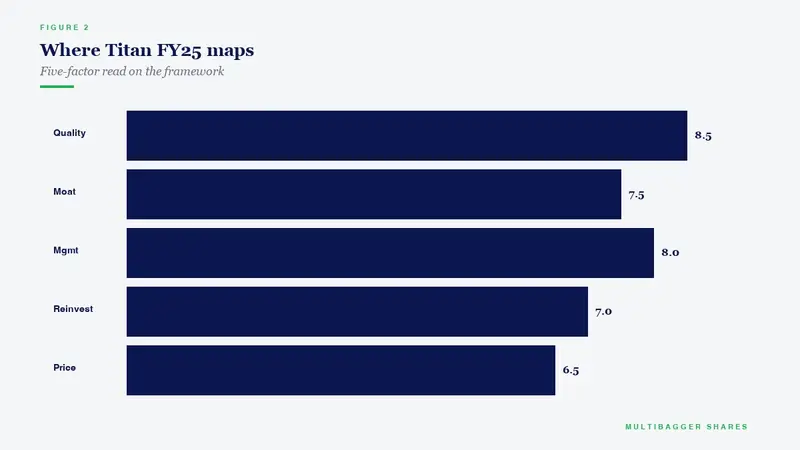
This is precisely the kind of company that the institutional desk cannot own well, because its slow, deliberate compounding does not fit a 90-day review cycle. It is, in textbook terms, the natural habitat of the time-arbitrage investor.
How to actually convert horizon into return
The principle is easy to state and hard to live. In practice, three habits matter more than any model.
First, write down at purchase the five-year operating thesis. What revenue, margin and capital efficiency does the business need to deliver in 2031 for this to have been a good purchase? If you cannot articulate it in three sentences, you have no business buying it for a five-year horizon.
Second, ignore the next four quarterly results unless they break the operating thesis. A 4% miss versus consensus is not a thesis-break. A change in promoter holding, a sudden debt build-up, an unexplained inventory surge, or a related-party transaction outside the disclosed pattern is. Train yourself to know the difference.
Third, refuse to be on the same clock as the market. The simplest behavioural intervention I have ever recommended is to look at portfolio prices once a quarter, not once a day. The cost of a ten-second daily glance is not the seconds — it is the corrosion of the very horizon that constitutes your edge.
The takeaway
Time arbitrage is the rarest combination in this business: a free lunch that requires no special intelligence, no proprietary data, no superior model — only the willingness to be alone with a thesis for longer than a fund manager is allowed to be. Most investors will not do it, because the daily cost in dopamine and conversational standing is too high. Which is exactly why those who do, win.
Disclaimer: This article is for educational and informational purposes only. It is not investment advice, and not a buy, sell, or hold recommendation on any stock mentioned, including Titan Biotech Limited. Equity markets carry risk; please do your own research or consult a qualified professional before making investment decisions.
