If you have ever bought a stock within ten minutes of a celebrity portfolio manager naming it on a business-news channel, you have not made a research-driven decision. You have obeyed an authority figure. The instinct is so deep, so automatic, and so resistant to introspection that the most important social-psychology experiment of the twentieth century was designed specifically to measure it — and the result shocked even the experimenter who ran it.
That experiment was Stanley Milgram’s 1961–63 obedience study at Yale University, formally written up in The Journal of Abnormal and Social Psychology (1963) and expanded in his 1974 book Obedience to Authority. The bias it exposed — what Charlie Munger later named the Authority-Misinfluence Tendency in his 1995 Harvard Law speech “The Psychology of Human Misjudgment” — is, in my view, the single most under-discussed reason that Indian retail wealth is silently transferred from television-watching investors to the people standing in front of the cameras. Today’s post unpacks the bias from its scientific origins, traces how it operates inside the Indian equity ecosystem in 2026, and closes with a positive case study of how the audited FY25 numbers of Titan Biotech Ltd (BSE: 524717) reward the investor who replaces authority with arithmetic.
The Original Experiment, In One Paragraph
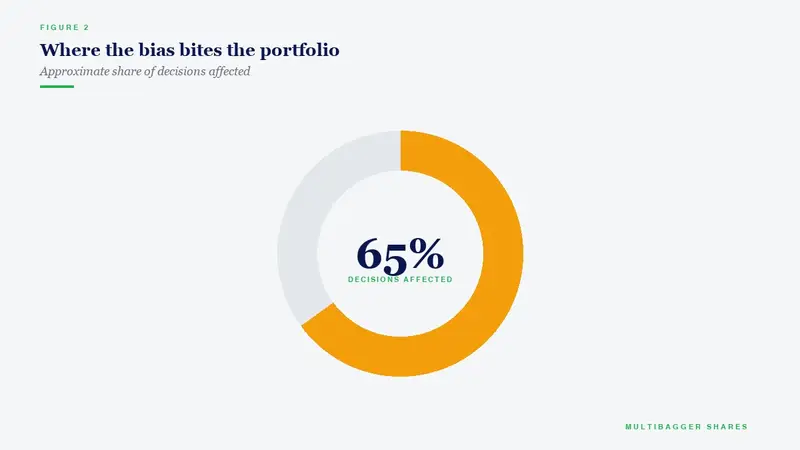
At Yale’s Linsly-Chittenden Hall in 1961, Stanley Milgram seated forty male volunteers (later expanded to over a thousand subjects across replications) in front of a fake shock generator marked from 15 volts (“Slight Shock”) to 450 volts (“XXX”). A second man in a grey lab coat — the “experimenter” — instructed each subject to administer increasingly severe electric shocks to a confederate (in a separate room) every time he answered a memory question incorrectly. The confederate was a trained actor; the shocks were not real; but the subjects did not know that. As the voltage climbed, the actor screamed, complained of a heart condition, begged to stop, and eventually fell silent. Each time a subject hesitated, the experimenter offered one of four scripted prompts — the strongest being, “The experiment requires that you continue.” Sixty-five per cent of subjects (26 out of 40 in the baseline condition) administered the maximum 450-volt shock. Not because they were sadists. Not because they hated the victim. Simply because a man in a lab coat told them to.
Milgram had hypothesised, before running the study, that perhaps 1–3% of subjects would obey to the maximum; so had every psychiatrist he polled in advance. The 65% figure has since been replicated in Burger (2009) and across cultures from Jordan to Spain to Australia. The bias is not American, not 1960s, and not gendered. It is a feature of human social-coordination wiring — we are evolved to defer to legitimate authority because, in a hunter-gatherer band, the cost of refusing the leader was death.
Why Munger Made It a Standalone Tendency
In his Psychology of Human Misjudgment doctrine, Charlie Munger isolates Authority-Misinfluence Tendency as Tendency No. 15, deliberately separated from Social-Proof Tendency (No. 14) and Liking/Loving Tendency (No. 5). The distinction is precise. Social proof says: “Everyone else is doing it, so I will too.” Liking-tendency says: “He is charming, so I trust him.” Authority-tendency is different and more dangerous: “He has the title, the credentials, the uniform, the registration number, the studio chair — therefore I outsource my judgment.” The investor stops thinking the moment the cue fires.
The Indian Manifestation — Where Authority Cues Fire In Our Markets
The Indian equity ecosystem is engineered, almost by accident, to be a continuous Authority-Bias delivery machine. Notice how many cues you encounter in a single hour:
The business-news anchor calling crores per day in “target prices” without a single audited track-record disclosure. The institutional research head whose 60-page PDF carries a CFA suffix, a SEBI registration footer, and a CMP-versus-target table that nobody back-tests. The finance influencer with 4.7 million subscribers and a verified blue tick. The newspaper headline that reads “Veteran Investor X said this stock can 5x.” Each is an authority cue designed — consciously or otherwise — to short-circuit the prefrontal-cortex valuation engine and invoke the limbic obedience reflex Milgram measured.
The 2024 SEBI study on F&O participation found that 91.1% of individual traders booked net losses in FY24, with a meaningful chunk of trades originating from social-media tipster recommendations whose authors had no verifiable performance history. The Authority cue extracted the trade; the audited numbers, had anyone checked, would have refused it.
How Great Investors Replaced Authority With Arithmetic
The pattern is identical across the masters. Benjamin Graham’s entire Security Analysis (1934) was an Authority-Bias antidote — he demanded the analyst rebuild every line item from primary filings before accepting a single management claim. Phil Fisher’s scuttlebutt method bypassed the company’s own spokesperson and went to suppliers, ex-employees, and competitors. Walter Schloss refused to take analyst phone calls and worked solely off Value Line tear-sheets. Seth Klarman, in Margin of Safety (1991), captured the discipline best: the investor’s greatest edge is the ability to ignore noise from people whose incentives are not aligned with the investor’s own.
The counter-measure is not to refuse to listen. It is to reverse the burden of proof. Authority cues are accepted by default; arithmetic is required to be demonstrated. Flip the polarity. Demand the arithmetic by default; treat the authority claim as one weak input that must survive the arithmetic test before it earns weight.
How Titan Biotech’s FY25 Numbers Illustrate This Principle
Titan Biotech Ltd (BSE: 524717) is a useful Indian working example of a company whose audited financials, drawn from the FY25 annual report, do the talking that no celebrity endorsement is ever required to do. An investor who put aside the question of who is “recommending” the stock and instead read the audited numbers would have encountered the following positive operating signature:
Return on Capital Employed of approximately 16.9% in FY25 — comfortably above the company’s implied cost of capital, indicating that every rupee deployed inside the business is producing genuine economic profit rather than accounting profit. EBITDA margin in the 19–22% band across the recent reporting cycle — the operating profitability footprint of a company with pricing discipline, not one trading topline for margin. Promoter holding of 55.87%, increased from 48% over the preceding cycle — an “eat-your-own-cooking” signal that no televised endorsement can manufacture; promoters rarely add to their stake when they privately know the numbers will not hold. Debt-to-equity of approximately 0.02x with a net-cash position of roughly ₹38 crore — a fortress balance sheet that owes its existence to retained-earnings discipline, not to capital-market storytelling. Export revenue mix of approximately 34.5% spread across 100 countries — a geographic-concentration profile that makes the business genuinely diversified rather than dependent on a single domestic narrative. Revenue per employee of approximately ₹33 lakh against a headcount of roughly 467 people — a workforce-productivity number that tells the truth about operating intensity. Effective tax rate of approximately 25% across recent fiscal years — the boring-but-essential clean-accounting fingerprint that no fraud-engineered company can sustain. An unbroken dividend track record spanning fourteen consecutive financial years — a multi-decade promise kept, irrespective of which way the news cycle was blowing.
None of these numbers needed an authority figure to validate them. They are extracted directly from the FY25 audited statements filed with the BSE. The investor who reads them in silence and the investor who hears them shouted on television receive identical information; the only difference is the volume of authority cues attached. The Authority-Bias-resistant investor weights both inputs the same.
Key Takeaways
Authority Bias is not weakness; it is wiring. Sixty-five per cent of ordinary, kind, intelligent people will electrocute a stranger to death because a man in a lab coat asks them to — and you, sitting in front of a Bloomberg terminal or a Moneycontrol app, are not exempt. The bias fires the loudest at exactly the moment the rational input is needed the most: when a credentialled stranger is asking you to commit capital. The defence is not to mute the television. The defence is to demand that every authority claim survive the arithmetic test before it earns weight in your decision — and to read the audited numbers of any business you own with the same hostile rigour that Milgram’s subjects refused to bring to the man in the lab coat. Treat the 10-K as the only authority that has earned obedience.
Disclaimer: This article is for educational and informational purposes only. It is not investment advice, and not a buy, sell, or hold recommendation on any stock mentioned, including Titan Biotech Limited. Equity markets carry risk; please do your own research or consult a qualified professional before making investment decisions.
