Value Investing — Educational Series
Think of the last time you walked into a big discount store like DMart with a small shopping list. The same one-kilo packet of toor dal, the same bar of soap, the same bottle of cooking oil that you buy from the friendly kirana shop (the small grocery store near your home) somehow cost a little less inside the big store. Not on a sale day. Every day. And yet the big store was packed, the queues were long, and it was clearly making money.
This is a small puzzle most of us notice and then forget. How can a shop charge less than its rivals, year after year, and still earn a healthy, steady profit? The answer is one of the most powerful and least understood ideas in all of investing. Once you see it, you will start spotting a certain kind of wonderful business everywhere — the kind that quietly gets stronger every single year while its competitors struggle to keep up.
A British investor named Nick Sleep gave this idea a simple name: scale economies shared. It sounds technical. It is actually very simple, and by the end of this letter you will be able to explain it to a friend over a cup of chai. More importantly, you will know how to look for it when you study a company — because a business with this engine running inside it can compound (grow on top of its own past growth, like interest earning interest) for decades.
What “scale economies shared” really means
Let us take the two words one at a time, because both matter.
“Scale” simply means size. A bigger business buys in bigger quantities. And anyone who has ever shopped knows that buying more gets you a better rate. Buy a single small packet of rice and you pay the full price. Buy a whole 25-kilo sack and the shopkeeper gives you a discount per kilo. Buy a hundred sacks and the wholesaler at the mandi (the wholesale market) cuts the rate further. This bulk discount, where being big lowers your cost for each unit, is what people mean by “economies of scale” (the savings a business gets purely from being large).
Almost every big company enjoys some economies of scale. That part is common. Here is the rare and special part — the word “shared”.
When a large company saves money by buying cheaply, it faces a simple choice with that saving. It can keep the saving, pocket it as extra profit, and report a fatter margin (the slice of each rupee of sales that turns into profit). Most companies do exactly this. Or it can give the saving back to its own customers in the form of lower prices, and keep only a small, steady profit for itself. Very few companies do this on purpose. The ones that do are the ones Nick Sleep was hunting for. Writing to his investors in 2004 about the American warehouse chain Costco, he called it “the best example we can find” of “scale efficiencies shared”.
So “scale economies shared” describes a business that grows bigger, uses its size to buy cheaper, and then hands almost all of that saving straight back to the customer as a lower price — instead of keeping it. At first glance this sounds like a foolish way to run a company. Why give away money you could keep? The answer is what makes the idea beautiful.
Why the wheel keeps spinning
Picture a heavy stone wheel, like the kind a potter spins (the kumhar’s chaak). When it is still, it takes real effort to get it moving. You push and push and it barely turns. But each push adds a little speed. After a while the wheel is spinning on its own momentum, and now even a gentle nudge keeps it going faster. That is exactly how this business works. Investors call it a “flywheel” (a heavy wheel that, once it gets going, keeps turning with less and less effort).
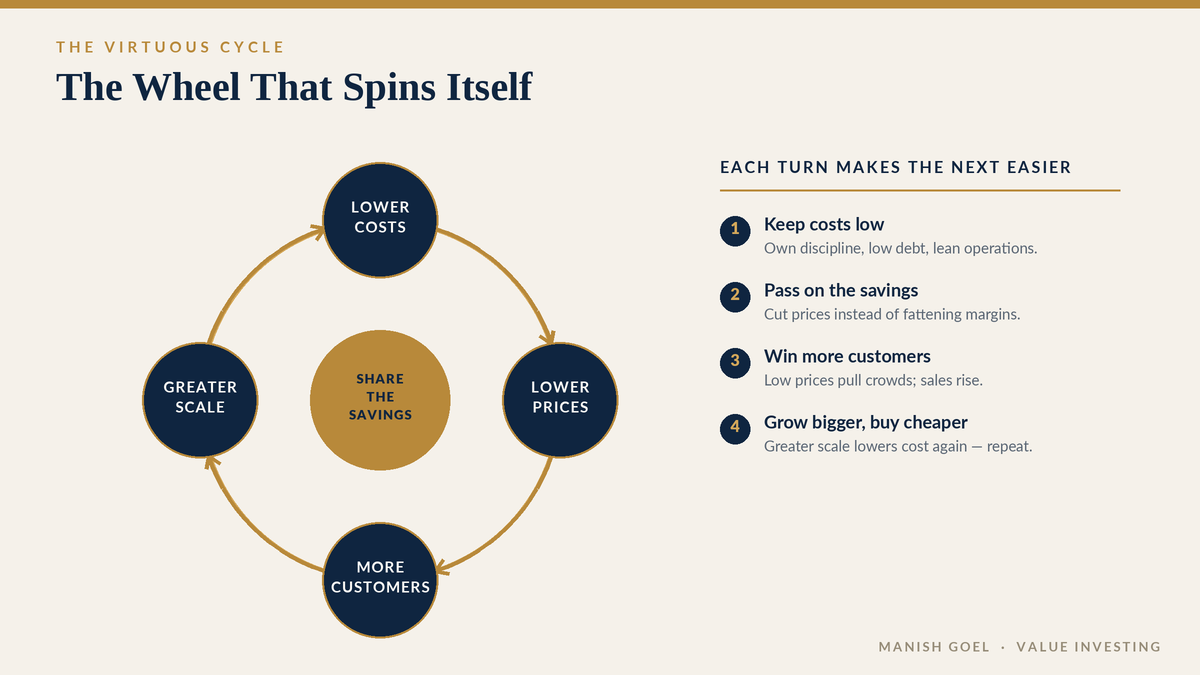
Here is the wheel, turn by turn. The company keeps its own costs very low. Because its costs are low, it can charge low prices. Low prices pull in more customers, so it sells more. Selling more makes it bigger, and being bigger lets it buy even more cheaply. Those fresh savings are passed back as still-lower prices. Lower prices pull in even more customers. And around the wheel goes again, a little faster each time.
Each turn of this wheel makes the next turn easier. That is the whole magic. The business is not relying on one clever product or one brilliant advertisement. It has built a machine that improves itself a little every year, almost automatically. Nick Sleep noticed that only a handful of companies in the whole world were running this machine on purpose, and that the stock market almost always underestimated how long the wheel could keep spinning.
There is one more reason this engine is so strong: a rival cannot easily copy it. Imagine a competitor that is used to fat margins. To match these low prices, it would have to give up the very profits its owners and managers have grown to love. Most simply cannot bring themselves to do it. So the low-cost sharer is left alone to spin its wheel, year after year, pulling further and further ahead. The advantage is not a secret formula. It is a discipline that others are unwilling to follow.
Costco: the textbook example
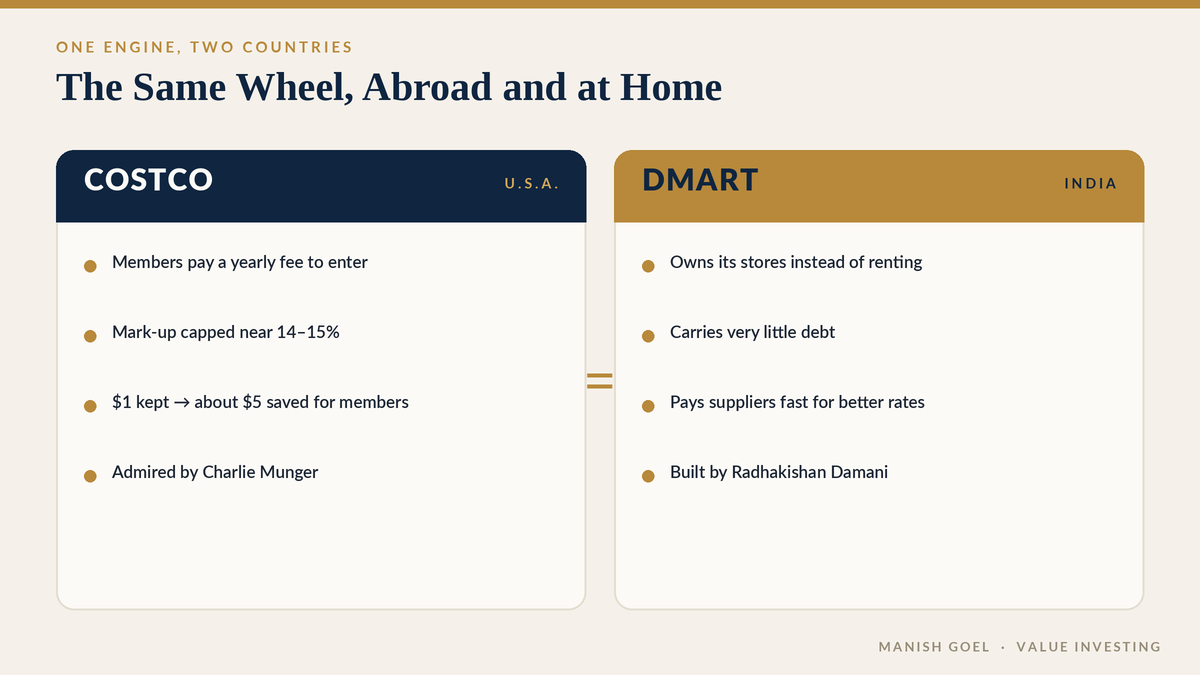
Costco, the company Nick Sleep admired most, runs warehouse-style stores where shoppers pay a yearly membership fee just to walk in. That fee is the clever bit. The membership money is almost pure profit, and it covers most of what Costco needs to earn. This frees the company to sell the actual groceries and goods at barely above cost.
To stop itself from ever getting greedy, Costco follows a strict self-made rule: it will not mark up a branded product by more than about 14 percent above what it paid, and its own in-house brand by more than about 15 percent. (A “mark-up” is the bit a shop adds on top of its cost to arrive at the selling price.) Ordinary retailers happily add 25, 50, even 100 percent. Costco refuses. When it buys better because it has grown bigger, that saving is not kept — it flows straight to the shopper as a lower price. Sleep once estimated that for every one dollar Costco kept for its shareholders, it handed about five dollars of savings to its customers.
Does giving away “five for one” sound like bad business? Look at the result. Customers feel they are being treated fairly, so they keep coming back and renew their memberships at very high rates. The stores sell so much that Costco’s sales per square foot of floor space tower over its rivals. Charlie Munger, the late partner of Warren Buffett, sat on Costco’s board for more than twenty-five years and called it “one of the most admirable capitalistic institutions in the world”. He admired it precisely because it chose, again and again, to share rather than to grab.
The same engine shows up in another company Nick Sleep came to own: Amazon. Years ago its founder Jeff Bezos sketched his plan on a paper napkin as a circle — lower prices bring more customers, more customers attract more sellers, more sellers mean more choice and still lower costs, which allow still lower prices. It was the same wheel, drawn by a different hand. The lesson travels across industries and across countries.
DMart: the wheel, made in India
You do not need to look abroad to find this engine. We have a magnificent home-grown example in DMart, run by the company Avenue Supermarts and built by the famously quiet investor Radhakishan Damani. If the name is new to you, here is a detail worth remembering: the legendary investor Rakesh Jhunjhunwala openly called Damani his guru, the man who taught him the market. Damani then went and built one of India’s most respected retail businesses on a single, stubborn idea — keep your own costs lower than anyone else’s, and pass the savings to the shopper.
How does DMart keep its costs so low? In several patient, unglamorous ways. It usually owns its stores rather than renting them, so it does not bleed rent every month or face sudden rent increases (much like the comfort of living in your own flat instead of paying an ever-rising rent). It carries very little debt, so it does not hand away profits as interest to banks. It pays its suppliers quickly and in full, which earns it better rates in return. And it opens new stores slowly and carefully rather than rushing. Each of these habits shaves a little off DMart’s costs. And those savings show up on the price tags, as everyday low prices that bring crowds through the doors. More crowds, more buying power, lower costs, lower prices. The wheel, turning in Mumbai and Maharashtra and far beyond, the same way it turns in America.
Notice what Damani did not do. He did not chase the fattest possible margin. He did not splurge on flashy stores. He treated low cost almost as a religion, and trusted the wheel to reward his patience. That temperament — calm, thrifty, long-term — is the quiet signature of this kind of business.
How you can use this idea
You and I cannot run a warehouse chain. But as investors trying to spot a genuinely high-quality business, we can learn to recognise this engine when it is running. Here are three simple, practical things to look for.
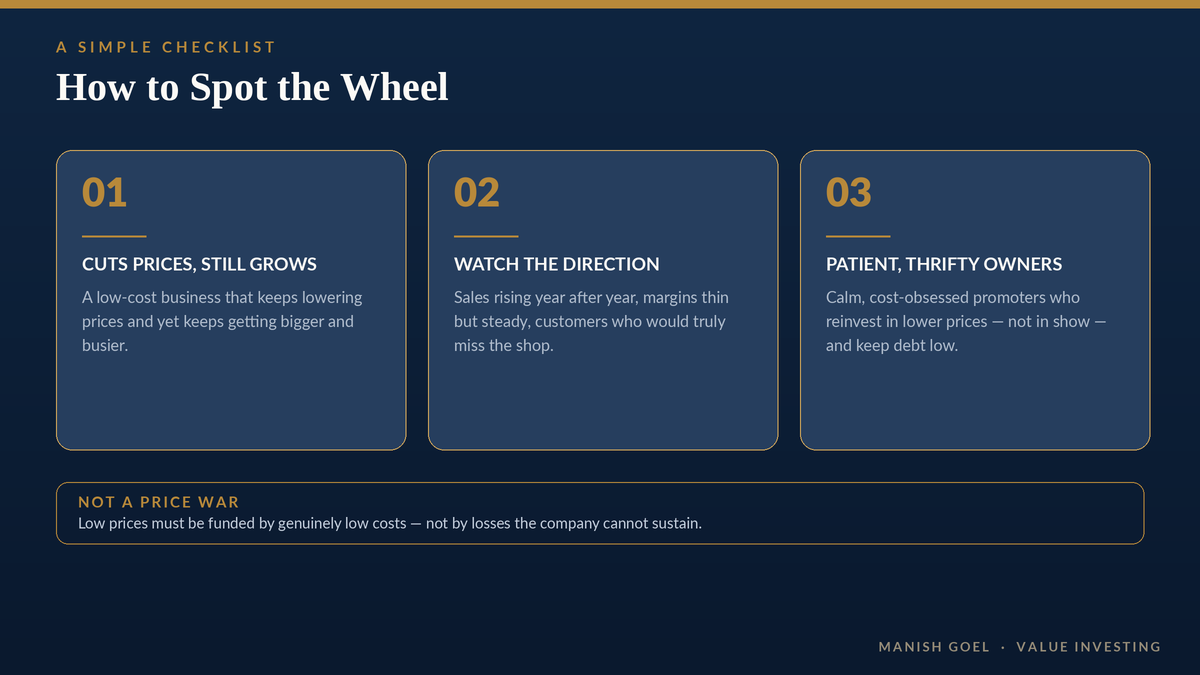
First, look for the rare company that keeps cutting prices and still keeps growing. Most businesses brag about raising prices. The scale-sharer does the opposite — it competes by being the cheapest, and it grows because of it. When you read about a company that is famous for low prices and is also getting steadily bigger and busier every year, your ears should prick up. That combination is unusual, and it is a clue that a wheel may be spinning inside.
Second, watch the direction of travel, not just one year’s numbers. A wheel reveals itself over time. Are sales rising year after year? Is the profit margin thin but steady, rather than swinging wildly? Are customers loyal — would they genuinely miss this shop if it shut? You can sense this even as an everyday shopper. A business people would walk an extra kilometre for is showing you its strength long before any spreadsheet does.
Third, back patient, honest, cost-obsessed owners. This engine is built by a certain kind of promoter (the founder or main owner-family that runs an Indian company): thrifty, calm, long-term, more interested in the customer than in showing off. Read what the promoters say and watch what they do with the company’s money. Do they keep debt low and reinvest in lower prices and better service? Or do they chase quick wins and fat margins? The temperament of the person holding the wheel tells you whether it will keep spinning.
A word of caution, so you are not misled. Sharing scale savings is not the same as selling below cost in a desperate price war. A price war burns money and ends in tears. The healthy wheel still earns a fair, steady profit on every sale — it simply chooses a small, dependable profit over a fat, fragile one. The test is whether low prices are funded by genuinely low costs (good and durable) or by losses the company cannot sustain (dangerous). Also remember that this is only one shape of a great business. Some wonderful companies do the opposite — they have such beloved products that they can quietly raise prices every year. That is called pricing power, and it is a different engine. Both can build a quality business. Today we have simply learned to recognise one of them.
Key takeaways
- Scale economies shared means a business grows bigger, buys cheaper, and gives the saving back to customers as lower prices instead of keeping it as extra profit.
- This creates a self-spinning flywheel: low cost leads to low price, low price brings more customers, more customers bring more scale, and more scale brings even lower cost.
- Rivals struggle to copy it because matching the low prices would force them to give up the fat margins they cherish — so the sharer pulls steadily ahead for years.
- Costco (admired by Charlie Munger) and DMart (built by Radhakishan Damani) are textbook examples — one abroad, one proudly Indian.
- To spot it, look for a low-cost business that keeps cutting prices yet keeps growing, with steady margins, loyal customers, and a patient, thrifty owner — and never confuse it with a money-losing price war.
— Manish Goel
