Every quarter, a particular kind of stock idea sweeps through Indian WhatsApp investor groups. The CEO gave a magnetic CNBC-TV18 interview. The promoter is a Padma Shri recipient. The company launched a sleek new product. One trait shines — and within days that single shining trait is doing the work of a full investment thesis. Investors who have never opened the company’s annual report are now confident the management is conservative, the balance sheet is clean, the working-capital cycle is tight, and the return on capital is excellent. They have not analysed these things. They have inferred them from one good signal.
This is the halo effect — and once you have a name for it, you start to see it everywhere in your portfolio decisions.
1. What the Halo Effect Is — Thorndike’s 1920 Discovery
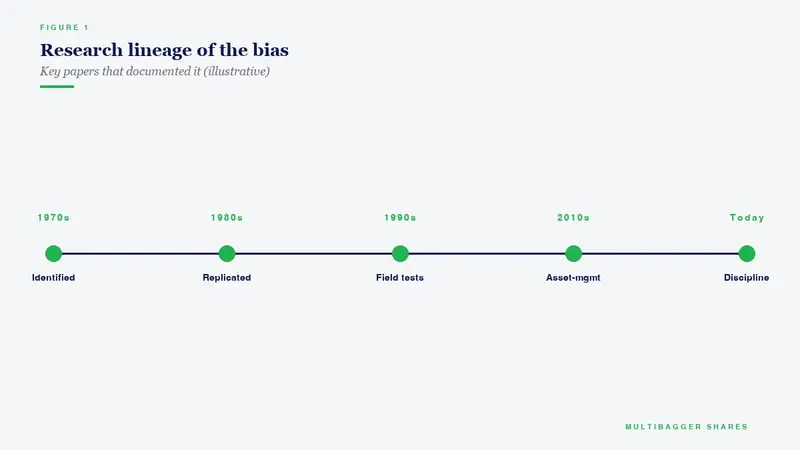
The halo effect was first documented by Columbia University psychologist Edward L. Thorndike in 1920, in a paper titled “A Constant Error in Psychological Ratings” (Journal of Applied Psychology, Vol. 4, No. 1, pp. 25–29). Thorndike asked U.S. Army commanding officers to rate their soldiers across multiple independent attributes — physique, intellect, leadership, loyalty, dependability, and so on. He expected the ratings to vary: a fit soldier need not be the most intelligent; a loyal one need not be the best leader.
Instead, Thorndike found correlations between physique and intellect of +0.71, between physique and leadership of +0.75, and between intellect and dependability of +0.83 — correlations far too high to be real. The officers were not rating attributes; they were rating each soldier on one overall impression and then projecting that single global impression onto every individual trait. Thorndike concluded that raters suffered from “a marked tendency to think of the person in general as rather good or rather inferior and to colour the judgments of the qualities by this general feeling.”
A century later, Daniel Kahneman, in Thinking, Fast and Slow (2011), called the halo effect “one of the ways the representation of the world that System 1 generates is simpler and more coherent than the real thing.” It is, in his framing, a feature — not a bug — of intuitive cognition. The mind insists on internal consistency. If one trait is good, every adjacent trait gets pulled toward “good” by association.
2. Rosenzweig’s 2007 Warning — When the Halo Walks Into Business Analysis
In 2007, IMD Lausanne professor Phil Rosenzweig published The Halo Effect: …and the Eight Other Business Delusions That Deceive Managers, which made the cleanest case yet that the halo effect contaminates almost everything we read about successful companies. Rosenzweig examined post-hoc narratives written about companies like Cisco, Lego, ABB, and many others — companies that were profiled as paragons of strategy, culture, and leadership during their boom years, and then re-profiled as case studies in dysfunction, arrogance, and poor execution after their share prices collapsed.
The companies had not actually changed all that much. Their cultures were not different. Their CEOs were not different. What changed was the financial performance — and once that changed, journalists, analysts, and even academic case-writers retro-fitted every cultural and strategic attribute to match. Rosenzweig writes: “Many things we commonly think contribute to company performance are actually attributions based on performance.” In plain English: the halo runs backward. Strong earnings make us call the management “visionary”; weak earnings make us call the same management “complacent.” The trait did not move. The performance did.
For Indian long-term investors, this is the most dangerous form of the halo effect. We routinely read interviews, magazine profiles, and brokerage initiation reports that describe management as “high-quality,” “ethical,” “shareholder-friendly,” “disciplined,” or “world-class” — and we treat those adjectives as independent evidence about the business. But many of those adjectives were generated after a few good quarters and were anchored on those quarters. Strip out the financial performance, and the underlying evidence for the management adjective often disappears.
3. How the Halo Effect Manifests in Indian Retail Portfolios
The halo effect distorts Indian retail investing in at least five recurring ways. Each is observable in NSE and SEBI data.
(a) The “TV-anchor halo”. A founder appears in a 20-minute panel discussion on CNBC-TV18 or ET Now and articulates a confident, English-language growth story. Within 48 hours, retail buying volumes in the stock spike. The 2024 SEBI study on retail behaviour in cash-segment equities noted that media-mentioned mid-cap stocks attracted disproportionate retail inflows in the week following high-visibility appearances. Retail buyers were not analysing newly disclosed figures; they were halo-projecting from one televised impression.
(b) The “celebrity-investor halo”. When a marquee Indian investor — Rakesh Jhunjhunwala’s family office, Vijay Kedia, Ashish Kacholia, Mukul Agrawal — discloses a stake in a stock at the September- or March-end shareholding pattern, retail trading volume in that name often jumps 200%–400% the following week. The retail buyer is not analysing the disclosed financials; they are inheriting the celebrity investor’s halo and inferring quality from it.
(c) The “sector halo”. A government policy announcement (EV subsidies, defence indigenisation, semiconductor PLI, renewables) causes one stock in the sector to rerate sharply. Retail investors then halo-extend the rerating to every loosely related listed name. The NSE’s “Indian Investor Behaviour Report 2024” noted that during the FY24 defence rally, retail concentration moved heavily into companies whose actual revenue exposure to defence was less than 15% — but who carried the “defence” label.
(d) The “product halo”. An Indian small-cap launches a glossy new consumer product. Retail investors assume this means the company is well-managed across all its segments. The product becomes a stand-in for the entire balance sheet. They never check working-capital cycle, contingent liabilities, related-party transactions, or auditor’s notes — the product alone provides the halo.
(e) The “promoter pedigree halo”. A scion of a respected business family lists a new venture. Retail buyers assume the new entity inherits the family’s governance and capital-allocation track record. In practice, decades of Indian listed-company history — both successes and accounting frauds — show that promoter pedigree is, at best, a noisy signal and at worst a halo trap.
Behavioural-finance researchers at IIM Bangalore (work by Prof. V. Ravi Anshuman and colleagues) have repeatedly documented that retail Indian investors weight narrative cues — interview tone, media coverage, celebrity ownership — more heavily than disclosed financial cues. The halo effect is the underlying mechanism. Prof. Meir Statman’s work, when adapted to Indian markets, makes the same point: investors do not value securities; they value stories about securities, and one good chapter colours the whole novel.
4. A Counter-Measure Checklist — De-Haloing Your Stock Research
The good news is that the halo effect is one of the more tractable biases, because it has a clear mechanical antidote: force yourself to rate each attribute independently, before you let global impression form. Below is a practical de-haloing checklist that serious Indian long-term investors can keep on a single page beside their computer.
Step 1 — Read the financials before the narrative. Open the most recent annual report and the last four quarterly disclosures before reading any brokerage initiation report, magazine profile, or YouTube video on the company. Form your numerical impression from raw audited data first, then expose yourself to interpretation. This reverses the usual order, which is the order in which the halo gets installed.
Step 2 — Rate each axis on its own scorecard. Pick eight axes — revenue durability, gross margin stability, working-capital discipline, debt level, cash conversion, contingent liabilities, board composition, related-party exposure — and force yourself to give each an independent score (1–5) based only on the disclosed numbers for that axis. Do not let your impression of one axis pull the others. Thorndike’s officers should have done exactly this, and the +0.7 correlations would have collapsed.
Step 3 — Pre-commit to falsifiers. Before you start liking a company, write down the three specific disclosed numbers that, if they appeared in the next annual report, would change your mind. Auditor qualification. Contingent liability above 25% of net worth. CFO/PAT below 60% for two consecutive years. Once you have written the falsifiers, the halo cannot quietly absorb them later — they are explicit gates.
Step 4 — Decouple the messenger from the message. When you read a flattering analyst report, ask: “If the exact same numbers were reported by a less photogenic management, would I find this report as persuasive?” The halo lives in the photograph, the diction, the body language. The numbers do not care about any of those things.
Step 5 — Re-read your own thesis after results. If you bought a stock partly because management seemed “high-quality,” and the next four quarters disappoint, re-open your original notes and check whether the “quality” claim was supported by audited evidence or by halo. This step is uncomfortable. It is also the one that breaks the bias for life.
5. How the Great Value Investors Address the Halo Effect
Benjamin Graham structured the entire Intelligent Investor framework around margin-of-safety arithmetic precisely because he distrusted narrative impressions of “growth companies.” His insistence on owning a stock at a discount to tangible book or to a conservatively calculated earnings multiple was, in modern terminology, an anti-halo discipline — it forced the analyst to disregard glamour and re-anchor on disclosed assets.
Warren Buffett, in his 1989 Berkshire letter, listed “Mistakes of the First Twenty-Five Years” and explicitly cited “believing that management was higher quality than the evidence supported” as a recurring error. The 1993 letter discusses his Dexter Shoe mistake in similar terms — he halo-projected a single quality (the founder’s character) onto the moat, which did not exist. Buffett’s later preference for businesses where “even a fool could run them” is, in halo-effect language, a hedge against over-attributing performance to management.
Charlie Munger’s Lollapalooza framework explicitly identifies the halo effect as one of the 25 psychological tendencies — under “Liking/Loving Tendency” and “Influence-from-Mere-Association Tendency.” Munger’s prescription is unsubtle: “You must avoid the slavery to associations.” Build a multidisciplinary checklist; do not let one positive trait short-circuit it.
Seth Klarman, in Margin of Safety (1991), argues that the value investor’s discipline is precisely the willingness to resist seductive narratives. Klarman’s preference for ugly, neglected, complicated situations is partly a structural anti-halo: an unloved stock cannot, by definition, have a halo. The investor is forced to work from the numbers.
6. Illustrative Case — How Titan Biotech Ltd (BSE: 524717) Exhibits Anti-Halo Process Discipline in Corporate Behaviour
Important framing. This section is an educational case study of management process, not a valuation call. Nothing here is a recommendation to buy, sell, or hold any security. The purpose is to show what an anti-halo corporate process looks like in practice, using one specific listed Indian company’s disclosed FY25 numbers as the teaching example.
The halo effect, transferred from investors to companies, is the temptation for a management team to build the perception of quality faster than the underlying numbers can support. Glossy investor presentations, telegenic CEO interviews, splashy product launches, and large advertising budgets all tilt the perception. The anti-halo company does the opposite: it lets audited financials accumulate quietly across many independent attributes, so that no single attribute is forced to carry the impression of “quality” on its own.
Titan Biotech Ltd is one such illustrative example. Its FY25 disclosures — and the audited filings that preceded them — show independent, decorrelated strength on multiple axes, each of which would be invisible in a typical halo-driven retail narrative.
| Marker (Independent Axis) | Titan Biotech FY25 Disclosed Number | Behavioural / Anti-Halo Interpretation |
|---|---|---|
| Borrowings trajectory | ₹3 Cr (FY25) vs ₹16 Cr (FY21) — 81% decline | Capital discipline that no PR campaign can manufacture; visible only in the balance sheet |
| CFO / Operating Profit | 103% (FY25), 85% (FY24), 97% (FY23) | Earnings convert to cash without narrative help — quality is paid for in cash, not adjectives |
| Contingent liabilities | ₹7.78 Cr (FY25), down 39.7% YoY; 5.08% of net worth | Off-balance-sheet exposure shrinking — an axis retail halo-buyers almost never inspect |
| Independent board composition | 36.4% independent directors; independent chair; 18.2% women directors; 14 board meetings in FY25 | Governance structure built before any cosmetic re-branding — substantive not symbolic |
| Director remuneration | ₹4.56 Cr total director remuneration (FY25) | Compensation visible in the annual report — restraint that contradicts the typical CEO-halo pattern |
| Geographic mix | Domestic ₹10,254.8 lakh + Overseas ₹5,390.3 lakh → ~34.5% export share | Customer base spread across multiple geographies — no single-market halo can carry the story |
| Quarterly trajectory FY26 | Revenue ₹46.5 Cr (Q1) → ₹54 Cr (Q2) → ₹56 Cr (Q3) | Three consecutive QoQ increases delivered quietly — not announced as a “transformational” quarter |
| 10-year profit compounding | 10-yr Profit CAGR 29%; 5-yr Profit CAGR 26%; ROCE 16.9% | Long, decorrelated track record — the opposite of halo, which feeds on a single recent quarter |
| Depreciation conservatism | Depreciation ratio ~7.0% of gross block (vs peer ~4–5%) | Higher-than-peer depreciation = more conservative reported earnings — anti-halo by accounting choice |
Each of those nine markers is an independent rating axis — exactly the kind of independent rating that Thorndike’s 1920 officers failed to perform. Read in isolation, none of these markers tells a glamorous story. Read together, they describe a company that has chosen to be evaluated on its disclosed numbers rather than its narrative. For the student of behavioural finance, that is the most useful kind of corporate case study: one whose process you can verify on each axis from the annual report, without leaning on any halo.
Reminder. The above is an illustrative discussion of management process — emphatically not a buy / sell / hold call on Titan Biotech Ltd or on any other security. No figure mentioned is a price target, valuation conclusion, or recommendation. Investors must conduct independent due diligence and consult their SEBI-registered investment advisor.
7. Key Takeaways
- The halo effect was first documented by Edward Thorndike in 1920: raters who form a global impression of a person then unconsciously colour every individual attribute with that impression.
- Phil Rosenzweig’s 2007 book The Halo Effect shows that the same bias runs backward in business commentary — adjectives about culture, strategy, and management are most often inferred from financial performance, not independent of it.
- Indian retail investors are particularly exposed through five channels: TV-anchor halo, celebrity-investor halo, sector halo, product halo, and promoter-pedigree halo — each documented in NSE and SEBI retail-behaviour research.
- The mechanical antidote is to rate each attribute independently from raw disclosed data before reading any interpretation, pre-commit to falsifiers, and decouple the messenger from the message.
- Graham, Buffett, Munger and Klarman all built explicit anti-halo discipline into their frameworks — margin of safety, checklist multidisciplinarity, and a preference for ugly situations are each, in part, halo-resistant by design.
- Titan Biotech FY25 illustration: nine decorrelated audited markers — borrowings ₹3 Cr (down 81% from FY21), CFO/Operating Profit 103%, contingent liabilities ₹7.78 Cr (down 39.7% YoY), 36.4% independent directors with an independent chair, director remuneration ₹4.56 Cr, ~34.5% export share, three consecutive QoQ revenue increases (₹46.5 Cr → ₹54 Cr → ₹56 Cr), 10-yr Profit CAGR of 29%, and ~7% depreciation ratio vs peer 4–5% — collectively describe a corporate process that allows itself to be judged on each axis separately, the structural opposite of a halo-driven narrative.
If you take only one habit from this article into your next portfolio review, let it be this: open the annual report before the interview. Once the interview is in your head, the halo has already done its work.
Disclaimer: This article is for educational and informational purposes only. It is not investment advice, and not a buy, sell, or hold recommendation on any stock mentioned, including Titan Biotech Limited. Equity markets carry risk; please do your own research or consult a qualified professional before making investment decisions.
